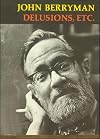
Delusions, Etc.
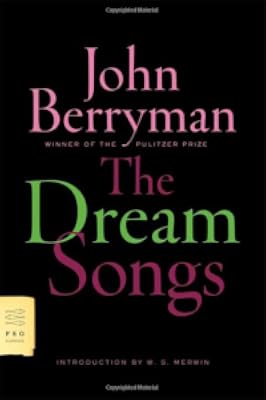
by John Berryman
On This Page
Description
Mr. Berryman's posthumous book of poems, Delusions, Etc., had been completed and was in proof before his death on January 7, 1972. The opening section, "Opus Dei," is a sequence of eight poems based on the offices of the day from Lauds to Compline-the lines above being quoted from Nones. Part two consists of five poems whose subject are George Washington ("Rectitude, and the terrible upstanding member"), Beethoven, Emily Dickinson, Georg Trakl, and Dylan Thomas. The thirteen poems in the show more third part include "Gislebertus' Eve," "Scholars at the Orchid Pavilion," "Ecce Homo," Tampa Stomp," and "Hello." The fourth part is arranged as a scherzo. It starts with "Navajo Setting the Record Straight" and ends with "Damn You, Jim D., You Woke Me Up." The concluding section is reflective and meditative in tone, with "The Prayer of the Middle-Aged Man," "Somber Prayer," "Minnesota Thanksgiving," and "A Usual Prayer," and a coda that rises to the high spirits of "King David Dances." Delusions, Etc. is an impressive collection of verse by one of the most original poets of our time, whose death at the height of his powers is a tragic loss to letters. show lessTags
Recommendations




























Member Reviews
Lines to Mr. Frost
Felled in my tracks by your tremendous horse
slain in its tracks by the angel of good God,
I wonder toward your marvellous tall art
warning away maybe in that same morning
you squandered afternoon of your great age
on my good gravid wife & me, with tales
gay of your cunning & colossal fame
& awful character, and - Christ - I see
I know & can do nothing, and don't mind -
you're talking about American power and how
somehow we've got to be got to give it up -
so help me, in my poverty-stricken way
I said the same goddamn thing yesterday
to my thirty kids, so I was almost ready
to hear you from the grave with these passionate grave
last words, and frankly Sir you fill me with joy.
Felled in my tracks by your tremendous horse
slain in its tracks by the angel of good God,
I wonder toward your marvellous tall art
warning away maybe in that same morning
you squandered afternoon of your great age
on my good gravid wife & me, with tales
gay of your cunning & colossal fame
& awful character, and - Christ - I see
I know & can do nothing, and don't mind -
you're talking about American power and how
somehow we've got to be got to give it up -
so help me, in my poverty-stricken way
I said the same goddamn thing yesterday
to my thirty kids, so I was almost ready
to hear you from the grave with these passionate grave
last words, and frankly Sir you fill me with joy.
this just kind of left me cold.
Ratings
Members
- Recently Added By
Author Information

36+ Works 2,771 Members
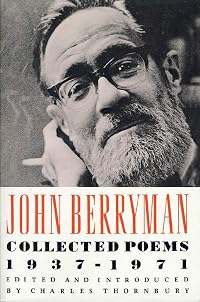
John Berryman's poetry has a depth and obscurity that discourages many readers while it entices critics. His major work, The Dream Songs (1969), forms a poetic notebook that captures the ephemera of mood and attitude of this most mercurial of poets. Born John Smith in McAlester, Oklahoma, in 1914 and educated at Columbia University and Clare show more College, Cambridge, he later taught at several universities. Berryman received the Shelley Memorial Award (1948), the Harriet Monroe Award (1957), the Loines Award for poetry of the National Institute of Arts and Letters (1964), and the fellowship of the Academy of American Poets (1966). In 1964 he won the Pulitzer Prize in poetry for 77 Dream Songs (1964). His short story "The Imaginary Jew" received the Kenyon-Doubleday Award and was listed in Best American Short Stories, (1946). He also wrote Stephen Crane (1950) and is the author of a novel, Recovery (1973). Often listed along with Sylvia Plath and Anne Sexton as a major confessional poet, he was as much concerned with literary artifice as he was with personal revelation. His works include The Freedom of the Poet, Henry's Fate & Other Poems, 1967-1972, Collected Poems 1937-1971, Berryman's Shakespeare, and Selected Poems. Berryman committed suicide in 1972. (Bowker Author Biography) show less
Classifications
Statistics
- Members
- 74
- Popularity
- 427,609
- Reviews
- 2
- Rating
- (4.00)
- Languages
- English
- Media
- Paper, Ebook
- ISBNs
- 4
- ASINs
- 3