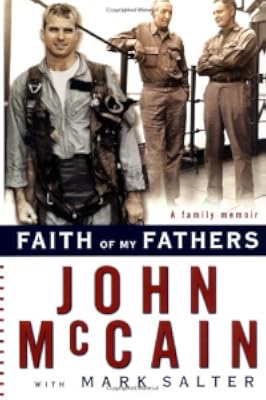
Faith of My Fathers
by John McCain
On This Page
Description
John McCain is one of the most admired leaders in the United States government, but his deeply felt memoir of family and war is not a political one and ends before his election to Congress. With candor and ennobling power, McCain tells a story that, in the words of Newsweek, "makes the other presidential candidates look like pygmies." John McCain learned about life and honor from his grandfather and father, both four-star admirals in the U.S. Navy. This is a memoir about their lives, their show more heroism, and the ways that sons are shaped and enriched by their fathers. John McCain's grandfather was a gaunt, hawk-faced man known as Slew by his fellow officers and affectionately, as Popeye by the sailors who served under him. McCain Sr. played the horses, drank bourbon and water, and rolled his own cigarettes with one hand. More significant, he was one of the navy's greatest commanders, and led the strongest aircraft carrier force of the Third Fleet in key battles during World War II. John McCain's father followed a similar path, equally distinguished by heroic service in the navy, as a submarine commander during World War II. McCain Jr. was a slightly built man, but like his father, he earned the respect and affection of his men. He, too, rose to the rank of four-star admiral, making the McCains the first family in American history to achieve that distinction. McCain Jr.'s final assignment was as commander of all U.S. forces in the Pacific during the Vietnam War. It was in the Vietnam War that John McCain III faced the most difficult challenge of his life. A naval aviator, he was shot down over Hanoi in 1967 and seriously injured. When Vietnamese military officers realized he was the son of a top commander, they offered McCain early release in an effort to embarrass the United States. Acting from a sense of honor taught him by his father and the U.S. Naval Academy, McCain refused the offer. He was tortured, held in solitary confinement, and imprisoned for five and a half years. Faith of My Fathers is about what McCain learned from his grandfather and father, and how their example enabled him to survive those hard years. It is a story of three imperfect men who faced adversity and emerged with their honor intact. Ultimately, Faith of My Fathers shows us, with great feeling and appreciation, what fathers give to their sons, and what endures. show lessTags
Recommendations









Member Reviews
Far, far superior to the usual political autobiography. This is largely because, in addition recounting his harrowing treatment as a POW, McCain spends two-thirds of the book on his father and grandfather, both riveting characters. His grandfather, a four star admiral, is a cursing, gambling eccentric adored by his men. His submariner father is driven to match these accomplishments, and, hemmed in by three Japanese destroyers, engineers an escape that beggars fiction. He too ends his career as a four star admiral. And don't miss the part where his grandfather (jokingly) accuses MacArthur of having VD. This must have been a fun book for Salter to write.
Read while traveling (3.5.08)
Read while traveling (3.5.08)
I liked John McCain before I started Faith of My Fathers, but I had my reservations when I saw that the book was co-authored by Mark Salter. If you've ever corrected someone else's essay, you know how words can be chucked and changed, until final product hardly bears a resemblance to the original. All the same, I foraged on ahead.
Unsurprisingly, McCain descends from a long line of military men. The first few chapters are filled with slow, winding descriptions of his grandfather and father, both four star admirals, and their numerous accomplishments. You'd think that the third McCain would be a hardworker with such a legacy, but instead, he's a self indulgent party boy and trouble maker, with lousy grades and an even lousier work show more ethic. Anyone else would have been expelled from the naval academy, but his influential father manages to keep his n'ere-do-well son out of serious trouble untli he gets to Vietnam.
Regardless of what you may think about his politics, it should be difficult for anyone to read McCain's account of his imprisonment and not at least respect the man. When his plane crashed in a lake in Hanoi, a mob of Vietnamese citizens dragged him out and began stabbing him with a bayonet. He was taken into custody and subsequently beaten, tortured, and starved. But as soon as Vietnamese officials became aware that his father was an importnat commander for the American military, they offered to send him home. After months of abuse, it would have been tempting to exchange the miserable prison conditions for the comforts of the United States. But despite his injuries, McCain refused, insisting he'd stay until the men captured before him were released first. And so ensued five and a half years of prison life, years that were marked with solitary confinement, sickness, torture, and boredom.
Extrodinarily, these are the years that turned McCain the callow youth into a courageous, formidable man. He humbly points out time and time again that the Vietnamese treated him better than other prisoners due to his father, and that harsher punishments were dealt to other men. The obnoxious rabble rousing we see in earlier chapters matures when McCain strives to raise the spirits of his fellow prisoners and rebels against his captors. He admits his flaws and pokes fun at himself, and learns that life is too short to hold grudges. It's a remarkable coming-of-age character transformation.
"I was no longer the boy to whom liberty meant simply that I could do as I pleased, and who, in my vanity, used my freedom to polish my image as an I-don't-give-a-damn nonconformist," he writes. "All of us were committed to one another. I knew what the others were suffering. Sitting in my cell, I could hear their screams as their faith was put to the test. My first concern was not that I might fail God and country, although I certainly hoped that I would not. I was afraid to fail my friends. I was afraid to come back from an interrogationa nd tell them I couldn't hold up as well as they had. However I measured my character before Vietnam no longer mattered. What mattered now was how they measured my character. My self-regard became indivisible from their regard to me. And it will remain so for the rest of my life."
While I still don't agree with our current foreign policy, this memoir helped me see where John McCain is coming from. show less
Unsurprisingly, McCain descends from a long line of military men. The first few chapters are filled with slow, winding descriptions of his grandfather and father, both four star admirals, and their numerous accomplishments. You'd think that the third McCain would be a hardworker with such a legacy, but instead, he's a self indulgent party boy and trouble maker, with lousy grades and an even lousier work show more ethic. Anyone else would have been expelled from the naval academy, but his influential father manages to keep his n'ere-do-well son out of serious trouble untli he gets to Vietnam.
Regardless of what you may think about his politics, it should be difficult for anyone to read McCain's account of his imprisonment and not at least respect the man. When his plane crashed in a lake in Hanoi, a mob of Vietnamese citizens dragged him out and began stabbing him with a bayonet. He was taken into custody and subsequently beaten, tortured, and starved. But as soon as Vietnamese officials became aware that his father was an importnat commander for the American military, they offered to send him home. After months of abuse, it would have been tempting to exchange the miserable prison conditions for the comforts of the United States. But despite his injuries, McCain refused, insisting he'd stay until the men captured before him were released first. And so ensued five and a half years of prison life, years that were marked with solitary confinement, sickness, torture, and boredom.
Extrodinarily, these are the years that turned McCain the callow youth into a courageous, formidable man. He humbly points out time and time again that the Vietnamese treated him better than other prisoners due to his father, and that harsher punishments were dealt to other men. The obnoxious rabble rousing we see in earlier chapters matures when McCain strives to raise the spirits of his fellow prisoners and rebels against his captors. He admits his flaws and pokes fun at himself, and learns that life is too short to hold grudges. It's a remarkable coming-of-age character transformation.
"I was no longer the boy to whom liberty meant simply that I could do as I pleased, and who, in my vanity, used my freedom to polish my image as an I-don't-give-a-damn nonconformist," he writes. "All of us were committed to one another. I knew what the others were suffering. Sitting in my cell, I could hear their screams as their faith was put to the test. My first concern was not that I might fail God and country, although I certainly hoped that I would not. I was afraid to fail my friends. I was afraid to come back from an interrogationa nd tell them I couldn't hold up as well as they had. However I measured my character before Vietnam no longer mattered. What mattered now was how they measured my character. My self-regard became indivisible from their regard to me. And it will remain so for the rest of my life."
While I still don't agree with our current foreign policy, this memoir helped me see where John McCain is coming from. show less
I put off reading this book for years, fearing it would be awful. I was pleasantly surprised that it was well written and not nearly as self-aggrandizing as I expected from a book written by a senator. Senator McCain's father and grand-father were very interesting subjects, especially as I was totally ignornant of them and their part in history. Senator McCain's coverage of his POW years was helped by the inclusion of the suffering of other POWs, and it made me appreciate all the more the terrible price each of them paid for falling into the hands of the enemy.
What a surprise this was! I am not a fan of John McCain, however, this was a fantastic family memoir. So many things that I was able to relate too; my father and uncles served in the military during WWII and my husband served in Vietnam. This is not a political book and I recommend it.
Got this book from my mom from the CCHS library. Read in the spring of 2023 in our upstairs guest room of the Del Mar house. Quick easy read that gave a lot of insight on the McCain family I had no previous knowledge of. Especially enjoyed learning about the experiences and devoted service of his father and grandfather. I also learned a lot more about his time as a POW and the incredible struggles he went through. The book has an excellent title that ties in with the overall purpose of the book. Would recommend to anyone who wants to learn about Senator McCain.
A very nice tribute by Sen. McCain to his father and grandfather. Pretty well-written, and you can tell it comes from the heart. A good read for those devotees of the Senator.
This was an amazing book, if anyone is curious about the snippets you have heard about the past of this great patriot running for President you need to read this and his subsequent book. In fields full of elitists Sen. John McCain and his father and his grandfather before him proudly served his country as members of the United States Navy. This history of service and the background of how John McCain looks at the world is all here; if you are even curious you should read this well written and very informative book about a great leader.
Members
- Recently Added By
Author Information

20+ Works 3,012 Members
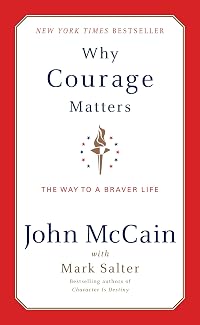
John Sidney McCain III was born in the Panama Canal Zone at Coco Solo Naval Air Station on August 29, 1936. In 1954, he entered the United States Naval Academy at Annapolis. He fought in the Vietnam War as a naval aviator and was a prisoner of war (POW) beginning on October 26, 1967. In March 1968, he was put into solitary confinement, where he show more would remain for two years. He was a POW for five and a half years before being released on March 14, 1973. He retired from the Navy as a Captain in 1981. He moved to Arizona and began a career in politics. He won two terms in the U. S. House of Representatives, from 1983 to 1987, followed by six terms in the U. S. Senate. He was the Republican presidential nominee in the 2008 United States presidential election. In 2015, he became chairman of the Armed Services Committee. He wrote numerous books with his aide Mark Salter including Worth the Fighting For; Why Courage Matters: The Way to a Braver Life; Character Is Destiny: Inspiring Stories Every Young Person Should Know and Every Adult Should Remember; Hard Call: Great Decisions and the Extraordinary People Who Made Them; 13 Soldiers: A Personal History of Americans at War; Faith of My Fathers; and The Restless Wave: Good Times, Just Causes, Great Fights and Other Appreciations. He died from brain cancer on August 25, 2018 at the age of 81. (Bowker Author Biography) show less
All Editions
Awards and Honors
Distinctions
Work Relationships
Common Knowledge
- People/Characters
- John McCain
- Related movies
- Faith of My Fathers (2005 | IMDb)
Classifications
- Genres
- Biography & Memoir, General Nonfiction, History, Nonfiction
- DDC/MDS
- 973.90922 — History & geography History of North America United States 1901- 1901 forward, by presidential administration
- LCC
- E840.8 .M467 .A3 — History of the United States United States Later twentieth century, 1961-2000 Biography (General)
- BISAC
Statistics
- Members
- 1,283
- Popularity
- 19,060
- Reviews
- 12
- Rating
- (3.73)
- Languages
- Chinese, Danish, English
- Media
- Paper, Audiobook, Ebook
- ISBNs
- 19
- ASINs
- 12