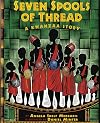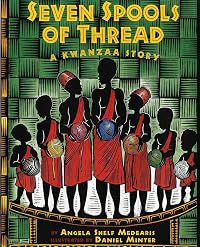
Seven Spools of Thread: A Kwanzaa Story
by Angela Shelf Medearis
On This Page
Description
When they are given the seemingly impossible task of turning thread into gold, the seven Ashanti brothers put aside their differences, learn to get along, and embody the principles of Kwanzaa. Includes information on Kwanzaa, West African cloth weaving, and instructions for making a belt.Tags
Recommendations




Member Reviews
Any family with seven sons must hear plenty of bickering, but the seven Ashanti brothers in this family quarrel from dawn to dusk and into the night. Their father leaves them a legacy in more than material terms, with the requirement that they must spin seven spools of thread (each in a different shade) into gold in only one day—with no arguing. Medearis has crafted an original story with the timeless tone of a traditional folktale, subtly incorporating the seven principles of Kwanzaa into her plot. The brothers learn to cooperate in both words and deeds, weaving their seven colors of silken thread into multicolored cloth so beautiful it is purchased for the king (with a bag of gold, of course). Demonstrating the Kwanzaa principle of show more cooperative economics, the brothers teach their whole village to weave the patterned fabric known as kente cloth. Minter’s striking linoleum block-print illustrations complement the story perfectly, with the seven decidedly different brothers shown in silhouette against jewel-bright backgrounds full of intriguing details of African village life. The history and seven principles of Kwanzaa are clearly explained in the introduction; directions for making a simple loom from straws and weaving a cloth belt are included in an appendix. This added information as well as the satisfying story will make this beautifully designed book a valuable selection for elementary-school teachers and librarians. A fine choice for a Kwanzaa gift, and a first choice for most school and public-library collections. (Picture book. 6-10)
-Kirkus Review show less
-Kirkus Review show less
A little too simple and predictable, so a weak four stars. But it does explain Kwanzaa and does have an important lesson for all of us. I like the art, too, though I usually don't like woodblock style. And I like the easy craft at the end. If I could think of a use for a belt-shaped textile, and I had scraps of yarn, I would make it.
This book is really good, full of colors and culture. The story is about seven brothers in an African village that would constantly fight. When their father died, the chief explains that they have until sundown to make gold out of seven spools of thread or they will be turned out as beggars. The brothers learn to work together and make something beautiful. They make a cloth, in which is bought as a gift for the king, in exchange for gold. The brothers continue to work together farming the land and teaching the village to make beautiful cloth. The story is adorable and teaches the life lesson of working together to accomplish a mission as well as giving back to the community when you have much while others have so little. The artwork is show more beautiful and colorful and very engaging. show less
This story was wonderfully illustrated. The story teaches students a wonderful lesson tied into the seven principles of Kwanzaa. The author gives an excellent description of Kwanzaa's history and principles in the beginning and even gives a fun craft activity at the end. However, the principles will not be obvious to children through the story alone. Connections need to be made through the information at the beginning or through discussion. But, it's an excellent book to discuss with children.
This is a great book that shows African tradition. It gives the reader a look into the importance of handmade clothes/things in Ghana. It is about a group of 7 brothers that must work together to gain their share of wealth, but they are required to make gold from the 7 spools before they can receive it. This book also shows that if you put your differences aside, you can create great things.
I had mixed feelings about this book after reading it. I liked the book because it taught the seven brothers how to work together and get along. But, I didn't like how the father had to die in order to teach his sons the lesson. Also, the language was very patterned which made the story easy to follow and understand which each brother said.
This is the story of seven brothers in Ghana, that always argued with one another. Upon their father's death, they learn that their inheritance will be divided evenly between them. But, in order to receive the inheritance, they must work together and "learn how to make gold out of these spools of silk thread." They decided to weave the thread together, to create a beautiful, patterned cloth. Then, they sold their cloth in exchange for gold. In order to help the poor people of their village, they decide to "teach them how to turn thread into gold." In the pages preceding the story, the author, Angela Shelf Medearis, provides information about the holiday Kwanzaa, and its seven principles. The story was written to embody the principles: show more unity, self-determination, collective work and responsibility, co-operative economics, purpose, creativity, and faith. Medearis' story shows what can happen when people work together. It is written as a kind of folk tale, and illustrated beautifully. Illustrator Daniel Minter created artwork from linoleum block prints. Each illustration shows the seven sons, wearing bright red garments that reveal their strong arms and dark skin. Their faces are not seen, but, instead, are like silhouettes. The sun shines in each picture, and and readers can almost feel its heat. Children who are learning about Kwanzaa can benefit from this story, as can any child. show less
Members
- Recently Added By
Lists

A Child's Book Tour of West Africa ::: Côte d'Ivoire, Mali, Ghana, Nigeria
59 works; 5 members

Youth: Holidays
56 works; 1 member
Author Information

98+ Works 13,916 Members
Angela Shelf Medearis is the author of many books about African-American history, including Little Louis and the Jazz Band. Anna Rich also illustrated Joshua's Masai Mask.
Awards and Honors
Awards
Distinctions
Notable Lists
Common Knowledge
- Important places
- Ghana
Classifications
Statistics
- Members
- 622
- Popularity
- 46,830
- Reviews
- 17
- Rating
- (4.24)
- Languages
- English, French, Portuguese
- Media
- Paper, Ebook
- ISBNs
- 14
- ASINs
- 1