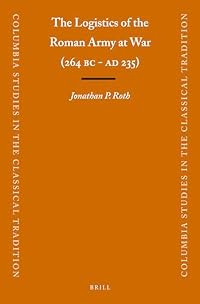
The Logistics of the Roman Army at War (264 B.C.–A.D.235)
by Jonathan Roth
On This Page
Description
"Relying on a variety of literary, documentary and archaeological sources, this work explores the Roman military supply system from the Punic Wars to the end of the Principate. Each chapter is devoted to a different aspect of logistics: supply needs and rations; packs, trains and military servants; foraging and requisition; supply lines; sources of supply; administration; and the impact of logistics on Roman warfare."--Jacket. "As a whole the book traces the development of the Roman show more logistics into a highly sophisticated supply system - a vital element in the success of Roman arms. In addition, it makes a critical study of important technical questions of Roman logistics, such as the size of the soldier's grain ration, the function of military servants, and the changes in logistical management under the Republic and Empire."--Jacket. show lessTags
Recommendations










Member Reviews
Well, what the title promises really; a study of what can be known or inferred about Roman logistical arrangements during the time period covered. If you're interested in that sort of thing, you'd probably like it. And it you're not interested in that sort of thing, it will probably bore you to tears.
Notable for ancient-logistics nerds is that he takes issue with the widely cited numbers of Engels' Alexander the Great and the Logistics of the Macedonian Army regarding how long an army could operate without replenishing supplies. According to Roth, Engels is excessively pessimistic because he overestimates the caloric requirements of ancient soldiers, who were on average older and smaller than the Vietnam-era Americans Engels bases his show more calculations on. He also thinks that the Romans would have been more willing to work their pack-animals to death or at least ill health than Engels allows for.
(An aspect neither seems to address head on is that even if you load your mules more heavily than is good for them at the start of an expedition, the load will fall as the men and animals consume the supplies. Presumably the load a mule can carry for a few days without lasting harm is higher than that it can carry indefinitely.) show less
Notable for ancient-logistics nerds is that he takes issue with the widely cited numbers of Engels' Alexander the Great and the Logistics of the Macedonian Army regarding how long an army could operate without replenishing supplies. According to Roth, Engels is excessively pessimistic because he overestimates the caloric requirements of ancient soldiers, who were on average older and smaller than the Vietnam-era Americans Engels bases his show more calculations on. He also thinks that the Romans would have been more willing to work their pack-animals to death or at least ill health than Engels allows for.
(An aspect neither seems to address head on is that even if you load your mules more heavily than is good for them at the start of an expedition, the load will fall as the men and animals consume the supplies. Presumably the load a mule can carry for a few days without lasting harm is higher than that it can carry indefinitely.) show less
Ratings
Members
- Recently Added By
Author Information
2+ Works 38 Members
Series
Belongs to Publisher Series
Common Knowledge
- Canonical title
- The Logistics of the Roman Army at War (264 B.C.–A.D.235) (264 B.C.&ndash | A.D.235)
Classifications
- Genres
- History, Nonfiction, Anthropology
- DDC/MDS
- 355.4 — Society, Government, and Culture Public administration & military science The Military - Land, Air & Sea / Warfare Military operations
- LCC
- DG89 .R675 — History of Europe, Asia, Africa and Oceania City History of Italy Ancient Italy. Rome to 476 Antiquities. Civilization. Culture. Ethnography
- BISAC
Statistics
- Members
- 37
- Popularity
- 778,142
- Reviews
- 1
- Rating
- (3.75)
- Languages
- English
- Media
- Paper, Ebook
- ISBNs
- 3