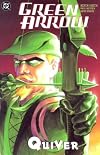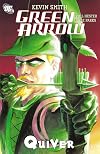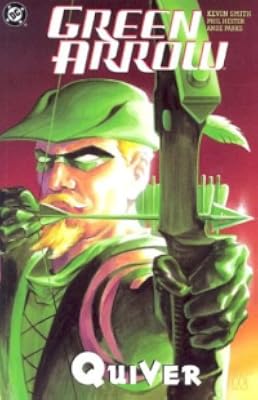
Green Arrow: Quiver
by Kevin Smith, Phil Hester (Illustrator), Ande Parks (Illustrator)
Green Arrow (2001 series collections) (1), Green Arrow
On This Page
Description
The original Green Arrow, Oliver Queen, reemerges after years of being assumed dead. But many people, including Black Canary, his ex-lover, Arsenal, his ex-partner, Connor Hawke, his son and temporary successor and Batman, the Dark Knight Detective, want to know how Green Arrow survived the airplane explosion and where he has been. Using strong characterization and engaging dialogue, comics, and screenplay writer and movie director Kevin Smith (Clerks, Dogma, Batman: Cacophony) successfully show more resurrects one of the world's classic heroes. show lessTags
Recommendations


Member Reviews
This is the first story of Green Arrow after his rebirth. You see, Oliver Queen had died back in 1995, thanks to some ecoterrorists, and Connor Hawke, his illegitimate son, had taken over as Green Arrow. But in 1996, during a crisis where the Earth's sun was shut off, Hal Jordan-- who Oliver Queen had previously killed or something-- brought Oliver back to life, though that was not revealed until this story, so I don't know what he got up to in all that time between. If there really was any time between.
Are you confused? So am I, and I've been looking stuff up on Wikipedia and a dozen other websites for the past half-hour trying to get it all straight. But here's the thing-- I hardly ever was while reading Quiver. Despite juggling a show more complex history that intersects numerous characters and stories, Kevin Smith always keeps the reader from drowning in a sea of continuity, even if there are times where you feel like you're only just barely afloat.
What works here are the characters. My only previous substantial Green Arrow experience was the "hard-traveling heroes" storyline, and this Green Arrow isn't quite that one, but that's a good thing, since that Green Arrow was more a one-note radical leftist mouthpiece for Denny O'Neil than an actual person. Smith's Oliver Queen is a hero, certainly; even as a half-crazed, just-resurrected man he builds himself a rudimentary bow and arrow and tries to stop a mugging, and once he gets his groove back, he's taking on corruption in Star City left, right, and center with some fun sequences. Green Arrow's archery shtick is nice and distinctive; he typically doesn't end up just punching things like many other superheroes.
But Green Arrow's got some problems-- he's got a bit of a habit of running away from responsibilities and messing things up with those he loves: his son, Connor Hawke; his ward, Roy Harper; and most importantly, his love, Dinah Lance the Black Canary. Of course, Ollie can't be blamed for disappearing this time-- he was dead, right?
Actually, it turns out he sort of can, because he's not wholly alive. When Hal Jordan resurrected Oliver Queen, Oliver's soul didn't want to leave the afterlife, as he'd finally found peace there. So the resurrected Oliver has the body and (most of) the memories of the original, but not the soul. It's pointed out that he's fundamentally the same person, but a danger arises from this-- if Oliver's body doesn't have a soul, another soul could easily move in. The book falters a little here, as the existential questions this whole idea raises are somewhat outside the remit of a comic book about a guy in a Robin Hood costume (or at least this comic book about a guy in a Robin Hood costume), so it just tries to avoid them but still gets bogged down in a lot of DC Universe metaphysics.
Metaphysics aren't the only thing going on, though; there's also a serial killer loose in Star City. Supposedly Green Arrow is trying to stop him, but this plotline suffers from two problems. First is that Green Arrow scarcely does anything in this line. It's not his fault, really; halfway through the book and he's just only really gotten back on his feat when the Demon Etrigan shows up and brings in the whole metaphysical thing, and GA never gets a chance to go back to his "mundane" storyline until events come to a head (and turn out to be much less mundane than they'd seemed). The second problem is that the identity of the serial killer is fricking obvious from chapter two of ten at the latest. Maybe Smith thought he was being subtle, maybe he wanted the reader to figure it out, but it's really annoying waiting eight chapters for the characters to catch up. And the eventual explanation of the motives of the killer are convoluted, to say the least.
But the small falterings of the book with crazy metaphysics and crazy killers can be overlooked, because the climax brings it all together. It's not Oliver Queen the just-resurrected soulless husk who has to learn to stop running away from the consequences of his actions; it's the soul hanging out in the afterlife doing nothing but shooting arrows at an ethereal target. That Oliver finally decides to be there for his son. Green Arrow may have not had a choice about his body being resurrected, but he did have a choice about his soul, and it's a choice he makes. It's a great moment when, soul returned, Oliver Queen joins his son in kicking tail and saving the day.
The book also has some cameos from around the DC Universe: Superman, Aquaman, Wonder Woman, the Flash, Martian Manhunter, Green Lantern, the Spectre, Jason Blood, and even Deadman make appearances. Most prominent, however, is Batman. I'm not sure what to think of Smith's Batman-- sometimes he's spot-on, but sometimes he drifts into caricature. But it's real good caricature, so I'm willing to forgive it. The Justice League as a whole suffers from a similar problem (I really think they'd be able to handle Oliver's resurrection better than this), but it's most pronounced with Batman.
Sometimes I also felt a little uneasy about Quiver's portrayal of women. Wonder Woman plants one on Green Arrow's lips when she first meets him, and judging from Wally West's reaction, it's a pretty intense kiss. Well of course she would; what else would an elated woman do but give a man a little bit of tounge? Deadman also gets one off Black Canary in a moment that's played for laughs, even if she does hit him in the jaw for it. And at the end, our serial killer friend also suddenly turns out to like raping teenage girls, seemingly just to up the level of danger a little bit. On the other hand, I have few complaints about Smith's portrayal of Black Canary as a well-rounded, independent woman, as much her own person as Green Arrow. And Mia Dearden is all sorts of awesome as well.
That said, I feel a bit skeevy myself complaining that the only real problem I have with Phil Hester's generally excellent artwork is that Black Canary is just nowhere near as hot as Black Canary should be.
I think the most important thing about Quiver is that though it deals with some crazy continuity, some abstract metaphysics, and some dark themes, is that it never loses its way. This book is about Oliver Queen/Green Arrow, what makes him a great hero and a sometimes not-so-great man, and about how he learns to come through in the end. And perhaps almost as importantly, it's always fun. Whoever doesn't love the boxing glove arrow ought to be lined up and shot.
Green Arrow: Next in sequence » show less
Are you confused? So am I, and I've been looking stuff up on Wikipedia and a dozen other websites for the past half-hour trying to get it all straight. But here's the thing-- I hardly ever was while reading Quiver. Despite juggling a show more complex history that intersects numerous characters and stories, Kevin Smith always keeps the reader from drowning in a sea of continuity, even if there are times where you feel like you're only just barely afloat.
What works here are the characters. My only previous substantial Green Arrow experience was the "hard-traveling heroes" storyline, and this Green Arrow isn't quite that one, but that's a good thing, since that Green Arrow was more a one-note radical leftist mouthpiece for Denny O'Neil than an actual person. Smith's Oliver Queen is a hero, certainly; even as a half-crazed, just-resurrected man he builds himself a rudimentary bow and arrow and tries to stop a mugging, and once he gets his groove back, he's taking on corruption in Star City left, right, and center with some fun sequences. Green Arrow's archery shtick is nice and distinctive; he typically doesn't end up just punching things like many other superheroes.
But Green Arrow's got some problems-- he's got a bit of a habit of running away from responsibilities and messing things up with those he loves: his son, Connor Hawke; his ward, Roy Harper; and most importantly, his love, Dinah Lance the Black Canary. Of course, Ollie can't be blamed for disappearing this time-- he was dead, right?
Actually, it turns out he sort of can, because he's not wholly alive. When Hal Jordan resurrected Oliver Queen, Oliver's soul didn't want to leave the afterlife, as he'd finally found peace there. So the resurrected Oliver has the body and (most of) the memories of the original, but not the soul. It's pointed out that he's fundamentally the same person, but a danger arises from this-- if Oliver's body doesn't have a soul, another soul could easily move in. The book falters a little here, as the existential questions this whole idea raises are somewhat outside the remit of a comic book about a guy in a Robin Hood costume (or at least this comic book about a guy in a Robin Hood costume), so it just tries to avoid them but still gets bogged down in a lot of DC Universe metaphysics.
Metaphysics aren't the only thing going on, though; there's also a serial killer loose in Star City. Supposedly Green Arrow is trying to stop him, but this plotline suffers from two problems. First is that Green Arrow scarcely does anything in this line. It's not his fault, really; halfway through the book and he's just only really gotten back on his feat when the Demon Etrigan shows up and brings in the whole metaphysical thing, and GA never gets a chance to go back to his "mundane" storyline until events come to a head (and turn out to be much less mundane than they'd seemed). The second problem is that the identity of the serial killer is fricking obvious from chapter two of ten at the latest. Maybe Smith thought he was being subtle, maybe he wanted the reader to figure it out, but it's really annoying waiting eight chapters for the characters to catch up. And the eventual explanation of the motives of the killer are convoluted, to say the least.
But the small falterings of the book with crazy metaphysics and crazy killers can be overlooked, because the climax brings it all together. It's not Oliver Queen the just-resurrected soulless husk who has to learn to stop running away from the consequences of his actions; it's the soul hanging out in the afterlife doing nothing but shooting arrows at an ethereal target. That Oliver finally decides to be there for his son. Green Arrow may have not had a choice about his body being resurrected, but he did have a choice about his soul, and it's a choice he makes. It's a great moment when, soul returned, Oliver Queen joins his son in kicking tail and saving the day.
The book also has some cameos from around the DC Universe: Superman, Aquaman, Wonder Woman, the Flash, Martian Manhunter, Green Lantern, the Spectre, Jason Blood, and even Deadman make appearances. Most prominent, however, is Batman. I'm not sure what to think of Smith's Batman-- sometimes he's spot-on, but sometimes he drifts into caricature. But it's real good caricature, so I'm willing to forgive it. The Justice League as a whole suffers from a similar problem (I really think they'd be able to handle Oliver's resurrection better than this), but it's most pronounced with Batman.
Sometimes I also felt a little uneasy about Quiver's portrayal of women. Wonder Woman plants one on Green Arrow's lips when she first meets him, and judging from Wally West's reaction, it's a pretty intense kiss. Well of course she would; what else would an elated woman do but give a man a little bit of tounge? Deadman also gets one off Black Canary in a moment that's played for laughs, even if she does hit him in the jaw for it. And at the end, our serial killer friend also suddenly turns out to like raping teenage girls, seemingly just to up the level of danger a little bit. On the other hand, I have few complaints about Smith's portrayal of Black Canary as a well-rounded, independent woman, as much her own person as Green Arrow. And Mia Dearden is all sorts of awesome as well.
That said, I feel a bit skeevy myself complaining that the only real problem I have with Phil Hester's generally excellent artwork is that Black Canary is just nowhere near as hot as Black Canary should be.
I think the most important thing about Quiver is that though it deals with some crazy continuity, some abstract metaphysics, and some dark themes, is that it never loses its way. This book is about Oliver Queen/Green Arrow, what makes him a great hero and a sometimes not-so-great man, and about how he learns to come through in the end. And perhaps almost as importantly, it's always fun. Whoever doesn't love the boxing glove arrow ought to be lined up and shot.
Green Arrow: Next in sequence » show less
When Green Arrow suddenly reappears on the scene in Star City everyone is dumbfounded. The man is supposed to be dead. It becomes even more baffling when those nearest to him realize that he's missing nearly a decade of his life. How is Oliver back and why? It's going to take the combined efforts of most of the Justice League to figure it out.
It's a solid comic arc for Green Arrow with an interesting choice for the "return from the dead" plotline. The plotting was solid and the male character development was solid. The characterization of the women had me less impressed - Black Canary blaming her emotional state on PMS felt so very 90s. If you're a Green Arrow fan, it's definitely worth reading but it may be helpful to know the larger show more DCU before tackling this one - or have a big DC fan on-call to answer any questions that arise. show less
It's a solid comic arc for Green Arrow with an interesting choice for the "return from the dead" plotline. The plotting was solid and the male character development was solid. The characterization of the women had me less impressed - Black Canary blaming her emotional state on PMS felt so very 90s. If you're a Green Arrow fan, it's definitely worth reading but it may be helpful to know the larger show more DCU before tackling this one - or have a big DC fan on-call to answer any questions that arise. show less
I've grown more dissatisfied with Kevin Smith's writing as I've grown older, but I think this holds up pretty well. It's wordier than it needs to be, but it's a strong story with som good character work.
I've been meaning to read this book for about a decade now. Comic book - Kevin Smith, what could be better? This book was a little dated by two things: pop culture references and New 52. To the first, while some of the references seems tale at least I can say that I think I got all of them. As for the New 52, well this book is about 8 or 9 years before the DC reboot and many of the characters are both mature in age and in their story lines by which I mean lots of things have happened including "being bad" and "dying" for many, many heroes. Since almost all of my recent reading has been in the New 52 universe, the book has to stand on its own more than being a part of a larger universe (unless I can find other DC books from the early show more 2000s).
This book has everything that you would expect from a Kevin Smith project - the good and the bad. I really like Queen's life is not only more complicated but more complex giving the feeling that this is actually a book for adults. The main drawback is that Smith can be wordy. This is a superhero story after all, it would be nice if we had more action to go along with all of the speech making. show less
This book has everything that you would expect from a Kevin Smith project - the good and the bad. I really like Queen's life is not only more complicated but more complex giving the feeling that this is actually a book for adults. The main drawback is that Smith can be wordy. This is a superhero story after all, it would be nice if we had more action to go along with all of the speech making. show less
Good, but not good enough to make me like Green Arrow. For some reason he's always rubbed me the wrong way--perhaps it's how literally his resemblance to Robin Hood is taken (a dude can steal from the rich and give to the poor without wearing a nonsensical little green hat, surely?), or that I already have my fair share of rich white dudes who fight crime, or maybe just that I was introduced to him at the wrong time. Whatever. The only thing I've ever found interesting about Green Arrow is his contentious relationship with Black Canary.
This graphic novel contains Green Arrow (Series 3) comics #1-10. The comic was resurrected by writer Kevin Smith and he does an excellent job! Not only is my favorite graphic novel, it is one of my favorite books ever!
Smith focuses more on the implications of Green Arrow's resurrection and what it means to the people who were close to him, then on the classic fight scenes. This character development is just what the non-teenaged comic crowd is now looking for.
At first, he doesn't even remember who he is. As he gets his memories back, he is reconnected with Arsenal, Black Canary, and his son, Connor. He also picks up a new protégé, "Speedy". Finally, he must face Spectre and exactly how his own resurrection came about.
And, of course, show more there are the standard villains, Batman, Green Lantern, and Aquaman, too... show less
Smith focuses more on the implications of Green Arrow's resurrection and what it means to the people who were close to him, then on the classic fight scenes. This character development is just what the non-teenaged comic crowd is now looking for.
At first, he doesn't even remember who he is. As he gets his memories back, he is reconnected with Arsenal, Black Canary, and his son, Connor. He also picks up a new protégé, "Speedy". Finally, he must face Spectre and exactly how his own resurrection came about.
And, of course, show more there are the standard villains, Batman, Green Lantern, and Aquaman, too... show less
Having never read a Green Arrow book before this was definitely interesting. I also love Kevin Smith, so that probably helped a lot. In this book Green Arrow literally gets the chance to start his life over. It will be interesting to see what he does with that chance as the series continues.
Members
- Recently Added By
Lists

Books Read in 2017
4,249 works; 129 members
Author Information

206+ Works 7,560 Members

All Editions
Awards and Honors
Distinctions
Series


Work Relationships
Is contained in
Common Knowledge
- Canonical title
- Green Arrow: Quiver
- Alternate titles
- Quiver
- Original publication date
- 2002
- People/Characters
- Green Arrow (the younger); Green Arrow (the older); Oliver Queen; Connor Hawke; Arsenal: Roy Harper; Black Canary (show all 7); Speedy (Mia Dearden)
- Important places
- Star City, California, USA
- First words
- So, this is what the cold feels like?
- Original language
- English
Classifications
- Genres
- Graphic Novels & Comics, Teen
- DDC/MDS
- 741.5973 — Arts & recreation Drawing & decorative arts Drawing Comic books, graphic novels, fotonovelas, cartoons, caricatures, comic strips History, geographic treatment, biography North American United States (General)
- LCC
- PN6728 .G725 .S66 — Language and Literature Literature (General) Literature (General) Collections of general literature Comic books, strips, etc.
- BISAC
Statistics
- Members
- 433
- Popularity
- 70,894
- Reviews
- 12
- Rating
- (3.83)
- Languages
- English, French
- Media
- Paper, Ebook
- ISBNs
- 10
- ASINs
- 4