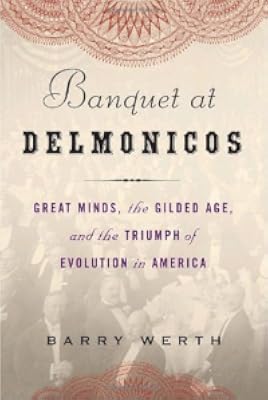
Banquet at Delmonico's: Great Minds, the Gilded Age, and the Triumph of Evolution in America
by Barry Werth
On This Page
Description
Draws readers inside the circle of philosophers, scientists, politicians, businessmen, clergymen, and scholars who brought Charles Darwin's controversial ideas to America in the crucial years after the Civil War. Prominent among these men were the English philosopher Herbert Spencer, industrialist Andrew Carnegie, clergyman Henry Ward Beecher, and political reformer Carl Schurz.Tags
Recommendations
















































Member Recommendations

Member Reviews
Connecting Darwin to social Darwinism
Darwinian theories of natural selection and evolution have been used (and misused) to explain just about everything. Charles Darwin himself never intended it so, the naturalist was a biologist and his theories were meant to be applied apolitically, amorally. But the idea of evolution, positivism, was just too irresistibly easy to be applied to social, political, and economic contexts.
In Barry Werth's new book, he traces the emergence of "social Darwinism" in America through the central characters of Herbert Spencer, Henry Ward Beecher, and Andrew Carnegie. Werth shows how Darwin's theories were institutionalized within every aspect of American society because it comfortably fit witin the context of show more the Gilded era but also because it conveniently supplied an ideology which explained American foundational principles of republicanism, Protestantism, and post-reconstruction Jim Crow.
If there is a criticism of the book, it is the excessive biographical information on Ward and Carnegie, which results in a bloated narrative. Otherwise, Werth's analysis is spot on and he uses plenty of great secondary sources to support his arguments.
Overall, a great read. Werth's book helps to connect the dots between Darwin and the philosophy of social Darwinism. show less
Darwinian theories of natural selection and evolution have been used (and misused) to explain just about everything. Charles Darwin himself never intended it so, the naturalist was a biologist and his theories were meant to be applied apolitically, amorally. But the idea of evolution, positivism, was just too irresistibly easy to be applied to social, political, and economic contexts.
In Barry Werth's new book, he traces the emergence of "social Darwinism" in America through the central characters of Herbert Spencer, Henry Ward Beecher, and Andrew Carnegie. Werth shows how Darwin's theories were institutionalized within every aspect of American society because it comfortably fit witin the context of show more the Gilded era but also because it conveniently supplied an ideology which explained American foundational principles of republicanism, Protestantism, and post-reconstruction Jim Crow.
If there is a criticism of the book, it is the excessive biographical information on Ward and Carnegie, which results in a bloated narrative. Otherwise, Werth's analysis is spot on and he uses plenty of great secondary sources to support his arguments.
Overall, a great read. Werth's book helps to connect the dots between Darwin and the philosophy of social Darwinism. show less
The last chapter, the Banquet, was a wonderful end to a great book. The author did a superb job of weaving the evolution theme in and through the gilded age of American history. The book has plenty of depth and weight in addition to the factual rendition of this brief historical period. Thrilled I "stumbled" onto this book.
Ratings
Members
- Recently Added By
Author Information

9 Works 683 Members
Barry Werth is the author of "The Billion-Dollar Molecule" & "Damages". He has written about Newton Arvin for "The New Yorker" & has also been published in "GQ" & "The New York Times Magazine". He lives in Northampton, Massachusetts. (Bowker Author Biography)
Common Knowledge
- Important places
- New York, New York, USA
- Important events
- Gilded Age
Classifications
- Genres
- Nonfiction, History, Science & Nature, Sociology, General Nonfiction, Biography & Memoir, Food & Cooking
- DDC/MDS
- 303.4097309034 — Society, government, & culture Social sciences, sociology & anthropology Social processes Social change Biography; History By Place North America
- LCC
- HM631 .W47 — Social sciences Sociology (General) Sociology Culture
- BISAC
Statistics
- Members
- 108
- Popularity
- 301,528
- Reviews
- 2
- Rating
- (3.95)
- Languages
- English
- Media
- Paper, Ebook
- ISBNs
- 4
- UPCs
- 1
- ASINs
- 2