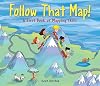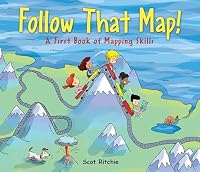
Follow That Map!: A First Book of Mapping Skills (Exploring Our Community)
by Scot Ritchie
Exploring Our Community
On This Page
Description
Follow That Map! is a mind-expanding adventure for the young and a unique way to introduce mapping concepts at the primary level and get kids started on the road to mastering this essential skill.Tags
Recommendations









Member Reviews
I enjoyed this book for several reasons. I liked how the author starts off with a story about a group of friends looking for their pets and uses that story to teach the reader about reading maps. For example, "Martin is getting close to the zoo. Which direction is he running? The compass rose on a map shows you directions such as north, south, east and west." The author relates a part of the story to an informational idea about compass'. This strategy keeps the reader interested, while he or she is learning about maps. I also liked how each page has a different illustration of a map. For example, there is a map of a city, a park, a neighborhood, and more. Each map includes symbols, legends, compass' or labels. This aids the reader in show more visualizing what each map tools looks like. I also liked that the information about maps is in bold on each page. This tells the reader that this part of the text is important to remember or important to read. The author also includes directions on how to create your own map at the end of the book. This book is very interactive and can easily engage readers. The big idea of the story is that maps can be helpful when taking adventures. show less
Elaborate compass roses, legends, latitudes, longitudes, scale indicators, and landmark icons; the world of maps is a mysterious, and often-complex one. In Follow That Map!: A First Book of Mapping Skills, book creator Scott Ritchie brings mapping down to a fun, colourful, and manageable level for young children.
Ritchie begins by introducing young readers to the characters, and a diagram that explains the common features found on a map, When Pedro notices that Sally’s dog Max, and her cat Ollie are “missing”, the children are off on an imaginary voyage that will take them around the world and back in search of the missing pets.
At each stop along the way, new mapping skills are taught by placing the characters directly on show more landscapes that appear as detailed maps from the overhead, offset perspective the bold illustrations are drawn from. This perspective is consistent throughout, even when no mapping skills are being taught, adding to a consistent feel throughout the book.
As the children scour the neighborhood for Max and Ollie, legend skills are introduced, with an interactive question to engage children. At each progressive stop additional skills are folded in, sometimes in combination with each other. When the children strike out through the city in search of the zoo, using a compass rose is the main focus, with legend skills also included.
When I sat down to work through Follow That Map! with my daughter it seemed almost too easy – the learning that came from reading the simple story and asking her the included questions was effortless and fun for both of us. The introductory level skills explored are: legends, trails, compass rose, scale bar, weather map, following directions with the help of a map, topographical maps, landmarks, and world maps. A simple map of the planets in our solar system is also included, as well as instructions on how to create a simple, yet accurate map of a room in your home with a sheet of graph paper.
Incredibly appealing to young children visually, the cartoon-like illustrations fill most of each two-page spread, with a small amount of text, plenty of white space, and a large font for early readers. Written for four to seven-year-olds, Follow That Map! serves as a geography primer of sorts – an easily accessible sample to pique the interest of young learners, and to familiarize them with tools that they will use for the rest of their lives. The bright drawings, game-like activities, and subtle humor encourage repeat readings, browsing, and informal map-play times guided by improvised questions.
Reviewed at quiverfullfamily.com show less
Ritchie begins by introducing young readers to the characters, and a diagram that explains the common features found on a map, When Pedro notices that Sally’s dog Max, and her cat Ollie are “missing”, the children are off on an imaginary voyage that will take them around the world and back in search of the missing pets.
At each stop along the way, new mapping skills are taught by placing the characters directly on show more landscapes that appear as detailed maps from the overhead, offset perspective the bold illustrations are drawn from. This perspective is consistent throughout, even when no mapping skills are being taught, adding to a consistent feel throughout the book.
As the children scour the neighborhood for Max and Ollie, legend skills are introduced, with an interactive question to engage children. At each progressive stop additional skills are folded in, sometimes in combination with each other. When the children strike out through the city in search of the zoo, using a compass rose is the main focus, with legend skills also included.
When I sat down to work through Follow That Map! with my daughter it seemed almost too easy – the learning that came from reading the simple story and asking her the included questions was effortless and fun for both of us. The introductory level skills explored are: legends, trails, compass rose, scale bar, weather map, following directions with the help of a map, topographical maps, landmarks, and world maps. A simple map of the planets in our solar system is also included, as well as instructions on how to create a simple, yet accurate map of a room in your home with a sheet of graph paper.
Incredibly appealing to young children visually, the cartoon-like illustrations fill most of each two-page spread, with a small amount of text, plenty of white space, and a large font for early readers. Written for four to seven-year-olds, Follow That Map! serves as a geography primer of sorts – an easily accessible sample to pique the interest of young learners, and to familiarize them with tools that they will use for the rest of their lives. The bright drawings, game-like activities, and subtle humor encourage repeat readings, browsing, and informal map-play times guided by improvised questions.
Reviewed at quiverfullfamily.com show less
I liked this book because it teaches kids how to read and use basic maps. This book explains all the key concepts of what a map has and how a map is used. It quickly gives examples on different types of maps. “Maps use symbols to help you find important places, such as the hospital, your school or your home. The symbols are explained on a legend or key.” I also like this book because it encourages children to participate in the book “Keep your eyes open. Somebody is going the wrong way. Who is it?” The main idea of this book was to teach children what a map is and how to use it.
A geography book for the early elementary grades. This is an excellent introduction to geography and the world of maps, bringing students from their own backyard out into the wide world.
This would a be a good book for my social studies class because it covers mapping skills. A group of kids go on an adventure following a map and teaching you how to use it.
This book o ers a creative approach for teaching young students about geographic concepts and mapping skills in the context of backyard, neighborhood, city, world, and space.
Delightful text, great illustrations. Nice story lin. Basic map skills for 1st & 2nd. Would work great for review in 2nd. Intro in 1st
Members
- Recently Added By
Lists

Lost ::: Mapping Tales for Kids
33 works; 2 members
Author Information

30+ Works 936 Members
Awards and Honors
Series

Classifications
- DDC/MDS
- 912.014 — History & geography Geography & travel Maps and plans of surface of earth and of extraterrestrial worlds modified standard subdivisions Philosophyand theory; map reading Map reading
- LCC
- GA105.6 .R58 — Geography, Anthropology and Recreation Mathematical geography. Cartography Mathematical geography. Cartography Cartography
- BISAC
Statistics
- Members
- 375
- Popularity
- 83,206
- Reviews
- 8
- Rating
- (4.15)
- Languages
- English
- Media
- Paper, Ebook
- ISBNs
- 7
- UPCs
- 1
- ASINs
- 1