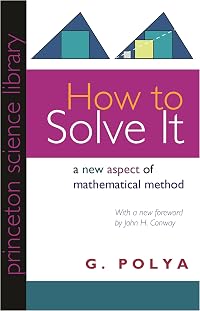
How to Solve It: A New Aspect of Mathematical Method
by G. Polya
On This Page
Description
A perennial bestseller by eminent mathematician G. Polya, How to Solve It will show anyone in any field how to think straight. In lucid and appealing prose, Polya reveals how the mathematical method of demonstrating a proof or finding an unknown can be of help in attacking any problem that can be "reasoned" out-from building a bridge to winning a game of anagrams. Generations of readers have relished Polya's deft-indeed, brilliant-instructions on stripping away irrelevancies and going show more straight to the heart of the problem. show lessTags
Recommendations







Member Recommendations
Member Reviews
[5 out of 5] My only regret is that I must return this book to the library. This is one of those rare books I recommend to pretty much anyone who has to deal with problem solving.
Not just mathematical problems, though. Polya writes an excellent case for the way we all should approach problems. It's not a formula, rather a scaffolding for thought, strategies for learning and teaching, reflections on successful solving and common pitfalls. If you want to think like a scientist, this is an excellent start, whether you have a science degree/background or not
Not just mathematical problems, though. Polya writes an excellent case for the way we all should approach problems. It's not a formula, rather a scaffolding for thought, strategies for learning and teaching, reflections on successful solving and common pitfalls. If you want to think like a scientist, this is an excellent start, whether you have a science degree/background or not
This actually seems to be a fairly basic sort of book with obvious advice. But maybe that’s not giving it credit. Admittedly, I’ve only read this as the Blinkist summary version and will have missed a lot of the detail that is in the full book. But I’ve found the Blinikist versions, have been able to extract the essence from most of their summaries that I have read: even where I’ve had the opportunity of comparing with the full book. Having said that I’ve just been trying to draw a square with three lines and clearly missed the first point about “understanding before action”. The trick is that you draw a square as normal (with four lines ...then you simply inscribe three lines inside this square that you have drawn: show more Presto! “A square with three lines”. I just was reading the instructions in a restricted way.
My observation with math solving techniques is that you really need to do a lot of practice problems to give you the “past experience” that is being recommended. If you haven’t done the practice drills then you won’t have experience to draw upon.
However, I've just done a bit of research on the Author: George Polya and I think I'm feeling the book too short. Polya was an accomplished mathematician and published papers in a lot of different mathematical fields. But he is probably most famous as an educator and an educator of math teachers. And the current book, is what made hi especially famous. So, the simplicity of approach belies the deep knowledge underpinning it. I am reviewing my rating on the basis of this extra knowledge. Here are some extracts which outline the basic points made:
"Understanding before action
What are they trying to find? What facts do they already know? How do these pieces fit together? Just by asking these questions, what seemed hard becomes much clearer.
Look at where you want to end up, see what you’re starting with, and figure out what rules you need to follow.....Taking time to understand requires stopping yourself from jumping in too fast.....Make it a habit to stop, ask questions, and really look at what you’re dealing with before trying to solve anything.
Finding your path
After you’ve seen what the problem’s all about, you need a smart plan to solve it.....This planning process often starts with looking at your past experiences.....These patterns become especially powerful as you gain experience. People who solve problems well do this naturally......Sometimes you can’t see the best path until you’ve started moving....Try to make a plan that keeps you on track but lets you try new ideas. It’s like having a good map for a trip
Execution and verification
Now that you have your plan, it’s time to put it into action....Start by breaking big problems into smaller pieces to check your work as you go.....When solving a big equation, try checking each step using different math tricks....If you solved something with geometry, see if you can prove it with algebra, too.....In geometry, your answer should work no matter how you turn or resize the shapes. In algebra, plug your answer back into the original problem to make sure it works.....All of this checking needs good record-keeping......What seems like extra work in writing things down actually saves time in the long run.....The last step is stepping back to look at your whole solution.
Problem-solving techniques
These methods-breaking problems into pieces, finding connections to similar problems, and looking at broader patterns-can turn what seems impossible into something you can handle step by step..... A cylinder's volume relates perfectly to the flat area of its base. Seeing these connections lets you use what you already know to tackle new problems....Often you'll spot patterns you couldn't see before-like stepping back from a painting....But you can also learn a lot by going the other way-looking at specific examples....Making a problem more general might help you see connections to other problems, while specific examples might suggest ways to break the problem into pieces.
The mental game
Often, a problem that seems impossible becomes clear after you step away for a while.
Many mathematicians set specific time limits, knowing that pushing too long usually doesn't help......Your unconscious mind does a lot of the work. People often get breakthroughs at unexpected times
Summary: Great problem-solvers combine methodical thinking, pattern recognition, and mental resilience to crack any challenge. The journey begins with deep observation before acting, then moves through careful planning and systematic execution. By breaking problems into manageable pieces and connecting them to familiar patterns, complex challenges become solvable. Understanding your mental process-including how to handle frustration and when to step back for clarity-transforms the way you tackle every problem. These proven approaches turn challenges of any size into clear, conquerable steps.
So what’s my overall take on the book?....It’s fine as far as it goes. But the steps are so general that they are not especially helpful. I guess the advice to make sure you are solving the right problem. And the suggestion to break it into steps and cross check with geometry vs algebra etc., are good suggestions. But not sure that I really learned a lot. I think I need to read the original. Clearly the summary misses a lot. Four stars from me. show less
My observation with math solving techniques is that you really need to do a lot of practice problems to give you the “past experience” that is being recommended. If you haven’t done the practice drills then you won’t have experience to draw upon.
However, I've just done a bit of research on the Author: George Polya and I think I'm feeling the book too short. Polya was an accomplished mathematician and published papers in a lot of different mathematical fields. But he is probably most famous as an educator and an educator of math teachers. And the current book, is what made hi especially famous. So, the simplicity of approach belies the deep knowledge underpinning it. I am reviewing my rating on the basis of this extra knowledge. Here are some extracts which outline the basic points made:
"Understanding before action
What are they trying to find? What facts do they already know? How do these pieces fit together? Just by asking these questions, what seemed hard becomes much clearer.
Look at where you want to end up, see what you’re starting with, and figure out what rules you need to follow.....Taking time to understand requires stopping yourself from jumping in too fast.....Make it a habit to stop, ask questions, and really look at what you’re dealing with before trying to solve anything.
Finding your path
After you’ve seen what the problem’s all about, you need a smart plan to solve it.....This planning process often starts with looking at your past experiences.....These patterns become especially powerful as you gain experience. People who solve problems well do this naturally......Sometimes you can’t see the best path until you’ve started moving....Try to make a plan that keeps you on track but lets you try new ideas. It’s like having a good map for a trip
Execution and verification
Now that you have your plan, it’s time to put it into action....Start by breaking big problems into smaller pieces to check your work as you go.....When solving a big equation, try checking each step using different math tricks....If you solved something with geometry, see if you can prove it with algebra, too.....In geometry, your answer should work no matter how you turn or resize the shapes. In algebra, plug your answer back into the original problem to make sure it works.....All of this checking needs good record-keeping......What seems like extra work in writing things down actually saves time in the long run.....The last step is stepping back to look at your whole solution.
Problem-solving techniques
These methods-breaking problems into pieces, finding connections to similar problems, and looking at broader patterns-can turn what seems impossible into something you can handle step by step..... A cylinder's volume relates perfectly to the flat area of its base. Seeing these connections lets you use what you already know to tackle new problems....Often you'll spot patterns you couldn't see before-like stepping back from a painting....But you can also learn a lot by going the other way-looking at specific examples....Making a problem more general might help you see connections to other problems, while specific examples might suggest ways to break the problem into pieces.
The mental game
Often, a problem that seems impossible becomes clear after you step away for a while.
Many mathematicians set specific time limits, knowing that pushing too long usually doesn't help......Your unconscious mind does a lot of the work. People often get breakthroughs at unexpected times
Summary: Great problem-solvers combine methodical thinking, pattern recognition, and mental resilience to crack any challenge. The journey begins with deep observation before acting, then moves through careful planning and systematic execution. By breaking problems into manageable pieces and connecting them to familiar patterns, complex challenges become solvable. Understanding your mental process-including how to handle frustration and when to step back for clarity-transforms the way you tackle every problem. These proven approaches turn challenges of any size into clear, conquerable steps.
So what’s my overall take on the book?....It’s fine as far as it goes. But the steps are so general that they are not especially helpful. I guess the advice to make sure you are solving the right problem. And the suggestion to break it into steps and cross check with geometry vs algebra etc., are good suggestions. But not sure that I really learned a lot. I think I need to read the original. Clearly the summary misses a lot. Four stars from me. show less
I'm conflicted about this book. There is a lot of good advice around the art of problem solving, but my god is there a lot of shit too. The layout is mostly a big alphabetical glossary of _math things_ --- everything from leading questions to notions of symmetry to anecdotes about absentminded professors --- and the layout doesn't particularly help. It's not organized by topic or ordered by first things first, it's just plopped down alphabetically. As such, it's hard to get into the flow.
This book however is lacking primarily in that it deals with how to solve "well-posed questions," which is to say, toy problems. There is very little about conducting your own open-ended research, and about how to turn wisps of ideas into well-posed ones.
This book however is lacking primarily in that it deals with how to solve "well-posed questions," which is to say, toy problems. There is very little about conducting your own open-ended research, and about how to turn wisps of ideas into well-posed ones.
I came across this book as a result of my entry into Mathematics. If you have read enough Philosophy and question your own assumptions, ideas, you'll find the ideas in this book are repetitive. I would recommend this book to someone who wants to know basic problem-solving skills.
Deus Vult,
Gottfried
Deus Vult,
Gottfried
Polya was more general than I would have liked, without a lot of examples that related to what I was trying to learn.
The best lesson i learned from this work was to first try to understand the problem before slogging into it with some random sort of method.
The best lesson i learned from this work was to first try to understand the problem before slogging into it with some random sort of method.
After more than 50 years, Polya's advice on tackling problems is still worth reading. But be warned, this is not the latest, brightest, trendiest, best-selling "problem solving book" out there that target MBAs or a kind of personal self-development book. Its author had contributed to important fields of mathematics and he had been through many problems, many difficulties, many students and many different questions by those students.
If you're a young but eager student who faces problems in math (or in natural sciences), a person trying to solve some puzzles or practical problems, or a researcher about to start a long and unguaranteed journey in order to solve a big problem then you owe yourself to have this classic on your bookshelf, or show more better on your table.
I'd like to quote some important passages from the book but last time I checked my notes they are about as long as the book. So maybe it is better to let Polya do the talking... show less
If you're a young but eager student who faces problems in math (or in natural sciences), a person trying to solve some puzzles or practical problems, or a researcher about to start a long and unguaranteed journey in order to solve a big problem then you owe yourself to have this classic on your bookshelf, or show more better on your table.
I'd like to quote some important passages from the book but last time I checked my notes they are about as long as the book. So maybe it is better to let Polya do the talking... show less
How to Solve It is decent, but overrated – the first 10% are pretty good, and then there are a few nuggets of really good advice interspersed with the neverending examples of the principles introduced in the first part.
Members
- Recently Added By
Lists

HS Mathematics class library
79 works; 6 members

Mind Expanding Books by hackerkid
581 works; 8 members

The r/AskScience Reading List
159 works; 3 members

Biblioteca de não ficção
41 works; 1 member

Finished in 2024
19 works; 1 member
Author Information

43+ Works 3,489 Members
Awards and Honors
Notable Lists
Series
Belongs to Publisher Series
Common Knowledge
- Canonical title
- How to Solve It: A New Aspect of Mathematical Method
- Original publication date
- 1945
- First words
- (Preface to the First Printing); A great discovery solves a great problem but there is a grain of disovery in the solution of any problem.
(Preface to the Second Edition): The present second edition adds, besides a few minor improvements, a new fourth part, "Problems, Hints, Solutions."
(Foreword by John H. Conway): How to Solve It is a wonderful book!
(Introduction): The following considerations are grouped around the preceding list of questions and suggestions entitled "How to Solve It."
One of the most important tasks of the teacher is to help his students. - Last words
- (Click to show. Warning: May contain spoilers.)There is an obvious analogy between her difficulties and our difficulties.
- Blurbers
- Bell, E. T.; Weyl, Herman; Schaeffer, A. C.; Davis, Bodanis
Classifications
Statistics
- Members
- 2,282
- Popularity
- 8,742
- Reviews
- 19
- Rating
- (3.96)
- Languages
- 9 — English, Estonian, Finnish, German, Hungarian, Italian, Spanish, Swedish, Turkish
- Media
- Paper, Ebook
- ISBNs
- 20
- ASINs
- 23