On This Page
Description
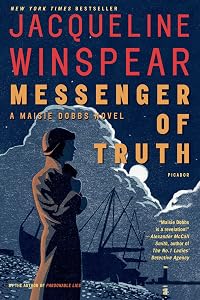
London, 1931. The night before an exhibition of his artwork opens at a famed Mayfair gallery, the controversial artist Nick Bassington-Hope falls to his death. The police rule it an accident, but Nick's twin sister, Georgina, a wartime journalist and a controversial figure in her own right, isn't so sure. When the authorities refuse to consider her theory that Nick was murdered, Georgina seeks out an old classmate from Girton College, Maisie Dobbs, psychologist and investigator, for help. show more Nick was a veteran of World War I, and before long the case leads Maisie to the desolate beaches of Dungeness in Kent, and into the sinister underbelly of the city's art world. Following up on the bestselling Pardonable Lies, Jacqueline Winspear here delivers another vivid, thrilling and utterly unique episode in the life of Maisie Dobbs, in Messenger of Truth. show lessTags
Recommendations













Member Reviews
This one had a really excellent premise, I thought, and the reverberations of the war -- this time, the artist first in the trenches and then creating propaganda posters under duress -- and questions about the moral responsibilities of art are very interesting. However. I don't know if I can go on reading these books.
They've always been a bit "woo woo", as people seem to be calling it now. Maisie has always relied upon her intuition, often getting a "feeling" from the rooms where someone lived or where an event occurred. She has scarcely solved a mystery without receiving some kind of hint during meditation. With skeptically reserved judgement, I can accept this. Even though it may violate the oath of the Detection Club (Dorothy Sayers show more wrote the oath, Chesterton was the first president, Agatha Christie et al. were members, *that* Detection Club) to abjure jiggery-pokery, it's still not entirely beyond the pale.
But in this book Maisie goes full on Absent Healer, using visualization to treat a child for life-threatening diphtheria when Maisie is at home meditating in her flat and the toddler is hospitalized. I found it extremely triggering. The process, described in detail, is virtually identical to the treatment my mother employed upon my sister and myself with the aid of absent healing thoughts sent by a Christian Science "Practitioner". The toddler in the book seemed to rally, and then died. The healing thoughts never worked for my sister or me either, and we were never offered other medical care. We were fortunate enough not to contract anything fatal. But our mother died of untreated breast cancer while under Christian Science care when we were still young children. It's very hard to think about this kind of thing and continue to breathe, so I will stop writing this and breathe instead. show less
They've always been a bit "woo woo", as people seem to be calling it now. Maisie has always relied upon her intuition, often getting a "feeling" from the rooms where someone lived or where an event occurred. She has scarcely solved a mystery without receiving some kind of hint during meditation. With skeptically reserved judgement, I can accept this. Even though it may violate the oath of the Detection Club (Dorothy Sayers show more wrote the oath, Chesterton was the first president, Agatha Christie et al. were members, *that* Detection Club) to abjure jiggery-pokery, it's still not entirely beyond the pale.
But in this book Maisie goes full on Absent Healer, using visualization to treat a child for life-threatening diphtheria when Maisie is at home meditating in her flat and the toddler is hospitalized. I found it extremely triggering. The process, described in detail, is virtually identical to the treatment my mother employed upon my sister and myself with the aid of absent healing thoughts sent by a Christian Science "Practitioner".
In this fourth Maisie Dobbs novel, psychologist and private investigator Maisie takes on a case at the request of a fellow Girton alumnus. Georgina Bassington-Hope, a noted war-time correspondent, is not satisfied with the ruling of accidental death in her twin Nick's fall from scaffolding at an art gallery. Nick was an artist, and was at the gallery alone to set up the pieces of his masterwork for an exhibition. Nick was very secretive about his work; no one else had seen the work, and no one knew what had happened to it after his death. Maisie's investigation exposes her to a different sort of people than she is used to -- artists, wealthy art patrons, and the wealthy Bassington-Hope family, whose economic situation affords them the show more freedom to adopt a bohemian lifestyle.
This is the best novel yet in the Maisie Dobbs series. Maisie is very much alone in this novel, having left the comfort of the home of friend and former employer Lady Rowan Compton for a flat of her own. As a result of her last major case, she is estranged from her mentor, Maurice Blanchard. She is even deprived of the support of her assistant, Billy Beale, when a family crisis claims his attention.
Maisie suffered a breakdown in the previous novel in the series, and when this book opens she is still recovering from its effects. The Bassington-Hope case is her first major case since the breakdown, and those closest to her are concerned that she has taken on too much too soon. Although Maisie has always been self-aware, her breakdown has left her in an even more reflective state. As the title of the book suggests, truth is a theme in this novel. A large part of the impact of Nick Bassington-Hope's art is the truths it depicts, especially of truths of character or activities that its subjects wish to conceal. Maisie's contemplation of truth in connection with her investigation leads her to recognize some unwelcome truths in her own psyche. By the end of the novel she seems to be well on the way to attaining some peace in her personal life.
Because Maisie's character development is such an important feature of this series, I recommend reading the previous books in the series before reading this one. show less
This is the best novel yet in the Maisie Dobbs series. Maisie is very much alone in this novel, having left the comfort of the home of friend and former employer Lady Rowan Compton for a flat of her own. As a result of her last major case, she is estranged from her mentor, Maurice Blanchard. She is even deprived of the support of her assistant, Billy Beale, when a family crisis claims his attention.
Maisie suffered a breakdown in the previous novel in the series, and when this book opens she is still recovering from its effects. The Bassington-Hope case is her first major case since the breakdown, and those closest to her are concerned that she has taken on too much too soon. Although Maisie has always been self-aware, her breakdown has left her in an even more reflective state. As the title of the book suggests, truth is a theme in this novel. A large part of the impact of Nick Bassington-Hope's art is the truths it depicts, especially of truths of character or activities that its subjects wish to conceal. Maisie's contemplation of truth in connection with her investigation leads her to recognize some unwelcome truths in her own psyche. By the end of the novel she seems to be well on the way to attaining some peace in her personal life.
Because Maisie's character development is such an important feature of this series, I recommend reading the previous books in the series before reading this one. show less
The best mysteries have the story plot and the back story intertwining --and Winspear offers this in spades. In this one an artist has created a work in secrecy and falls from a scaffolding as he is putting up the canvasses for a show. His sister hires Maisie, something isn't right. And what Maisie uncovers is indeed not right -- and ethically interesting as well. A subplot that is dark and more typically nefarious is also uncovered, confusing the matter for a time ... and in the backstory Maisie must make a personal decision. ****
As I wrote in my review of the 1st novel in the Maisie Dobbs series,
From the moment I met the character of Maisie Dobbs, I loved her and couldn't wait to see her succeed in the opening of her very own office on Warren Street, "M. Dobbs, Trade and Personal Investigations" and to learn her backstory.
The year is now 1930, and readers of the series have known Maisie since Jacqueline Winspear introduced her to us as a woman that became a psychologist and investigator in the late 1920s following her service for England as a nurse on the battlefields of WWI France.
After reading "Messenger of Truth" at the end of March-beginning of April of this year I was so deeply touched by Maisie's experiences as she investigates a case for client show more Georgina Bassington-Hope that I could not write my review right away. As time continued to pass regardless of the times I passed the title on the list I couldn’t write the review. I finally realized that in order to write about the novel I needed to read it again. It truly was a necessity for me as I felt the call to read the author's descriptions of this time period of Maisie's life again of both her personal growth and also her progression of solving the inquiry for fellow Girton graduate Georgina.
Anyone that knows me well is aware how rare the occasion for me to re-read any book as there are so many novels that are always on my wish-to-read list and by the authors that I’ve yet to discover. That said, time spent with the writing of Jacqueline Winspear is always an enlightening experience. The series of Maisie Dobbs not only opens a view of history to life in England after World War I but conveys with exquisite writing the complexities of life from its beauty to its horrors and for me has touched some of the deepest parts of my heart and soul and at times putting into words thoughts felt but always left unspoken.
"Messenger of Truth" conveys Maisie’s humanity as well as recognition of her own fragility after recovery from a breakdown that occurred after she returned to the site in France of her most painful WWI memories. This story also shows that as part of Maisie’s recovery she becomes more determined to move forward not only in her personal life but to give her best to her investigations using all of her life experiences, the teachings of her father to those realized as a household maid for employer and suffragette Lady Rowan Compton, studies at Girton, and under the mentorship of Maurice Blanche. It is beautiful to read of the way in which she mentors her employee Billy Beale and a young woman named Sandra. I have found the character of Maisie Dobbs to be very insightful but particularly in this novel as she recognizes qualities of herself and accepts herself for who she has become and needs to be going forward. There is also insight to Georgina the journalist expressing herself with words and her twin brother Nick the artist expressing himself with the color, texture, and light of his art.
To be sure Jacqueline Winspear is an artist of her own merit and talent with words and I am profoundly touched by perceptions shared through her writing. I look forward to reading more about Maisie Dobbs. show less
From the moment I met the character of Maisie Dobbs, I loved her and couldn't wait to see her succeed in the opening of her very own office on Warren Street, "M. Dobbs, Trade and Personal Investigations" and to learn her backstory.
The year is now 1930, and readers of the series have known Maisie since Jacqueline Winspear introduced her to us as a woman that became a psychologist and investigator in the late 1920s following her service for England as a nurse on the battlefields of WWI France.
After reading "Messenger of Truth" at the end of March-beginning of April of this year I was so deeply touched by Maisie's experiences as she investigates a case for client show more Georgina Bassington-Hope that I could not write my review right away. As time continued to pass regardless of the times I passed the title on the list I couldn’t write the review. I finally realized that in order to write about the novel I needed to read it again. It truly was a necessity for me as I felt the call to read the author's descriptions of this time period of Maisie's life again of both her personal growth and also her progression of solving the inquiry for fellow Girton graduate Georgina.
Anyone that knows me well is aware how rare the occasion for me to re-read any book as there are so many novels that are always on my wish-to-read list and by the authors that I’ve yet to discover. That said, time spent with the writing of Jacqueline Winspear is always an enlightening experience. The series of Maisie Dobbs not only opens a view of history to life in England after World War I but conveys with exquisite writing the complexities of life from its beauty to its horrors and for me has touched some of the deepest parts of my heart and soul and at times putting into words thoughts felt but always left unspoken.
"Messenger of Truth" conveys Maisie’s humanity as well as recognition of her own fragility after recovery from a breakdown that occurred after she returned to the site in France of her most painful WWI memories. This story also shows that as part of Maisie’s recovery she becomes more determined to move forward not only in her personal life but to give her best to her investigations using all of her life experiences, the teachings of her father to those realized as a household maid for employer and suffragette Lady Rowan Compton, studies at Girton, and under the mentorship of Maurice Blanche. It is beautiful to read of the way in which she mentors her employee Billy Beale and a young woman named Sandra. I have found the character of Maisie Dobbs to be very insightful but particularly in this novel as she recognizes qualities of herself and accepts herself for who she has become and needs to be going forward. There is also insight to Georgina the journalist expressing herself with words and her twin brother Nick the artist expressing himself with the color, texture, and light of his art.
To be sure Jacqueline Winspear is an artist of her own merit and talent with words and I am profoundly touched by perceptions shared through her writing. I look forward to reading more about Maisie Dobbs. show less
An insightful look at the horrors of the Great War as they continue to reverberate years later. Maisie is asked investigate the accidental death of an iconoclastic realist painter of WW1 battle scenes. The bleak economic world of 30's England is contrasted poignantly against the lives of the rich and famous as she sorts it all out.
The fourth book in the series finds our heroine investigating the death of a famous young artist. His death is ruled an accident, but his twin sister (an aristocratic young war reporter) just doesn't believe it. The police push her off on Maisie, who ultimately finds herself (as always!) tangled up in something far messier than she first thought. There are a lot of endings and beginnings in this book, which focuses somewhat more on Maisie's emotional life and how she is moving on from her past as she becomes more independent and successful. The case and the people she encounters force Maisie to think about what kind of person she is and whether she wants to be that person. Once again, lovely social detail about the war and aftermath, show more this time zeroing in on wartime propaganda, post-war political attitudes (eventual leader of the British Union of Fascists Oswald Mosley makes an appearance!), and the deprivations faced by the unemployed and working class. I often find that I tire of a series because each book has a certain sameness, but with this series, each book varies the formula just enough to be comforting without getting old. show less
I still can't quit this series. It's still bad. This is one of the better entries, in that the mystery wasn't solved by, say, a ghost speaking to Maisie, or by someone else while Maisie hid, so perhaps Winspear is getting better at plotting? But she's got a long way to go before she reaches the starting line.
There's a mushy, ridiculous opening in which Winspear declines to name the character you're following, even though it's going to be obvious and it's no one you have met earlier in the series, so there's no surprise element possible. At the end, Winspear makes another fumbled play for suspense; she drags out the solution for Big Drama, having Maisie set up a drawing room (well, art gallery) reveal by visiting person after person show more without ever saying what she's doing. Since I already knew who the killer was (it was extremely obvious), it was, uh, not suspenseful, and in reaching for suspense she managed to ruin both the beginning and the end of her novel. Not great.
It's also not great that this book is about a great artist and a great work of art when Winspear doesn't appear to understand either of them. A friend of mine said that when writers write about art, they're actually writing about writing. I kept thinking about that as Winspear described art that was fairly obviously bad as brilliant and earth-shaking and as she went on long discursions into the Meaning of Art that were obviously meaningless. That was definitely the funniest part of the novel for me.
There were other funny parts, though. The client in this story, Georgina, feels unfamiliar heat at Maisie's touch, and yet somehow it's not a romance between Georgina and Maisie? (Even after Georgina takes pains to inquire about Maisie's marital status.) And at one point, Georgina says the word "triptych," and Maisie, who has been to college and had a first-rate education outside of that at the hands of the cultured Maurice Blanche, doesn't know what it is. (And it's not just that Winspear needs to define it for her readers; Billy is there, too, and he has good reason not to know, so he asks along with Maisie, and could have asked by himself. Winspear just genuinely thinks that "triptych" is such a rare word that no one who isn't an artist would understand it, no matter how well-educated.)
Also, there are the usual anachronisms and mistakes, including a weird one. There are multiple mentions of a politician nicknamed "Jix." That's a real nickname for a real British politician of the period (who really did the things described), but his name was Joynson-Hicks, while Winspear repeatedly refers to Joyston-Hicks. It was a weird, jarring error that I found far more irritating than it deserved, simply because I only read these books because I love the period.
The real jarring element, though, wasthe death of Billy Beale's youngest child, Lizzie. I think you owe it to your readers to write stuff like that only if you're up to the task of doing it well and with care for all characters concerned. Winspear's not. I deeply resent the gratuitous child death, which seems to be a ham-handed attempt to talk about economic inequality. You can do that without this!
All in all: a bad entry in a bad series that my brain won't let me stop reading. I hate it here. show less
There's a mushy, ridiculous opening in which Winspear declines to name the character you're following, even though it's going to be obvious and it's no one you have met earlier in the series, so there's no surprise element possible. At the end, Winspear makes another fumbled play for suspense; she drags out the solution for Big Drama, having Maisie set up a drawing room (well, art gallery) reveal by visiting person after person show more without ever saying what she's doing. Since I already knew who the killer was (it was extremely obvious), it was, uh, not suspenseful, and in reaching for suspense she managed to ruin both the beginning and the end of her novel. Not great.
It's also not great that this book is about a great artist and a great work of art when Winspear doesn't appear to understand either of them. A friend of mine said that when writers write about art, they're actually writing about writing. I kept thinking about that as Winspear described art that was fairly obviously bad as brilliant and earth-shaking and as she went on long discursions into the Meaning of Art that were obviously meaningless. That was definitely the funniest part of the novel for me.
There were other funny parts, though. The client in this story, Georgina, feels unfamiliar heat at Maisie's touch, and yet somehow it's not a romance between Georgina and Maisie? (Even after Georgina takes pains to inquire about Maisie's marital status.) And at one point, Georgina says the word "triptych," and Maisie, who has been to college and had a first-rate education outside of that at the hands of the cultured Maurice Blanche, doesn't know what it is. (And it's not just that Winspear needs to define it for her readers; Billy is there, too, and he has good reason not to know, so he asks along with Maisie, and could have asked by himself. Winspear just genuinely thinks that "triptych" is such a rare word that no one who isn't an artist would understand it, no matter how well-educated.)
Also, there are the usual anachronisms and mistakes, including a weird one. There are multiple mentions of a politician nicknamed "Jix." That's a real nickname for a real British politician of the period (who really did the things described), but his name was Joynson-Hicks, while Winspear repeatedly refers to Joyston-Hicks. It was a weird, jarring error that I found far more irritating than it deserved, simply because I only read these books because I love the period.
The real jarring element, though, was
All in all: a bad entry in a bad series that my brain won't let me stop reading. I hate it here. show less
Members
- Recently Added By
Published Reviews
ThingScore 50
MESSENGER OF TRUTH is something of a transitional book... the plot hinges on distant conflicts that have no immediacy, and the real issue seems to be whether Maisie will find a way “to move on, to dance with life again” — and, one hopes, to recover her original vocation.
added by y2pk
Lists

Books Read in 2014
2,343 works; 86 members

Books Read in 2020
4,379 works; 123 members

Books Read in 2023
5,547 works; 145 members

Books We Discovered On LibraryThing
530 works; 130 members
Author Information

33+ Works 32,752 Members
Jacqueline Winspear was born in the county of Kent, England. She was educated at the University of London's Institute of Education. After graduation, she worked in academic publishing, in higher education, and in marketing communications in the UK. In 1990, she emigrated to the United States. She was working in business and as a show more personal/professional coach when she decided to try writing. Her first novel, Maisie Dobbs, won the Agatha Award for Best First novel, the Macavity Award for Best First Novel, and the Alex Award. She is the author of the Maisie Dobbs Mystery series. She has also won the Agatha Award for Best Novel, the inaugural Sue Feder/Macavity Award for Best Historical Mystery, and the Bruce Alexander Award for Best Historical Mystery. Her title, A Dangerous Place, made The New York Times High Profile titles list. Journey to Munich, a book in the Maisie Dobbs Series, made the New York Times bestseller list in 2016. (Bowker Author Biography) show less
Some Editions
Awards and Honors
Awards
Series

Work Relationships
Is contained in
Common Knowledge
- Canonical title
- Messenger of Truth
- Original publication date
- 2006-08-22
- People/Characters
- Maisie Dobbs; Billy Beale; Doreen Beale; Georgina Bassington-Hope; Piers Bassington-Hope; Emma Bassington-Hope (show all 11); Noelle 'Nolly' Grant; Harry Bassington-Hope; Richard Stratton (DI); Andrew Dene; Duncan Haywood
- Important places
- London, England, UK; Kent, England, UK; Dungeness, Kent, England, UK; Hastings, East Sussex, England, UK
- Epigraph
- I am no longer an artist interested and anxious. I am a messenger who will bring back word from the men who are fighting to those who want the war to go on forever. Feeble, inarticulate, will be my message, but it will have a... (show all) bitter truth, and may it burn in their lousy souls. -- Paul Nash, Artist 1899-1946
January - You enter the London year - it is cold - it is wet - but there are gulls on the embankment. - from When You Go To London, by H.V. Morton, published 1931 - Dedication
- Dedicated to My Cheef Resurcher (who knows who he is)
- First words
- The taxi-cab slowed down alongside the gates of Camden Abbey, a red brick former mansion that seemed even more like a refuge as a bitter sleet swept across the gray forbidding landscape.
- Last words
- (Click to show. Warning: May contain spoilers.)It was time to move on, to dance with life again.
- Blurbers
- Smith, Alexander McCall
Classifications
Statistics
- Members
- 2,155
- Popularity
- 9,451
- Reviews
- 86
- Rating
- (3.86)
- Languages
- English, Portuguese, Spanish
- Media
- Paper, Audiobook, Ebook
- ISBNs
- 26
- ASINs
- 13