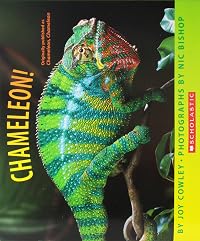
Chameleon, Chameleon
by Joy Cowley
On This Page
Description
Experience close-up the many moods (and colors) of chameleons. One brave chameleon ventures from the safety of his tree in search of a new home. On his journey, he meets other rain forest animals, not all of them friendly! Alas, the new tree he chooses is already home to another chameleon. She dons her aggressive coloring until she's sure that the visitor is friend, not foe. Then they welcome each other with brilliant, happy colors. Incredible photographs and simple text perfect for young show more children is rounded out with informative backmatter on one of the planet's most captivating creatures. show lessTags
Recommendations













Member Reviews
The photographs in this nonfiction “picture” book are captivating. With frame-by-frame action-packed close-ups, readers are immersed in the world of the chameleon and his neighbors — and from these photos and the accompanying (sparse) text will learn loads of information without even realizing they are reading a book that’s supposed to be telling them something. In this way, the book could be a great mentor text, to get students thinking about the unorthodox ways the books is successful as an expository text. For example, there is a two-page “Did You Know?” spread at the end that presents more information about chameleons in a more traditional text format. Readers could compare and contrast these formats, noticing what the show more photo spreads tell readers, what is left out, and where readers have to make inferences — and in those cases, how the photos supports readers to be successful. Students could be given questions to encourage them to be metacognitive about their own responses as readers to these different presentations of the content, and to think about using the strategies they notice for their own writing. In addition, there are also novel things happening with point of view. Mostly told in third person, there are questions posed that could be the chameleon’s own. Students could use this a model to test the effect of informational text presented in the first person from an animal or object. Students could also use the book as inspiration to create their own photography or multi-media informational projects. Depending on the depth of these activities, the book could be used across grades from elementary to secondary school. show less
Impressively engaging and educational, despite being very short and simple. The two good author's notes help, but so does the photography that tells a large part of the 'story' of this chameleon's adventure. It makes me want to learn more, as now I have lots of questions.
I found it particularly interesting that it was the other critters in the environment were using color for camouflage; apparently those kinds of chameleons who use color actually do so to signal mood. (And yes, there are different kinds of chameleons.)
I found it particularly interesting that it was the other critters in the environment were using color for camouflage; apparently those kinds of chameleons who use color actually do so to signal mood. (And yes, there are different kinds of chameleons.)
The photographs in this nonfiction “picture” book are captivating. With frame-by-frame action-packed close-ups, readers are immersed in the world of the chameleon and his neighbors — and from these photos and the accompanying (sparse) text will learn loads of information without even realizing they are reading a book that’s supposed to be telling them something. In this way, the book could be a great mentor text, to get students thinking about the unorthodox ways the books is successful as an expository text. For example, there is a two-page “Did You Know?” spread at the end that presents more information about chameleons in a more traditional text format. Readers could compare and contrast these formats, noticing what the show more photo spreads tell readers, what is left out, and where readers have to make inferences — and in those cases, how the photos supports readers to be successful. Students could be given questions to encourage them to be metacognitive about their own responses as readers to these different presentations of the content, and to think about using the strategies they notice for their own writing. In addition, there are also novel things happening with point of view. Mostly told in third person, there are questions posed that could be the chameleon’s own. Students could use this a model to test the effect of informational text presented in the first person from an animal or object. Students could also use the book as inspiration to create their own photography or multi-media informational projects. Depending on the depth of these activities, the book could be used across grades from elementary to secondary school.
Book Review, Pierce College, Ages (2-5) show less
Book Review, Pierce College, Ages (2-5) show less
Experience close-up the many moods (and colors) of chameleons. One brave chameleon ventures from the safety of his tree in search of a new home. On his journey, he meets other rain forest animals, not all of them friendly! Alas, the new tree he chooses is already home to another chameleon. She dons her aggressive coloring until she's sure that the visitor is friend, not foe. Then they welcome each other with brilliant, happy colors.
Experience close-up the many moods (and colors) of chameleons. One brave chameleon ventures from the safety of his tree in search of a new home. On his journey, he meets other rain forest animals, not all of them friendly! Alas, the new tree he chooses is already home to another chameleon. She dons her aggressive coloring until she's sure that the visitor is friend, not foe. Then they welcome each other with brilliant, happy colors.
A day in the life of a chameleon, with beautiful color photographs of a chameleon in its tree, climbing down, encountering a gecko, avoiding a scorpion, climbing another tree, shooting out its tongue to eat a caterpillar, and meeting a new chameleon. The new chameleon's skin is dark when angry, pale when friendly. Back matter includes "Did You Know?" with much more information; the text throughout the book is minimal. There's also an explanation of how the photographs were taken.
Summary: This book tells about the very different colors of chameleons. The story follows a brave chameleon that ventures from the safety of his home in search of another one. During his journey he meets many animals, some of them friendly, and others.... not so much. The chameleon finds a home, but it turns out its another chameleon's home. The chameleon is hostile at first putting on her aggressive color, but once they find out each other are friendly they turn bright happy colors.
personal reaction: the book was very colorful and I loved that. The book was so cute and it is definitely something that I would read again.
Extension ideas:
Art: Print out a picture of a chameleon for each student and have them color it with bright colors. show more
Mood Rings: Give each student a mood ring, and explain that the way the mood ring works is similar to the way that a chameleon works.
Writing: Have students write about what it would be like if they suddenly woke up as a chameleon one day and had to come to school. show less
personal reaction: the book was very colorful and I loved that. The book was so cute and it is definitely something that I would read again.
Extension ideas:
Art: Print out a picture of a chameleon for each student and have them color it with bright colors. show more
Mood Rings: Give each student a mood ring, and explain that the way the mood ring works is similar to the way that a chameleon works.
Writing: Have students write about what it would be like if they suddenly woke up as a chameleon one day and had to come to school. show less
Members
- Recently Added By
Author Information

1,358+ Works 32,945 Members
Cassia Joy Cowley is a New Zealand language and reading specialist. She was born on August 7, 1936, in Levin, New Zealand. She has written more than 500 books for beginning readers, many of which have been honored internationally. The Cheese Trap won the AIM Children's Book Award for Best Picture Book (1996) and Red-Eyed Tree Frog won the Boston show more Globe-Horn Book Award for Best Picture Book (1999). She has won New Zealand Post Children's Book Awards for Best Junior Fiction for Ticket to the Sky Dance (1998) and Starbright and the Dream Eater (1999). The Mouse Bride (1998) is being produced as an animated program for New Zealand television. In 2002, Cowley was awarded the Roberta Long Medal, presented by the University of Alabama at Birmingham for culturally diverse children's literature. In 2004, she was awarded the A. W. Reed Award for Contribution to New Zealand Literature, and in 2010, she won the Prime Minister's Award for Literary Achievement in the Fiction category. She is also a 2016 Astrid Lindgren award nominee. In 2018 she will be awarded the New Zealand Order of Merit and also shortlisted for The Hans Christian Andersen Award. She was also awarded the Storylines Gaelyn Gordon Award for her her title Nicketty-Nacketty, Noo-Noo-Noo in 2018. She was awarded the 2018 Order of New Zealand, which recognises outstanding service to the state and people of the country. (Bowker Author Biography) show less
Awards and Honors
Awards
Distinctions
Notable Lists
Common Knowledge
- Canonical title
- Chameleon, Chameleon
Classifications
Statistics
- Members
- 1,445
- Popularity
- 16,277
- Reviews
- 40
- Rating
- (3.98)
- Languages
- English, German
- Media
- Paper
- ISBNs
- 8
- ASINs
- 2