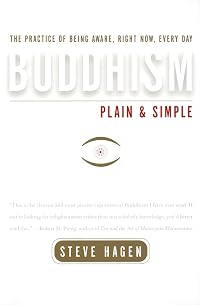
Buddhism Plain and Simple
by Steve Hagen
On This Page
Description
Buddhism Plain and Simple offers a clear, straightforward treatise on Buddhism in general and on awareness in particular. When Buddha was asked to sum up his teaching in a single world, he said, "Awareness." The Buddha taught how to see directly into the nature of experience. His observations and insights are plain, practical, and down-to-earth, and they deal exclusively with the present. Longtime teacher of Buddhism Steve Hagan presents the Buddha's uncluttered, original teachings in show more everyday, accessible language unencumbered by religious ritual, tradition, or belief. show lessTags
Recommendations





Member Reviews
A book I've carried with me for decades, a really great short introduction to buddhism principles that sheds the usual obscurantist language or appeals to traditionalism, in favour of leapfrogging the affectations of buddhist practice and making you realize those too are only stumbling blocks. The biggest strength is that the author works very hard to explain the fundamental mystery of seeing and striving, while keeping the history and complexity of actual buddhist practice and the confusingly religious reality of buddhism in the east at bay.
Best for:
Those interested in Buddhism.
In a nutshell:
Zen priest Hagen offers his take on Buddha’s observations.
Worth quoting:
“First, you must truly realize that life is fleeting. Next, you must understand that you are already complete, worthy, whole. Finally, you must see that you are your own refuge, your own sanctuary, your own salvation.”
Why I chose it:
Continuing my spiritual journey. (I’ve always assumed I’m way too sarcastic for that level of sincerity, but here we are.)
What it left me feeling:
Content
Review:
This book is both extremely straightforward and also challenging. Not because of the writing, but because of the concepts. And even that isn’t the best way for me to describe it.
Hagen breaks the book into three parts. show more In the first, he looks at what he calls ‘The Perennial Problem’, basically the human condition as most people experience it. In the second, called ‘The Way to Wake Up,’ he explores different concepts: wisdom, morality, practice, and freedom. In the final section, ‘Free Mind,’ he looks deeper into Truth and Reality.
This is the kind of book that I’m still processing, and that I’ll read again. I think that’s kind of the case with books of this type - it’s not something that one just reads and sets up on the shelf, or put in the donation bin. The way the information is presented generally worked for me - the chapters were fairly short, and there are some good examples to help solidify the ideas. But it requires a lot of thinking from me. I think that’s the point, though. Not that it requires a lot of thinking (one might even argue that goes against the main points of the book!), but that it’s got me thinking in the right direction.
Recommend to a Friend / Keep / Donate it / Toss it:
Keep show less
Those interested in Buddhism.
In a nutshell:
Zen priest Hagen offers his take on Buddha’s observations.
Worth quoting:
“First, you must truly realize that life is fleeting. Next, you must understand that you are already complete, worthy, whole. Finally, you must see that you are your own refuge, your own sanctuary, your own salvation.”
Why I chose it:
Continuing my spiritual journey. (I’ve always assumed I’m way too sarcastic for that level of sincerity, but here we are.)
What it left me feeling:
Content
Review:
This book is both extremely straightforward and also challenging. Not because of the writing, but because of the concepts. And even that isn’t the best way for me to describe it.
Hagen breaks the book into three parts. show more In the first, he looks at what he calls ‘The Perennial Problem’, basically the human condition as most people experience it. In the second, called ‘The Way to Wake Up,’ he explores different concepts: wisdom, morality, practice, and freedom. In the final section, ‘Free Mind,’ he looks deeper into Truth and Reality.
This is the kind of book that I’m still processing, and that I’ll read again. I think that’s kind of the case with books of this type - it’s not something that one just reads and sets up on the shelf, or put in the donation bin. The way the information is presented generally worked for me - the chapters were fairly short, and there are some good examples to help solidify the ideas. But it requires a lot of thinking from me. I think that’s the point, though. Not that it requires a lot of thinking (one might even argue that goes against the main points of the book!), but that it’s got me thinking in the right direction.
Recommend to a Friend / Keep / Donate it / Toss it:
Keep show less
Without a doubt one of the best books on the topic. Steve Hagen, an ordained Buddhist priest, and author of several others books boils down the essence of Buddha's teachings in a way all can understand. Pointing out that the teachings of Buddha are NOT an 'ism' like other spiritual practices since it lacks rules, guides and constriction. He points out repeatedly that Buddha taught 'being awake' and 'seeing' with respect to the ever changing 'stream' we call life. It's not about identifying with a practice but instead being aware of the stream in every moment. Highly recommended.
I am not a believer in any God, Goddess or Deity of any kind. But I heard a description of Buddhism as simply a philosophy of how to live your life, so when I watched a few YouTube videos of the four noble truths and the eightfold path I was very interested in learning more. I picked up this book on one of the videos recommendations and could not have been more disappointed. The book felt very negative to me with the authors viewpoint that most of humans dukkha comes from a constant fear and terror of death. I found many times in the book to be in complete disagreement with the author. I think Buddhism has many offshoots and variations so maybe this book was just not the right one for me. After taking a look at others library's who show more rated this book low I noticed that they have given other Buddhism books a four and five star rating. show less
As I read this book on the beach, a woman asked me if it was good. "Is it understandable?" she asked. I told her that yes, it was - it was the best book I'd read on the subject so far.
The closer I got to the end of the book, though, the harder I had to work at understanding - and the harder you try to understand, the further you are from Seeing. So I am not yet enlightened.
I do recommend this book for anyone interested in Zen Buddhism. The subject may be plain and simple, but human nature makes it slippery.
The closer I got to the end of the book, though, the harder I had to work at understanding - and the harder you try to understand, the further you are from Seeing. So I am not yet enlightened.
I do recommend this book for anyone interested in Zen Buddhism. The subject may be plain and simple, but human nature makes it slippery.
From 43 Folders
A wonderful reader gifted me with a much-desired item from my AMZN wishlist — a terrific little book called Buddhism Plain and Simple. In the 20 years I’ve flirted with learning more about Buddhist practice, this book has brought the clearest and most practical presentation I’ve come across. Re-framing Buddhism not as a religion but as a way of seeing has really flipped a switch in my head. Great little book that I can highly recommend (and many thanks to my kind giftor for bringing it to me).
A wonderful reader gifted me with a much-desired item from my AMZN wishlist — a terrific little book called Buddhism Plain and Simple. In the 20 years I’ve flirted with learning more about Buddhist practice, this book has brought the clearest and most practical presentation I’ve come across. Re-framing Buddhism not as a religion but as a way of seeing has really flipped a switch in my head. Great little book that I can highly recommend (and many thanks to my kind giftor for bringing it to me).
A wonderful starter book for anyone interested in buddhism. Hagen does his best at explaining that which cannot be explained and succeeds sufficiently to get the curious beginner on the right path without scaring them away with romantic mysticism.
Members
- Recently Added By
Lists

Books Read in 2019
4,052 works; 108 members
Author Information

11+ Works 2,121 Members
Steve Hagen, Roshi, has been a student and practitioner of Zen since 1967. For fifteen years he studied with Dainin Katagiri, Roshi, from whom he received Dharma Transmission (endorsement to teach) in 1989. He is the founder of the Dharma Field Zen Center in Minneapolis, Minnesota, and the author of such works as Buddhism Is Not What You Think show more (2004), Meditation Now or Never (2007) and Why the World Doesn't Seem to Make Sense (2012). show less
Common Knowledge
- Canonical title*
- Boeddhisme in alle eenvoud
- Original title
- Buddhism plain and simple
- Original publication date
- 1997; 1999 (Nederlandse vertaling) (Nederlandse vertaling)
- Dedication
- With gratitude I dedicate this book to all beings.
- First words
- As the new millennium dawns, most of us have lost faith in our ancient storybook versions of the world.
- Last words
- (Click to show. Warning: May contain spoilers.)Whether you awaken or not is completely up to you.
- Original language*
- Engels
*Some information comes from Common Knowledge in other languages. Click "Edit" for more information.
Classifications
Statistics
- Members
- 1,486
- Popularity
- 15,727
- Reviews
- 15
- Rating
- (3.92)
- Languages
- Dutch, English, German, Portuguese
- Media
- Paper, Audiobook, Ebook
- ISBNs
- 16
- UPCs
- 1
- ASINs
- 10