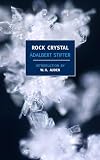
Rock Crystal
by Adalbert Stifter
On This Page
Description
Seemingly the simplest of stories—a passing anecdote of village life— Rock Crystal opens up into a tale of almost unendurable suspense. This jewel-like novella by the writer that Thomas Mann praised as "one of the most extraordinary, the most enigmatic, the most secretly daring and the most strangely gripping narrators in world literature" is among the most unusual, moving, and memorable of Christmas stories. Two children—Conrad and his little sister, Sanna—set out from their village show more high up in the Alps to visit their grandparents in the neighboring valley. It is the day before Christmas but the weather is mild, though of course night falls early in December and the children are warned not to linger. The grandparents welcome the children with presents and pack them off with kisses. Then snow begins to fall, ever more thickly and steadily. Undaunted, the children press on, only to take a wrong turn. The snow rises higher and higher, time passes: it is deep night when the sky clears and Conrad and Sanna discover themselves out on a glacier, terrifying and beautiful, the heart of the void. Adalbert Stifter's rapt and enigmatic tale, beautifully translated by Elizabeth Mayer and Marianne Moore, explores what can be found between Christmas Eve and Christmas Day—or on any night of the year. show lessTags
Recommendations


















Member Recommendations
by anonymous user
Member Reviews
A curious little book I couldn't put down. Written in the 19thC. Set in the mountains of southern Germany, Stifter writes in long, clear, dense, descriptive sentences. The landscape is everything - forming individuals as much as groups. Two villages a 3 hour walk away are as different as a neighbouring nation. And it takes a generation or more to be accepted. You may not be accepted if you move for marriage from one town to the next.
A cobbler marries the daughter of the next village. Her family are very rich. The cobbler had to prove himself. He did. You have to be tough in this world. the neighbourhood is as tough as the mountains.
It's all descriptive prose:
Ascent of the mountain is made from the valley. One follows in the southerly show more direction a smooth, well made road that leads by a neck or "col" into another valley. A col is a mountain range of moderate height, connecting two larger, more considerable, ranges; and following it, one passes between the ranges from one valley to another.
I hadn't known what a col was. For about ten years, I watched the Tour de France and heard the word as I watched cyclists ascend and descend "The Col XXXX".
And note Stifters's use of semi-colon that makes the rhythm of the sentence. It feels old fashioned but it's very readable.
The cobbler's children, brother and a sister, visit their grandmother in the next visit for a Christmas Eve lunch.
The ground then rises sharply and the ascent is long; one climbs in a worn groove or trench, which has the advantage of preventing one from losing the way over the vast sameness of heath.
They are warned to leave early. Grandma packs them some treats and presents in plenty of time for them to return before nightfall, issuing the same warnings their parents as the parents earlier in the day. The return however goes off course. What we get is a description of weather and landscape change in such detail and drama, it's a kind of cinematic experience in words.
The children's journey is tough, frightening, character and legend forming. They face more than they had known in their brief lives:
As far as the eye could reach there was only ice. Pointed masses and irregular clumps thrusting up from the fearsome snow encrusted ice. Instead of a barricade that could be surmounted, with snow beyond, as they had expected, yet other walls of ice rose from the buttress, cracked and fissured, with innumerable meandering blue veins, and beyond these walls, others like them and beyond, others, until the falling snow blurred the distance in its veil of grey.
Whew! What a read! show less
A cobbler marries the daughter of the next village. Her family are very rich. The cobbler had to prove himself. He did. You have to be tough in this world. the neighbourhood is as tough as the mountains.
It's all descriptive prose:
Ascent of the mountain is made from the valley. One follows in the southerly show more direction a smooth, well made road that leads by a neck or "col" into another valley. A col is a mountain range of moderate height, connecting two larger, more considerable, ranges; and following it, one passes between the ranges from one valley to another.
I hadn't known what a col was. For about ten years, I watched the Tour de France and heard the word as I watched cyclists ascend and descend "The Col XXXX".
And note Stifters's use of semi-colon that makes the rhythm of the sentence. It feels old fashioned but it's very readable.
The cobbler's children, brother and a sister, visit their grandmother in the next visit for a Christmas Eve lunch.
The ground then rises sharply and the ascent is long; one climbs in a worn groove or trench, which has the advantage of preventing one from losing the way over the vast sameness of heath.
They are warned to leave early. Grandma packs them some treats and presents in plenty of time for them to return before nightfall, issuing the same warnings their parents as the parents earlier in the day. The return however goes off course. What we get is a description of weather and landscape change in such detail and drama, it's a kind of cinematic experience in words.
The children's journey is tough, frightening, character and legend forming. They face more than they had known in their brief lives:
As far as the eye could reach there was only ice. Pointed masses and irregular clumps thrusting up from the fearsome snow encrusted ice. Instead of a barricade that could be surmounted, with snow beyond, as they had expected, yet other walls of ice rose from the buttress, cracked and fissured, with innumerable meandering blue veins, and beyond these walls, others like them and beyond, others, until the falling snow blurred the distance in its veil of grey.
Whew! What a read! show less
I enjoyed it despite the disconnect between Hannah Arendt's blurb on the back cover... "Stifter can be compared to no other writer of the nineteenth century in pure happiness, wisdom, and beauty"... and this from W.H. Auden's adapted NYT review from 1945 that serves as the introduction: "in 1868, ill and discouraged by the public indifference to his two big novels, Nachsommer and Witiko, he cut his own throat."
The novella is delicious in its description of the two valleys high up in the Alps, connected by mountainous col, in which the action takes place, and of the extremely tight-knit and resistant to outsiders attitude of the villagers of Gschaid. Arendt's description of Stifter as the greatest landscape-painter in literature in his show more time makes sense. A strong picture is conveyed of the village and the route through the forest and mountains the children in the tale will soon take to their grandparent's home the next valley over, which is something like a 3 hour walk. Why are two small children walking alone for 3 hours through the high Alps? Different time and place, that!
The children, Conrad and Sanna, frequently walk from Gschaid to their mother's parents in Millsdorf. Because of this they, like their mother, are not fully accepted as part of Gschaid, showing how extremely insular these people are. It is Christmas Eve, or Holy Eve in this culture, when the story takes place. Unaware of the portents of bad weather (a stream trickling a clear bright blue means much colder weather coming down, which has frozen the ground upstream preventing sediment from falling into the water as it flows... good tip!) they visit their grandparents, have lunch, and set off back home.
On their way back a ferocious blizzard descends, and the children lose their way. They stray high off into the mountain's glacier field and its stark and treacherous terrain. Completely lost, they survive the night and are found the next day by search parties from Gschaid.
The story ends as a parable: having barely avoided tragedy this Holy Eve and Christmas Day, the villagers now fully accept the children and their mother; they are henceforth no longer treated as outsiders. As upright and industrious as these people may have been, they surely could have used a lesson in loving one's neighbors.
To quote Auden again, "To bring off, as Stifter does, a story of this kind, with its breathtaking risks of appalling banalities, is a great feat. What might so easily have been a tear-jerking melodrama becomes in his hands a quiet and beautiful parable about the relation of people to places, of man to nature." show less
The novella is delicious in its description of the two valleys high up in the Alps, connected by mountainous col, in which the action takes place, and of the extremely tight-knit and resistant to outsiders attitude of the villagers of Gschaid. Arendt's description of Stifter as the greatest landscape-painter in literature in his show more time makes sense. A strong picture is conveyed of the village and the route through the forest and mountains the children in the tale will soon take to their grandparent's home the next valley over, which is something like a 3 hour walk. Why are two small children walking alone for 3 hours through the high Alps? Different time and place, that!
The children, Conrad and Sanna, frequently walk from Gschaid to their mother's parents in Millsdorf. Because of this they, like their mother, are not fully accepted as part of Gschaid, showing how extremely insular these people are. It is Christmas Eve, or Holy Eve in this culture, when the story takes place. Unaware of the portents of bad weather (a stream trickling a clear bright blue means much colder weather coming down, which has frozen the ground upstream preventing sediment from falling into the water as it flows... good tip!) they visit their grandparents, have lunch, and set off back home.
On their way back a ferocious blizzard descends, and the children lose their way. They stray high off into the mountain's glacier field and its stark and treacherous terrain. Completely lost, they survive the night and are found the next day by search parties from Gschaid.
The story ends as a parable: having barely avoided tragedy this Holy Eve and Christmas Day, the villagers now fully accept the children and their mother; they are henceforth no longer treated as outsiders. As upright and industrious as these people may have been, they surely could have used a lesson in loving one's neighbors.
To quote Auden again, "To bring off, as Stifter does, a story of this kind, with its breathtaking risks of appalling banalities, is a great feat. What might so easily have been a tear-jerking melodrama becomes in his hands a quiet and beautiful parable about the relation of people to places, of man to nature." show less
Adalbert Stifter's Rock Crystal is a simple story almost a parable or a fairytale except that he spends so much time detailing the life and culture of the mountains.
Stifter saves the story through is appreciation of the combined beauty and danger of nature (as expressed in the snow storm and the mountain pass). The moutain and the storm almost become characters in the story.
I was also intrigued by the tension between the Catholicism of the villagers and a sense of the divine being dwarfed by nature and nature itself as the threat against human existence which seems more akin to the sense of nature in early Nordic sagas.
I don't want to read too much into it since is is essentially a simple tale, but I liked it more than I anticipated. show more My only complaint is that one should wait to read the introduction by Auden until after reading the story since he gives the plot of the story almost immediately and it ruined the sense of discovery I might have otherwise felt about the story. show less
Stifter saves the story through is appreciation of the combined beauty and danger of nature (as expressed in the snow storm and the mountain pass). The moutain and the storm almost become characters in the story.
I was also intrigued by the tension between the Catholicism of the villagers and a sense of the divine being dwarfed by nature and nature itself as the threat against human existence which seems more akin to the sense of nature in early Nordic sagas.
I don't want to read too much into it since is is essentially a simple tale, but I liked it more than I anticipated. show more My only complaint is that one should wait to read the introduction by Auden until after reading the story since he gives the plot of the story almost immediately and it ruined the sense of discovery I might have otherwise felt about the story. show less
This unassuming novella strikes a deep chord. One never does know precisely what two children lost in an alpine snowstorm encounter, but the beauty of the telling of their tale is striking; the vision lingers.
The unreckonable mountain is as much a focus of the story as are the characters—it is actually by far the most delineated, the most detailed sketch. The power of this simple story lies perhaps in its lingering descent from the mountain peaks into two small towns in neighboring valleys, and only then into the lives of some of their inhabitants—a godlike view, if you will, that serves to hold the fate of two small and unformed beings against the weight and longevity of a glacial age, somehow for a moment balancing the two.
I'll show more echo others in this: you'll be glad if you skip Auden's rather perfunctory introduction or go back to it only after you've read the story. show less
The unreckonable mountain is as much a focus of the story as are the characters—it is actually by far the most delineated, the most detailed sketch. The power of this simple story lies perhaps in its lingering descent from the mountain peaks into two small towns in neighboring valleys, and only then into the lives of some of their inhabitants—a godlike view, if you will, that serves to hold the fate of two small and unformed beings against the weight and longevity of a glacial age, somehow for a moment balancing the two.
I'll show more echo others in this: you'll be glad if you skip Auden's rather perfunctory introduction or go back to it only after you've read the story. show less
Beautifully translated, perfectly formed novella. Stifter is the "landscape painter" of German realist novelists, and this little novel begins with a liesurely tour of a mountain range, so that as readers we know our way around. Then two little children get lost in the mountains. It's not meant to be melodramatic: it's the opposite: a potentially maudlin story told with absolute calm and with fastidious and accurate attention to the Alpine landscape. Beautiful and serene.
W.H. Auden makes all these points in his intentionally simple introduction. Stifter means to make a Christian parable, but it is not a parable of redemption. It is about harmony: harmony of people with themselves, with eachother, with the landscape. People and mountains show more are largely silent. A person's regard of another shows how much they understand of that other: the boy of his devoted sister, both the boy and the girl of the mountain.
The pace and the purpose of the story couldn't be farther from the frenetic & hysterical inventions of our current novelists (thinking of McCarthy, Galchen, Baker, et al.).
it is a wonderful tonic. I would read it as a tonic, a reminder of the fact that the frantic need to invent clevernesses in every line, which has come to seem like nothing other than good writing, is a form of obliviousness to other meanings. show less
W.H. Auden makes all these points in his intentionally simple introduction. Stifter means to make a Christian parable, but it is not a parable of redemption. It is about harmony: harmony of people with themselves, with eachother, with the landscape. People and mountains show more are largely silent. A person's regard of another shows how much they understand of that other: the boy of his devoted sister, both the boy and the girl of the mountain.
The pace and the purpose of the story couldn't be farther from the frenetic & hysterical inventions of our current novelists (thinking of McCarthy, Galchen, Baker, et al.).
it is a wonderful tonic. I would read it as a tonic, a reminder of the fact that the frantic need to invent clevernesses in every line, which has come to seem like nothing other than good writing, is a form of obliviousness to other meanings. show less
Rock Crystal tells a simple story: two children, crossing a mountain range, become lost in the snow and are forced to spend a harrowing evening stranded on a glacier.
The prose, beautifully translated by Elizabeth Mayer and Marianne Moore, is a marvel of compression and economy. Not a single word seems either out of place or extraneous. The structure of the story--best described, perhaps, as a novella--is as precise as a geometric pattern.
As for deeper meaning, it is difficult to fully assess the totality of the work without giving away the ending (a sin blithely committed by W.H. Auden in his thoroughly mediocre introduction--DO NOT READ IT UNTIL YOU HAVE FINISHED THE BOOK!). Suffice it to say, it is a Christmas story as well as a show more fable. And, it is a story about the nature of community--the process by which outsiders become part of the whole. As is quickly evident from the many literati who have lavishly praised this book, there is a great deal moving under the surface of this relatively linear narrative.
Above all, this is a remarkably written book that has the power to move you. A wonderful Christmas read. show less
The prose, beautifully translated by Elizabeth Mayer and Marianne Moore, is a marvel of compression and economy. Not a single word seems either out of place or extraneous. The structure of the story--best described, perhaps, as a novella--is as precise as a geometric pattern.
As for deeper meaning, it is difficult to fully assess the totality of the work without giving away the ending (a sin blithely committed by W.H. Auden in his thoroughly mediocre introduction--DO NOT READ IT UNTIL YOU HAVE FINISHED THE BOOK!). Suffice it to say, it is a Christmas story as well as a show more fable. And, it is a story about the nature of community--the process by which outsiders become part of the whole. As is quickly evident from the many literati who have lavishly praised this book, there is a great deal moving under the surface of this relatively linear narrative.
Above all, this is a remarkably written book that has the power to move you. A wonderful Christmas read. show less
A Perilous Christmas
A review of the NYRB Classics eBook (December 15, 2015) as translated by [author:Marianne Moore|82947] & [author:Elizabeth Wolff Mayer|53708701] with an Introduction by [author:W.H. Auden|233593] as first published by Pantheon Books (1945) from the original German language [book:Bergkristall - Der Heilige Abend|59969385] [Rock Crystal: The Holy Night aka Christmas Eve] (1845) later collected as story #4 in [book:Bunte steine: ein Festgeschenk|9618240] [Motley Stones: A Celebratory Gift] (1853).
This is a fairy-tale like story of two children trapped by a sudden snow storm as they travel home through a mountain pass in the Swiss Alps from their grandparents village to that of their parents. The two families and two show more villages are estranged from each other despite the inter-village marriage by the parents of the children. The search for the missing children brings them all together.
See illustration at https://upload.wikimedia.org/wikipedia/commons/thumb/e/e5/Bunte_Steine_1853_-_Fr...
Image the 1853 edition sourced from Wikipedia by Ludwig Richter - This image has been extracted from another file, Public Domain, Link
This is heavily dated by its insistence on Christian imagery and symbolism, but the heart of the story about siblings trusting and supporting each other and the reconciliation of family is a timeless topic regardless. I read quite a few duds in my Christmas themed reading this year, so this was redemptive and a good note on which to end my reading and reviewing year for 2025.
All best wishes to GR friends and follows for the end of the year and the new year to come!
Trivia and Links
Rock Crystal has been adapted for films several times. A complete list of adaptations is listed here. One of the most recent adaptations is the 2004 German language movie Bergkristall and you can see a trailer for it here.
The original German language text and an earlier 1914 translation by [author:Lee M. Hollander|67395] are in the Public Domain. You can read the original German at Zeno.org and the Hollander translation at Project Gutenberg. An audiobook narration of the Hollander translation is available at Librivox. show less
A review of the NYRB Classics eBook (December 15, 2015) as translated by [author:Marianne Moore|82947] & [author:Elizabeth Wolff Mayer|53708701] with an Introduction by [author:W.H. Auden|233593] as first published by Pantheon Books (1945) from the original German language [book:Bergkristall - Der Heilige Abend|59969385] [Rock Crystal: The Holy Night aka Christmas Eve] (1845) later collected as story #4 in [book:Bunte steine: ein Festgeschenk|9618240] [Motley Stones: A Celebratory Gift] (1853).
This is a fairy-tale like story of two children trapped by a sudden snow storm as they travel home through a mountain pass in the Swiss Alps from their grandparents village to that of their parents. The two families and two show more villages are estranged from each other despite the inter-village marriage by the parents of the children. The search for the missing children brings them all together.
See illustration at https://upload.wikimedia.org/wikipedia/commons/thumb/e/e5/Bunte_Steine_1853_-_Fr...
Image the 1853 edition sourced from Wikipedia by Ludwig Richter - This image has been extracted from another file, Public Domain, Link
This is heavily dated by its insistence on Christian imagery and symbolism, but the heart of the story about siblings trusting and supporting each other and the reconciliation of family is a timeless topic regardless. I read quite a few duds in my Christmas themed reading this year, so this was redemptive and a good note on which to end my reading and reviewing year for 2025.
All best wishes to GR friends and follows for the end of the year and the new year to come!
Trivia and Links
Rock Crystal has been adapted for films several times. A complete list of adaptations is listed here. One of the most recent adaptations is the 2004 German language movie Bergkristall and you can see a trailer for it here.
The original German language text and an earlier 1914 translation by [author:Lee M. Hollander|67395] are in the Public Domain. You can read the original German at Zeno.org and the Hollander translation at Project Gutenberg. An audiobook narration of the Hollander translation is available at Librivox. show less
Members
- Recently Added By
Lists

Favourite 19th century fiction
257 works; 62 members

Winter Books
127 works; 17 members

19th Century
190 works; 16 members

German Literature
514 works; 49 members

Short and Sweet
243 works; 23 members

Reading Globally
136 works; 16 members

Global Reads: Books Set in Western Europe
186 works; 10 members
Author Information

Some Editions
Awards and Honors
Awards
Series
Belongs to Publisher Series
Work Relationships
Is contained in
Is retold in
Has as a student's study guide
Common Knowledge
- Canonical title
- Rock Crystal
- Original title
- Bergkristall
- Original publication date
- 1845; 1945 (English: Auden) (English: Auden)
- First words
- The church observes various festivals that are ever dear to the heart. What more gracious than Whitsuntide: more sacred or of deeper significance than Easter. The portentous sadness of Holy Week and the exaltation of the Sund... (show all)ay following, accompany us throughout life.
Unsere Kirche feiert verschiedene Feste, welche zum Herzen dringen. - Last words
- (Click to show. Warning: May contain spoilers.)The children, however, can never forget the mountain, and earnestly fix their gaze upon it when in the garden, when as in times past the sun is out bright and warm, and linden diffuses its fragrance, the bees are humming, and the mountain looks down upon them as serene and blue as the sky above.
(Click to show. Warning: May contain spoilers.)Die Kinder aber werden den Berg nicht vergessen, und werden ihn jetzt noch ernster betrachten, wenn sie in dem Garten sind, wenn wie in der Vergangenheit die Sonne sehr schön scheint, der Lindenbaum duftet, die Bienen summen, und er so schön und so blau wie das sanfte Firmament auf sie hernieder schaut. - Original language*
- Duits
*Some information comes from Common Knowledge in other languages. Click "Edit" for more information.
Classifications
- Genres
- Fiction and Literature, General Fiction
- DDC/MDS
- 833.7 — Literature & rhetoric German & related literatures German fiction 1832-1856 : 19th century
- LCC
- PT2525 .B4 .E5 — Language and Literature German, Dutch and Scandinavian literatures German literature Individual authors or works 1700-ca. 1860/70
- BISAC
Statistics
- Members
- 573
- Popularity
- 51,129
- Reviews
- 21
- Rating
- (3.68)
- Languages
- 6 — Czech, Dutch, English, French, German, Italian
- Media
- Paper, Audiobook, Ebook
- ISBNs
- 54
- ASINs
- 24