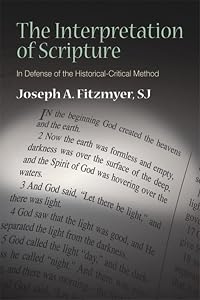
The Interpretation of Scripture: In Defense of the Historical-Critical Method
by Joseph A. Fitzmyer
On This Page
Description
This book seeks to establish the properly oriented use of the historical-critical method as the mode of ascertaining the sense of the written Word of God.Tags
Recommendations











Member Reviews
Jesuit Fitzmyer has written a short apology for the historical-critical method of reading Scripture in Catholicism. This is little surprise: Fitzmyer and his close friend Raymond Brown were the two giants of the first generation of Catholic historical-critical Biblical scholars following the 1943 encyclical allowing this method. Though using historical-critical methodology is far from controversial in the Church now, there are some traditionalists who question its use and fear its past associations.
Historical-critical methodology developed in nineteenth-century Germany out of historical tools sharpened by the Enlightenment. These include a new attention to questions of authorship, authorical context, style, and other questions show more associated with form, source, redaction, and textual criticism. These methods were aided by the advent of Biblical archaeology and the decoding of ancient Near Eastern languages, allowing us to read cognate texts and genres from cultures surrounding ancient Israel. While being a genuinely new event, these methods had precedents in Church Fathers' use of classical philology and Origen's proto-textual criticism. It would have been impossible without the Reformation "return to the sources": studying Biblical languages and casting off highly speculative allegorical readings favored in some medieval circles.
Unortunately, the Church was at first highly opposed to these new methods. Its cultured despisers used them to attack Christianity, such as the various quests for the historical Jesus done in the nineteenth century. Later, Bultmann used them as part of his demythologization of the Gospels, promoting his own kerygmatic theology detached from any historical Jesus. Yet Pope Pius VII saw the need to open the Church to these new methods, and in 1943 his encyclical Divino Afflante Spiritu he did. Vatican II's Dei Verbum upheld this new shift, as did the Pontifical Biblical Commission in its 1964 "Instruction on the Historicity of the Gospels" (which I reviewed above).
What is the significance of the historical-critical method? Fitzmyer's strongest argument for it is that in order for Revelation and its meaning to be preserved, scholars must constantly seek to understand what Revelation meant in its original context. This does not deny later re-readings of scripture or creatively imagining how it can be read to inform the current situation of the Church and the World. But these later interpretations must always begin with the literal sense: "the sense which the human author directly intended and which the written words conveyed." This literal sense is not a new invention, but was described by medieval exegetes and the PBC's 1993 document "The Interpretation of the Bible in the Church": the literl sense, the spiritual (Christological sense), the fuller sense of how ongoing tradition has made sense of a text.
To Catholics who feel that we should return wholly to how the Church Fathers and the Magisterium read scripture, Fitzmyer responds that this is hardly a unanimous tradition. As my next review will explore, the Fathers hotly debated between literal/historical and allegorical readings of scripture. The Magisterium has rarely defined the meaning of a particular verse or book. And while historical-critical scholarship can demolish the assumed Biblical bases for some doctrines, the Catholic belief that the Holy Spirit guides our tradition prevents us from having to take hard lines on historical debates to save key doctrines. And of course, historical-critical Catholic exegetes still do their work in the context of the tradition and the Magisterium, though debates about which one takes preference still continue.
Fiztmyer's short, useful book is marred in one respect: it's somewhat repetitive and discontinuous. It is not so much a book as a collection of various articles Fitzmyer published, strung together to be more coherent. Still, it's a useful guide to how Catholic Biblical scholars read scripture and how one major exegete views his vocation and its meaning. show less
Historical-critical methodology developed in nineteenth-century Germany out of historical tools sharpened by the Enlightenment. These include a new attention to questions of authorship, authorical context, style, and other questions show more associated with form, source, redaction, and textual criticism. These methods were aided by the advent of Biblical archaeology and the decoding of ancient Near Eastern languages, allowing us to read cognate texts and genres from cultures surrounding ancient Israel. While being a genuinely new event, these methods had precedents in Church Fathers' use of classical philology and Origen's proto-textual criticism. It would have been impossible without the Reformation "return to the sources": studying Biblical languages and casting off highly speculative allegorical readings favored in some medieval circles.
Unortunately, the Church was at first highly opposed to these new methods. Its cultured despisers used them to attack Christianity, such as the various quests for the historical Jesus done in the nineteenth century. Later, Bultmann used them as part of his demythologization of the Gospels, promoting his own kerygmatic theology detached from any historical Jesus. Yet Pope Pius VII saw the need to open the Church to these new methods, and in 1943 his encyclical Divino Afflante Spiritu he did. Vatican II's Dei Verbum upheld this new shift, as did the Pontifical Biblical Commission in its 1964 "Instruction on the Historicity of the Gospels" (which I reviewed above).
What is the significance of the historical-critical method? Fitzmyer's strongest argument for it is that in order for Revelation and its meaning to be preserved, scholars must constantly seek to understand what Revelation meant in its original context. This does not deny later re-readings of scripture or creatively imagining how it can be read to inform the current situation of the Church and the World. But these later interpretations must always begin with the literal sense: "the sense which the human author directly intended and which the written words conveyed." This literal sense is not a new invention, but was described by medieval exegetes and the PBC's 1993 document "The Interpretation of the Bible in the Church": the literl sense, the spiritual (Christological sense), the fuller sense of how ongoing tradition has made sense of a text.
To Catholics who feel that we should return wholly to how the Church Fathers and the Magisterium read scripture, Fitzmyer responds that this is hardly a unanimous tradition. As my next review will explore, the Fathers hotly debated between literal/historical and allegorical readings of scripture. The Magisterium has rarely defined the meaning of a particular verse or book. And while historical-critical scholarship can demolish the assumed Biblical bases for some doctrines, the Catholic belief that the Holy Spirit guides our tradition prevents us from having to take hard lines on historical debates to save key doctrines. And of course, historical-critical Catholic exegetes still do their work in the context of the tradition and the Magisterium, though debates about which one takes preference still continue.
Fiztmyer's short, useful book is marred in one respect: it's somewhat repetitive and discontinuous. It is not so much a book as a collection of various articles Fitzmyer published, strung together to be more coherent. Still, it's a useful guide to how Catholic Biblical scholars read scripture and how one major exegete views his vocation and its meaning. show less
Wonderful explanation and endorsement of the historical-critical method.
It goes over the need to evaluate the text according to historical, and literary critical standards.
It goes over the need to evaluate the text according to historical, and literary critical standards.
A collection of essays on the method of biblical interpretation.
Ratings
Members
- Recently Added By
Published Reviews
added by Christa_Josh
Author Information

76+ Works 5,142 Members
Joseph A. Fitzmyer is Professor Emeritus of Biblical Studies at the Catholic University of America.
Classifications
- Genres
- Religion & Spirituality, Nonfiction, General Nonfiction
- DDC/MDS
- 220.601 — Religion The Bible The Bible Interpretation and criticism (Exegesis) Philosophy and theory; Hermeneutics
- LCC
- BS531 .F58 — Philosophy, Psychology and Religion The Bible The Bible Works about the Bible Criticism and interpretation
- BISAC
Statistics
- Members
- 59
- Popularity
- 523,585
- Reviews
- 3
- Rating
- (4.00)
- Languages
- English
- Media
- Paper, Ebook
- ISBNs
- 2