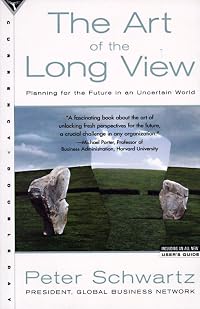
The Art of the Long View: Planning for the Future in an Uncertain World
by Peter Schwartz
On This Page
Description
What increasingly affects all of us, whether professional planners or individuals preparing for a better future, is not the tangibles of life--bottom-line numbers, for instance--but the intangibles: our hopes and fears, our beliefs and dreams. Only stories--scenarios--and our ability to visualize different kinds of futures adequately capture these intangibles. In The Art of the Long View, now for the first time in paperback and with the addition of an all-new User's Guide, Peter Schwartz show more outlines the "scenaric" approach, giving you the tools for developing a strategic vision within your business. Schwartz describes the new techniques, originally developed within Royal/Dutch Shell, based on many of his firsthand scenario exercises with the world's leading institutions and companies, including the White House, EPA, BellSouth, PG&E, and the International Stock Exchange. show lessTags
Recommendations


Member Reviews
I've been calling myself a futurist for the past five years, and for five years, I've been lying. But no longer, because I've read this book, which is every bit as a thought-provoking as Science Fiction for Prototyping proved disappointing. Peter Schwartz is one of the founders of the Global Business Network consulting firm, and honed his skills designing scenarios for Shell Oil in the 1980s. In The Art of the Long View, he makes a strong case for the utility of scenario planning, explains how to develop a proper futurist mindset, and how to create your own scenarios.
Scenario planning is not predicting the future. Rather, it is about challenging the official future, and the assumptions that underlie it. Scenarios force you to examine show more your unspoken beliefs and values, the evidence supporting them, and how you might react in the future. An organization that includes scenario planning in its process is better able to react to rapidly changing conditions, and less likely to be rendered slowly obsolete through technological change.
Scenario planning is inherently interdisciplinary. A scenario plan has to include technological, economic, cultural, and political factors, as well as individual psychology. Broad areas of knowledge rather than deep and narrow research is better suited at picking up on trends. The ideas and forces that most powerfully influence the future originate on the margins of society, among the dispossessed, the utopian, or the just plain weird. Finally, Schwartz includes a detailed, 8 stage guide to using scenarios in your own organization, with a good balance of theories and examples. Perhaps the ultimate success of scenario planning is that it creates a shared language to talk about the future.
Scenario planning might not be about predicting the future, but a futurist who makes no predictions isn't very useful. The book was published in 1991, and some parts feel oddly anachronistic, like the Japanophilia, the groping towards a 'digital global teenager', and the absence of the War on Terror. On the other hand, he offers three scenarios for the world in 2005: New Empires focused on regional militarism, Market World with multicultural entrepreneurialism, and Change Without Progress, where the wealthy hollow out states, and fear of losing what little remains prevents successful action. Change Without Progress is strikingly similar to the world today, with our 1%ers and 99%ers, paralyzed multinational bodies, and collapsing infrastructure.
Scenario planning is not a strict methodology that automatically produces valid results, it's an attitude towards the future that is based on broad understandings of historical forces and skepticism about the status quo. The results will vary on the quality of the questions you can ask, the data available, and the conversation you foster. But as far as crystal balls go, scenario planning is one of the best. show less
Scenario planning is not predicting the future. Rather, it is about challenging the official future, and the assumptions that underlie it. Scenarios force you to examine show more your unspoken beliefs and values, the evidence supporting them, and how you might react in the future. An organization that includes scenario planning in its process is better able to react to rapidly changing conditions, and less likely to be rendered slowly obsolete through technological change.
Scenario planning is inherently interdisciplinary. A scenario plan has to include technological, economic, cultural, and political factors, as well as individual psychology. Broad areas of knowledge rather than deep and narrow research is better suited at picking up on trends. The ideas and forces that most powerfully influence the future originate on the margins of society, among the dispossessed, the utopian, or the just plain weird. Finally, Schwartz includes a detailed, 8 stage guide to using scenarios in your own organization, with a good balance of theories and examples. Perhaps the ultimate success of scenario planning is that it creates a shared language to talk about the future.
Scenario planning might not be about predicting the future, but a futurist who makes no predictions isn't very useful. The book was published in 1991, and some parts feel oddly anachronistic, like the Japanophilia, the groping towards a 'digital global teenager', and the absence of the War on Terror. On the other hand, he offers three scenarios for the world in 2005: New Empires focused on regional militarism, Market World with multicultural entrepreneurialism, and Change Without Progress, where the wealthy hollow out states, and fear of losing what little remains prevents successful action. Change Without Progress is strikingly similar to the world today, with our 1%ers and 99%ers, paralyzed multinational bodies, and collapsing infrastructure.
Scenario planning is not a strict methodology that automatically produces valid results, it's an attitude towards the future that is based on broad understandings of historical forces and skepticism about the status quo. The results will vary on the quality of the questions you can ask, the data available, and the conversation you foster. But as far as crystal balls go, scenario planning is one of the best. show less
I’ve based this review just based on the Blinkist summary of the book. A summary inevitably misses much but I’ve found the Blinkist summaries to be remarkably good at distilling the essence of the book. And if I find it sufficiently stimulating, I’ll purchase and read the full version. In the meantime, Here are a few extracts from the summary that seemed to capture the main messages of the book:
People want a combination of financial success and happiness.....This tells us that financial success is important, but ideally, this money won’t come at the expense of happiness or a healthy work-life balance.
The answer to this [equation of balance] lies in taking all the aspects of your life into consideration and emerging with a path show more that allows you to be successful without sacrificing important things like family, friends and health.
iI you are serious about securing a fulfilling career, you’ll eventually need to look at things from a long-term perspective.......There’s a saying that your career should be thought of as a marathon, not a sprint. It’s likely that 85 to 90 percent of your personal wealth will likely be accumulated after your fortieth birthday. [Basically the law of compound interest at play].
Until then, it’s best to take your time and figure out what you really like doing and how you can become an expert in your field. This way, you won’t be stuck doing something you hate for the next 45 years.
The three pillars are:
• transferable skills,
• meaningful experiences and
• enduring relationships.
Picture being 40 years old, losing your job and being forced to start all over again on your own.......You should spend your twenties and thirties gaining skills....Now, the best ones to have are transferable skills, which can be applied to a variety of different jobs. You can get these by picking up academic degrees, foreign languages and computer skills, as well as more personal characteristics like communication skills and emotional intelligence.
Having strong and persuasive communication skills is an excellent trait for any job. You should also be working in different environments in order to build meaningful experiences.
People who spend their career in one environment probably know how to do one thing efficiently but get overwhelmed when confronted with something out of the ordinary.
So take chances and move from a corporate environment into an entrepreneurial one that might provide the opportunity to launch a new brand from the ground up. Or perhaps work abroad for a while. Either way, don’t be afraid to fail, as failure also comes with important lessons.
The best relationships you can form all fall into one of four levels:
1. The first level is your basic contacts,......These might not be the strongest connections, but they’re useful for sharing a message
2. The second level contains the experts, who are people that carry specific knowledge and have access to certain information that could one day be the solution to a major problem.
3. At the third level are the critical colleagues, which include your boss and other people who have the most impact on your career success.
4. Finally, the fourth level contains the champions, such as your mentors and the small number of people who are there to offer support and advice.
Now that you have them in order, it’s good to regularly check in and identify your key contacts. And it’s always good to spend the most time with those who make you feel intelligent, stronger and more able to conquer your career goals.
Careers last an average of 45 years,
The first stage is all about getting yourself in the game, so this includes putting together a plan for your job search and building connections to land that first gig.....Creating a spreadsheet can be useful, as you can fill in the first column with around 20 different companies......LinkedIn can be a good tool for establishing these contacts,
Once you find a connection, send a short e-mail, along with your resume, to see if they’d be willing to spend 15 to 20 minutes talking about their job.
With job hunting, having a connection within the company always provides a huge advantage and increases your chances.....This first stage is also a time to discover what you are good at and improving these skills.
No matter what, the 15 years of the first stage in your career should always be about finding ways to continue accumulating knowledge, better understand your strengths and overcome your weaknesses.......The main goal here is to lay a solid foundation to build upon during the next two stages.
Stage two is about becoming an expert at it by building upon your core strengths and making sure you stand out from the rest......A great way to set yourself apart is to find your “sweet spot,” which is the intersection between what you are good at, what you love doing and which service you can provide the world.
So, if you are a talented communicator, you might focus your time and energy on building a reputation as being the best public speaker in your company.......Or, if you are a creative genius, work at becoming the company’s visionary and go-to person for innovative ideas.
You should be familiar with your weaknesses as well as your strengths. You can use this information to your advantage by building a strong team that contains people with skills that complement one another...... No one is perfect, so use this time to surround yourself with teammates that can compensate for the areas that aren’t your strongest.
Because people are living longer, a person’s career can last longer than it ever has before.
[So later in life] you can plan ahead, you can still pass the torch on to others and maintain a sense of contribution and value. Succession is one of the most popular ways to go about this, as it ensures your company is prepared and can seamlessly transition from one leader to the next.
Depending on your area and depth of knowledge, your third stage [I guess he means retirement] could include time spent teaching a college course or perhaps offering classes in your neighbourhood to help people of all ages learn a new skill.
It’s important to stay up-to-date on all the latest developments if your expertise is going to stay relevant......So, use your mentoring sessions with the younger generation to both pass on knowledge and stay informed on current topics.
The key message in this book: We often underestimate how long a career is and miss out on the big picture by focusing on short-term successes. We can fix this short-sightedness by recognizing the long journey that constitutes a successful career and equipping ourselves with the right skills and relevant experiences to attain long-term satisfaction.
My take on the book. Actually quite useful. And I’ll try and get my young son to read it. (Don’t like my chances). But it’s very directed at a corporate type of career with a distinctively American bias. I also think he’s underplaying the impact of people living longer and populations aging. Inevitably this is going to mean that people will probably be working longer. I rather liked his point that once you had your foot in the door, that it was smart to find your niche.....like being the best communicator. And this would apply no matter whether you were employed as an engineer or a nurse.
Nothing really revolutionary here but some good solid advice. Four stars from me. show less
People want a combination of financial success and happiness.....This tells us that financial success is important, but ideally, this money won’t come at the expense of happiness or a healthy work-life balance.
The answer to this [equation of balance] lies in taking all the aspects of your life into consideration and emerging with a path show more that allows you to be successful without sacrificing important things like family, friends and health.
iI you are serious about securing a fulfilling career, you’ll eventually need to look at things from a long-term perspective.......There’s a saying that your career should be thought of as a marathon, not a sprint. It’s likely that 85 to 90 percent of your personal wealth will likely be accumulated after your fortieth birthday. [Basically the law of compound interest at play].
Until then, it’s best to take your time and figure out what you really like doing and how you can become an expert in your field. This way, you won’t be stuck doing something you hate for the next 45 years.
The three pillars are:
• transferable skills,
• meaningful experiences and
• enduring relationships.
Picture being 40 years old, losing your job and being forced to start all over again on your own.......You should spend your twenties and thirties gaining skills....Now, the best ones to have are transferable skills, which can be applied to a variety of different jobs. You can get these by picking up academic degrees, foreign languages and computer skills, as well as more personal characteristics like communication skills and emotional intelligence.
Having strong and persuasive communication skills is an excellent trait for any job. You should also be working in different environments in order to build meaningful experiences.
People who spend their career in one environment probably know how to do one thing efficiently but get overwhelmed when confronted with something out of the ordinary.
So take chances and move from a corporate environment into an entrepreneurial one that might provide the opportunity to launch a new brand from the ground up. Or perhaps work abroad for a while. Either way, don’t be afraid to fail, as failure also comes with important lessons.
The best relationships you can form all fall into one of four levels:
1. The first level is your basic contacts,......These might not be the strongest connections, but they’re useful for sharing a message
2. The second level contains the experts, who are people that carry specific knowledge and have access to certain information that could one day be the solution to a major problem.
3. At the third level are the critical colleagues, which include your boss and other people who have the most impact on your career success.
4. Finally, the fourth level contains the champions, such as your mentors and the small number of people who are there to offer support and advice.
Now that you have them in order, it’s good to regularly check in and identify your key contacts. And it’s always good to spend the most time with those who make you feel intelligent, stronger and more able to conquer your career goals.
Careers last an average of 45 years,
The first stage is all about getting yourself in the game, so this includes putting together a plan for your job search and building connections to land that first gig.....Creating a spreadsheet can be useful, as you can fill in the first column with around 20 different companies......LinkedIn can be a good tool for establishing these contacts,
Once you find a connection, send a short e-mail, along with your resume, to see if they’d be willing to spend 15 to 20 minutes talking about their job.
With job hunting, having a connection within the company always provides a huge advantage and increases your chances.....This first stage is also a time to discover what you are good at and improving these skills.
No matter what, the 15 years of the first stage in your career should always be about finding ways to continue accumulating knowledge, better understand your strengths and overcome your weaknesses.......The main goal here is to lay a solid foundation to build upon during the next two stages.
Stage two is about becoming an expert at it by building upon your core strengths and making sure you stand out from the rest......A great way to set yourself apart is to find your “sweet spot,” which is the intersection between what you are good at, what you love doing and which service you can provide the world.
So, if you are a talented communicator, you might focus your time and energy on building a reputation as being the best public speaker in your company.......Or, if you are a creative genius, work at becoming the company’s visionary and go-to person for innovative ideas.
You should be familiar with your weaknesses as well as your strengths. You can use this information to your advantage by building a strong team that contains people with skills that complement one another...... No one is perfect, so use this time to surround yourself with teammates that can compensate for the areas that aren’t your strongest.
Because people are living longer, a person’s career can last longer than it ever has before.
[So later in life] you can plan ahead, you can still pass the torch on to others and maintain a sense of contribution and value. Succession is one of the most popular ways to go about this, as it ensures your company is prepared and can seamlessly transition from one leader to the next.
Depending on your area and depth of knowledge, your third stage [I guess he means retirement] could include time spent teaching a college course or perhaps offering classes in your neighbourhood to help people of all ages learn a new skill.
It’s important to stay up-to-date on all the latest developments if your expertise is going to stay relevant......So, use your mentoring sessions with the younger generation to both pass on knowledge and stay informed on current topics.
The key message in this book: We often underestimate how long a career is and miss out on the big picture by focusing on short-term successes. We can fix this short-sightedness by recognizing the long journey that constitutes a successful career and equipping ourselves with the right skills and relevant experiences to attain long-term satisfaction.
My take on the book. Actually quite useful. And I’ll try and get my young son to read it. (Don’t like my chances). But it’s very directed at a corporate type of career with a distinctively American bias. I also think he’s underplaying the impact of people living longer and populations aging. Inevitably this is going to mean that people will probably be working longer. I rather liked his point that once you had your foot in the door, that it was smart to find your niche.....like being the best communicator. And this would apply no matter whether you were employed as an engineer or a nurse.
Nothing really revolutionary here but some good solid advice. Four stars from me. show less
Read this because of Stewart Brand's "The Clock of the Long Now", and because I thought it might be helpful if I changed my career at my company to something more related to scenario planning and systems dynamics. Not a hard book to read, but it's not readily apparent how something that seems a relatively simple process could have such a huge impact in various businesses. Guess I need to see it in action sometime.
This is a book about the use of scenarios in business planning and societal planning. There is a key difference between Schwartz’ approach and the everyday use of scenarios in interaction design: Schwartz advocates the development of multiple scenarios expressing parallel plausible futures, and then using the scenarios to make decisions and prepare for different courses of action. The book outlines the elements of planning-scenarios and the craft of building them, along with a number of examples mainly drawn from business planning. The multiple-scenario approach and the emphasis on the big picture are valuable takeaways for interaction designers, perhaps mainly in concept and product development work.
A great planning book. Teaches how to really build your future scenarios.
A classic text in analisys of the future, one of the first books to detail scenario planning for all audiences.
From an expert, skills that help identify new products/ideas in a global market. Read with *The Long Tail,* and *From Global to Metanational.*
Members
- Recently Added By
Author Information

11+ Works 945 Members
Peter Schwartz is cofounder and chairman of Global Business Network, part of the Monitor Group, and is a partner in the venture capital firm Alta Partners
Awards and Honors
Common Knowledge
- Original publication date
- 1991
- Epigraph
- All the notions we thought solid, all the values of civilized life, all that made for stability in international relations, all that made for regularity in the economy...in a word, all that tended happily to limit the uncerta... (show all)inty of the morrow, all that gave nations and individuals some confidence in the morrow...all this seems badly compromised. I have consulted all the augurs I could find, of every species, and I have heard only vague words, contradictory prophecies, curiously feeble assurances. Never has humanity combined so much power with so much disorder, so much anxiety with so many playthings, so much knowledge with so much uncertainty. - Paul Valery, The Historical Fact (1932)
- Dedication
- For my mother and father, whose lives inspired mine.
- First words
- This book is about freedom.
- Last words
- (Click to show. Warning: May contain spoilers.)Scenarios help us perceive the nature of these interconnections.
- Original language
- English
Classifications
- Genres
- Business, Nonfiction, General Nonfiction
- DDC/MDS
- 658.4012 — Applied science & technology Management & public relations General management Executive Planning, control, strategy Strategy
- LCC
- HD30.28 .S316 — Social sciences Industries. Land use. Labor Industries. Land use. Labor Management. Industrial management
- BISAC
Statistics
- Members
- 661
- Popularity
- 43,707
- Reviews
- 7
- Rating
- (3.79)
- Languages
- English, Portuguese (Portugal)
- Media
- Paper, Audiobook, Ebook
- ISBNs
- 10
- ASINs
- 4