Against Love: A Polemic
by Laura Kipnis
On This Page
Description
Who would dream of being against love? No one. Love is, as everyone knows, a mysterious and all-controlling force, with vast power over our thoughts and life decisions. But is there something a bit worrisome about all this uniformity of opinion? Is this the one subject about which no disagreement will be entertained, about which one truth alone is permissible? Consider that the most powerful organized religions produce the occasional heretic; every ideology has its apostates; even sacred show more cows find their butchers. Except for love. Hence the necessity for a polemic against it. A polemic is designed to be the prose equivalent of a small explosive device placed under your E-Z-Boy lounger. It won’t injure you (well not severely); it’s just supposed to shake things up and rattle a few convictions. show lessTags
Recommendations


















Member Reviews
Five stars is probably too much for this; in truth it's at three and a half stars. But for me, this book had an impact that can't be denied: I discovered this book whilst taking a Marxist politics course in my first year of uni. I was distinctly unimpressed by the Marxist politics, but this book managed to perfectly state my uneasy feelings about the complacency so many of my friends and colleagues had toward the idea of love and marriage as an unshakable moral code.
Kipnis frankly states that she is not, really, against *love* (the title is muckraking more than anything else). Really, she's against the perception that marriage should be a lifelong bond that can never be broken; that affairs or feelings of infidelity are somehow immoral, show more unnatural and should be grounds for dismissing someone from public office; and other such ludicrous strains of "moral fibre" which permeate our society.
A couple of the chapters, which attempt to mix in Kipnis' own Marxist beliefs, go a bit too far. Not because of the Marxism, but because they dilute her central argument and - to be honest - feel like chapters from another book altogether. However, I heartily recommend this book even if you'll end up disagreeing with a lot of it! No one says you have to change your opinion because you read "Against Love"; but who wants to go through life not even having heard the other side of the debate? show less
Kipnis frankly states that she is not, really, against *love* (the title is muckraking more than anything else). Really, she's against the perception that marriage should be a lifelong bond that can never be broken; that affairs or feelings of infidelity are somehow immoral, show more unnatural and should be grounds for dismissing someone from public office; and other such ludicrous strains of "moral fibre" which permeate our society.
A couple of the chapters, which attempt to mix in Kipnis' own Marxist beliefs, go a bit too far. Not because of the Marxism, but because they dilute her central argument and - to be honest - feel like chapters from another book altogether. However, I heartily recommend this book even if you'll end up disagreeing with a lot of it! No one says you have to change your opinion because you read "Against Love"; but who wants to go through life not even having heard the other side of the debate? show less
I recommend this book highty, not for its answers (it doesn't pretend to have any) but for its questions, which appraise every aspect of contemporary coupledom (which, she explains, is what she means by 'love'). In lesser hands this could be an intolerable bore, but Kipnis's intelligence and wit keep it readable.
The most spectacular set piece is compiled from actual answers to the question "what can't you do if you're part of a couple?" The list--made up almost entirely of phrases the reader will instantly recognize--runs to eight pages, and doesn't come close to repeating itself.
Her approach is external, like an economist or anthropologist, but informed by a little Freud and a lot of common sense. Ultimately she is asking "Why should show more we trust this odd set of beliefs about love when so much of the available evidence contradicts them?" I should add that the set of beliefs brought into question includes some of more than intimate interest, such as "we didn't care when JFK slept around, so why was there such a fuss about Clinton? What's changed?"
She suggests a few answers, some of which are more convincing than others, but it's the questions that matter, and she poses them brilliantly. show less
The most spectacular set piece is compiled from actual answers to the question "what can't you do if you're part of a couple?" The list--made up almost entirely of phrases the reader will instantly recognize--runs to eight pages, and doesn't come close to repeating itself.
Her approach is external, like an economist or anthropologist, but informed by a little Freud and a lot of common sense. Ultimately she is asking "Why should show more we trust this odd set of beliefs about love when so much of the available evidence contradicts them?" I should add that the set of beliefs brought into question includes some of more than intimate interest, such as "we didn't care when JFK slept around, so why was there such a fuss about Clinton? What's changed?"
She suggests a few answers, some of which are more convincing than others, but it's the questions that matter, and she poses them brilliantly. show less
This rant (for that is what a polemic is) is delightfully well written and certainly well worth the read - but as light amusement rather than as an educative experience.
Kipnis comes from the Susan Sontag school of writing where the rules are:
1) Be witty and make clever observations.
2) If you disagree with someone, put them down with snide comments rather than solid arguments.
3) Don't bother doing any research as being bloated from a diet of popular culture is a good substitute for the collection of facts.
The experience would have been more edifying if Kipnis had spent some time examining the biology of love. An explanation of what actually goes on in our neurobiologies when we fall for someone would have disillusioned much more than a show more cynical survey of the results of those neurochemicals firing. Think how Darwin destroyed religious superstition with his research.
Kipnis' argument that adultery is a significant form of political resistance to oppressive social mores is far less successful than her argument against marriage. While there is undoubtedly a political element to cheating (inasmuch as marriage is an inherently social phenomenon), she wildly overstates its subversive power. In fact, it would not be at all difficult to argue that adultery oftentimes prolongs the misery of a bad marriage. One could even argue that cheating simply carries the delusions typically associated with marriage into non-married territory.
People who cheat on their spouses are like the Luddites, the factory workers who attacked the factory machinery instead of the plant owners -their rage is real and valid, but entirely ineffectively directed.
Opposed to marriage? Don't get married, and don't hesitate to tell people why you think marriage is a bad idea. Unhappy in a marriage? Get divorced. But whatever you do, don't try to couch fundamental dishonesty in the rhetoric of righteousness (as Kipnis does here)- we get enough of that from our politicians.
Having said all that, though, it cheered me up no end after a recent disastrous relationship. show less
Kipnis comes from the Susan Sontag school of writing where the rules are:
1) Be witty and make clever observations.
2) If you disagree with someone, put them down with snide comments rather than solid arguments.
3) Don't bother doing any research as being bloated from a diet of popular culture is a good substitute for the collection of facts.
The experience would have been more edifying if Kipnis had spent some time examining the biology of love. An explanation of what actually goes on in our neurobiologies when we fall for someone would have disillusioned much more than a show more cynical survey of the results of those neurochemicals firing. Think how Darwin destroyed religious superstition with his research.
Kipnis' argument that adultery is a significant form of political resistance to oppressive social mores is far less successful than her argument against marriage. While there is undoubtedly a political element to cheating (inasmuch as marriage is an inherently social phenomenon), she wildly overstates its subversive power. In fact, it would not be at all difficult to argue that adultery oftentimes prolongs the misery of a bad marriage. One could even argue that cheating simply carries the delusions typically associated with marriage into non-married territory.
People who cheat on their spouses are like the Luddites, the factory workers who attacked the factory machinery instead of the plant owners -their rage is real and valid, but entirely ineffectively directed.
Opposed to marriage? Don't get married, and don't hesitate to tell people why you think marriage is a bad idea. Unhappy in a marriage? Get divorced. But whatever you do, don't try to couch fundamental dishonesty in the rhetoric of righteousness (as Kipnis does here)- we get enough of that from our politicians.
Having said all that, though, it cheered me up no end after a recent disastrous relationship. show less
I'm not sure how to sum this one up. An interesting failure? Maddening yet compelling? I think I remember hearing it angered a lot of people because it challenged their beliefs - which I'm all in favor of. Unfortunately, what aggravated me about this book is that it doesn't do it well. It's filled with instances of faulty logic (if A sometimes leads to B, it's a bit hinky to imply that A always leads to B), leaps of reasoning that border on the ludicrous, and arguments that start with the conclusion and then look for rationales and anecdotes to lead up to them. Surprisingly, I didn't dislike this book because of the beliefs it fervently embraced; instead, I just wished I could read the better-written version of this book.
This woman is becoming my favourite writer. She just TAKES THINGS ON. Her writing style is breathless, filled with long expostulatory sentences and mad alliteration and just the most wonderful rantings. I've just started Against Love and I am already totally hooked. Can't wait to read Bad Behaviour.
Laura Kipnis is clearly in love with her writing, so much that her polemic comes across as a self-congratulatory attempt at insight rather than a true work of against the way we perceive and interact with the concept of love in contemporary society.
“...when it comes to love, trying is always trying too hard: work doesn’t work. Erotically speaking, play is what works.”
“falling in love means committing to commitment.”
“falling in love also commits us to anxiety”
“For the Greeks, love was a disordering and thus preferably brief experience; the goal of marriage an orderly and well-managed household, not a path toward salvation or self-realization."
“psychotherapy: the world’s most expensive lubricant.”
“...we’ve mortgaged our emotional well-being to intimacy institutions what hinge on elaborate fictions themselves..."
“...despite the tendency to treat the American-style nuclear family as derived from nature and alternative practices as threatening social show more pathologies, the sheer number of laws required to enforce monogamous heterosexual marriages in itself contradicts the claim..."
“marriage always was and is an economic institution" show less
“falling in love means committing to commitment.”
“falling in love also commits us to anxiety”
“For the Greeks, love was a disordering and thus preferably brief experience; the goal of marriage an orderly and well-managed household, not a path toward salvation or self-realization."
“psychotherapy: the world’s most expensive lubricant.”
“...we’ve mortgaged our emotional well-being to intimacy institutions what hinge on elaborate fictions themselves..."
“...despite the tendency to treat the American-style nuclear family as derived from nature and alternative practices as threatening social show more pathologies, the sheer number of laws required to enforce monogamous heterosexual marriages in itself contradicts the claim..."
“marriage always was and is an economic institution" show less
Members
- Recently Added By
Author Information

9+ Works 1,294 Members
Common Knowledge
- First words
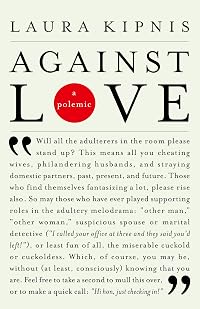
- Will all the adulterers in the room please stand up?
- Last words
- (Click to show. Warning: May contain spoilers.)Or alter the context—here’s an idea to flirt with—which could make it mean something else entirely.
Classifications
- Genres
- Sociology, Nonfiction, General Nonfiction, Sexuality and Gender Studies
- DDC/MDS
- 306 — Society, government, & culture Social sciences, sociology & anthropology Social Behavior - Dating, Marriage, Divorce
- LCC
- HQ806 .K48 — Social sciences The family. Marriage, Women and Sexuality The Family. Marriage. Women The family. Marriage. Home Adultery
- BISAC
Statistics
- Members
- 548
- Popularity
- 54,029
- Reviews
- 12
- Rating
- (3.65)
- Languages
- 6 — English, Finnish, French, Italian, Portuguese, Spanish
- Media
- Paper, Ebook
- ISBNs
- 9
- ASINs
- 2