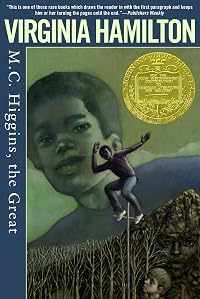
M. C. Higgins: The Great
by Virginia Hamilton
On This Page
Description
As a slag heap, the result of strip mining, creeps closer to his house in the Ohio hills, fifteen-year-old M.C. is torn between trying to get his family away and fighting for the home they love.Tags
Recommendations






Member Reviews
The story of a few tumultuous days in the life of M.C. Higgins, a 13-year-old in the hills of southern Ohio.
This book won a trifecta of awards in its year: the Newbery Medal, the Boston Globe/Horn Book Award, and the National Book Award. The writing is undoubtedly distinguished, reminding me a little bit of Flannery O'Connor's writing in its use of symbolism. However, my enjoyment of the book was hampered by a strong dislike for the main character and his interactions with the girl he meets (one of the book's major plot points). I'm glad to be able to say I've read it, but it's not a book I'll ever want to revisit.
This book won a trifecta of awards in its year: the Newbery Medal, the Boston Globe/Horn Book Award, and the National Book Award. The writing is undoubtedly distinguished, reminding me a little bit of Flannery O'Connor's writing in its use of symbolism. However, my enjoyment of the book was hampered by a strong dislike for the main character and his interactions with the girl he meets (one of the book's major plot points). I'm glad to be able to say I've read it, but it's not a book I'll ever want to revisit.
In M. C. Higgins, the Great, the title character, a tall, athletic, thoughtful black teenager who lives in the Cumberland Mountains, must come to terms with conflicting allegiances, to his father and the traditions of his family, on one hand, and to his mother and the younger children in the family, on the other. Faced with a threat to the family that is beyond his control, M. C. learns that being an adult means doing one’s limited best in an imperfect world.
M. C. Higgins, the Great is one of those books that once you start you can’t put down, but it is so much more than that. Her characters are deep, wise and reverent. The world through M. C.’s eyes is one I could never have imagined or experienced and one that I didn’t want to leave. This is a coming of age story and watching M.C. sort through so many complex feelings really allows the reader to identify with him.
Since this is based on life in 1974, today's younger readers may need some background knowledge and understanding of what life was like in the time and place that M.C. lived. The first chapter was a little difficult for me to get into, so students may need some encouragement to get beyond the first chapter. However, I was show more hooked after that. Also, how M.C. treats Lurhetta Outlaw in the beginning may need some discussion. In addition, the relationship between M.C. and his father could use some discussion, especially for the scene when father and son wrestle. Some students may not understand their complex relationship and interpret this portion of the book incorrectly. It may need to be explained that Jones is trying to teach M.C. something and to make him strong in what is a very tough world. Lastly, this book deals with prejudice but not prejudice as you would expect and Virginia Hamilton presents and works this through for the reader beautifully.
Amazon recommends this book for ages 8-12, however, I would say it is for students age 12-17 because of the complexity of the text and the emotional maturity required to understand much of the story. It is 288 pages long. show less
Since this is based on life in 1974, today's younger readers may need some background knowledge and understanding of what life was like in the time and place that M.C. lived. The first chapter was a little difficult for me to get into, so students may need some encouragement to get beyond the first chapter. However, I was show more hooked after that. Also, how M.C. treats Lurhetta Outlaw in the beginning may need some discussion. In addition, the relationship between M.C. and his father could use some discussion, especially for the scene when father and son wrestle. Some students may not understand their complex relationship and interpret this portion of the book incorrectly. It may need to be explained that Jones is trying to teach M.C. something and to make him strong in what is a very tough world. Lastly, this book deals with prejudice but not prejudice as you would expect and Virginia Hamilton presents and works this through for the reader beautifully.
Amazon recommends this book for ages 8-12, however, I would say it is for students age 12-17 because of the complexity of the text and the emotional maturity required to understand much of the story. It is 288 pages long. show less
This was a curious book - I never could decide what I hoped for M.C. and his family. I did like the end, because M.C. found positive ways to deal with the things he feared and to maintain his connection to the family land. Ms. Hamilton gives the reader things to think about - like what does the pole represent? how does Lurhetta change things? what about M.C.'s relationship with his father?
Read for Dec. 2021 Children's Books group Newbery club. I had a paper copy, but it is also avl. at openlibrary.org.
Halfway through. I do not appreciate the default cover, but prefer the one I got. So far I am bored to the point of fatigue, except when I am disturbed.
I am not disturbed so much by the rough 'games' he plays with his father; I see his father's point that the kids need to be raised to be tough. But I am disturbed that this big tall boy "hunts" a girl (young woman) as she explores the wilderness, to the point where he cuts her and almost rapes her. And that he doesn't want his friend to skin a rabbit, because he prefers to slice it and peel it off himself.
I guess the way that they are raised, mother working very long hours show more as a housekeeper, father day labor, kids alone all day most days, under a mining spoil, etc... would have an effect on their outlook.
I find it interesting that they lie to the "dude" from the city who comes to record mother's singing. I understand lying to anthropologists, but dude is Black, and M.C. at least has high hopes he'll help them get what they do want.
It does make me wonder how many lies were spread irl to John and Alan Lomax, the WPA, Foxfire, and other preservationists.
---
Ok, closer to done. Now the author is lying to us about hoop snakes and milk snakes. Both myths! (There is a milk snake, but it doesn't steal from cows. Just mis-named.)
I see that some reviewers call this 'weird' and imply that it's a difficult read. I do agree that the part where the boy is remembering a birthday isn't clearly marked off as a memory and it did confuse me for a bit. But otherwise it's clear enough. It just takes place in such a limited timeframe, and place, and mostly inside M.C.'s head, too. So it's different. Enlightening? Maybe.
---
Done. Terrific for the right audience, I believe. I may have been that, at another time... perhaps when I was studying to be a teacher, or when I was home with my first-born son. Now, well, I just couldn't click with it.
No idea how to rate. I advise you decide for yourself what you think of it. show less
Halfway through. I do not appreciate the default cover, but prefer the one I got. So far I am bored to the point of fatigue, except when I am disturbed.
I am not disturbed so much by the rough 'games' he plays with his father; I see his father's point that the kids need to be raised to be tough. But I am disturbed that this big tall boy "hunts" a girl (young woman) as she explores the wilderness, to the point where he cuts her and almost rapes her. And that he doesn't want his friend to skin a rabbit, because he prefers to slice it and peel it off himself.
I guess the way that they are raised, mother working very long hours show more as a housekeeper, father day labor, kids alone all day most days, under a mining spoil, etc... would have an effect on their outlook.
I find it interesting that they lie to the "dude" from the city who comes to record mother's singing. I understand lying to anthropologists, but dude is Black, and M.C. at least has high hopes he'll help them get what they do want.
It does make me wonder how many lies were spread irl to John and Alan Lomax, the WPA, Foxfire, and other preservationists.
---
Ok, closer to done. Now the author is lying to us about hoop snakes and milk snakes. Both myths! (There is a milk snake, but it doesn't steal from cows. Just mis-named.)
I see that some reviewers call this 'weird' and imply that it's a difficult read. I do agree that the part where the boy is remembering a birthday isn't clearly marked off as a memory and it did confuse me for a bit. But otherwise it's clear enough. It just takes place in such a limited timeframe, and place, and mostly inside M.C.'s head, too. So it's different. Enlightening? Maybe.
---
Done. Terrific for the right audience, I believe. I may have been that, at another time... perhaps when I was studying to be a teacher, or when I was home with my first-born son. Now, well, I just couldn't click with it.
No idea how to rate. I advise you decide for yourself what you think of it. show less
Mrs. Senuta,
You were my, what, fifth grade teacher? The inscription is in my hand, but it says, " From: Mrs. Senuta, To: Brie." If my memory serves me correctly, you also gave me a reader's journal with it. That too, has been carried with me, untouched for all these years.
So here is by book report, long over due.
M.C. Higgins, The Great is an enchanting story of one boy's journey through defining who he is in relation to the world. For a boy who lives on the mountain, far from a city life, he has plenty of conflicting forces in his world.
He wants to acheive greatness, even if it comes through his mother's success in the music world. He wants off the mountain, as he thinks only devestation exists for him there (and he may be right). He show more has conflict about the boy who could be defined as both his best friend and no more than a shadow, since MC's world has taught him that Ben is not something to be valued. He wants to be something his father is not, to be able to move about the world as his father seemingly can't, which I believe is what draws him to the pole. He can climb the metal pole with ease, escaping from the world beneath him, watching over the distance to be a protector and a provider, something Jones (his father) isn't.
It isn't until he gets caught up in his desire to know Lurhetta, though, that the story gets interesting for me. He meets this girl, is drawn to her freedom, and seemingly wants to tame her. He again, is conflicted about his true desire, swinging from wanting to keep her on the mountain and wanting to run away with her.
She is able to teach him to view the world more openly, though, as she pushes him to accept Ben (the "six-fingered witchy") for what he is, a true friend and confidant. In doing so, she also teaches him that the mountain is in fact what he loves, much as it is what his father loves, and is likely to be what his children someday will love, too.
MC is not destined to be his father, though, which is the beauty of this novel. For as much as some traits may be passed down a genetic line, there are always choices to be made, such as which walls to tear down, and which to build up. show less
You were my, what, fifth grade teacher? The inscription is in my hand, but it says, " From: Mrs. Senuta, To: Brie." If my memory serves me correctly, you also gave me a reader's journal with it. That too, has been carried with me, untouched for all these years.
So here is by book report, long over due.
M.C. Higgins, The Great is an enchanting story of one boy's journey through defining who he is in relation to the world. For a boy who lives on the mountain, far from a city life, he has plenty of conflicting forces in his world.
He wants to acheive greatness, even if it comes through his mother's success in the music world. He wants off the mountain, as he thinks only devestation exists for him there (and he may be right). He show more has conflict about the boy who could be defined as both his best friend and no more than a shadow, since MC's world has taught him that Ben is not something to be valued. He wants to be something his father is not, to be able to move about the world as his father seemingly can't, which I believe is what draws him to the pole. He can climb the metal pole with ease, escaping from the world beneath him, watching over the distance to be a protector and a provider, something Jones (his father) isn't.
It isn't until he gets caught up in his desire to know Lurhetta, though, that the story gets interesting for me. He meets this girl, is drawn to her freedom, and seemingly wants to tame her. He again, is conflicted about his true desire, swinging from wanting to keep her on the mountain and wanting to run away with her.
She is able to teach him to view the world more openly, though, as she pushes him to accept Ben (the "six-fingered witchy") for what he is, a true friend and confidant. In doing so, she also teaches him that the mountain is in fact what he loves, much as it is what his father loves, and is likely to be what his children someday will love, too.
MC is not destined to be his father, though, which is the beauty of this novel. For as much as some traits may be passed down a genetic line, there are always choices to be made, such as which walls to tear down, and which to build up. show less
‘”I don’t know.” M.C. signed. “…But I’m getting tired of Daddy. Tired as I can be.”“Come on,” Banina said. “We’ll miss the morning sun.” And later: “It’s not your daddy you tired of, M.C. It’s here. It’s this place. The same thing day after day is enemy to a growing boy.”And all the ghosts, M.C. thought. All of the old ones.’M.C. lives on the side of a mountain, just like his father before him and his grandmother before him. But all that must come to an end. Strip mining threatens to send a pile of rubble down on his home. M.C.’s father refuses to see it.But M.C. is watching for ways to get away and one of the ways arrives in the form of a fellow recording songs. This fellow, this dude, as M.C. show more calls him, will get M.C.’s mother a singing contract and take the family away from the hills, M.C. thinks.Another stranger visits, a girl traveling around the country, a city girl who shows M.C. other ways of thinking, of viewing his world, the bigger world. She could be a way out, M.C. thinks.But again and again life disappoints, people disappoint. Out of the disappointments M.C. takes new knowledge and adds it to his old life, building a new life out of the old. show less
Members
- Recently Added By
Lists

Best Newbery Medal Winners
94 works; 54 members

Honey For a Child's Heart
1,152 works; 25 members

Newbery Medal Winners - By Year
105 works; 7 members
Before Austen Comes Aesop
318 works; 9 members

Books Read in 2021
5,361 works; 114 members

EGBERTINA's List of Newbery books that I hated or found unnecessary
58 works; 3 members
Author Information

49+ Works 16,346 Members
Some Editions
Awards and Honors
Awards
Distinctions
Work Relationships
Is contained in
Common Knowledge
- Canonical title
- M. C. Higgins: The Great
- Original title
- M. C. Higgins, the Great
- Original publication date
- 1974
- People/Characters
- Mayo Cornelius Higgins
- Important places
- Kentucky, USA; Ohio River, USA
- Dedication
- for Susan Hirschman
- First words
- Mayo Cornelius Higgins raised his arms high to the sky and spread them wide. He glanced furtively around. It was all right. There was no one to see his greeting to the coming sunrise.
- Last words
- (Click to show. Warning: May contain spoilers.)And it was rising.
- Original language
- English
Classifications
Statistics
- Members
- 2,854
- Popularity
- 6,333
- Reviews
- 31
- Rating
- (3.46)
- Languages
- English, German
- Media
- Paper, Audiobook, Ebook
- ISBNs
- 50
- ASINs
- 15