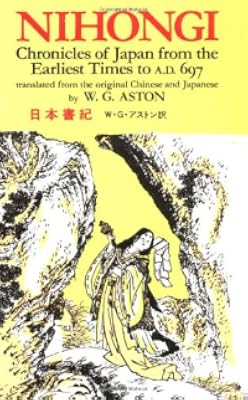
Nihongi: Chronicles of Japan from the Earliest Times to A.D. 697 (Tut Books. H)
by W. G. Aston
On This Page
Description
Nihongi: Chronicles of Japan from the Earliest Times to A.D. 697, oftencalled the Nihonshoki, is one of Japan's great classics of literature. It provides a vivid picture of a nation in formation. In Nihongi we see the growth of national awareness following the assimilation of Buddhism and the general Chinese and Indian influence on Japanese culture. For a thousand years emperors, scholars, courtiers, and imperial historians have found in the Nihongi knowledge and guidance. The translator, show more William George Aston, C.M.G., pioneered the translation of Japanese i show lessTags
Recommendations











Member Reviews
W.G. Aston's Nihongi is the standard translation of one of Japan's greatest works of early literature. For those studying early Japanese history or folklore it is a must read. It describes the creation myths of Japan, the origin of Amaterasu, the sun goddess and the descent of the emperors from the gods (kami). It transitions slowly from myth to history somewhere around 400 AD as it begins to describe the acts of the emperors and Japan's interaction with its neighbours, most notably the kingdoms of Pekche, Silla and Koryo in what is now Korea.
The creation myths are somewhat jumbled in format and, without Aston's copious footnotes, would be almost unintelligible to the uninitiated. While at times the translator's commentary threatens to show more overwhelm the actual text, for the most part it plays a key role in aiding our understanding. The expert may find the notes annoying (and possibly dated since the book was translated in 1896) but I found them quite helpful. As the book proceeds into the more narrative historical sections, the footnotes decrease accordingly.
It appears that the Nihongi was written to provide the back-story to the role of the emperor as it existed circa 800 AD. Thus genealogical information forms a large part of the book and there are a lot of names in here. Aston also points out, with considerable annoyance, that many of the speeches and acts of the Nihongi are anachronistically cribbed from Chinese material extant at the time of the Nihongi's writing. Poetry, as well, is a large component of the work, often with inscrutable translations but tempered by copious notes. It should also be noted that to avoid corrupting the morals of the youth, passages dealing with sex are translated from Japanese into Latin. The curious and prurient may wish to brush up on their classical studies.
I was completely unaware, as I read the book, that the Cosimo edition of the Nihongi is only the first of two original volumes. Nowhere in the book is it made clear that there is another volume, although if you read the preface closely you will note that Aston refers to the "thirty books" of the Nihongi - in this edition there are only 16. The errata published at the back are for two volumes, one of which is that in hand while the other is clearly not present, and the title indicates the book will take us to 637 AD while the table of contents only goes as far as Muretsu in AD 499. It is difficult to believe you could publish this book without being aware that there was a second volume and almost as difficult to believe the publisher deliberately misled the readers into buying what was effectively only half of a book. Whatever the answer, I am quite disappointed in the lack of a second volume.
The writings themselves are excellent. While I usually enjoy folklore more than history, in this case, the best and most moving tales belong to the "historical" portion of the book. Tales of the evil emperor Yoriaku, the bold empress Okinaga and others are quite entertaining, while obviously not completely factual. I would have to give the Nihongi 5 stars as a great work of literature, Aston's translation 4 stars due to is dated nature and the publisher 1 star for delivering only half of the great tale. show less
The creation myths are somewhat jumbled in format and, without Aston's copious footnotes, would be almost unintelligible to the uninitiated. While at times the translator's commentary threatens to show more overwhelm the actual text, for the most part it plays a key role in aiding our understanding. The expert may find the notes annoying (and possibly dated since the book was translated in 1896) but I found them quite helpful. As the book proceeds into the more narrative historical sections, the footnotes decrease accordingly.
It appears that the Nihongi was written to provide the back-story to the role of the emperor as it existed circa 800 AD. Thus genealogical information forms a large part of the book and there are a lot of names in here. Aston also points out, with considerable annoyance, that many of the speeches and acts of the Nihongi are anachronistically cribbed from Chinese material extant at the time of the Nihongi's writing. Poetry, as well, is a large component of the work, often with inscrutable translations but tempered by copious notes. It should also be noted that to avoid corrupting the morals of the youth, passages dealing with sex are translated from Japanese into Latin. The curious and prurient may wish to brush up on their classical studies.
I was completely unaware, as I read the book, that the Cosimo edition of the Nihongi is only the first of two original volumes. Nowhere in the book is it made clear that there is another volume, although if you read the preface closely you will note that Aston refers to the "thirty books" of the Nihongi - in this edition there are only 16. The errata published at the back are for two volumes, one of which is that in hand while the other is clearly not present, and the title indicates the book will take us to 637 AD while the table of contents only goes as far as Muretsu in AD 499. It is difficult to believe you could publish this book without being aware that there was a second volume and almost as difficult to believe the publisher deliberately misled the readers into buying what was effectively only half of a book. Whatever the answer, I am quite disappointed in the lack of a second volume.
The writings themselves are excellent. While I usually enjoy folklore more than history, in this case, the best and most moving tales belong to the "historical" portion of the book. Tales of the evil emperor Yoriaku, the bold empress Okinaga and others are quite entertaining, while obviously not completely factual. I would have to give the Nihongi 5 stars as a great work of literature, Aston's translation 4 stars due to is dated nature and the publisher 1 star for delivering only half of the great tale. show less
The first major English translation of one of the two basic Japanese chronicles. The material is a bit old-fashined, especially the transcription of the divine names.
Ratings
Members
- Recently Added By
Author Information
12 Works 258 Members
Classifications
Statistics
- Members
- 172
- Popularity
- 191,271
- Reviews
- 2
- Rating
- (3.57)
- Languages
- English, Japanese
- Media
- Paper, Ebook
- ISBNs
- 14
- ASINs
- 3