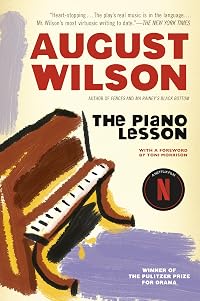
The Piano Lesson
by August Wilson
Century Cycle: Chronological Order (1930s), Century Cycle: Production Order (play 5)
On This Page
Description
August Wilson has already given the American theater such spell-binding plays about the black experience in 20th-century America as Ma Rainey's Black Bottom, Joe Turner's Come and Gone, and the Pulitzer Prize-winning, Fences. In his second Pulitzer Prize-winner, The Piano Lesson, Wilson has fashioned his most haunting and dramatic work yet. At the heart of the play stands the ornately carved upright piano which, as the Charles family's prized, hard-won possession, has been gathering dust in show more the parlor of Berniece Charles's Pittsburgh home. When Boy Willie, Berniece's exuberant brother, bursts into her life with his dream of buying the same Mississippi land that his family had worked as slaves, he plans to sell their antique piano for the hard cash he needs to stake his future. But Berniece refuses to sell, clinging to the piano as a reminder of the history that is their family legacy. This dilemma is the real "piano lesson," reminding us that blacks are often deprived both of the symbols of their past and of opportunity in the present. show lessTags
Recommendations











Member Reviews
3.75 stars. this was super interesting. there is a lot covered, a lot to think on, and a lot of depth in such a short little play. i guess there's room for more because there is virtually no stage direction; nearly the entire thing is dialogue, so we have time to work through some stuff. (i want more stage direction in general when reading a play. i had a little trouble picturing everything, but i guess that adds to the fun when watching it performed because it could certainly be interpreted in different ways as almost everything is left open.)
i really liked how both berniece and willie boy, coming from opposite perspectives, both made totally logical and compelling cases for what to do with the piano that is the centerpiece of the show more play. keep it (and the past, and the family, and the history, and the memories, and the pain) like she wants, or sell it (and use the pain as a footstool to better things and become independent and prosperous) like he wants. this piano haunts them both figuratively as it comes between their sibling relationship (which doesn't seem all that solid anyway) and literally as the ghost of their family's slave master is attached to it. they have to work through what this legacy - the piano, slavery - leaves them and how to use it or come out on the other side from it, how to shape their future with this as their past.
it's kind of fascinating and leaves a lot to think about. i wanted a bit quicker of a start, more stage direction, and a little more detail. (so i wanted it to be a little longer.) i wasn't as interested in the ghost theme that works its way through, and i need to give more thought to the train/moving on theme that's there as well, just not as prominently. it was this idea of how the past shapes your future, but also how you let it, how you hold on to it and let it mold the future, that i really find interesting.
i loved this whole passage from berniece:
"You trying to tell me a woman can't be nothing without a man. But you alright, huh? You can just walk out of here without me - without a woman - and still be a man. That's alright. Ain't nobody gonna ask you, 'Avery, who you got to love you?' That's alright for you. But everybody gonna be worried about Berniece. 'How Berniece gonna take care of herself? How she gonna raise that child without a man? Wonder what she do with herself. How she gonna live like that?' Everybody got all kinds of questions for Berniece. Everybody telling me I can't be a woman unless I got a man."
"Everybody got stones in their passway. You got to step over them or walk around them. You picking them up and carrying them with you. All you got to do is set them down by the side of the road. You ain't got to carry them with you." show less
i really liked how both berniece and willie boy, coming from opposite perspectives, both made totally logical and compelling cases for what to do with the piano that is the centerpiece of the show more play. keep it (and the past, and the family, and the history, and the memories, and the pain) like she wants, or sell it (and use the pain as a footstool to better things and become independent and prosperous) like he wants. this piano haunts them both figuratively as it comes between their sibling relationship (which doesn't seem all that solid anyway) and literally as the ghost of their family's slave master is attached to it. they have to work through what this legacy - the piano, slavery - leaves them and how to use it or come out on the other side from it, how to shape their future with this as their past.
it's kind of fascinating and leaves a lot to think about. i wanted a bit quicker of a start, more stage direction, and a little more detail. (so i wanted it to be a little longer.) i wasn't as interested in the ghost theme that works its way through, and i need to give more thought to the train/moving on theme that's there as well, just not as prominently. it was this idea of how the past shapes your future, but also how you let it, how you hold on to it and let it mold the future, that i really find interesting.
i loved this whole passage from berniece:
"You trying to tell me a woman can't be nothing without a man. But you alright, huh? You can just walk out of here without me - without a woman - and still be a man. That's alright. Ain't nobody gonna ask you, 'Avery, who you got to love you?' That's alright for you. But everybody gonna be worried about Berniece. 'How Berniece gonna take care of herself? How she gonna raise that child without a man? Wonder what she do with herself. How she gonna live like that?' Everybody got all kinds of questions for Berniece. Everybody telling me I can't be a woman unless I got a man."
"Everybody got stones in their passway. You got to step over them or walk around them. You picking them up and carrying them with you. All you got to do is set them down by the side of the road. You ain't got to carry them with you." show less
Ever since I saw the film of Wilson's play Fences, I have wanted to explore his other work. Part of Wilson's 10-play "Pittsburgh (or Century) Cycle", this play is every bit as powerful, and I would love to see it performed. Berniece and her 11-year-old daughter live with Berniece's Uncle Doaker since her husband Crawley was shot and killed three years ago. A piano with elaborate carvings documents her family's slave history, and she treasures it as a link to her past, although it is also a constant reminder of subjugation and loss. When Berniece's brother Boy Willie shows up with a plan to sell the piano so he can buy the Mississippi land where their family was once enslaved, he meets total resistance. Reading this one just made me want show more more.
ETA: I have now seen the movie version of this work, and it is excellent. Kudos to Denzel Washington for bringing Wilson's plays to a wider audience. 1-2025 show less
ETA: I have now seen the movie version of this work, and it is excellent. Kudos to Denzel Washington for bringing Wilson's plays to a wider audience. 1-2025 show less
One of the Pittsburgh Cycle plays, this takes place during the Great Depression as a family struggles to survive against difficult odds. The dreams of the family center around an old family heirloom, a piano that appears to be responsible for a great deal of their grief. The struggle between a brother and sister who each claim half ownership of the instrument is complicated by the presence of a ghost that one can see and the other can't. The characters struggle with identity, their ideas of self-worth, and even their religious views as they play a tug-of-war over the eventual disposition of the piano. The strong female character gives Wilson a chance to speak for equality of the sexes as well as the races, but even within that, the show more characters struggle with uncertainty. The author does not cave in to a pressure common on all writers and wrap everything up neatly; the ending is left with a level of ambiguity that allows the reader to wonder what will become of the characters. show less
This Is a very interesting read about Black families and their specific struggles and connection to enslavement. This story follows a family who finds an interesting marking from an enslaved family member. This story definitely has strong works and interesting themes. This story is a strong read for African-American students if they would like stories that specifically follow black households and their struggles with classifications and issues that may arise when it come to race and identity.
This play takes place in the 1930s and is part of Wilson's Century Cycle.
This is a play about Boy Willie visiting his sister, Bernice to get the family piano. Boy Willie wants to take this piano which has significant and sentimental value to the family and sell it to buy some land with the hope of generating generational wealth. Bernice wants to keep the piano that her father died for and represents their ancestry.
This play disappointed me as it is generally considered one of the best in the Cycle. Wilson uses ghosts in this play more than any other I have read and the confusion at the climax of the play just made me anxious. This story didn't ring true or as deep as the others.
This is a play about Boy Willie visiting his sister, Bernice to get the family piano. Boy Willie wants to take this piano which has significant and sentimental value to the family and sell it to buy some land with the hope of generating generational wealth. Bernice wants to keep the piano that her father died for and represents their ancestry.
This play disappointed me as it is generally considered one of the best in the Cycle. Wilson uses ghosts in this play more than any other I have read and the confusion at the climax of the play just made me anxious. This story didn't ring true or as deep as the others.
The Piano Lesson takes place in 1930s Pittsburgh (and is actually the fourth play in Wilson's series The Pittsburgh Cycle), at the home of Doaker, his widowed niece Berniece, and her daughter Maretha. Berniece's brother Boy Willie is in need of some money so he and his friend Lymon come up from the south to sell a truckload of watermelons and negotiate the sale of a family heirloom, an intricately carved piano. Boy Willie has a chance to buy the land that their family had worked as slaves, if he can just get enough money together. But the piano has a history that makes it un-sellable in Berniece's eyes. The conflict between the brother and sister and the ghosts of the past and the present give this play a tension and presence that you show more can feel through the pages. It is pretty easy to see why The Piano Lesson won the Pulitzer Prize for Drama...
[full review here: http://spacebeer.blogspot.com/2010/01/piano-lesson-by-august-wilson-1990.html ] show less
[full review here: http://spacebeer.blogspot.com/2010/01/piano-lesson-by-august-wilson-1990.html ] show less
The Piano Lesson is a play with two acts. It takes place over less than a week’s time. The story is compact and engaging. Readers get to know the characters from the dialogue and some stage directions. Wilson relies more on the language and dialogue to tell the story than the stage directions. He uses authentic language to describe the culture and times. Wilson describes the conflict and tension over the piano in such a way that readers find themselves unsure what is the best solution to the problem. Each argument is full of passion and reason. Wilson uses trains as effective metaphors for the comings and goings of life as well as how choices change our lives directions.
Members
- Recently Added By
Lists


Author Information

28+ Works 5,915 Members
Playwright August Wilson was born on April 27, 1945 in Pittsburgh, Pennsylvania. His experiences of living in a primarily black community and then being the only black student in his class at a Roman Catholic high school would inform his dramatic writings. He dropped out of school at the age of 15 and continued his education on his own. Wilson show more wrote a ten play cycle that chronicles each decade of the black experience in the 20th century. Each of his plays focuses on what he perceived as the largest issue to confront African-Americans in that decade. He won the Pulitzer Prize for Drama for Fences and Piano Lesson, the best play Tony Award for Fences, and seven New York Drama Critics' Circle awards. He also received the Whiting Foundation Award, the American Theatre Critics Award, the 1999 National Humanities Medal awarded by the President, and numerous honorary degrees. He died of liver cancer on October 2, 2005 at the age of 60. (Bowker Author Biography) show less
Awards and Honors
Awards
Series


Belongs to Publisher Series
Work Relationships
Is contained in
Has the adaptation
Is abridged in
Has as a student's study guide
Has as a teacher's guide
Common Knowledge
- Original publication date
- 1990
- People/Characters
- Boy Willie Charles; Berniece Charles; Doaker Charles; Wining Boy Charles; Lymon Jackson; Avery (show all 8); Maretha; Grace
- Important places
- Pittsburgh, Pennsylvania, USA; Pennsylvania, USA
- Related movies
- Hallmark Hall of Fame: The Piano Lesson (1995 | IMDb); The Piano Lesson (2024 | IMDb)
- Quotations
- (Boy Willie): I’m going to tell you the way I see it. The only thing that make that piano worth something is them carvings Papa Willie Boy put on there. That’s what make it worth something. That was my great granddaddy. P... (show all)apa Boy Charles brought that piano into the house. Now, I’m supposed to build on what they left me. You can’t do nothing with that piano sitting up here in the house. That’s just like if I let them watermelons sit out there and rot. I’d be a fool. Alright now, if you say to me, Boy Willie, I’m using that piano. I give out lessons on it and that help me make my rent or whatever. Than that be something else. I’d have to go on and say, well Berniece using that piano. She building on it. Let her go on and use it. I got to find another way to get Sutter’s land. But Doaker say you ain’t touched that piano the whole time it’s been up here. So why you wanna stand in my way?
Classifications
Statistics
- Members
- 1,084
- Popularity
- 23,591
- Reviews
- 13
- Rating
- (3.78)
- Languages
- English
- Media
- Paper, Ebook
- ISBNs
- 15
- ASINs
- 6