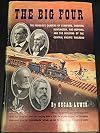
The Big Four: The Story of Huntington, Stanford, Hopkins, and Crocker, and of the Building of the Central Pacific
by Oscar Lewis
On This Page
Description
Here for the first time is told in a single volume one of the most remarkable stories in American history. An Eastener is never long in California without hearing something of "the big four": four Sacramento shopkeepers--Collis P. Huntington, Lelan Stanford, Mark Hopkins, and Charles Crocker--who got control of the newly organized Central Pacific Railroad property. These men are portrayed in Mr. Lewis's volume vividly and with a great wealth or pertinent anecdote. Thus their true characters show more are revealed and the grandiose era in which they lived and operated is re-created as well. Huntington, the shrewd manipulator and lobbyist in Washington, founded the great fortune which is responsible for the magnificent library at San Marino; Leland Stanford, Governor of California and United States Senator, created Leland Stanford Junior University; Hopkins, the cold, quiet watchdog of the railroad's treasury, kept himself out of the limelight, out of politics and scandal, yet, like the others, died enormously wealthy; while Crocker founded a dynasty of bankers still important in the affairs of California and the nation. Oscar Lewis, a longtime authority on Californiana and secretary of the Book Club of California, spent six years gathering the material for The Big Four and writing it. The result is a definitive telling of a story that is ever fresh and ever fascinating. show lessTags
Recommendations























Member Reviews
Very interesting book on the four powerful men who established the Central Pacific in California and built a big part of the transcontinental RR. It later became the Southern Pacific.
The Big Four were Leland Stanford, Mark Hopkins, Charles Crocker and Collis Huntington. They were they organizers and founders of the Central Pacific and Southern Pacific Railroads. They first came together to build and manage the Central Pacific Railroad which was the western part of the first transcontinental railroad finished in 1869. The Big Four became some of the richest and most powerful men in the whole country. This they achieved by a combination of efficient organization, ruthless competition, bribery and corruption. The corporations they controlled probably bought and owned more elected officials than ever before or since. In the 19th century it seemed that they bought every elected official in California.
The excesses of the show more Southern Pacific Railroad let to eventual regulation of transportation and commerce. Before controls on monopolies the Big Four set their freight charges to all "all the traffic would bear. They they kept their high rates just low enough that the merchants and farmers of California would not go bankrupt. It is no wonder that all four were so hated by the majority of the populace.
In spite of their practices they did some good. Leland Stanford is remembered for the University he endowed in memory of his son, Leland Stanford Jr. University. Crocker lives on in the Crocker Art Museum in Sacramento and Huntington in the Huntington Library in Southern California. Mark Hopkins was no philanthropist but his name is memorialized in a San Francisco Hotel.
Oscar Lewis wrote The Big Four in 1938. At that time the excessive power of corporations had been limited by regulations. Now that power is back and Big Four reads like a very contemporary book.
' show less
The excesses of the show more Southern Pacific Railroad let to eventual regulation of transportation and commerce. Before controls on monopolies the Big Four set their freight charges to all "all the traffic would bear. They they kept their high rates just low enough that the merchants and farmers of California would not go bankrupt. It is no wonder that all four were so hated by the majority of the populace.
In spite of their practices they did some good. Leland Stanford is remembered for the University he endowed in memory of his son, Leland Stanford Jr. University. Crocker lives on in the Crocker Art Museum in Sacramento and Huntington in the Huntington Library in Southern California. Mark Hopkins was no philanthropist but his name is memorialized in a San Francisco Hotel.
Oscar Lewis wrote The Big Four in 1938. At that time the excessive power of corporations had been limited by regulations. Now that power is back and Big Four reads like a very contemporary book.
' show less
Ratings
Members
- Recently Added By
Author Information
71+ Works 808 Members
Oscar Lewis, an American anthropologist, was renowned for his studies of poverty in Mexico and Puerto Rico and for his controversial concept of "the culture of poverty." After graduating from Columbia University, where he studied under Ruth Benedict, Franz Boas, and Margaret Mead, his first major book, Life in a Mexican Village (1951), was a show more restudy of Robert Redfield's village of Tepoztlan, which reached a number of conclusions opposed to those reached by Redfield. Much of the controversy over the culture of poverty disappeared when Lewis labeled it a subculture; ironically, reactionaries have used the concept to blame the poor for their poverty, whereas Lewis believed the poor to be victims. Many of his books are based on tape recordings of family members, a technique in which Lewis was a pioneer. (Bowker Author Biography) show less
Awards and Honors
Common Knowledge
- Canonical title
- The Big Four: The Story of Huntington, Stanford, Hopkins, and Crocker, and of the Building of the Central Pacific
- Original publication date
- 1938
- People/Characters
- Collis P. Huntington; Leland Stanford; Mark Hopkins; Charles Crocker
- Important places
- Western United States
Classifications
Statistics
- Members
- 88
- Popularity
- 365,131
- Reviews
- 2
- Rating
- (3.38)
- Languages
- English
- Media
- Paper, Ebook
- ISBNs
- 6
- ASINs
- 11