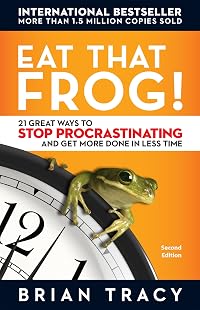
Eat That Frog! 21 Great Ways to Stop Procrastinating and Get More Done in Less Time
by Brian Tracy
On This Page
Description
Business. Self-Improvement. Nonfiction. HTML:NEW EDITION, REVISED AND UPDATEDThe legendary Eat That Frog! (more than 1.5 million copies sold worldwide and translated into 42 languages) will change your life. There just isn't enough time for everything on our "To Do" list—and there never will be. Successful people don't try to do everything. They learn to focus on the most important tasks and make sure they get done.
There's an old saying that if the first thing you do each morning is to show more eat a live frog, you'll have the satisfaction of knowing that it's probably the worst thing you'll do all day. Using "eat that frog" as a metaphor for tackling the most challenging task of your day—the one you are most likely to procrastinate on, but also probably the one that can have the greatest positive impact on your life—Eat That Frog! shows you how to zero in on these critical tasks and organize your day. You'll not only get more done faster, but get the right things done.
Bestselling author Brian Tracy cuts to the core of what is vital to effective time management: decision, discipline, and determination. In this fully revised and updated second edition, he provides brand new information on how to keep technology from dominating your time. He details twenty-one practical and doable steps that will help you stop procrastinating and get more of the important tasks done—today!. show less
Tags
Recommendations


Member Reviews
Legitimately unhelpful. While the titular premise is promising, that is all this book has to uniquely offer.
The advice boils down to "Never EVER perform a low priority task if you have a high priority task, never EVER do tasks that are not immediately tied to success, and play less golf."
Much of his advice directly contradicts robust scientific evidence. His early assertion that you are a spineless failure if you succumb to the allure of getting a quick task "out of the way" before tackling your hardest most challenging obstacle is not evidence-based. Getting a small task done can boost your self-confidence and give you momentum to begin a task you're procrastinating on. Likewise, his demand that you only ever perform the most grueling show more task on your checklist while never EVER taking a breather to clear out some pesky lower priority tasks is in reality the quickest way to burn yourself out while dropping the ball in all other areas of your life.
His approach is not possible for a large number of occupations and professions. And that is my biggest gripe about this book: it is only helpful for the very specific circumstance that the author must be imagining in his head.
In short, large swaths of this book are full of neutrally inapplicable or even actively harmful advice. It is inflexible and without nuance. And I haven't even mentioned how repetitive and condescending it is.
If you want a steady stream of "Do as I say and you will be great, you will be better than everyone else, you can do anything" and nothing more, this is the book for you. Otherwise, I urge you to look elsewhere. show less
The advice boils down to "Never EVER perform a low priority task if you have a high priority task, never EVER do tasks that are not immediately tied to success, and play less golf."
Much of his advice directly contradicts robust scientific evidence. His early assertion that you are a spineless failure if you succumb to the allure of getting a quick task "out of the way" before tackling your hardest most challenging obstacle is not evidence-based. Getting a small task done can boost your self-confidence and give you momentum to begin a task you're procrastinating on. Likewise, his demand that you only ever perform the most grueling show more task on your checklist while never EVER taking a breather to clear out some pesky lower priority tasks is in reality the quickest way to burn yourself out while dropping the ball in all other areas of your life.
His approach is not possible for a large number of occupations and professions. And that is my biggest gripe about this book: it is only helpful for the very specific circumstance that the author must be imagining in his head.
In short, large swaths of this book are full of neutrally inapplicable or even actively harmful advice. It is inflexible and without nuance. And I haven't even mentioned how repetitive and condescending it is.
If you want a steady stream of "Do as I say and you will be great, you will be better than everyone else, you can do anything" and nothing more, this is the book for you. Otherwise, I urge you to look elsewhere. show less
This book starts out strong, centered around its valuable 'Eat That Frog' prescription, but then gets more and more ridiculous the further along you get. By the end, each chapter sounds like a parody of itself.
Once I got to the technology chapters, I was certain I was reading some poorly aged book from the 90's, which is mostly true since the first edition came out in 2001. But then the author includes specific mentions of smart phones so no one can claim it hasn't been updated. I think the truth is Eat That Frog was written for the boomer white-collar demographic, now at retirement age, and unfortunately that means you can expect a certain level of tone deafness about what challenges the younger digital natives are facing.
Once I got to the technology chapters, I was certain I was reading some poorly aged book from the 90's, which is mostly true since the first edition came out in 2001. But then the author includes specific mentions of smart phones so no one can claim it hasn't been updated. I think the truth is Eat That Frog was written for the boomer white-collar demographic, now at retirement age, and unfortunately that means you can expect a certain level of tone deafness about what challenges the younger digital natives are facing.
According to this book, I should not be updating my Goodreads first thing in the morning, but here we are.
I had recently taken a quiz on PureWow or some such site about my "chronotype," which is like what kind of productivity schedule works best for you based on different animals, and that had convinced me to work on my most strenuous tasks between the hours of 10 and 2. But obviously, 10 became 10:30, then 11, or if I never got into my toughest stuff, I didn't even sweat it. It really just became a looming deadline of when I would have to start my most difficult, dreaded tasks. When I was discussing that concept with friends, they mentioned "eating the frog," which I had never heard before but could kind of guess what it meant.
The show more title is ostensibly based on a Mark Twain quote, “Eat a live frog first thing in the morning and nothing worse will happen to you the rest of the day," which gets transmuted into “If it's your job to eat a frog, it's best to do it first thing in the morning. And if it's your job to eat two frogs, it's best to eat the biggest one first,” somewhere on the back of the boook. Although actually, there isn't much evidence outside of the internet that Mark Twain ever actually said that, and it probably originated from the French humorist/social critic Nicolas Chamfort (this is according to what I read on quoteinvestigator.com), with a couple of journalists taking the liberty in the late 80s/early 90s of attributing this to Mark Twain, because, why not? This is a little bit depressing because obviously it makes one question the reliability of all of the other information that is presented as fact in the book, but I do like the approach in general, namely that you should get your biggest, most important, most vital tasks done first thing, rather than last thing. The book goes off the rails at some points; the author goes from saying that optimism (a.k.a. being action/solutions-oriented, practicing positive thinking) is an important virtue to saying that you should always answer "I'm feeling terrific" when someone asks you how you are and that you should never share your problems with anyone (80% of them don't care, 20% of them are happy that you have them–although I'm slightly obsessed with this). He spends a lot of time talking about the utmost importance of maximum productivity, but he also prefaces it with the overall goal of minimizing time at work and maximizing time with loved ones, for example, and how to set meaningful goals and define success for yourself in all areas of life. This book is from 2006, for better and for worse; there are references to Blackberries and PDAs (lol), but he still makes some good points about technology being a servant > master, and the value of unplugging. I'm also just a big fan of any book that doesn't primarily exist as a tool to sell you something else (a planner, journal, course, etc.).
I listened to this book, but I definitely just put a hold on it so that I can work through the exercises and activities on paper, too. I'm excited to institute this as my New Year's resolution and see what happens in my work and life spaces! show less
I had recently taken a quiz on PureWow or some such site about my "chronotype," which is like what kind of productivity schedule works best for you based on different animals, and that had convinced me to work on my most strenuous tasks between the hours of 10 and 2. But obviously, 10 became 10:30, then 11, or if I never got into my toughest stuff, I didn't even sweat it. It really just became a looming deadline of when I would have to start my most difficult, dreaded tasks. When I was discussing that concept with friends, they mentioned "eating the frog," which I had never heard before but could kind of guess what it meant.
The show more title is ostensibly based on a Mark Twain quote, “Eat a live frog first thing in the morning and nothing worse will happen to you the rest of the day," which gets transmuted into “If it's your job to eat a frog, it's best to do it first thing in the morning. And if it's your job to eat two frogs, it's best to eat the biggest one first,” somewhere on the back of the boook. Although actually, there isn't much evidence outside of the internet that Mark Twain ever actually said that, and it probably originated from the French humorist/social critic Nicolas Chamfort (this is according to what I read on quoteinvestigator.com), with a couple of journalists taking the liberty in the late 80s/early 90s of attributing this to Mark Twain, because, why not? This is a little bit depressing because obviously it makes one question the reliability of all of the other information that is presented as fact in the book, but I do like the approach in general, namely that you should get your biggest, most important, most vital tasks done first thing, rather than last thing. The book goes off the rails at some points; the author goes from saying that optimism (a.k.a. being action/solutions-oriented, practicing positive thinking) is an important virtue to saying that you should always answer "I'm feeling terrific" when someone asks you how you are and that you should never share your problems with anyone (80% of them don't care, 20% of them are happy that you have them–although I'm slightly obsessed with this). He spends a lot of time talking about the utmost importance of maximum productivity, but he also prefaces it with the overall goal of minimizing time at work and maximizing time with loved ones, for example, and how to set meaningful goals and define success for yourself in all areas of life. This book is from 2006, for better and for worse; there are references to Blackberries and PDAs (lol), but he still makes some good points about technology being a servant > master, and the value of unplugging. I'm also just a big fan of any book that doesn't primarily exist as a tool to sell you something else (a planner, journal, course, etc.).
I listened to this book, but I definitely just put a hold on it so that I can work through the exercises and activities on paper, too. I'm excited to institute this as my New Year's resolution and see what happens in my work and life spaces! show less
The book has much good advice, but only when looked at from a high level: don’t procrastinate; don’t perform meaningless tasks, take a long-term view of your life. Tracy get to applying this very common wisdom he reveals his flawed biases. He claims, for example, his system is equally applicable to both professional and private life, when it’s really only helpful to people who work in white collar corporate settings.
Here’s his problem: He believes that everyone has the ability to choose what they want to do next, and the problem with most people’s lives is that they routinely choose to perform low-value tasks like responding to emails instead of eating that frog and getting the biggest, ugliest, most high-value task out of show more the way first thing. Makes sense.
This is, however, only helpful to people, like me, whose jobs are filled with so many meaningless tasks that I have the freedom to choose what I want to do next. I can routinely put off eating frogs and although I won’t get ahead in my profession, I won’t necessarily lose my job, either.
If I had a real job (e.g., doctor, teacher, car mechanic, homemaker) I wouldn’t have the luxury of choosing what task I do next. Their client dictates it (e.g., I promised to fix their car, the sick person needs comfort, the baby’s diaper needs to be changed). People who have real jobs must routinely submit themselves to the actual needs of others, and have objective standards of performance they must live up to. People with real jobs don’t have the luxury to choose to eat that frog, because their clients constantly give them frogs throughout their workdays. (btw, preparing a spreadsheet or presentation for your boss is not submitting to someone’s needs nor does it have objective quality standards.)
Debilitating procrastination only exists when your life is filled with a bunch of meaningless stuff to do. Since most of our white collar jobs are meaningless, this book is great for most people. But even there, encouraging people to master their sinking ships well isn’t really wise advice. In general, people don’t need to eat that frog every day, they need to find jobs where there’s nothing but frogs to eat.
The details of his advice shouldn’t be helpful for your family life either since putting your own aspirations and desires first is not the way to live fully in personal relationships. Rather our lives should be directed through submission to the needs of others who come to us in need. (Greater love has no one than this, that he lay down his life for his friends.) show less
Here’s his problem: He believes that everyone has the ability to choose what they want to do next, and the problem with most people’s lives is that they routinely choose to perform low-value tasks like responding to emails instead of eating that frog and getting the biggest, ugliest, most high-value task out of show more the way first thing. Makes sense.
This is, however, only helpful to people, like me, whose jobs are filled with so many meaningless tasks that I have the freedom to choose what I want to do next. I can routinely put off eating frogs and although I won’t get ahead in my profession, I won’t necessarily lose my job, either.
If I had a real job (e.g., doctor, teacher, car mechanic, homemaker) I wouldn’t have the luxury of choosing what task I do next. Their client dictates it (e.g., I promised to fix their car, the sick person needs comfort, the baby’s diaper needs to be changed). People who have real jobs must routinely submit themselves to the actual needs of others, and have objective standards of performance they must live up to. People with real jobs don’t have the luxury to choose to eat that frog, because their clients constantly give them frogs throughout their workdays. (btw, preparing a spreadsheet or presentation for your boss is not submitting to someone’s needs nor does it have objective quality standards.)
Debilitating procrastination only exists when your life is filled with a bunch of meaningless stuff to do. Since most of our white collar jobs are meaningless, this book is great for most people. But even there, encouraging people to master their sinking ships well isn’t really wise advice. In general, people don’t need to eat that frog every day, they need to find jobs where there’s nothing but frogs to eat.
The details of his advice shouldn’t be helpful for your family life either since putting your own aspirations and desires first is not the way to live fully in personal relationships. Rather our lives should be directed through submission to the needs of others who come to us in need. (Greater love has no one than this, that he lay down his life for his friends.) show less
This is a great book, and to tell you the truth, I’ve got frogs jumping all over my desk and they are the mean and ugly kind. I know the rules, I know the techniques and I’ll happily return to them as soon as I finish reading all my GR Friends’ reviews, and the stack of books on my computer, tablets, and telephones – and oh, I really want to tackle that closet, and try some new recipes, oh, oh, and I’d like to go out for half an hour to see what’s new at the supermarket, the deck could really use a scrub, I haven’t taken my walk yet today, and I absolutely have to update and reload my Xiaomi box with the latest apps for movies and TV programs that I will never watch. That list on my desk grows longer and longer, as I add show more more and more things that I really want to prioritize.
What’s a person to do? I love all my bad habits and vices. Let’s face it, the more interests and opportunities for immediate gratification available, the less likely I’ll be willing to squander all those delectable endorphins on eating frogs!
When the frogs are threatening to eat me, that is when I step up to the plate and get the jobs done.
Seriously though, if you haven’t figured out these methods on your own, or if you need to be reminded how great you’ll feel if you can sleep all night without worrying about all the work piling up on your desk, you really should read Tracey’s book. show less
What’s a person to do? I love all my bad habits and vices. Let’s face it, the more interests and opportunities for immediate gratification available, the less likely I’ll be willing to squander all those delectable endorphins on eating frogs!
When the frogs are threatening to eat me, that is when I step up to the plate and get the jobs done.
Seriously though, if you haven’t figured out these methods on your own, or if you need to be reminded how great you’ll feel if you can sleep all night without worrying about all the work piling up on your desk, you really should read Tracey’s book. show less
A very generic self-help book that draws strongly on other self-help books. On the plus side, it lines up with a lot of my own personal views and was very short. On the negative side, my wife and daughter are already tired of me talking about eating frogs.
There's some good advice in here, but it's both a bit dated and a bit cliched. Still, by virtue of being concise (rather than padded), it's a good book. If it were any longer it would be 3/5. Actually, it really is a 3/5.
There are some good things in here -- that you will ultimately be judged on effectiveness (actually, only true in certain jobs; there are a bunch of jobs where politics and appearance matter more than task completion, and jobs where adequacy in task completion effectiveness, coupled with good optics management, is the ideal), that there's a flywheel effect from success (when you finish something, you get better and more motivated at finishing), etc.
Something which presented largely the same ideas but using some show more real-world examples (both anecdotes and data) would be a lot stronger. Also, for me, a presentation using analogy or references to tech would make a lot of these concepts clearer -- "context switching" is a known performance cost in computing, and there are strategies to handle it, which the author didn't include. Economics includes the concept of "sunk costs fallacy", and if he referenced it, could have done a better job.
Fundamentally my problem with the book is he says "don't do X" rather than "this is how to do X in the least bad way". A blanket proscription on multitasking is nice, and encouraging single-minded focus on a single task to completion, but to make that work, you have to have either other people enabling you (by buffering interactions with the outside world), or you have to set up systems to, e.g. downconvert phone calls and IMs into email and then handle all of those in a single 30 minute period at the end of the day. There are tips for multitasking like breaking things up by location or time, leaving tasks in states which are easily resumed, etc. show less
There are some good things in here -- that you will ultimately be judged on effectiveness (actually, only true in certain jobs; there are a bunch of jobs where politics and appearance matter more than task completion, and jobs where adequacy in task completion effectiveness, coupled with good optics management, is the ideal), that there's a flywheel effect from success (when you finish something, you get better and more motivated at finishing), etc.
Something which presented largely the same ideas but using some show more real-world examples (both anecdotes and data) would be a lot stronger. Also, for me, a presentation using analogy or references to tech would make a lot of these concepts clearer -- "context switching" is a known performance cost in computing, and there are strategies to handle it, which the author didn't include. Economics includes the concept of "sunk costs fallacy", and if he referenced it, could have done a better job.
Fundamentally my problem with the book is he says "don't do X" rather than "this is how to do X in the least bad way". A blanket proscription on multitasking is nice, and encouraging single-minded focus on a single task to completion, but to make that work, you have to have either other people enabling you (by buffering interactions with the outside world), or you have to set up systems to, e.g. downconvert phone calls and IMs into email and then handle all of those in a single 30 minute period at the end of the day. There are tips for multitasking like breaking things up by location or time, leaving tasks in states which are easily resumed, etc. show less
Members
- Recently Added By
Lists

Perspectives Book Club Picks
49 works; 3 members

Men's healing resources
747 works; 1 member
Author Information

333+ Works 8,365 Members
Brian Tracy is one of the world's most successful speakers and consultants on personal and professional development, addressing more than 250,000 people a year. His San Diego-based firm, Brian Tracy International, has affiliates across the United States and in 31 other countries. He is a bestselling author whose previous books include The Power of show more Charm, Focal Point, Time Power, Create Your Own Future, Eat That Frog!, and Goals. He lives in Solana Beach, California. show less
Some Editions
Work Relationships
Is contained in
Has the adaptation
Is abridged in
Has as a reference guide/companion
Common Knowledge
- Canonical title
- Eat That Frog! 21 Great Ways to Stop Procrastinating and Get More Done in Less Time
- Original title
- Eat that frog!
- Original publication date
- 2001; 2007 [2d edition]; 2017 (revised edition) (revised edition)
- Dedication
- To my remarkable daughter Catherine, an amazing girl with a wonderful mind and an incredible future lying before her.
- First words
- This is a wonderful time to be alive. (Introduction)
Before you can determine your "frog" and get on with the job of eating it, you have to decide exactly what you want to achieve in each area of your life. (Chapter 1) - Last words
- (Click to show. Warning: May contain spoilers.)Just do it! Eat that frog.
Classifications
Statistics
- Members
- 2,591
- Popularity
- 7,327
- Reviews
- 60
- Rating
- (3.59)
- Languages
- 18 — Czech, Danish, Dutch, English, French, German, Hungarian, Italian, Malay, Polish, Portuguese, Romanian, Russian, Croatian, Spanish, Swedish, Thai, Turkish
- Media
- Paper, Audiobook, Ebook
- ISBNs
- 93
- UPCs
- 2
- ASINs
- 37