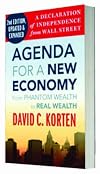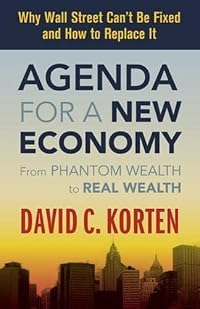
Agenda for a New Economy: From Phantom Wealth to Real Wealth
by David C. Korten
On This Page
Description
Today's economic crisis is the worst since the Great Depression. However, as David Korten shows, the steps being taken to address it do nothing to deal with the reality of a failed economic system. Korten identifies the deeper sources: Wall Street institutions that have perfected the art of creating "wealth" without producing anything of real value: phantom wealth. Our hope lies not with Wall Street, Korten argues, but with Main Street, which creates real wealth from real resources to meet show more real needs. He outlines an agenda to create a new economy--locally based, community oriented, and devoted to creating a better life for all, not simply increasing profits. It will require changes to how we measure economic success, organize our financial system, even the very way we create money.--From publisher description. show lessTags
Recommendations



Member Reviews
The premise of the book was relatively straightforward - the U.S. economy is dominantly under the control of the wall street wealthy, who propel the economy in to debt and material irrelevence through the reliance on "phantom wealth." The author supports this argument well, going in to detail to some detail to describe - amongst other things - how inflation and the creation of money are driven by private banks' accounting practices, how short-term lending turns business investment in to a gambling game, how GDP doesn't reflect "real" wealth such as the destruction of the environment and the failure to provide services for the disenfranchised.
My major criticism is that towards the end of the book, it strays in to a broad and show more over-reaching left agenda, portraying a socially liberal utopia with reduced teen pregnancy amongst other unrelated social benefits. A cynic would perhaps describe him as a Luddite. Until this point, the book could've just been an argument for a manufacturing-based economy like Germany, Australia, or Scandenavia, but it instead seems to draw that the future involves entirely locally owned economies with a philosophy of minimalist living. I quite like this idea and see the value in it, but it was poorly tied to the rest of the book, linked by rhetoric moreso than argument. A seperate book would perhaps have supported this extension better.
Still highly reccommended, and in its closing perhaps reccommends a kind of extreme liberalism which serves to sharpen and provide boundaries around one's own critique of the U.S. Economy and Wall Street's influence over it. show less
My major criticism is that towards the end of the book, it strays in to a broad and show more over-reaching left agenda, portraying a socially liberal utopia with reduced teen pregnancy amongst other unrelated social benefits. A cynic would perhaps describe him as a Luddite. Until this point, the book could've just been an argument for a manufacturing-based economy like Germany, Australia, or Scandenavia, but it instead seems to draw that the future involves entirely locally owned economies with a philosophy of minimalist living. I quite like this idea and see the value in it, but it was poorly tied to the rest of the book, linked by rhetoric moreso than argument. A seperate book would perhaps have supported this extension better.
Still highly reccommended, and in its closing perhaps reccommends a kind of extreme liberalism which serves to sharpen and provide boundaries around one's own critique of the U.S. Economy and Wall Street's influence over it. show less
This Second Edition of David Korten's latest book is one of the best analyses I have read on how Wall Street economics have led to America'a current situation and are incapable of correcting it. No less importantly Dr. Korten paints a picture of what an ecological and humane economy would look like and suggests what life style and political changes we Americans must make to move towards a viable future.
Concise, accessible explanation of how the current economic system robs us of real wealth and contributes to the degradation of the planet, and how the system was able to develop this way.
Clear vision of an alternate economy and how we can get there with minimal dislocation.
Clear vision of an alternate economy and how we can get there with minimal dislocation.
A bit dry but some excellent ideas.
Author argues that the economic system of Wall Street must be left behind and replaced a Main Street based economy
Ratings
Members
- Recently Added By
Lists

Floor books
23 works; 1 member
Author Information

22+ Works 1,420 Members
David C. Korten is a cofounder and board chair of YES! Magazine, a cochair of the New Economy Working Group, the founder and president of the Living Economies Forum on Globalization, and a former Harvard Business School professor.
Awards and Honors
Classifications
- Genres
- Economics, Nonfiction, Business, General Nonfiction
- DDC/MDS
- 330.973 — Society, Government, and Culture Economics Jobs & Careers Economic geography and history North America United States
- LCC
- HC106.83 .K67 — Social sciences Economic history and conditions Economic history and conditions By region or country
- BISAC
Statistics
- Members
- 199
- Popularity
- 163,877
- Reviews
- 5
- Rating
- (3.75)
- Languages
- English, Swedish
- Media
- Paper, Ebook
- ISBNs
- 9
- ASINs
- 4