Umbrella Summer
by Lisa Graff
On This Page
Description
After her brother Jared dies, ten-year-old Annie worries about the hidden dangers of everything, from bug bites to bicycle riding, until she is befriended by a new neighbor who is grieving her own loss.Tags
Recommendations
















Member Reviews
When Jared Richards died of an undiagnosed heart condition it shattered his younger sister Annie’s world. She lives in a state of constant worry and anxiety where a mosquito bite or an upset stomach signals horrendous and fatal medical conditions. She wears a bike helmet when riding in the car and ace bandages on her ankles to avoid sprains and everyone around her gives her the “dead brother” look when they try to explain that she really is safe. She doesn’t know what safe is anymore and she is pretty certain that no one else does either.
This summer with her brother’s birthday looming and her anxiety overshadowing her life, she and her parents must find a way to move forward. With the help of a new neighbor, she may just be show more able to find a way back to the living.
This book is heartbreaking in so many ways. Annie is desperate to find some control over her world and her friends and family want to help even their own worlds are spiraling out control. I loved the connection between Mrs. Finch and Annie, a bond that could offer healing to both of them. I loved how Annie's friends never gave up on her despite all that had been going on. All the characters in this story were refreshingly authentic. When dealing with a subject such as this, it is always too easy to fall into archetypes and caricatures. I especially loved the use of Charlotte’s Web to make the point of an ever-changing world where life goes on after death.
This book may be a lot to handle for a child who has lost a family member, but it would make for a great discussion tool for most kids ages 5-13. It is a wonderful story. show less
This summer with her brother’s birthday looming and her anxiety overshadowing her life, she and her parents must find a way to move forward. With the help of a new neighbor, she may just be show more able to find a way back to the living.
This book is heartbreaking in so many ways. Annie is desperate to find some control over her world and her friends and family want to help even their own worlds are spiraling out control. I loved the connection between Mrs. Finch and Annie, a bond that could offer healing to both of them. I loved how Annie's friends never gave up on her despite all that had been going on. All the characters in this story were refreshingly authentic. When dealing with a subject such as this, it is always too easy to fall into archetypes and caricatures. I especially loved the use of Charlotte’s Web to make the point of an ever-changing world where life goes on after death.
This book may be a lot to handle for a child who has lost a family member, but it would make for a great discussion tool for most kids ages 5-13. It is a wonderful story. show less
Spoiler Alert:
Because this is an in-depth review, it's impossible not to talk about the story from beginning to end. If you feel that would spoil the novel for you, please read Umbrella Summer first before reading this review.
Theme:
The theme of Umbrella Summer, by Lisa Graff, (HarperCollins, 2009), is one of loss, grief, and eventual healing. Few middle grade authors are capable of achieving an exposition of this theme in the manner of Lisa Graff. Her use of dark humor, which at once is engaging and yet tragic, forces us to examine what it means to lose a loved one. It illustrates what it means to live beyond the pain of loss.
Basic Plot:
Annie Richards is a ten-year-old girl who lost her brother five months prior. Her brother, Jared, had show more been playing hockey and was hit in the sternum by the puck. Her parents took him to the hospital because of his chest pains, but he was given a clean bill of health and sent home. He died shortly thereafter from what was later discovered to be an aortic dissection.
As a result of his accident, Annie is terrified that something, anything, could happen to her and she could end up dead as well. She becomes obsessed with being careful. When she goes out to play, she does so wearing Band-Aids over any mark or discoloration on her skin. She keeps ace bandages on her ankles to prevent unintended sprains, and dons full padding and a helmet whenever she rides her bike. At the very beginning of the story, we see that she will not even ride her bike down a hill because of the potential danger of going too fast; instead, she climbs off and walks it all the way down.
Since anything might be the cause of her demise, she reads up on all manner of disease and accidents so as to prevent them. She even steals a book about diseases from a neighbor during a yard sale and reads it obsessively in secret.
When the elderly Mrs. Finch, a newly widowed woman, moves into the neighborhood, she and Annie strike up a curious friendship. Together they help each other come to terms with their individual and isolating grief. Mrs. Finch tells Annie that her obsession with illnesses is really an umbrella she puts up to protect herself from the rain of grief she feels over her brother's death. The idea being that if she’s worried about being sick, then she is distracted from the pain she has, the sadness that Annie’s best friend’s father labeled “despondent.”
Mrs. Finch goes on to explain that when it's raining you need an umbrella, but if you leave it up too long, it blocks out the sunshine that is sure to follow. Annie agrees with her, and she and Mrs. Finch make a deal to help each other lower their individual umbrellas.
Nevertheless, as her late brother's birthday approaches, her parents become ever more distant from her. Annie is left to deal with her grief on her own. She is forced to come to terms with the reasons for her obsessive-compulsive fears, move past them, or become their prisoner forever.
Eventually, after problems at school and problems with her friends, she begins to see that her way isn't working. Through a series of realizations, and the counseling of Mrs. Finch, she not only finds a way to help herself back into life but finds a way to help her parents come out of their grief as well. Ultimately she learns it takes the help of others to bring down one's own defensive umbrella.
Setting:
Cedar Haven, California is the fictitious town where Annie lives with her parents. Her father is a writer, and her best friend's father is a physician. The kids are allowed to ride their bikes around the neighborhood unsupervised, so we get the impression of an upper middle-class setting. The very name “Haven” suggest a safe place to live.
The author's use of an idyllic summer setting, as opposed to a more violent urban environment heightens our sense of tragedy. The death of Jared occurs in a place where nothing bad is supposed to happen. This juxtaposition adds depth to the story and amplifies the impact of its theme.
Character:
The main character list includes Annie, herself, Rebecca (her best friend), Doug (the boy she loves to hate), the old lady, Ms. Finch, Annie's mother, Annie’s father, Rebecca's father, and of course, Annie's late brother, Jared.
The character arc for Annie is revealed as she moves from scared, obsessive-compulsive hypochondriac, to confident child, taking life by the handlebars and coming to peace with the death of her older brother. Annie, as it turns out, grows up as she grows beyond her grief.
Having said that, I was surprised by Graff's unique ability to create an eminently memorable character with Annie Richards. She acheived this by taking a risk. Since middle grade fiction normally focuses on the main character's reactions to external events, most middle grade uses a third person perspective; however, in this story, the author chooses first person narration to emphasize the subtle humor within the character's thought processes. Ultimately this makes Annie an interesting and unforgettable character--very well done in my opinion.
Symbolism:
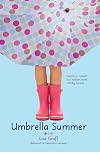
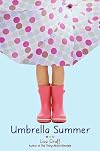
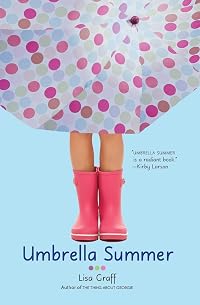
An obvious symbol in the story is the umbrella. Indeed the cover illustration is that of an umbrella covering a young girl, but to consider the umbrella the central symbolism would be a major error.
Consider that until Mrs. Finch puts forward her theory of an imaginary defensive umbrella created by Annie's hypochondriasis, Annie's obsessive-compulsiveness with illness and injury seems to have a different origin. Annie is being completely ignored by her parents following the death of her brother. His room is kept locked and in exactly the way it was before his demise--as a kind of shrine. Since the grief of his loss consumes her mother to the extent of ignoring her only other child, and since her father has also detached himself from her, it is completely reasonable that Annie views her brother as more important dead than he ever was alive.
For that reason, I believe Annie's hypervigilance symbolizes Annie’s own death wish. After all, if she can become dead like her brother, then perhaps her parents will love her as they love him. For Annie, surviving has become a worse demise than being dead.
This same dynamic is present in the book by Judith Guest, Ordinary People. The main character, Conrad, is faced with the same parental message: his brother is more important than he is because his brother is dead.
Therefore, it is reasonable to assume the umbrella is not the real central symbol. Rather, I suggest Annie's OCD is the central symbol. Each disease Annie reads about, and claims to be scared of, really represents an essential death wish that scares her more than anything else.
This theory is supported in the text when Annie goes into her father's home office and sees a calendar with a big red circle around her late brother's birthday. She thinks:
He would always be the exact same age he was in February. But next year, on my birthday, I was going to turn eleven, and then the year after that I'd be twelve, and then I'd be older than my older brother. I went back to my room and crawled under the covers, wondering which would be worse--growing older than Jared or catching the plague.
Essentially, what Annie is telling us is that she is unsure whether it is better to go on living or to go ahead and die. How could she ever be more prominent (older) than her brother? How could she ever compete with his death for her parent’s attention?
Furthermore, the umbrella as symbol in this work seems forced upon us; it seems too simple. Like a clue that is too obvious in a mystery, it beckons us to look deeper into things. We are overtly informed her hypervigilance is an umbrella to protect her from feeling bad about her brother, but her hypervigilance appears more like a reaction formation against a desire to die and therefore be loved as her brother is loved.
Of course there is another major symbol in this story apart from both the hypochondriasis and the umbrella, and it further supports a theory of an unwanted death wish on the part of Annie. That symbol is the obstacle course her friend Doug keeps trying to get her to engage in. She won't build or participate in an obstacle course, because she is too afraid of being injured.
The obstacle course is mentioned throughout the entire novel, so we know it's a symbol of sorts, and by the end of the story, we see that it truly represents the struggle Annie has had in overcoming the death of her brother and in helping her parents to overcome their grief as well. It is only once she has resolved this struggle, and is once again unified with and loved by her parents, that she then finds the courage to run through Doug's obstacle course.
And that brings us to the end of Umbrella Summer. As Annie completes her character arc, she navigates the obstacle course with Doug and her friend Rebecca, and just before she does so, she tears up a will that she has written out and carried with her at all times. Thus we see that when the symbolism of the obstacle course comes to fruition--when Annie has won her struggle to regain her parents love, when she no longer fears having to die to get it--she destroys her unwanted “will of death.”
Moral:
An important moral of this story is that we, the living, have a responsibility to go on living even in the face of grief over the loss of a loved one. The gravity of that loss can pull us down like a whirlpool sucking us under the surface, but we have to be strong and find our way out. Of course this is easier said than done, but if we don't do so, we find in the message of Umbrella Summer, that a death can be contagious.
Impact:
Unfortunately, as it may present itself on the surface, I don't see Umbrella Summer as particularly useful to a child who has actually lost a loved one. The reason being is that the character of Annie is too outrageous, complex, and specialized to be widely applicable to most children. But therein lies the beauty of it:
Any child reading this book will fall in love with the character of Annie Richards. Graff's skill in characterization ensures it. In so doing, a child may find herself inclined toward the field of medicine. If she then explores the depths of this story and its characters, she may be inclined specifically toward psychology or psychiatry. For that reason, this story is important in that it encourages kids toward those noble fields of endeavor. It romanticizes them--and that is the heart of inspiration.
Recommendation:
Umbrella Summer is a must read. It’s a classic piece of middle grade literature. This review is late in coming, but this story is timeless, and I'm shocked it never won a national award such as the Newbery. Nevertheless, Lisa Graff has several books out, and she is a prolific writer. Her latest novel, at the time of this writing, is Lost in the Sun (Penguin, May 2015); therefore, I have no doubt with her continuing talent and unique middle grade voice; we will see her star rising very soon.
Reviewed by Edward J. Gordon, MGWA
See his video review of this title at: https://www.youtube.com/watch?v=njjrZV2mjkk show less
Because this is an in-depth review, it's impossible not to talk about the story from beginning to end. If you feel that would spoil the novel for you, please read Umbrella Summer first before reading this review.
Theme:
The theme of Umbrella Summer, by Lisa Graff, (HarperCollins, 2009), is one of loss, grief, and eventual healing. Few middle grade authors are capable of achieving an exposition of this theme in the manner of Lisa Graff. Her use of dark humor, which at once is engaging and yet tragic, forces us to examine what it means to lose a loved one. It illustrates what it means to live beyond the pain of loss.
Basic Plot:
Annie Richards is a ten-year-old girl who lost her brother five months prior. Her brother, Jared, had show more been playing hockey and was hit in the sternum by the puck. Her parents took him to the hospital because of his chest pains, but he was given a clean bill of health and sent home. He died shortly thereafter from what was later discovered to be an aortic dissection.
As a result of his accident, Annie is terrified that something, anything, could happen to her and she could end up dead as well. She becomes obsessed with being careful. When she goes out to play, she does so wearing Band-Aids over any mark or discoloration on her skin. She keeps ace bandages on her ankles to prevent unintended sprains, and dons full padding and a helmet whenever she rides her bike. At the very beginning of the story, we see that she will not even ride her bike down a hill because of the potential danger of going too fast; instead, she climbs off and walks it all the way down.
Since anything might be the cause of her demise, she reads up on all manner of disease and accidents so as to prevent them. She even steals a book about diseases from a neighbor during a yard sale and reads it obsessively in secret.
When the elderly Mrs. Finch, a newly widowed woman, moves into the neighborhood, she and Annie strike up a curious friendship. Together they help each other come to terms with their individual and isolating grief. Mrs. Finch tells Annie that her obsession with illnesses is really an umbrella she puts up to protect herself from the rain of grief she feels over her brother's death. The idea being that if she’s worried about being sick, then she is distracted from the pain she has, the sadness that Annie’s best friend’s father labeled “despondent.”
Mrs. Finch goes on to explain that when it's raining you need an umbrella, but if you leave it up too long, it blocks out the sunshine that is sure to follow. Annie agrees with her, and she and Mrs. Finch make a deal to help each other lower their individual umbrellas.
Nevertheless, as her late brother's birthday approaches, her parents become ever more distant from her. Annie is left to deal with her grief on her own. She is forced to come to terms with the reasons for her obsessive-compulsive fears, move past them, or become their prisoner forever.
Eventually, after problems at school and problems with her friends, she begins to see that her way isn't working. Through a series of realizations, and the counseling of Mrs. Finch, she not only finds a way to help herself back into life but finds a way to help her parents come out of their grief as well. Ultimately she learns it takes the help of others to bring down one's own defensive umbrella.
Setting:
Cedar Haven, California is the fictitious town where Annie lives with her parents. Her father is a writer, and her best friend's father is a physician. The kids are allowed to ride their bikes around the neighborhood unsupervised, so we get the impression of an upper middle-class setting. The very name “Haven” suggest a safe place to live.
The author's use of an idyllic summer setting, as opposed to a more violent urban environment heightens our sense of tragedy. The death of Jared occurs in a place where nothing bad is supposed to happen. This juxtaposition adds depth to the story and amplifies the impact of its theme.
Character:
The main character list includes Annie, herself, Rebecca (her best friend), Doug (the boy she loves to hate), the old lady, Ms. Finch, Annie's mother, Annie’s father, Rebecca's father, and of course, Annie's late brother, Jared.
The character arc for Annie is revealed as she moves from scared, obsessive-compulsive hypochondriac, to confident child, taking life by the handlebars and coming to peace with the death of her older brother. Annie, as it turns out, grows up as she grows beyond her grief.
Having said that, I was surprised by Graff's unique ability to create an eminently memorable character with Annie Richards. She acheived this by taking a risk. Since middle grade fiction normally focuses on the main character's reactions to external events, most middle grade uses a third person perspective; however, in this story, the author chooses first person narration to emphasize the subtle humor within the character's thought processes. Ultimately this makes Annie an interesting and unforgettable character--very well done in my opinion.
Symbolism:
An obvious symbol in the story is the umbrella. Indeed the cover illustration is that of an umbrella covering a young girl, but to consider the umbrella the central symbolism would be a major error.
Consider that until Mrs. Finch puts forward her theory of an imaginary defensive umbrella created by Annie's hypochondriasis, Annie's obsessive-compulsiveness with illness and injury seems to have a different origin. Annie is being completely ignored by her parents following the death of her brother. His room is kept locked and in exactly the way it was before his demise--as a kind of shrine. Since the grief of his loss consumes her mother to the extent of ignoring her only other child, and since her father has also detached himself from her, it is completely reasonable that Annie views her brother as more important dead than he ever was alive.
For that reason, I believe Annie's hypervigilance symbolizes Annie’s own death wish. After all, if she can become dead like her brother, then perhaps her parents will love her as they love him. For Annie, surviving has become a worse demise than being dead.
This same dynamic is present in the book by Judith Guest, Ordinary People. The main character, Conrad, is faced with the same parental message: his brother is more important than he is because his brother is dead.
Therefore, it is reasonable to assume the umbrella is not the real central symbol. Rather, I suggest Annie's OCD is the central symbol. Each disease Annie reads about, and claims to be scared of, really represents an essential death wish that scares her more than anything else.
This theory is supported in the text when Annie goes into her father's home office and sees a calendar with a big red circle around her late brother's birthday. She thinks:
He would always be the exact same age he was in February. But next year, on my birthday, I was going to turn eleven, and then the year after that I'd be twelve, and then I'd be older than my older brother. I went back to my room and crawled under the covers, wondering which would be worse--growing older than Jared or catching the plague.
Essentially, what Annie is telling us is that she is unsure whether it is better to go on living or to go ahead and die. How could she ever be more prominent (older) than her brother? How could she ever compete with his death for her parent’s attention?
Furthermore, the umbrella as symbol in this work seems forced upon us; it seems too simple. Like a clue that is too obvious in a mystery, it beckons us to look deeper into things. We are overtly informed her hypervigilance is an umbrella to protect her from feeling bad about her brother, but her hypervigilance appears more like a reaction formation against a desire to die and therefore be loved as her brother is loved.
Of course there is another major symbol in this story apart from both the hypochondriasis and the umbrella, and it further supports a theory of an unwanted death wish on the part of Annie. That symbol is the obstacle course her friend Doug keeps trying to get her to engage in. She won't build or participate in an obstacle course, because she is too afraid of being injured.
The obstacle course is mentioned throughout the entire novel, so we know it's a symbol of sorts, and by the end of the story, we see that it truly represents the struggle Annie has had in overcoming the death of her brother and in helping her parents to overcome their grief as well. It is only once she has resolved this struggle, and is once again unified with and loved by her parents, that she then finds the courage to run through Doug's obstacle course.
And that brings us to the end of Umbrella Summer. As Annie completes her character arc, she navigates the obstacle course with Doug and her friend Rebecca, and just before she does so, she tears up a will that she has written out and carried with her at all times. Thus we see that when the symbolism of the obstacle course comes to fruition--when Annie has won her struggle to regain her parents love, when she no longer fears having to die to get it--she destroys her unwanted “will of death.”
Moral:
An important moral of this story is that we, the living, have a responsibility to go on living even in the face of grief over the loss of a loved one. The gravity of that loss can pull us down like a whirlpool sucking us under the surface, but we have to be strong and find our way out. Of course this is easier said than done, but if we don't do so, we find in the message of Umbrella Summer, that a death can be contagious.
Impact:
Unfortunately, as it may present itself on the surface, I don't see Umbrella Summer as particularly useful to a child who has actually lost a loved one. The reason being is that the character of Annie is too outrageous, complex, and specialized to be widely applicable to most children. But therein lies the beauty of it:
Any child reading this book will fall in love with the character of Annie Richards. Graff's skill in characterization ensures it. In so doing, a child may find herself inclined toward the field of medicine. If she then explores the depths of this story and its characters, she may be inclined specifically toward psychology or psychiatry. For that reason, this story is important in that it encourages kids toward those noble fields of endeavor. It romanticizes them--and that is the heart of inspiration.
Recommendation:
Umbrella Summer is a must read. It’s a classic piece of middle grade literature. This review is late in coming, but this story is timeless, and I'm shocked it never won a national award such as the Newbery. Nevertheless, Lisa Graff has several books out, and she is a prolific writer. Her latest novel, at the time of this writing, is Lost in the Sun (Penguin, May 2015); therefore, I have no doubt with her continuing talent and unique middle grade voice; we will see her star rising very soon.
Reviewed by Edward J. Gordon, MGWA
See his video review of this title at: https://www.youtube.com/watch?v=njjrZV2mjkk show less
Annie is coping with the death of her brother by being overly cautious about everything and her parents are distant as they grieve the death of their son. But with the friendship of another grieving woman and friends who keep reaching out, Annie learns to let the sunshine in and encourage her family to do the same.
Kicking off summer reading (school's out next week) sitting in the sun at Portland Rose Festival's Dragon Boat races reading from next near's OBOB 3-5th grade book list. I finished this book today and loved it.
Annie, the quirky main character is dealing with the recent loss of her 11 year old brother. She learns a lesson about life from the characteristic grandma figure, Mrs. Finch, who is recently widowed and dealing with her own healing. Now, If Annie can get her parents to move past Jared's death and be there for her, maybe she will start being a kid again.
Annie, the quirky main character is dealing with the recent loss of her 11 year old brother. She learns a lesson about life from the characteristic grandma figure, Mrs. Finch, who is recently widowed and dealing with her own healing. Now, If Annie can get her parents to move past Jared's death and be there for her, maybe she will start being a kid again.
Umbrella Summer was a quick and easy read. It didn't capture me at the beginning like I had hoped, but it packed a punch at the end. Annie is quite a character and it was easy to fall in love with her. I found myself wanting to just give her a hug! Especially since her parents, though grieving the loss of their son, were totally uninvolved with her life. It almost seemed that Annie had better relationships with the adult neighbors around her than with her own parents. Through one of those relationships, the one with the new neighbor, Annie finally learns about her umbrella. I loved this part of the book. When it's explained how she uses her worries to distract her from feeling Jared's loss. It was such a great image and very age show more appropriate for someone in Annie's shoes.
I also enjoyed the interaction between Annie and her friends. She and Rebecca were best friends. I really thought that Rebecca respected Annie and played in a way that Annie wasn't worried about getting hurt. Then, there was Tommy. Tommy was Jared's best friend, but he still treated Annie like a person. They ended up helping each other in the end, and I liked how that played out. It was fitting that it was Annie and Tommy who remembered Jared on his birthday. There was also a conflict between Rebecca and Annie that was a perfect fit to the story. Not only because conflicts between girls of that age are certain, but it also provided an aspect of friendship and how forgiveness is important.
Overall, I enjoyed the book. It wasn't heavy as I'm sure some books about death are. It was light and really did carry a powerful message for children and adults alike! show less
I also enjoyed the interaction between Annie and her friends. She and Rebecca were best friends. I really thought that Rebecca respected Annie and played in a way that Annie wasn't worried about getting hurt. Then, there was Tommy. Tommy was Jared's best friend, but he still treated Annie like a person. They ended up helping each other in the end, and I liked how that played out. It was fitting that it was Annie and Tommy who remembered Jared on his birthday. There was also a conflict between Rebecca and Annie that was a perfect fit to the story. Not only because conflicts between girls of that age are certain, but it also provided an aspect of friendship and how forgiveness is important.
Overall, I enjoyed the book. It wasn't heavy as I'm sure some books about death are. It was light and really did carry a powerful message for children and adults alike! show less
1
Annie has become overly cautious since the sudden death of her older brother and is now afraid to take risks. She is quite loveable with her quirky ideas and worries, but my favourite character is Mrs Finch, Annie's elderly neighbour who helps her to close her umbrella and move forward. A sweet story for younger readers with an important message.
I love reading middle grade books because the characters are always so quirky and lovable. In this book the main character Annie is afraid of everything ever since her brother Jared dies unexpectedly. Annie’s parents haven’t been the same since her brother’s death, but they refuse to talk about it, leaving Annie to deal with things in her own way. She wears a helmet when walking down the street, goes through more boxes of band-aids than a family of 12, and knows more about diseases than any 10 year old should (thanks to Mrs. Harper’s giant green copy of The Everyday Guide to Preventing Illness.) Friends and family all tell her that she needs to stop worrying so much. Like it’s that easy.
It takes a new neighbor who can relate show more to Annie to show her that you can’t spend your life afraid of everything that could happen because if you do you’ll loose out on all the good things life has to offer.
I thoroughly enjoyed myself while reading this book. I liked the characters, I liked the storyline, and I liked the message it sent. show less
It takes a new neighbor who can relate show more to Annie to show her that you can’t spend your life afraid of everything that could happen because if you do you’ll loose out on all the good things life has to offer.
I thoroughly enjoyed myself while reading this book. I liked the characters, I liked the storyline, and I liked the message it sent. show less
Members
- Recently Added By
Lists

AR Level 4 in cloudLibrary
244 works; 1 member
Author Information

18+ Works 4,427 Members
Awards and Honors
Awards
Common Knowledge
- Canonical title
- Umbrella Summer
Classifications
Statistics
- Members
- 561
- Popularity
- 52,964
- Reviews
- 25
- Rating
- (3.98)
- Languages
- English
- Media
- Paper, Ebook
- ISBNs
- 13
- ASINs
- 2