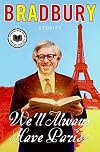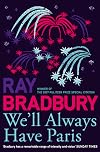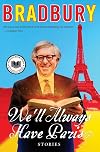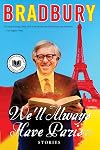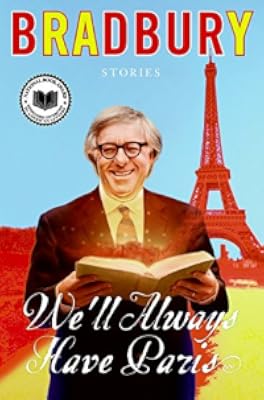
We'll Always Have Paris
by Ray Bradbury
On This Page
Description
A new collection of never-before-published stories, in which Bradbury explores the myriad ways to be reborn, the circumstances that can make any man a killer, and returns us to Mars.Tags
Recommendations

















Member Reviews
There’s a perfect Ray Bradbury town. It’s small, located somewhere in middle America, one of those states where you have to work hard at a real job to get by, where the local economy, or more to the point the locals, will tolerate weakness like mild alcoholism, but won’t tolerate a weakness like trying to get rich off of the misery or sweat of others. The town has one high street and it has just about everything you could need, there’s a drug store with a soda fountain, there’s a saloon for those that like that sort of thing, there’s a hardware store and, most important of all, there’s a post office where the exotica you have purchased from mail order catalogues will be delivered. What Bradbury realises is that, like the show more things in the mail order catalogues, things as they appear on the page are hints of perfection, when they rub up against reality, that perfection degrades.
There are communities, usually gated, that are a version of a perfect town but, like an image seen in a distorting mirror of a creepy carney, there’s something unsettling about them. Doors and porches are a certain way because of regulations, not because folk like them that way. These communities are great to a certain extent, because they keep all the low-brow middle class safely segregated from real people who live in the real world, but they’re breeding and something tells me that their children won’t read Ray Bradbury – more than a shame, that’s abuse.
It’s a shame for any couple living in their gated community too, because a lot of the stories in ‘We’ll always have Paris’ are about couples. Couples, and time travel, the hardest kind of time travel to achieve, the one where you move forward one second, hour, day and year at a time in the company of another and, at critical points in the journey, not only feel pleased that you’ve come so far together, but are still excited about going on together.
Some of the tales are not so much short stories, but more observations about being in a relationship and Bradbury explores many aspects of the pleasures and strains of hitching your star to somebody else’s wagon.
The stories are superb and the book is an absolute delight. Every time I finished a story I would think ‘that was my favourite’, only to revise my opinion half-way through the next one. When I closed the back cover I ducked the issue completely and decided that they are all favourites. A blatant cop-out I know, and one that means that if I do, at some future date, provoked by a random thought, impulse, memory or scent, want to re-read one of the stories from this collection, it’ll inevitably mean re-reading the whole thing. No chore.
Okay, so no favourites, but two stories notable if, for nothing else, the reaction they provoked.
If you’ve been married a while (and you’ll know for yourself how long ‘a while’ is), then ‘The Twilight Greens’ is probably one of the most chilling stories you’ll ever read. It’s like a litmus test for your relationship and, depending on who in the story you identify with, may well lead to you actually being a more thoughtful, considerate and caring human being. Or it may be the wake-up call you need to shake you out of emotional torpor, or you may just buy some golf clubs. One thing is for sure though, you’ll never look at golf the same way again and you’ll never walk or drive past a golf-course at dusk again without thinking of this story.
Judging from the annotation at the start of the story, Bradbury wrote ‘The visit’ in 22 minutes. I read it on public transport and had to blink away tears and fake a cough to disguise the fact that I was pretty close to crying, like the big wuss I am. It’s a remarkable story, even more so because the subject of it is both common and remarkable, miraculous even.
(Oh, rocket-ship and spaceman fans, don’t worry, your needs are catered for admirably too, with a tale of exploration and colonisation.) show less
There are communities, usually gated, that are a version of a perfect town but, like an image seen in a distorting mirror of a creepy carney, there’s something unsettling about them. Doors and porches are a certain way because of regulations, not because folk like them that way. These communities are great to a certain extent, because they keep all the low-brow middle class safely segregated from real people who live in the real world, but they’re breeding and something tells me that their children won’t read Ray Bradbury – more than a shame, that’s abuse.
It’s a shame for any couple living in their gated community too, because a lot of the stories in ‘We’ll always have Paris’ are about couples. Couples, and time travel, the hardest kind of time travel to achieve, the one where you move forward one second, hour, day and year at a time in the company of another and, at critical points in the journey, not only feel pleased that you’ve come so far together, but are still excited about going on together.
Some of the tales are not so much short stories, but more observations about being in a relationship and Bradbury explores many aspects of the pleasures and strains of hitching your star to somebody else’s wagon.
The stories are superb and the book is an absolute delight. Every time I finished a story I would think ‘that was my favourite’, only to revise my opinion half-way through the next one. When I closed the back cover I ducked the issue completely and decided that they are all favourites. A blatant cop-out I know, and one that means that if I do, at some future date, provoked by a random thought, impulse, memory or scent, want to re-read one of the stories from this collection, it’ll inevitably mean re-reading the whole thing. No chore.
Okay, so no favourites, but two stories notable if, for nothing else, the reaction they provoked.
If you’ve been married a while (and you’ll know for yourself how long ‘a while’ is), then ‘The Twilight Greens’ is probably one of the most chilling stories you’ll ever read. It’s like a litmus test for your relationship and, depending on who in the story you identify with, may well lead to you actually being a more thoughtful, considerate and caring human being. Or it may be the wake-up call you need to shake you out of emotional torpor, or you may just buy some golf clubs. One thing is for sure though, you’ll never look at golf the same way again and you’ll never walk or drive past a golf-course at dusk again without thinking of this story.
Judging from the annotation at the start of the story, Bradbury wrote ‘The visit’ in 22 minutes. I read it on public transport and had to blink away tears and fake a cough to disguise the fact that I was pretty close to crying, like the big wuss I am. It’s a remarkable story, even more so because the subject of it is both common and remarkable, miraculous even.
(Oh, rocket-ship and spaceman fans, don’t worry, your needs are catered for admirably too, with a tale of exploration and colonisation.) show less
Of course we will always have Ray Bradbury! As long as children run to the sound of the carousel, and the circus parade; as long as dandelions still grow in our front lawns; as long as the call of the train or bright trails of rockets reach out to us across the miles, Ray will be with us. Whether, as in this collection of never before published stories, we walk the streets of Venice, Ca., or the rues de Paris, or discover the true nature of man's best friend or the truth in young love, we we can be sure that Ray's view of the ordinary will be just a bit extraordinary.
Yet another excellent collection of stories from Ray Bradbury...several great ones, many good, only a couple of really weak ones and none that I would call bad (with the possible exception of "Pater Caninus"). From "The Reincarnate", about a man who rises from the grave and tries to pick up where he left off with his beloved ("Love depends on more than thought...because thought itself is built upon the senses"), to "A Literary Encounter" about a couple whose relationship reflects whatever he happens to be reading at the moment, these stories are brimming over with Bradbury's characteristic feeling and charm.
But my favorite story here, and now one of my all-time favorites, is "Un-pillow Talk". It opens with a couple who've just made show more passionate love, but we soon learn that they've just been friends up to this point and now worry that this will ruin the really great friendship they've had. So the story mainly consists of them sort of retracing their relationship, trying to talk themselves back to where they were before they made this terrible mistake. The ending is so sweet and absolutely perfect and left me feeling good for days.
I just picked this collection up from the public library, but I enjoyed it so much that I'm going to have to add it to my own personal library! show less
But my favorite story here, and now one of my all-time favorites, is "Un-pillow Talk". It opens with a couple who've just made show more passionate love, but we soon learn that they've just been friends up to this point and now worry that this will ruin the really great friendship they've had. So the story mainly consists of them sort of retracing their relationship, trying to talk themselves back to where they were before they made this terrible mistake. The ending is so sweet and absolutely perfect and left me feeling good for days.
I just picked this collection up from the public library, but I enjoyed it so much that I'm going to have to add it to my own personal library! show less
A collection of short stories by the Master, these harken in style back to his earlier days of effortless whimsical fantasy. There is a nursing home dog who makes the rounds of those soon to die, listening patiently as they pour out their last thoughts as if he were human and had a collar. There is an elderly couple who convince themselves to break out of their fossilized routine, realizing by day's end that lifelong routines have their little points. Particularly touching are "Pieta Summer", a perhaps autobiographical story in which a boy suddenly realizes the true breadth of his father's love, "If Paths Must Cross Again", in which a new couple about to be separated by duty and World War II discover that their paths crossed years ago show more in their childhood town, and "A Literary Encounter", in which a couple who have been patterning their lives by the classics they read, re-discover their love by going back to writers who valued the true and fine in life, including an old favorite of mine, William Saroyan. I suspect that Ray Bradbury and I have read and loved many of the same books. show less
This book makes me sad. It has all the style of Bradbury that we have all come to expect. The quiet moments. The perfect sentimentalism. The microcosmic snapshots of life with “things” going on around them. It comes so close to that Bradbury magic. Yet, the stories are all missing something. It is almost as if someone is imitating Bradbury – using his style to tell stories that don’t really matter.
And that gets to the problem. The stories, once the reader is done, just don’t matter. There is not a single one that sticks in the mind, that haunts the reader, that brings the reader to a new place. I, literally, look through the table of contents after reading the book and struggle to remember what a single one of the stories is show more about.
All the style; none of the substance. And now I desperately need to go back and re-read the older collections to remember how Bradbury, at his best, could do so much with the short story. show less
And that gets to the problem. The stories, once the reader is done, just don’t matter. There is not a single one that sticks in the mind, that haunts the reader, that brings the reader to a new place. I, literally, look through the table of contents after reading the book and struggle to remember what a single one of the stories is show more about.
All the style; none of the substance. And now I desperately need to go back and re-read the older collections to remember how Bradbury, at his best, could do so much with the short story. show less
A few good stories in this collection, but on the whole it just felt a bit dirty, and most of it was unenjoyable. Fly Away Home was an excellent story about humans traveling to Mars, and the value of familiar surroundings. Pater Caninus had a dog taking confessions at a hospital, to the distress of a priest. Apple-core Baltimore was a study of childhood friendships and relationships, and A Literary Encounter handles the formative effects of what we read on our personality.
One of Bradbury's final books, released in 2009. This is a broad collection of subjects, primarily mainstream in my opinion, and the flyleaf says it is a new collection of never-before-published stories. In his brief introduction Bradbury states,after discussing the first story: "The other stories, one by one, came to me throughout my life - from a very young age through my middle and later years. Every one of them has been a passion."
I got the feeling from that intro that these stories were probably ones put away in a file after writing, that maybe weren't his best and didn't have a place to go. Like songwriters and musicians, though, sometimes really good songs were born between albums, or didn't fit with the style of others, and show more slipped away until collected at a later date. I was hoping to find some of the "hidden gem" stories in this collection that might be like that. There are a couple of good stories in here. However, for the most part many of these stories are rather mediocre and unmemorable, bits of fluff. Let's call them lesser tales from the master. Some needed more polish, some were never fleshed out, and some others just aren't remarkable. A few I disliked or wondered why they had been written. One story, "Arrival and Departure" was also in "Summer Morning, Summer Night," published at about the same time.
There is one story in here that is nominally science fiction. Two rockets go to Mars. That is all the science fiction in the story. What the story is really about is explorers far from home.
Overall this was weak and disappointing and barely an "OK." show less
I got the feeling from that intro that these stories were probably ones put away in a file after writing, that maybe weren't his best and didn't have a place to go. Like songwriters and musicians, though, sometimes really good songs were born between albums, or didn't fit with the style of others, and show more slipped away until collected at a later date. I was hoping to find some of the "hidden gem" stories in this collection that might be like that. There are a couple of good stories in here. However, for the most part many of these stories are rather mediocre and unmemorable, bits of fluff. Let's call them lesser tales from the master. Some needed more polish, some were never fleshed out, and some others just aren't remarkable. A few I disliked or wondered why they had been written. One story, "Arrival and Departure" was also in "Summer Morning, Summer Night," published at about the same time.
There is one story in here that is nominally science fiction. Two rockets go to Mars. That is all the science fiction in the story. What the story is really about is explorers far from home.
Overall this was weak and disappointing and barely an "OK." show less
Members
- Recently Added By
Published Reviews
ThingScore 75
"We'll Always Have Paris" is unashamedly a collection of stories written decades apart, sharing no theme or real raison d'être. And while this isn't Bradbury at the top of his game, this collection pulls its weight and hits enough weird and beautiful poetic notes to satisfy and even surprise his constant readers.
added by Shortride
Lists

Paris, City of Lights
103 works; 17 members
Author Information

942+ Works 168,844 Members
Ray Bradbury was born in Waukegan, Illinois on August 22, 1920. At the age of fifteen, he started submitting short stories to national magazines. During his lifetime, he wrote more than 600 stories, poems, essays, plays, films, television plays, radio, music, and comic books. His books include The Martian Chronicles, Fahrenheit 451, The show more Illustrated Man, Dandelion Wine, Something Wicked This Way Comes, and Bradbury Speaks. He won numerous awards for his works including a World Fantasy Award for Life Achievement in 1977, the 2000 National Book Foundation Medal for Distinguished Contribution to American Letters, the 2004 National Medal of Arts, and the 2007 Pulitzer Prize Special Citation. He wrote the screen play for John Huston's classic film adaptation of Moby Dick, and was nominated for an Academy Award. He adapted 65 of his stories for television's The Ray Bradbury Theater, and won an Emmy for his teleplay of The Halloween Tree. The film The Wonderful Ice Cream Suit was written by Ray Bradbury and was based on his story The Magic White Suit. He was the idea consultant and wrote the basic scenario for the United States pavilion at the 1964 World's Fair, as well as being an imagineer for Walt Disney Enterprises, where he designed the Spaceship Earth exhibition at Walt Disney World's Epcot Center. He died after a long illness on June 5, 2012 at the age of 91. (Bowker Author Biography) show less
Work Relationships
Is contained in
Contains
Common Knowledge
- Canonical title
- We'll Always Have Paris
- Original title
- We'll Always Have Paris
- Original publication date
- 2008-12
- Dedication
- With love to my lifetime friend
Donald Harkins,
who is buried in Paris - First words
- The stories in this collection were created by two people: The me who watches and the me who writes. (Introduction)
- Last words
- (Click to show. Warning: May contain spoilers.)You are the dream that other people dream.
- Original language
- English
Classifications
Statistics
- Members
- 438
- Popularity
- 70,103
- Reviews
- 11
- Rating
- (3.64)
- Languages
- 5 — Czech, English, Italian, Russian, Spanish
- Media
- Paper, Audiobook, Ebook
- ISBNs
- 22
- ASINs
- 8