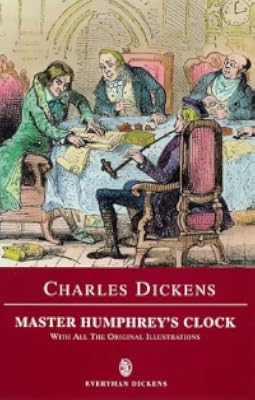
Master Humphrey's Clock and Other Stories
by Charles Dickens
On This Page
Description
A unique selection of Dickens's shorter fiction - Public Life of Mr Tulrumble, Master Humphrey's Clock, The Lamplighter's Story, To Be Read At Dusk, Hunted Down and George Silverman's Explanation.Tags
Recommendations















Member Reviews
G.K. Chesterton's review says it all about Master Humphrey's Clock: "As a triumph of Dickens, at least, it is not of great importance. But as a sample of Dickens it happens to be of quite remarkable importance. The very fact that it is somewhat more level and even monotonous than most of his creations makes us realise, as it were, against what level and monotony those creations commonly stand out."
Originally a regular magazine written entirely by Charles Dickens, Master Humphrey's Clock uses an elderly gentleman named Master Humphrey as a frame for a number of stories. It starts out in the style of 1,001 Nights with stories within stories, which works reasonably well. But as Dickens worked, one of this "stories" turned into the full show more length novel The Old Curiosity Shop and another into Barnaby Rudge. As a result, reading Master Humphrey today (which omits these two novels) becomes increasingly too much frame relative to the stories.
Master Humphrey's Clock is also the only Dickens work where characters reappear from other works -- specifically Pickwick and some of his friends. The reappearance is much flatter than the original and might explain why Dickens did not go the route of Balzac in populating his novels with overlapping characters and incidents. show less
Originally a regular magazine written entirely by Charles Dickens, Master Humphrey's Clock uses an elderly gentleman named Master Humphrey as a frame for a number of stories. It starts out in the style of 1,001 Nights with stories within stories, which works reasonably well. But as Dickens worked, one of this "stories" turned into the full show more length novel The Old Curiosity Shop and another into Barnaby Rudge. As a result, reading Master Humphrey today (which omits these two novels) becomes increasingly too much frame relative to the stories.
Master Humphrey's Clock is also the only Dickens work where characters reappear from other works -- specifically Pickwick and some of his friends. The reappearance is much flatter than the original and might explain why Dickens did not go the route of Balzac in populating his novels with overlapping characters and incidents. show less
Dickens' least convincing long piece. It's a miscellany, loosely held together by two groups of friends who tell one another stories. The stories they tell are not particularly interesting. But it is Dickens, and he has not lost his ear for language or ability to create characters.
G.K. Chesterton's review says it all about Master Humphrey's Clock: "As a triumph of Dickens, at least, it is not of great importance. But as a sample of Dickens it happens to be of quite remarkable importance. The very fact that it is somewhat more level and even monotonous than most of his creations makes us realise, as it were, against what level and monotony those creations commonly stand out."
Originally a regular magazine written entirely by Charles Dickens, Master Humphrey's Clock uses an elderly gentleman named Master Humphrey as a frame for a number of stories. It starts out in the style of 1,001 Nights with stories within stories, which works reasonably well. But as Dickens worked, one of this "stories" turned into the full show more length novel The Old Curiosity Shop and another into Barnaby Rudge. As a result, reading Master Humphrey today (which omits these two novels) becomes increasingly too much frame relative to the stories.
Master Humphrey's Clock is also the only Dickens work where characters reappear from other works -- specifically Pickwick and some of his friends. The reappearance is much flatter than the original and might explain why Dickens did not go the route of Balzac in populating his novels with overlapping characters and incidents. show less
Originally a regular magazine written entirely by Charles Dickens, Master Humphrey's Clock uses an elderly gentleman named Master Humphrey as a frame for a number of stories. It starts out in the style of 1,001 Nights with stories within stories, which works reasonably well. But as Dickens worked, one of this "stories" turned into the full show more length novel The Old Curiosity Shop and another into Barnaby Rudge. As a result, reading Master Humphrey today (which omits these two novels) becomes increasingly too much frame relative to the stories.
Master Humphrey's Clock is also the only Dickens work where characters reappear from other works -- specifically Pickwick and some of his friends. The reappearance is much flatter than the original and might explain why Dickens did not go the route of Balzac in populating his novels with overlapping characters and incidents. show less
an old man and 3 others sit around and palaver. Basically this was a serialization between novels. It was not a story in and of itself. Not very interesting. The only thing going for it was the inclusion of Pickwick and the Weller's.
Ratings
Members
- Recently Added By
Author Information

2,578+ Works 313,139 Members
Charles Dickens, perhaps the best British novelist of the Victorian era, was born in Portsmouth, Hampshire, England on February 7, 1812. His happy early childhood was interrupted when his father was sent to debtors' prison, and young Dickens had to go to work in a factory at age twelve. Later, he took jobs as an office boy and journalist before show more publishing essays and stories in the 1830s. His first novel, The Pickwick Papers, made him a famous and popular author at the age of twenty-five. Subsequent works were published serially in periodicals and cemented his reputation as a master of colorful characterization, and as a harsh critic of social evils and corrupt institutions. His many books include Oliver Twist, David Copperfield, Bleak House, Great Expectations, Little Dorrit, A Christmas Carol, and A Tale of Two Cities. Dickens married Catherine Hogarth in 1836, and the couple had nine children before separating in 1858 when he began a long affair with Ellen Ternan, a young actress. Despite the scandal, Dickens remained a public figure, appearing often to read his fiction. He died in 1870, leaving his final novel, The Mystery of Edwin Drood, unfinished. (Bowker Author Biography) show less
Work Relationships
Common Knowledge
- Canonical title
- Master Humphrey's Clock and Other Stories
- Disambiguation notice
- This is a collection of five stories (see description for exact titles). Please do not combine with other collections unless the contents are the same.
Classifications
Statistics
- Members
- 29
- Popularity
- 951,084
- Reviews
- 4
- Rating
- (3.75)
- Languages
- English
- Media
- Paper
- ISBNs
- 1