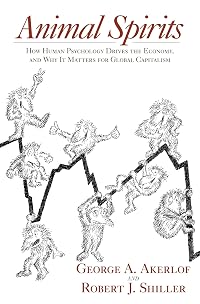
Animal Spirits: How Human Psychology Drives the Economy, and Why It Matters for Global Capitalism
by George A. Akerlof, Robert J. Shiller
On This Page
Description
The global financial crisis has made it painfully clear that powerful psychological forces are imperiling the wealth of nations today. From blind faith in ever rising housing prices to plummeting confidence in capital markets, "animal spirits" are driving financial events worldwide. In this book, the authors, both economists, challenge the economic wisdom that got us into this mess, and put forward a bold new vision that will transform economics and restore prosperity. They reassert the show more necessity of an active government role in economic policymaking by recovering the idea of "animal spirits", a term John Maynard Keynes used to describe the gloom and despondence that led to the Great Depression and the changing psychology that accompanied recovery. Like Keynes, they know that managing these animal spirits requires the steady hand of government; simply allowing markets to work won't do it. In rebuilding the case for a more robust, behaviorally informed Keynesianism, they detail the most pervasive effects of animal spirits (i.e. human psychology), in contemporary economic life, such as confidence, fear, bad faith, corruption, a concern for fairness, and the stories we tell ourselves about our economic fortune, and show how Reaganomics, Thatcherism, and the rational expectations revolution failed to account for them. The authors then offer a road map for reversing the financial misfortunes besetting us today; they teach how leaders can channel animal spirits, the powerful forces of human psychology that are afoot in the world economy today, and making them work for and not against us. show lessTags
Recommendations








Member Reviews
In [b:The General Theory|303615|The General Theory of Employment, Interest, and Money|John Maynard Keynes|https://d.gr-assets.com/books/1415594896s/303615.jpg|1711698], [a:John Maynard Keynes|159357|John Maynard Keynes|https://d.gr-assets.com/authors/1244623131p2/159357.jpg] wrote that the switches between optimism and pessimism which drive rises/falls in investment spending which, in turn, cause rises/falls in output, were driven by '"animal spirits". This was always one of the weaker points of Keynes' analysis, essentially a big shrug of the shoulders, removing any notion of economic actors rational responses to changing circumstances. This book is simply a longer restatement of that argument. People are crazy, so the authors say, show more their behaviour is irrational and, in the Keynesian way, this can cause economies to crash and stay crashed. Only the wise hand of government on economic the tiller can save us.
This leaves several questions unanswered. Why do people make the same mistake over and over? There is no learning in the model. Why is empirical evidence used so sparingly? In cases such as 1929 and 2008-2009, there were identifiable, proximate causes for people's actions which we can turn to without invoking "animal spirits". Why is it assumed that the politicians who will save us from our irrationality are any more rational than we are?
Psychology in economics is a fascinating and emerging field, but you'd never know it from this shallow and reductive book. show less
This leaves several questions unanswered. Why do people make the same mistake over and over? There is no learning in the model. Why is empirical evidence used so sparingly? In cases such as 1929 and 2008-2009, there were identifiable, proximate causes for people's actions which we can turn to without invoking "animal spirits". Why is it assumed that the politicians who will save us from our irrationality are any more rational than we are?
Psychology in economics is a fascinating and emerging field, but you'd never know it from this shallow and reductive book. show less
Creative destruction?
When I studied economics and business administration in the 1980's, some of the professors mocked the faculty's desire to move to the building for the exact sciences. Human behaviour played too important a role, they claimed. Economics is a social science. It can however frame the results of human behaviour in mathematic models that help forecast economic developments. Although we were taught about utility optimisation, it was never interpreted as a simple trade-off like "more goods for money". However, since then econometric modelling (and geeky risk management with lots of statistics at financial institutions) has become de rigueur. And now that books like Freakonomics have made the homo economicus a mainstream show more idea, the professional pendulum is swinging back: various economists are questioning the strict interpretation of rational economic behaviour.
Akerlof and Shiller, two eminent American economists, are among these. The Nobel Prize winning Mr. Akerlof is mainly famous for studying asymmetric information, as is Mr. Shiller for his American house price index and for the ratio between the stock price and the average 10-years earnings (the latter is a measure for the over- or undervaluation of the stock market).
The two authors stated that they have worked four years on this book. This somewhat surprised me. Given that the book is not very detailed, it seems to be targeting a general audience and not economists per sé. Some of the points in the book (the boom in the housing market and people’s lacking interest to invest in long-term needs like pensions) have been commonly discussed for quite some time already. The tone of the book is also quite confrontational.
If, like me, you have not kept up with the latest economic literature since your master’s, you may be surprised with Akerlof and Shiller’s unabashed support for Keynesian politics in the opening chapter: Keynesian macroeconomic policies have largely worked, they claim. Country after country has maintained full employment. This is due to Keynes’ understanding of “animal spirits”: the non-economic and non-rational behaviour that explains the underlying instability of capitalism. Governments should give a guiding hand. Ugly neoclassical economists have swept this knowledge under the rug. The authors then claim that their theory of “animal spirits” is “an easy answer” to eight important policy issues. Their theory would “fully and naturally” explain how the economy has fallen into the crisis of 2008.
The authors claim that five elements of human behaviour greatly influence the economy:
Confidence as an important factor to drive investment decisions is underestimated by traditional economists. Economists claim that rational analysis is at the basis of such decisions (although the pork cycle, a theory about adaptive expectations, has been around since the 1920’s), but in a world of uncertainty, confidence is required to come to decisions. You can even apply a Keynesian multiplier to confidence. Mr. Akerlof and Mr. Shiller do not mention Antonio Damasio’s research in human decision taking (see, among others, Peterson’s “Inside the Investor’s Brain”). The human brain cannot take decisions without involving his emotions. The human brain is also biased in favour and against certain other behaviours. Mr. Akerlof and Mr. Shiller see a direct application for their findings if the economic authorities would target credit flows as at full employment in times of a severe confidence crisis. They accept however that you cannot force financial institutions to increase lending even with the right monetary tools.
Fairness is a biological need that can override rational analysis. Fairness is a motivation in itself for the human animal, as psychological tests have proven. People desire exchanges of equal value. As an example, Mr. Akerlof and Mr. Shiller quote research about weak supervisors that sought advice from other weak supervisors, rather than from those with superior knowledge. Also, people like to live up to what they think is fair and expect so from others.
Corruption and bath faith, particularly when it applies to accounting, have great influence on people’s confidence, and scandals determine the severity of a crisis. Laxer accounting standards or a general reduced respect for the law are excellent forecasters for coming economic crises, as is exuberant consumer spending.
Money illusion, the idea that people do not understand the compounding effect of inflation (or growing capital) is more important than neoclassical economists thought. Most labour contracts do not include automatic indexation, and people dislike price hikes as much as salary cuts in times of deflation. Equally, inflation-linked bonds are relatively rare. The old Keynesian Phillips-curve (the trade off between inflation and employment) is not as flat as the Chicago School claims. Here we may see progress in the understanding of economic actors. Here in the Netherlands in the 1970’s we had Keynesian policies and they did not work (neither did they work in Britain and later in France). But we had lots of labour contracts with automatic price indexation. When unions started to understand that it harmed their members’ interests because price adjustment no longer worked, these automatic adjustments were omitted. Equally, inflation-linked bonds are not very popular if investors fear that they will be renominated to a fixed interest rate if the governments require so (basically, modern pension funds would love inflation-linked bonds with a fair spread).
Stories are necessary for people to understand themselves and the world around them. For economists they lead to an underestimation of randomness. Stories can move markets irrespective of cold facts like figures, and inspirational stories generate confidence. This confidence spreads through contagion, like a virus. It can also disappear like a virus.
So although these five factors seem fair points that influence human behaviour, the authors do not state why other behaviours do not have this influence on the economy. And they certainly do not state how these traits could be included in economic models. This is not a new theory. All you learn here is that you should take the outcome of exisiting models with a grain of salt, and I find that somewhat disappointing for a book that claims to give an easy answer to important policy questions.
Also benign government intervention and paternalism require consensus in society and high quality standards of a country’s economic policy makers. Mr. Akerlof and Mr. Shiller laud Singapore’s Minister Mentor Harry Lee Kuan Yew for this (Singaporeans who question the wisdom of their government’s investment decisions may be somewhat surprised here). Such consensus and trust, or in brief confidence, may also exist in various countries in north-western Europe, but it does not seem to be the case in the United States. The distrust of elites in southern Europe makes such policies inapplicable there.
Rather than that, Mr. Akerlof and Mr. Shiller give examples of their theories in practice. At the end of the book they claim that they do not need statistics: following their own theories, they state that the stories are enough.
Mr. Akerlof and Mr. Shiller analyse the crises of 1890 and the Great Depression in terms of animal spirits, and without much quantitative support, even when it comes to the impact of “stories”. On a global scale, there have been many more crises, so as proof this chapter seems weaker than necessary. Given that the descriptions are brief, it also gives them a certain power however. The warning for workers not accepting salary cuts in times of deflation may be useful if such a situation would occur, although in recent we have seen individual cases were people accepted such cuts (e.g. European car workers in the last decade).
The authors also analyse the crisis of 2008 in terms of lack of trust, caused by the distribution of credit. I would say that this is one important factor. Certainly, the Federal Reserve’s actions to avoid a liquidity crisis in the financial system have contributed to avoid a total crash of the system. But there are many more reasons for the confidence crisis, from the FED’s policy to continuously increase the money supply, to the ludicrous American bankruptcy laws and remuneration policies for bankers and CEO’s. Mr. Akerlof and Mr. Shiller are right if they claim that trust was not included in macro economic models, but neither was this the case with a host of other factors. The authors state again that the FED should target a credit level to the "real economy", aiming at full employment. But this implies that there is no skill friction in the American labour market, and that full employment is only a matter of macro-economic policy. Central banks in other countries do not apply such policies.
The authors then give interesting examples of markets that do not adhere to standard economic analyses. Truck driver salaries and salaries for secretaries (in America) differ from industry to industry. Here the motivation and fair treatment of workers seem to play an important role in the determination of pay differences within a company. If bosses are paid more, then so are the secretaries. Companies may also have another incentive to overpay staff. Full employment would cause workers to resign and move to a competitor sooner, and that would be a bad motivator. From personal observation I may add that managers are risk averse and prefer to hire staff that have performed the same job elsewhere. Hence, with their conservatism they reduce the pool of talent they could employ, and drive up the cost of labour.
Mr. Akerlof and Mr. Shiller the return to money illusion, which they acknowledge is one of the main reasons for writing this book. Money illusion works differently in environments with high and low inflation. In the case of high inflation workers demand full compensation, because workers demand fairness. In the case of low inflation employers have more leeway for adjustment. The authors also claim that a reduction of inflation will lead to unemployment. Workers don't understand inflation like economists, as is proven by questionnaires. Workers see a pay rise as a fair reward for their labour; even if prices rise with an equivalent percentage, they still experience it as a motivator.
Money illusion is also at play when it comes to savings, as people do not understand the effect of compounded interest. Adam Smith saw savings as the prime reason for economic growth, but in the United States the saving rate was reduced from 10% to 0% in the last decade, and bankruptcy was less seen as personal failure. The authors blame this primarily on the function of credit cards. Other factors may play a role as well. Compared to other developed economies, particularly those in Europe, consumption tax in the United States is relatively low, thus making consumption more attractive versus saving. Income differences grew because of taxation decisions by the government, reducing the rise of incomes for the lower and middle classes to near zero for prolonged periods of time. Credit was the way to increase income and keep up with the Joneses. The time horizon of people is a cultural factor, as we can find in Hofstede’s “Cultures and Organizations”. Mr. Akerlof and Mr. Shiller mention the story of patriotism that stimulates savings in places like China and Singapore. They also advocate automatic enrollment in pension plans with opt out clauses, as they are proven to be more successful at making people save than voluntary plans.
Mr. Akerlof and Mr. Shiller then move to markets in stocks, oil, and real estate, markets that are all driven by emotion. Unfortunately, they do not mention Piet Eichholz’ highly instructive Herengracht Index . Mr. Eichholz followed house prices on an area that has been prime real estate in the capital of a consistently rich country for over 3 centuries and corrected these prices for inflation. Despite great price swings, the overall rise is about 1% per annum.
After a chapter about race influencing people’s self perception as economic actors (a story), the authors end with the conclusion that bad macro economic policies can unleash animal spirits. Markets require safeguards to protect people’s trust, and that unbridled capitalism can be dangerous. I would say that is the conclusion after each crisis, but as the authors state, animal spirits lead to relaxed rules time and time again. Just read Reinhart & Rogoff’s “This Time is Different”. They blame it on hubris. show less
When I studied economics and business administration in the 1980's, some of the professors mocked the faculty's desire to move to the building for the exact sciences. Human behaviour played too important a role, they claimed. Economics is a social science. It can however frame the results of human behaviour in mathematic models that help forecast economic developments. Although we were taught about utility optimisation, it was never interpreted as a simple trade-off like "more goods for money". However, since then econometric modelling (and geeky risk management with lots of statistics at financial institutions) has become de rigueur. And now that books like Freakonomics have made the homo economicus a mainstream show more idea, the professional pendulum is swinging back: various economists are questioning the strict interpretation of rational economic behaviour.
Akerlof and Shiller, two eminent American economists, are among these. The Nobel Prize winning Mr. Akerlof is mainly famous for studying asymmetric information, as is Mr. Shiller for his American house price index and for the ratio between the stock price and the average 10-years earnings (the latter is a measure for the over- or undervaluation of the stock market).
The two authors stated that they have worked four years on this book. This somewhat surprised me. Given that the book is not very detailed, it seems to be targeting a general audience and not economists per sé. Some of the points in the book (the boom in the housing market and people’s lacking interest to invest in long-term needs like pensions) have been commonly discussed for quite some time already. The tone of the book is also quite confrontational.
If, like me, you have not kept up with the latest economic literature since your master’s, you may be surprised with Akerlof and Shiller’s unabashed support for Keynesian politics in the opening chapter: Keynesian macroeconomic policies have largely worked, they claim. Country after country has maintained full employment. This is due to Keynes’ understanding of “animal spirits”: the non-economic and non-rational behaviour that explains the underlying instability of capitalism. Governments should give a guiding hand. Ugly neoclassical economists have swept this knowledge under the rug. The authors then claim that their theory of “animal spirits” is “an easy answer” to eight important policy issues. Their theory would “fully and naturally” explain how the economy has fallen into the crisis of 2008.
The authors claim that five elements of human behaviour greatly influence the economy:
Confidence as an important factor to drive investment decisions is underestimated by traditional economists. Economists claim that rational analysis is at the basis of such decisions (although the pork cycle, a theory about adaptive expectations, has been around since the 1920’s), but in a world of uncertainty, confidence is required to come to decisions. You can even apply a Keynesian multiplier to confidence. Mr. Akerlof and Mr. Shiller do not mention Antonio Damasio’s research in human decision taking (see, among others, Peterson’s “Inside the Investor’s Brain”). The human brain cannot take decisions without involving his emotions. The human brain is also biased in favour and against certain other behaviours. Mr. Akerlof and Mr. Shiller see a direct application for their findings if the economic authorities would target credit flows as at full employment in times of a severe confidence crisis. They accept however that you cannot force financial institutions to increase lending even with the right monetary tools.
Fairness is a biological need that can override rational analysis. Fairness is a motivation in itself for the human animal, as psychological tests have proven. People desire exchanges of equal value. As an example, Mr. Akerlof and Mr. Shiller quote research about weak supervisors that sought advice from other weak supervisors, rather than from those with superior knowledge. Also, people like to live up to what they think is fair and expect so from others.
Corruption and bath faith, particularly when it applies to accounting, have great influence on people’s confidence, and scandals determine the severity of a crisis. Laxer accounting standards or a general reduced respect for the law are excellent forecasters for coming economic crises, as is exuberant consumer spending.
Money illusion, the idea that people do not understand the compounding effect of inflation (or growing capital) is more important than neoclassical economists thought. Most labour contracts do not include automatic indexation, and people dislike price hikes as much as salary cuts in times of deflation. Equally, inflation-linked bonds are relatively rare. The old Keynesian Phillips-curve (the trade off between inflation and employment) is not as flat as the Chicago School claims. Here we may see progress in the understanding of economic actors. Here in the Netherlands in the 1970’s we had Keynesian policies and they did not work (neither did they work in Britain and later in France). But we had lots of labour contracts with automatic price indexation. When unions started to understand that it harmed their members’ interests because price adjustment no longer worked, these automatic adjustments were omitted. Equally, inflation-linked bonds are not very popular if investors fear that they will be renominated to a fixed interest rate if the governments require so (basically, modern pension funds would love inflation-linked bonds with a fair spread).
Stories are necessary for people to understand themselves and the world around them. For economists they lead to an underestimation of randomness. Stories can move markets irrespective of cold facts like figures, and inspirational stories generate confidence. This confidence spreads through contagion, like a virus. It can also disappear like a virus.
So although these five factors seem fair points that influence human behaviour, the authors do not state why other behaviours do not have this influence on the economy. And they certainly do not state how these traits could be included in economic models. This is not a new theory. All you learn here is that you should take the outcome of exisiting models with a grain of salt, and I find that somewhat disappointing for a book that claims to give an easy answer to important policy questions.
Also benign government intervention and paternalism require consensus in society and high quality standards of a country’s economic policy makers. Mr. Akerlof and Mr. Shiller laud Singapore’s Minister Mentor Harry Lee Kuan Yew for this (Singaporeans who question the wisdom of their government’s investment decisions may be somewhat surprised here). Such consensus and trust, or in brief confidence, may also exist in various countries in north-western Europe, but it does not seem to be the case in the United States. The distrust of elites in southern Europe makes such policies inapplicable there.
Rather than that, Mr. Akerlof and Mr. Shiller give examples of their theories in practice. At the end of the book they claim that they do not need statistics: following their own theories, they state that the stories are enough.
Mr. Akerlof and Mr. Shiller analyse the crises of 1890 and the Great Depression in terms of animal spirits, and without much quantitative support, even when it comes to the impact of “stories”. On a global scale, there have been many more crises, so as proof this chapter seems weaker than necessary. Given that the descriptions are brief, it also gives them a certain power however. The warning for workers not accepting salary cuts in times of deflation may be useful if such a situation would occur, although in recent we have seen individual cases were people accepted such cuts (e.g. European car workers in the last decade).
The authors also analyse the crisis of 2008 in terms of lack of trust, caused by the distribution of credit. I would say that this is one important factor. Certainly, the Federal Reserve’s actions to avoid a liquidity crisis in the financial system have contributed to avoid a total crash of the system. But there are many more reasons for the confidence crisis, from the FED’s policy to continuously increase the money supply, to the ludicrous American bankruptcy laws and remuneration policies for bankers and CEO’s. Mr. Akerlof and Mr. Shiller are right if they claim that trust was not included in macro economic models, but neither was this the case with a host of other factors. The authors state again that the FED should target a credit level to the "real economy", aiming at full employment. But this implies that there is no skill friction in the American labour market, and that full employment is only a matter of macro-economic policy. Central banks in other countries do not apply such policies.
The authors then give interesting examples of markets that do not adhere to standard economic analyses. Truck driver salaries and salaries for secretaries (in America) differ from industry to industry. Here the motivation and fair treatment of workers seem to play an important role in the determination of pay differences within a company. If bosses are paid more, then so are the secretaries. Companies may also have another incentive to overpay staff. Full employment would cause workers to resign and move to a competitor sooner, and that would be a bad motivator. From personal observation I may add that managers are risk averse and prefer to hire staff that have performed the same job elsewhere. Hence, with their conservatism they reduce the pool of talent they could employ, and drive up the cost of labour.
Mr. Akerlof and Mr. Shiller the return to money illusion, which they acknowledge is one of the main reasons for writing this book. Money illusion works differently in environments with high and low inflation. In the case of high inflation workers demand full compensation, because workers demand fairness. In the case of low inflation employers have more leeway for adjustment. The authors also claim that a reduction of inflation will lead to unemployment. Workers don't understand inflation like economists, as is proven by questionnaires. Workers see a pay rise as a fair reward for their labour; even if prices rise with an equivalent percentage, they still experience it as a motivator.
Money illusion is also at play when it comes to savings, as people do not understand the effect of compounded interest. Adam Smith saw savings as the prime reason for economic growth, but in the United States the saving rate was reduced from 10% to 0% in the last decade, and bankruptcy was less seen as personal failure. The authors blame this primarily on the function of credit cards. Other factors may play a role as well. Compared to other developed economies, particularly those in Europe, consumption tax in the United States is relatively low, thus making consumption more attractive versus saving. Income differences grew because of taxation decisions by the government, reducing the rise of incomes for the lower and middle classes to near zero for prolonged periods of time. Credit was the way to increase income and keep up with the Joneses. The time horizon of people is a cultural factor, as we can find in Hofstede’s “Cultures and Organizations”. Mr. Akerlof and Mr. Shiller mention the story of patriotism that stimulates savings in places like China and Singapore. They also advocate automatic enrollment in pension plans with opt out clauses, as they are proven to be more successful at making people save than voluntary plans.
Mr. Akerlof and Mr. Shiller then move to markets in stocks, oil, and real estate, markets that are all driven by emotion. Unfortunately, they do not mention Piet Eichholz’ highly instructive Herengracht Index . Mr. Eichholz followed house prices on an area that has been prime real estate in the capital of a consistently rich country for over 3 centuries and corrected these prices for inflation. Despite great price swings, the overall rise is about 1% per annum.
After a chapter about race influencing people’s self perception as economic actors (a story), the authors end with the conclusion that bad macro economic policies can unleash animal spirits. Markets require safeguards to protect people’s trust, and that unbridled capitalism can be dangerous. I would say that is the conclusion after each crisis, but as the authors state, animal spirits lead to relaxed rules time and time again. Just read Reinhart & Rogoff’s “This Time is Different”. They blame it on hubris. show less
I've been working in the financial industry for more than a dozen years, and over that time I've grown less confident that we really understand what drives our economy. The myth of the rational actor is disturbing. Of course, it's possible that in aggregate, the actions of myriad nonrational actors may appear rational, but the fact that it's possible doesn't make it necessary. It seems to me we've constructed a house of cards on a flimsy rationalization.
With that in mind, I was excited to read "Animal Spirits" by Akerlof and Shiller. I'd recently read Shiller on the housing bust, and though I think he is too optimistic about using financial markets to correct for price bubbles, I think he has a good perspective.
"Animal Spirits" is more show more a manifesto than a fully thought-out economic model. It points the way to a more mature way of modeling behavior, taking into account feedback loops due to confidence, etc. It's only half a model at this point, though: it provides a reasonable framework for interpreting events in the past, but I'm not sure it's ready to make predictions about the future. This is the true test of a model.
The prose is good, and the economics are clear. Akerlof and Shiller are clearly writing for the average reader, who'd rather not see an equation in the middle of a casual read. They have an annoying tendency to refer to themselves individually in parenthesis, but otherwise, a nice prose style. show less
With that in mind, I was excited to read "Animal Spirits" by Akerlof and Shiller. I'd recently read Shiller on the housing bust, and though I think he is too optimistic about using financial markets to correct for price bubbles, I think he has a good perspective.
"Animal Spirits" is more show more a manifesto than a fully thought-out economic model. It points the way to a more mature way of modeling behavior, taking into account feedback loops due to confidence, etc. It's only half a model at this point, though: it provides a reasonable framework for interpreting events in the past, but I'm not sure it's ready to make predictions about the future. This is the true test of a model.
The prose is good, and the economics are clear. Akerlof and Shiller are clearly writing for the average reader, who'd rather not see an equation in the middle of a casual read. They have an annoying tendency to refer to themselves individually in parenthesis, but otherwise, a nice prose style. show less
First of all, the good bits - this book was originally written in 2008, and the 2010 paperback edition preface states:
However, the problem I have with this book is that it tends to sell a viewpoint of how the economy works without presenting enough of the alternative viewpoints (though, as the authors state, they perceive their -neokeynesian - view as a minority view at present).
In a nutshell, and very coarsely, the main view is: people are boundedly rationaly, this is something that the mainstream economic view does not want to know about, but really they should, as "animal spirits" do matter a lot - and they proceed to show how this point of view sheds light on a number of economic issues, from why people cannot find work to why financial markets are volatile.
In the end, however, I don't think they manage to reach their objective, as I think most readers would come away with a picture whereby (macro)economists belong to either of two tribes, one peddling unfettered markets, while the other calls for more geovernment intervention to "save" individuals from the effects of their cognitive shortcomings (saving more for retirement, not fallig for snake oil and the like). This is compounded by (macro)economists being unable to agree on the basics (e.g. is there or is there not a trade-off between inflation and unemployment? Does a natural rate of unemployment exists), so surely the reader is bound to be more baffled after reading this book than before starting it. show less
As we write this in October 2009, we are afraid that the optimism, even if still a bit guarded, reflects an Indian summer. We do not know what lies ahead. We go along with those who consider it a good sign, at the time of this writing, that there are “green shoots” of recovery, and that forecasters are talking about growth of GDP sometime in the near future. It would be far worse if people were gloomier.show more
But the Animal Spirits view of confidence, both overconfidence and underconfidence, makes us wary. It tells us that we do not know what lies ahead. And now should be the time when we are making plans for what happens
if there are future shocks: if there are future Lehman Brothers, future massive declines in the stock market, yet more unanticipated bankruptcies. In the United States, for example, we fear that neither the Congress nor the Obama administration is now readying the public for the possible necessity of further stimulus packages, or for further dramatic action by the Federal Reserve to support credit markets if that should become necessary.
However, the problem I have with this book is that it tends to sell a viewpoint of how the economy works without presenting enough of the alternative viewpoints (though, as the authors state, they perceive their -neokeynesian - view as a minority view at present).
In a nutshell, and very coarsely, the main view is: people are boundedly rationaly, this is something that the mainstream economic view does not want to know about, but really they should, as "animal spirits" do matter a lot - and they proceed to show how this point of view sheds light on a number of economic issues, from why people cannot find work to why financial markets are volatile.
In the end, however, I don't think they manage to reach their objective, as I think most readers would come away with a picture whereby (macro)economists belong to either of two tribes, one peddling unfettered markets, while the other calls for more geovernment intervention to "save" individuals from the effects of their cognitive shortcomings (saving more for retirement, not fallig for snake oil and the like). This is compounded by (macro)economists being unable to agree on the basics (e.g. is there or is there not a trade-off between inflation and unemployment? Does a natural rate of unemployment exists), so surely the reader is bound to be more baffled after reading this book than before starting it. show less
Animal Spirits is a macroeconomics book for the “popular reader.” Although I am popular, and a reader, I didn’t fully understand it. However, I got some good information out of it anyway—info that I’m sure will build a knowledge base on something I know little about. As I understand it, the premise is that the US/world economy is driven by “animal spirits,” a force which leads people not to think rationally about money, but emotionally. Thus, sometimes the general populace will feel happy and safe about the economy and spend a lot, thus boosting the economy. And sometimes they will feel scared and unsafe, so they don’t invest or spend, promoting a recession.
If you’re looking for a book that explains behavioral show more economics to people who don’t understand, this is not the book for you. Since I didn’t understand it, I can’t say whether it’s any good for people who DO understand what the writers are talking about. show less
If you’re looking for a book that explains behavioral show more economics to people who don’t understand, this is not the book for you. Since I didn’t understand it, I can’t say whether it’s any good for people who DO understand what the writers are talking about. show less
This is a book on behavioral economics. The animal spirits is derived from Latin, and refers more to states of mind. Economics is driven more by perceptions and ideas about economics, sometimes irrational. The Keynesian adherence to simple profit-motivated activities can be misleading and inaccurate.
George Akerlof argues in support of behavioral economics over the more popular Keynesian economic theory. He pulls examples over the past 20 years or so to establish his argument over behavioral economic's superiority. He posits that people work from stories about economic behavior. These stories are patters of behavior that they expect others to follow. Through the book he uses these stories to explain unemployment, recessions, other show more behaviors.
The book makes good use of examples and the author does take the time to explain his theory and how it differs from Keynesian economics.
Its weakness is in the approach. Some of the "real people" examples seem odd, for instance, the real person who who is young, and fresh out of school is a female professor at Harvard. This doesn't feel like a real person and weakens the value of his example. Many of his examples, especially those from history feel either contrived or cherry-picked. In my opinion, the book would have been much stronger if he had pointed out criticisms or alternate theories and addressed them in comparison. He does provide a lot of notes, some with references, which does give it some feel of a scientific paper.
I don't feel there is enough in the book to convince me of the strength of his theory of behavioral economics, but it does offer some real good food for thought. show less
George Akerlof argues in support of behavioral economics over the more popular Keynesian economic theory. He pulls examples over the past 20 years or so to establish his argument over behavioral economic's superiority. He posits that people work from stories about economic behavior. These stories are patters of behavior that they expect others to follow. Through the book he uses these stories to explain unemployment, recessions, other show more behaviors.
The book makes good use of examples and the author does take the time to explain his theory and how it differs from Keynesian economics.
Its weakness is in the approach. Some of the "real people" examples seem odd, for instance, the real person who who is young, and fresh out of school is a female professor at Harvard. This doesn't feel like a real person and weakens the value of his example. Many of his examples, especially those from history feel either contrived or cherry-picked. In my opinion, the book would have been much stronger if he had pointed out criticisms or alternate theories and addressed them in comparison. He does provide a lot of notes, some with references, which does give it some feel of a scientific paper.
I don't feel there is enough in the book to convince me of the strength of his theory of behavioral economics, but it does offer some real good food for thought. show less
I was expecting a lot more psychology than there was. All of this was pretty much commonsense which even as a non-financial person, I knew several years ago even before the housing bubble burst.
Members
- Recently Added By
Published Reviews
ThingScore 88
There is much to criticize in modern acroeconomics. But as the NYU economist Tom Sargent tells his students, “it takes a model to beat a model”. Akerlof and Shiller’s book criticizes classical economics but does not offer a viable or coherent alternative. Instead they advocate Keynesian policies that were discredited in the 1970s; a massive expansion of liquidity and a massive fiscal show more expansion. History has taught us that a massive expansion of liquidity will lead to inflation. show less
added by mercure
In Animal Spirits, two Keynesian economists — George Akerlof, a Nobel-prizewinning economist at the University of California, Berkeley, and Robert Shiller, an economist at Yale University — use findings from psychology to amplify one of economist John Maynard Keynes's theories. In his signature 1936 work, The General Theory of Employment, Interest and Money, Keynes explained that economies show more should fluctuate because people behave in unpredictable ways — under the influence of what he called "animal spirits". show less
added by jlelliott
the authors attempt to restore animal spirits to economic theory. They do this by drawing on the greater understanding of human psychology that exists today, and which Akerlof and Shiller, along with other economists, have incorporated into the relatively new field of behavioral economics.
added by mikeg2
Lists

The Enlightened Economist
107 works; 1 member

My wishlist
85 works; 1 member
Author Information

23 Works 1,374 Members
George Arthur Akerlof is an American economist and Koshland Professor of Economics at the University of California, Berkeley. Akerlof received his Bachelor's degree from Yale University in 1962, and his Ph.D. from MIT in 1966, and has taught at the London School of Economics. Akerlof won the 2001 Nobel Prize in Economics (shared with Michael show more Spence and Joseph E. Stiglitz). and is perhaps best known for his article, "The Market for Lemons: Quality Uncertainty and the Market Mechanism", published in Quarterly Journal of Economics in 1970. Akerlof's authored book titles include: An Economic Theorist's Book of Tales (Cambridge University Press, 1984), Explorations in Pragmatic Economics (Oxford University Press, 2005), and Animal Spirits: How Human Psychology Drives the Economy, and Why It Matters for Global Capitalism (Princeton University Press, 2009). (Bowker Author Biography) show less

14 Works 3,079 Members
Robert J. Shiller is the Stanley B. Resor Professor of Economics at Yale University. Also the author of the award-winning "Macro Markets" as well as "Market Volatility", he lives in New Haven, Connecticut. (Bowker Author Biography)
Awards and Honors
Awards
Notable Lists
Common Knowledge
- Canonical title
- Animal Spirits: How Human Psychology Drives the Economy, and Why It Matters for Global Capitalism
- Original publication date
- 2009
Classifications
Statistics
- Members
- 789
- Popularity
- 35,253
- Reviews
- 10
- Rating
- (3.39)
- Languages
- 10 — Chinese, Czech, English, Finnish, French, German, Italian, Portuguese, Russian, Spanish
- Media
- Paper, Audiobook, Ebook
- ISBNs
- 26
- UPCs
- 1
- ASINs
- 8