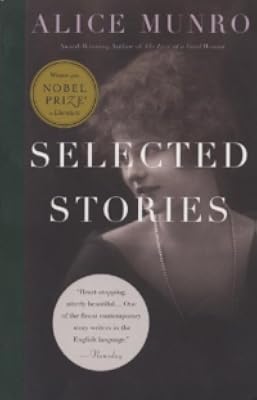
Selected Stories
by Alice Munro
On This Page
Description
WINNER OF THE 2013 NOBEL PRIZE IN LITERATURESpanning almost thirty years and settings that range from big cities to small towns and farmsteads of rural Canada, this magnificent collection brings together twenty-eight stories by a writer of unparalleled wit, generosity, and emotional power. In her Selected Stories, Alice Munro makes lives that seem small unfold until they are revealed to be as spacious as prairies and locates the moments of love and betrayal, desire and forgiveness, that show more change those lives forever. To read these stories--about a traveling salesman and his children on an impromptu journey; an abandoned woman choosing between seduction and solitude--is to succumb to the spell of a writer who enchants her readers utterly even as she restores them to their truest selves.
. show less
Tags
Recommendations


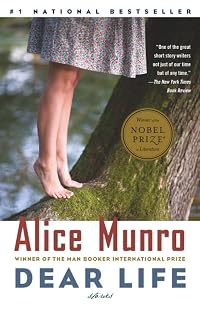

Member Recommendations
Member Reviews
Alice Munro was a Canadian author who only published short stories, she was awarded the Nobel Prize in Literature in 2013 and she died in 2024 There are 23 Stories in this collection and by the time I had finished the book I wanted to read more of them, (163 have been published) but also wanted to re-read the ones that I had just read. For lovers of short stories they are a must read, but many are literary in both form and complexity and I came away from some of them a little confused about what I had just read. Few are straight forward and as they are collected in chronological order the later ones find the author playing with the whole concept of a short story and events are not always told in a linear fashion.
Many of her stories in show more this collection are set in her native Huron County in Southwestern Ontario, an area I am not familiar with, but after reading some wonderful descriptions of the natural world in her stories I am thinking that her precise style reflects the diamond hard snowy landscapes of a world that was all too familiar to her. She tends to keep her characters at arms length even though some of the stories are written in the first person, she tends to look into the tableaus that she has created pinpointing thoughts and emotions that are both surprising and true to life. Her stories do not ramble away from her, they are there to fix the readers attention on yet another aspect of human life which can be uncomfortable to consider. The stories do not always work out in ways that one would like them to, there are no Hollywood endings.
All of these stories have a female protagonist and emotional and physical crimes committed against them by men in their lives are not always clearly stated, the reader does not quite have to read between the lines, but needs to be aware of what is going on. Her female characters have a variety of wants and needs in their relationships and look to different characters to supply those needs. There are no heroes or knights in shinning armour, but sometimes there is enough for a partnership to survive. In the story Meneseteung; Almeda a female poet reflects on men and marriage;
"Marriage forces him to live with more ornament as well as sentiment, and it protects him, also, from the extremities of his own nature—from a frigid parsimony or a luxuriant sloth, from squalor, and from excessive sleeping or reading, drinking, smoking, or freethinking."
There is variety in these stories, some are set in the past and some are obviously contemporary, there are stories that cover a short period in the life of a young woman like The Turkey Season and others that tell almost a whole life story like "Friends of my Youth" In many of the stories death is an event that can change the way characters feel and act and although death is not a subject in itself, it does not seem to be far from touching characters in Munro's tales.
Most of these stories are so good I could write many words about each one of them, but because Munro is able to cover much ground very quickly and pack so many ideas and thoughts into so few words it would seem a pointless exercise. I can only recommend all lovers of short fiction to give Alice Munro a try and why not start with this selection - 5 stars. show less
Many of her stories in show more this collection are set in her native Huron County in Southwestern Ontario, an area I am not familiar with, but after reading some wonderful descriptions of the natural world in her stories I am thinking that her precise style reflects the diamond hard snowy landscapes of a world that was all too familiar to her. She tends to keep her characters at arms length even though some of the stories are written in the first person, she tends to look into the tableaus that she has created pinpointing thoughts and emotions that are both surprising and true to life. Her stories do not ramble away from her, they are there to fix the readers attention on yet another aspect of human life which can be uncomfortable to consider. The stories do not always work out in ways that one would like them to, there are no Hollywood endings.
All of these stories have a female protagonist and emotional and physical crimes committed against them by men in their lives are not always clearly stated, the reader does not quite have to read between the lines, but needs to be aware of what is going on. Her female characters have a variety of wants and needs in their relationships and look to different characters to supply those needs. There are no heroes or knights in shinning armour, but sometimes there is enough for a partnership to survive. In the story Meneseteung; Almeda a female poet reflects on men and marriage;
"Marriage forces him to live with more ornament as well as sentiment, and it protects him, also, from the extremities of his own nature—from a frigid parsimony or a luxuriant sloth, from squalor, and from excessive sleeping or reading, drinking, smoking, or freethinking."
There is variety in these stories, some are set in the past and some are obviously contemporary, there are stories that cover a short period in the life of a young woman like The Turkey Season and others that tell almost a whole life story like "Friends of my Youth" In many of the stories death is an event that can change the way characters feel and act and although death is not a subject in itself, it does not seem to be far from touching characters in Munro's tales.
Most of these stories are so good I could write many words about each one of them, but because Munro is able to cover much ground very quickly and pack so many ideas and thoughts into so few words it would seem a pointless exercise. I can only recommend all lovers of short fiction to give Alice Munro a try and why not start with this selection - 5 stars. show less
These stories are x-rays of human thoughts, emotions and motivations. The protagonist often analyses her/his motives very sharply, without hesitations, which often is painful, but honest to the bone. After reading a few of these stories you are left with the idea that no morality is possible, human behaviour is just too ambiguous and complex. Very, very well written.
I love literary fiction short stories, but over and over again I've found myself left cold and unmoved by Alice Munro stories. This puzzles me, since Munro has been widely hailed as one of the greatest short story writers of our time, and I'm a great fan of some of the writers she's been compared to: Chekhov, Mansfield, Joyce. So in an attempt to delve into this puzzle I decided to read a goodly batch of Munro stories; perhaps (I thought) I'd grow to appreciate what so many others seem to love in this author, or perhaps I'd come to understand what it is about her stories that I don't like. As it turned out, the conclusion of my experiment was more along the lines of the second item.
It seems to me that the failings of Munro stories come show more down to two huge absences: humor and passion.
Humor: There is an almost complete lack of humor in Munro's stories. Reading her, I was paradoxically reminded of something David Sedaris said recently about Lorrie Moore's stories: "There's joke after joke after joke, and yet when you get to the end, you're just devastated." To me, Alice Munro is the exact polar opposite of Lorrie Moore in that respect. Most of her characters are humorless prigs who go through life in a perpetual grumpy funk, and when you get to the end of their story... well, speaking for myself, I'm glad to be done with them.
Passion: Munro seems to shy away from strong emotions. I'm not looking for romance-novel heaving bosoms and rending of bodices, but just some occasional clear, sharp, strong feelings in a character or narrative. Certainly Munro makes use of emotions; many -- perhaps most -- of her stories seem to engage in an almost mathematical complexity of shifting feelings: When character A is under circumstances B and C, she reacts with emotions X and Y. Later, when her circumstances change to D and E, her emotions become W and Z. And it's usually all very convincing and realistic, but there's no _life_ to these mathematical constructions. We see and understand how people feel, but they're rarely feelings of any intensity, and when they are we don't share those feelings. We're just told about them from a long, cold distance. For just one example, in "The Beggar Maid" a man supposedly loves the protagonist, but we only see this character through the detached gaze of the protagonist, whose feelings are ambivalent at best. It's typical in a Munro story for characters to get married out of listless inertia rather than love, and then to grind their way to an inevitable divorce. Often when something intense happens, such as a birth, marriage, or death, the narrator is literally distant. She reads about the event in a letter or hears about it second hand, and then it's dryly passed along to the reader. In addition to letters, another favorite distancing device of Munro's is newspaper clippings. In "Menesteung," for example, we learn about the deaths of the two main characters via their newspaper obituaries. (This could have been poignant, if it had been in contrast to the rest of the story -- that is, if we'd ever gotten close to these characters, but we never did.) And yet another distancing device is unreliable memory: A character will recall some deeply moving event, and then later the memory will be called into question, with the character admitting she must have imagined some of the very details that made the memory intense.
In talking about writing, Robert Olen Butler has often repeated a quote from Akira Kurosawa: "An artist is someone who does not avert his eyes." It seems to me that Munro habitually averts her eyes. Whenever situations threaten to get too intense, she diffuses them, she backs away, she averts her eyes.
The above, of course, is a series of generalizations; things that I feel apply to "typical" Munro stories. Contrary to those generalizations, there are a rare few Munro stories that I've found moving and wonderful (in particular, two that aren't in this collection: "Floating Bridge" and "The Bear Came Over the Mountain"). And I still wonder if some day the scales will fall from my eyes and I'll see something human and beautiful in all the Munro stories that now seem to me more like precise little painted dolls -- neatly constructed, but lacking in the stuff of life. show less
It seems to me that the failings of Munro stories come show more down to two huge absences: humor and passion.
Humor: There is an almost complete lack of humor in Munro's stories. Reading her, I was paradoxically reminded of something David Sedaris said recently about Lorrie Moore's stories: "There's joke after joke after joke, and yet when you get to the end, you're just devastated." To me, Alice Munro is the exact polar opposite of Lorrie Moore in that respect. Most of her characters are humorless prigs who go through life in a perpetual grumpy funk, and when you get to the end of their story... well, speaking for myself, I'm glad to be done with them.
Passion: Munro seems to shy away from strong emotions. I'm not looking for romance-novel heaving bosoms and rending of bodices, but just some occasional clear, sharp, strong feelings in a character or narrative. Certainly Munro makes use of emotions; many -- perhaps most -- of her stories seem to engage in an almost mathematical complexity of shifting feelings: When character A is under circumstances B and C, she reacts with emotions X and Y. Later, when her circumstances change to D and E, her emotions become W and Z. And it's usually all very convincing and realistic, but there's no _life_ to these mathematical constructions. We see and understand how people feel, but they're rarely feelings of any intensity, and when they are we don't share those feelings. We're just told about them from a long, cold distance. For just one example, in "The Beggar Maid" a man supposedly loves the protagonist, but we only see this character through the detached gaze of the protagonist, whose feelings are ambivalent at best. It's typical in a Munro story for characters to get married out of listless inertia rather than love, and then to grind their way to an inevitable divorce. Often when something intense happens, such as a birth, marriage, or death, the narrator is literally distant. She reads about the event in a letter or hears about it second hand, and then it's dryly passed along to the reader. In addition to letters, another favorite distancing device of Munro's is newspaper clippings. In "Menesteung," for example, we learn about the deaths of the two main characters via their newspaper obituaries. (This could have been poignant, if it had been in contrast to the rest of the story -- that is, if we'd ever gotten close to these characters, but we never did.) And yet another distancing device is unreliable memory: A character will recall some deeply moving event, and then later the memory will be called into question, with the character admitting she must have imagined some of the very details that made the memory intense.
In talking about writing, Robert Olen Butler has often repeated a quote from Akira Kurosawa: "An artist is someone who does not avert his eyes." It seems to me that Munro habitually averts her eyes. Whenever situations threaten to get too intense, she diffuses them, she backs away, she averts her eyes.
The above, of course, is a series of generalizations; things that I feel apply to "typical" Munro stories. Contrary to those generalizations, there are a rare few Munro stories that I've found moving and wonderful (in particular, two that aren't in this collection: "Floating Bridge" and "The Bear Came Over the Mountain"). And I still wonder if some day the scales will fall from my eyes and I'll see something human and beautiful in all the Munro stories that now seem to me more like precise little painted dolls -- neatly constructed, but lacking in the stuff of life. show less
A book I come back to over and over again when I can't figure out how to write a particular image, reach a specific moment. It's not a book you read cover to cover, but one you take years to get through because there's only so much beauty and heartbreak I can take in a day. I wanted to go slow with her, let her reveal the world a moment at a time.
http://nwhyte.livejournal.com/2677295.html
You may have noticed that I've been on a bit of an Alice Munro binge over the last year, generated in the first place by enthusiasm from my wife. These are selected stories from her output in 1968-1994, and they are all good, some of them brillinat, observation of life in southern Ontario (particularly for women) over the decades. "Postcard", from which I've taken an excerpt above, is a particularly good one told by a woman in a doomed relationship that everyone else, including the reader, can see isn't happening. "Carried Away" is an intricate tale of a librarian, a soldier, and a decapitation. "Dance of the Happy Shades" features the discomfort afflicting the comfortable resulting from a show more musical performance by children with special needs. In "Fits", a woman finds her neighbours' bodies after a murder/suicide pact, but the real story is how the details become known to her community and her husband. All take you into the moment; all recommended. show less
You may have noticed that I've been on a bit of an Alice Munro binge over the last year, generated in the first place by enthusiasm from my wife. These are selected stories from her output in 1968-1994, and they are all good, some of them brillinat, observation of life in southern Ontario (particularly for women) over the decades. "Postcard", from which I've taken an excerpt above, is a particularly good one told by a woman in a doomed relationship that everyone else, including the reader, can see isn't happening. "Carried Away" is an intricate tale of a librarian, a soldier, and a decapitation. "Dance of the Happy Shades" features the discomfort afflicting the comfortable resulting from a show more musical performance by children with special needs. In "Fits", a woman finds her neighbours' bodies after a murder/suicide pact, but the real story is how the details become known to her community and her husband. All take you into the moment; all recommended. show less
Short stories focused on Canadian women; a selection of Munro's best.
Royal Beatings, The Turkey Season, Labor Day Dinner ... these are incomparable short stories. The protagonists are inclined to fall in love with men, are entangled with men (their fathers, their lovers), yet can never fully trust or rely on these men. Many of the stories are packed with information that at first seems extraneous - Royal Beatings, notably - but there's always a storyteller's logic at work. Munro is not afraid of the physical. Her women come in all shapes and sizes, from all classes, and their allegiances are unpredictable ... sometimes they side with their friends, sometimes with their husbands, lovers.
Royal Beatings, The Turkey Season, Labor Day Dinner ... these are incomparable short stories. The protagonists are inclined to fall in love with men, are entangled with men (their fathers, their lovers), yet can never fully trust or rely on these men. Many of the stories are packed with information that at first seems extraneous - Royal Beatings, notably - but there's always a storyteller's logic at work. Munro is not afraid of the physical. Her women come in all shapes and sizes, from all classes, and their allegiances are unpredictable ... sometimes they side with their friends, sometimes with their husbands, lovers.
Alice writes stories of personal epiphanies that capture my imagination and haunt my mind for days after. Short stories may in fact be my preferred way of digesting Alice.
Members
- Recently Added By
Lists

The Top Ten: Writers Pick Their Favorite Books
240 works; 31 members

100 books to read in a lifetime
102 works; 37 members

100 New Classics
101 works; 13 members

Books Read in 2017
4,249 works; 130 members
Author Information

127+ Works 30,437 Members
Alice Munro was born Alice Laidlaw in Wingham, Ontario on July 10, 1931. She published her first story, The Dimensions of a Shadow, while a student at the University of Western Ontario in 1950. She left the university in 1951 to get married and start a family. In 1972 she became Writer in Residence at the University of Western Ontario. Her first show more collection, Dance of the Happy Shades, was published in 1968 and won the Governor General's Award, Canada's highest literary prize. Her other works include Lives of Girls and Women, The View from Castle Rock, Something I've Been Meaning to Tell You, Too Much Happiness, and Dear Life. She has received several awards including the Governor General's Award for fiction for Who Do You Think You Are? and The Progress of Love, the Giller Prize for Runaway in 2004, the Man Booker International Prize in 2009 for her lifetime body of work, and the 2013 Nobel Prize in Literature. Her stories have appeared in numerous publications including The New Yorker, The Paris Review, and The Atlantic Monthly. Also, in 2013, her title Dear Life: Stories made The New York Times Best Seller List. (Bowker Author Biography) show less
Awards and Honors
Common Knowledge
- Original publication date
- 1985
- Dedication
- For Virginia Barber My essential support and friend for twenty years
- First words
- After supper my father days, "want to go down and see if the Lake's still there?" (Walker Brothers Cowboy)
Classifications
Statistics
- Members
- 1,496
- Popularity
- 15,522
- Reviews
- 13
- Rating
- (4.17)
- Languages
- English
- Media
- Paper, Ebook
- ISBNs
- 14
- ASINs
- 5