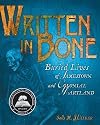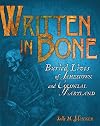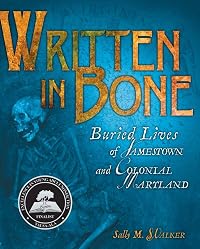
Written in Bone: Buried Lives of Jamestown and Colonial Maryland
by Sally M. Walker
On This Page
Description
This book reports on the work of forensic scientists who are excavating grave sites in James Fort, in Jamestown, Virginia, to understand the people who lived in the Chesapeake Bay area in the 1600s and 1700s.Tags
Recommendations


Member Reviews
Sally M. Walker presents an exciting and informative look at forensics, archeology and anthropology in this fantastic non-fiction book. She works hard to give detailed scientific information at a level not above or below the heads of the average teenager.
Each step of the process includes historical atmosphere, maps, photos and descriptions. Her focus on the mysterious aspects of parts of the excavation (a possible murder, bodies buried together, etc.) grabbed my attention and held it.
Every chapter is like a separate vignette (or, if you are me, a new episode of Law and Order, Colonial Times). One is about a boy they found and how they tried to determine cause of death, his birth origin and more. Another chapter is titled “The show more Captain,” the name they gave to another body after an x-ray revealed an object associated with high ranking military of the time. Still another is “The Body in the Basement.”
Throughout the book teens will learn about the complex processes of excavating a site of historical importance. The care taken by scientists, forensic experts, archaeologists and others is highlighted and combined with a fun sense of mystery and intrigue (and some amazing photos!). I would recommend this to all teens. show less
Each step of the process includes historical atmosphere, maps, photos and descriptions. Her focus on the mysterious aspects of parts of the excavation (a possible murder, bodies buried together, etc.) grabbed my attention and held it.
Every chapter is like a separate vignette (or, if you are me, a new episode of Law and Order, Colonial Times). One is about a boy they found and how they tried to determine cause of death, his birth origin and more. Another chapter is titled “The show more Captain,” the name they gave to another body after an x-ray revealed an object associated with high ranking military of the time. Still another is “The Body in the Basement.”
Throughout the book teens will learn about the complex processes of excavating a site of historical importance. The care taken by scientists, forensic experts, archaeologists and others is highlighted and combined with a fun sense of mystery and intrigue (and some amazing photos!). I would recommend this to all teens. show less
This book shows and explains how archaeologists discovered some of the little-known facts of colonial Maryland, from the bones of those that had lived then. First, we have a teenage boy, who was estimated to have been about eighteen or nineteen years old, which scientists could tell by his leg and arm bones, and his teeth. Next is a ship's captain, who was buried with an iron pike, proving his importance in the colonies. Third is an obviously mistreated indentured servant, who was buried, clearly in a hurry, in a trash heap. He must have worked hard, because he had bone development that showed muscle growth from hard work. Fourth is a colonial official with his family, only they aren't buried all together; they are all buried in show more separate, though fitting, literally, lead coffins, in which the archaeologists hoped to find some seventeenth-century air. Lastly is an African slave girl, who was buried around 1726-1776, judging from a brass button on the man buried near her.
I give this book five stars because it went into great detail on how the scientists discovered who people were. It talked about using their teeth, their arm and leg bones, and even their skulls to tell how old someone is and what gender they are. They could also tell what ethnicity a person was, judging by their skull features, like if their teeth stick out or not. I really enjoyed this book, because it told me how archaeologists really do things, not just what they discovered. Most books just cover what they find, but not how they find it or how they came to their conclusions. At the start of each dig, the teams are always hopeful, but I'm sure they're ecstatic when they really find something that helps discovery along. All in all, definitely recommend this to any and all. show less
I give this book five stars because it went into great detail on how the scientists discovered who people were. It talked about using their teeth, their arm and leg bones, and even their skulls to tell how old someone is and what gender they are. They could also tell what ethnicity a person was, judging by their skull features, like if their teeth stick out or not. I really enjoyed this book, because it told me how archaeologists really do things, not just what they discovered. Most books just cover what they find, but not how they find it or how they came to their conclusions. At the start of each dig, the teams are always hopeful, but I'm sure they're ecstatic when they really find something that helps discovery along. All in all, definitely recommend this to any and all. show less
Written in Bone: Buried Lives of Jamestown and Colonial Maryland by Sally M. Walker (Carolrhoda, 2009) is about what we can learn about a few early American settlers from their bones and burial. It is both a lesson in very early American history as well as a scientific exploration of forensic anthropology. Since I’m studying Jamestown this week with my son and since I’m a big fan of the television show Bones for it’s insight into forensic anthropology, I really enjoyed Written in Bone. Walker approaches her subject with obvious passion, clear language, and well done scientific explanations, all for a young adult audience. She teaches without belittling her audience, a difficult task to do when she’s writing for youth as young as show more 12 and as old as any adult.
The book is easily accessible, with full color pages providing information for the reader, including black and white historical photos, color photos from the recent archeological digs, charts and diagrams, and maps and illustrations. Her chapters focus on a few different sets of human remains, including a boy from Jamestown, a well-to-do middle-aged man afforded a dramatic burial (including a coffin, which was rare in the starving early years of Jamestown), a teenager’s body found in the basement cellar, a family buried in lead coffins, and a hilltop cemetery. Some of these burials were covered in more chapters than just one, and for many of the people, scientists were able to estimate what the person may have looked like, and we were able to see a visual representation of their faces made from clay by a forensic artist.
To me, the most interesting stories were not those of the rich and well esteemed. Rather, I most enjoyed learning about the unknown poor people, especially those for whom we do not know their names: the indentured servant beaten to death in the cellar, the slaves buried on a hillside, even the boy with rotten teeth who died very soon after arriving in Jamestown. I loved how the scientists were able to determine what chores these people did by looking at their bones, and I especially loved seeing their faces reconstructed by artists.
I have so far loved every thing I’ve read that has been authored by Sally M. Walker, so when I heard of this book about Jamestown colony, I knew it would be just perfect for me right now. I’m so glad I found it. I’d highly recommend it to the student of American history, the student of history in general, and anyone interested in what science can tell us by reading the evidence from the past. Sally Walker once again has brought history and science alive in Written in Bone.
Cross-posted on my blog show less
The book is easily accessible, with full color pages providing information for the reader, including black and white historical photos, color photos from the recent archeological digs, charts and diagrams, and maps and illustrations. Her chapters focus on a few different sets of human remains, including a boy from Jamestown, a well-to-do middle-aged man afforded a dramatic burial (including a coffin, which was rare in the starving early years of Jamestown), a teenager’s body found in the basement cellar, a family buried in lead coffins, and a hilltop cemetery. Some of these burials were covered in more chapters than just one, and for many of the people, scientists were able to estimate what the person may have looked like, and we were able to see a visual representation of their faces made from clay by a forensic artist.
To me, the most interesting stories were not those of the rich and well esteemed. Rather, I most enjoyed learning about the unknown poor people, especially those for whom we do not know their names: the indentured servant beaten to death in the cellar, the slaves buried on a hillside, even the boy with rotten teeth who died very soon after arriving in Jamestown. I loved how the scientists were able to determine what chores these people did by looking at their bones, and I especially loved seeing their faces reconstructed by artists.
I have so far loved every thing I’ve read that has been authored by Sally M. Walker, so when I heard of this book about Jamestown colony, I knew it would be just perfect for me right now. I’m so glad I found it. I’d highly recommend it to the student of American history, the student of history in general, and anyone interested in what science can tell us by reading the evidence from the past. Sally Walker once again has brought history and science alive in Written in Bone.
Cross-posted on my blog show less
I was utterly entranced by this book. There are numerous "unsolved" mysteries in this book, until Douglas Owsley takes a look that is. The writing is excellent. The book is peppered with photographs, sidebars and diagrams that grace almost every page. In the back there is a timeline, a bibliography and additional recommended books and websites. In one of these graves even the archaeologists were shocked to see who was in there. As they say, "expect the unexpected," but I would say you can expect to love this book!
Because my wife and I are big fans of the TV show Bones, I was pleasantly surprised when I stumbled across Sally M. Walker’s Written in Bone: Buried Lives of Jamestown and Colonial Maryland in the “science” section of my library. Like Bones, Walker’s book deals with forensic anthropology: the scientific process of examining skeletons for clues and evidence. In fact, much of Walker’s book follows the same procedures utilized in every episode of Bones, ranging from soil samples to skeletal examinations to artistic recreations of the deceased. Although Written in Bone lacks the wit, drama, and action of its television counterpart, it nonetheless provides an interesting glimpse into the world of forensic anthropology.
Walker begins show more her book with some brief background knowledge about the Jamestown settlement that is the setting for this study. After briefly giving some historical context of the settlers, she discusses archaeological methods for digging at sites and the need for preservation. As she moves through the book, Walker introduces a variety of methods for the process of scientific inquiry: studying historical documents, conducting interviews, examining local architecture, and using technology to meld science with history. The widespread incorporation of so much science tends to drive this book towards a target audience of high school students, most of whom will have a greater grasp on science and history. Additionally, because Walker’s writing can be somewhat complex at times, younger readers might have some difficulty following along with her book. Plus, some maturity is required to study dead bodies in so much depth and detail: older audiences might be a little less likely to have nightmares.
In order to frame her story, Walker discusses several key corpses discovered in the excavations of colonial Virginia and Maryland. Walker’s use of specific case studies is a clever way of introducing a variety of scientific methods to the reader: with each successive skeleton, Walker introduces stable isotope analysis (for carbon-dating), ground-penetrating radar, soil samples, dental fossils, and facial reconstructions. With this wide range of scientific methods incorporated into the narrative, Written in Bone can feel a little intimidating at times because it illustrates just how much knowledge and expertise is required to carry out an archaeological dig (such as the one described in the book). If nothing else, Written in Bone reinforces the idea that most scientific inquiry requires a team of scientists and specialists to make progress on a case.
Although the premise of the book is absolutely fascinating, I started to lose interest towards the end of the book: suddenly, the novelty factor wasn’t quite as captivating as it was a hundred pages earlier. Of course, this might also be a reflection of my personal lack of interest in science, as opposed to the quality of Walker’s book; on the contrary, the fact that Walker managed to keep my attention for so long is a testament to her intriguing narrative. In the end, Walker reminds us that the skeletal remains discovered are all that’s left of people’s lives: “These tales, written only in bone, await those with the patience to find them” (134). Because of her book, Walker will undoubtedly inspire many to pursue further studies in forensic anthropology and discover more stories that remain buried… for the time being. show less
Walker begins show more her book with some brief background knowledge about the Jamestown settlement that is the setting for this study. After briefly giving some historical context of the settlers, she discusses archaeological methods for digging at sites and the need for preservation. As she moves through the book, Walker introduces a variety of methods for the process of scientific inquiry: studying historical documents, conducting interviews, examining local architecture, and using technology to meld science with history. The widespread incorporation of so much science tends to drive this book towards a target audience of high school students, most of whom will have a greater grasp on science and history. Additionally, because Walker’s writing can be somewhat complex at times, younger readers might have some difficulty following along with her book. Plus, some maturity is required to study dead bodies in so much depth and detail: older audiences might be a little less likely to have nightmares.
In order to frame her story, Walker discusses several key corpses discovered in the excavations of colonial Virginia and Maryland. Walker’s use of specific case studies is a clever way of introducing a variety of scientific methods to the reader: with each successive skeleton, Walker introduces stable isotope analysis (for carbon-dating), ground-penetrating radar, soil samples, dental fossils, and facial reconstructions. With this wide range of scientific methods incorporated into the narrative, Written in Bone can feel a little intimidating at times because it illustrates just how much knowledge and expertise is required to carry out an archaeological dig (such as the one described in the book). If nothing else, Written in Bone reinforces the idea that most scientific inquiry requires a team of scientists and specialists to make progress on a case.
Although the premise of the book is absolutely fascinating, I started to lose interest towards the end of the book: suddenly, the novelty factor wasn’t quite as captivating as it was a hundred pages earlier. Of course, this might also be a reflection of my personal lack of interest in science, as opposed to the quality of Walker’s book; on the contrary, the fact that Walker managed to keep my attention for so long is a testament to her intriguing narrative. In the end, Walker reminds us that the skeletal remains discovered are all that’s left of people’s lives: “These tales, written only in bone, await those with the patience to find them” (134). Because of her book, Walker will undoubtedly inspire many to pursue further studies in forensic anthropology and discover more stories that remain buried… for the time being. show less
This book is being mentioned for a possible award come January, and I definitely think it would make an excellent Siebert Award candidate. This book examines colonial America through the eyes of archaelogists and forensic archaelogists and sees what we can deduce about colonial America. There are some really interesting things that they can discover about colonial Americans, including how they worked, what kind of work they did, and quite often how they died. Walker also goes through the whole process of a dig and how things are unearthed - very interesting and well-written. What I also like about the book is that the captions of the photos and charts sort of serve as an indicator of what's on that page - more than usual - so that kids show more skimming the book can stop and read more about something that might interest them. Very complete and absorbing. show less
Written in Bone: Burried Lives of Jamestown and Colonial Maryland by Sally M. Walker is a great book if you're interested in old bones, history, forensics and mysteries. The book contains glossy pages and photos interspersed amongst the print. The language is simple and straight-forward. Scientific concepts are explained in easy to understand terms. And the mysteries are engaging.
It is amazing what you can learn from where graves are discovered (inside the fort or church, or outside), the position of the bones (carefully laid out for a man of stature vs. tossed in the grave for an abused indentured servant), what is included in the grave, etc. Forensic scientists can look at bones to see whether they were broken and if so before or show more after death and how long before death. The bone structure and fusing can help determine age. The study of isotopes can help determine how long the deceased was in America vs. England.
The scientists take what they have discovered and try to relate it to the written record to determine whose body it is. Since colonial America was relatively sparsely inhabited, it is easier to review records to determine whose body it might be. show less
It is amazing what you can learn from where graves are discovered (inside the fort or church, or outside), the position of the bones (carefully laid out for a man of stature vs. tossed in the grave for an abused indentured servant), what is included in the grave, etc. Forensic scientists can look at bones to see whether they were broken and if so before or show more after death and how long before death. The bone structure and fusing can help determine age. The study of isotopes can help determine how long the deceased was in America vs. England.
The scientists take what they have discovered and try to relate it to the written record to determine whose body it is. Since colonial America was relatively sparsely inhabited, it is easier to review records to determine whose body it might be. show less
Members
- Recently Added By
Author Information

93+ Works 4,156 Members
Awards and Honors
Awards
Distinctions
Common Knowledge
- Canonical title
- Written in Bone: Buried Lives of Jamestown and Colonial Maryland
- Important places
- Jamestown, Virginia, USA
Classifications
Statistics
- Members
- 393
- Popularity
- 79,748
- Reviews
- 34
- Rating
- (4.18)
- Languages
- English
- Media
- Paper, Audiobook, Ebook
- ISBNs
- 14
- ASINs
- 9