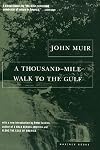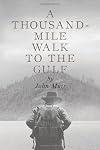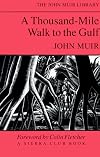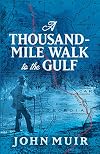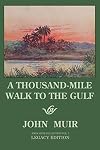
A Thousand-Mile Walk to the Gulf
by John Muir 
On This Page
Description
Here is the adventure that started John Muir on a lifetime of discovery. Taken from his earliest journals, this book records Muir's walk in 1867 from Indiana across Kentucky, Tennessee, North Carolina, Georgia, and Florida to the Gulf Coast. In his distinct and wonderful style, Muir shows us the wilderness, as well as the towns and people, of the South immediately after the Civil War.Tags
Recommendations




















Member Reviews
I was geared up to read a book about nature, plantlife, and animal habitats, camping out, and roughing it. But maybe half the narrative was about John Muir's daily need to find someone to provide food and a bed. And then he'd write about these people disparagingly, or condescendingly, or both. This was an interesting book, a quick read, a snapshot of sorts of the times, but not at all what I was expecting.
John Muir (naturalist and founder of the Sierra Club) left his home in Indiana at age 29 and "rambled" 1,000 miles through the woods of the southern US ending in Florida in 1867/68. It was just 2 years after the end of the Civil War and he ran into "wild negros" and long-haired horse-riding ex-guerrillas who would kill a man for $5. He passed through uninhabited stretches of burnt out fields and deserted farms and was often seen as a northern interluder mistrusted by his southern guests. He lived mostly on stale pieces of bread, almost dieing of starvation while camping in a graveyard outside of Savanah, GA. He caught malaria and was bed ridden for 3 months, cared for by a kind family in Florida.
This is a snapshot of the south right show more after the war. Muir's writing is under-stated - the book was published posthumously and is more a diary than a finished book, which gives it a truthfulness and matter of factness. Fundamentally a Romanticist world-view - the power of nature and mans relation to it - Muir delights in finding, sampling and discussing plants, animals and geography. The genre is best compared with Robert Louis Stevenson's "Travels with a Donkey" and Thoreau's "The Maine Woods".
Read via Internet Archive, first edition, illustrated:
http://www.archive.org/details/thousandmile00muirrich show less
This is a snapshot of the south right show more after the war. Muir's writing is under-stated - the book was published posthumously and is more a diary than a finished book, which gives it a truthfulness and matter of factness. Fundamentally a Romanticist world-view - the power of nature and mans relation to it - Muir delights in finding, sampling and discussing plants, animals and geography. The genre is best compared with Robert Louis Stevenson's "Travels with a Donkey" and Thoreau's "The Maine Woods".
Read via Internet Archive, first edition, illustrated:
http://www.archive.org/details/thousandmile00muirrich show less
I enjoyed this book which was composed by John Muir from notes he had made while on his travels. Although the name of the book would suggest he had traveled only to the Gulf Coast, in fact, he also traveled to Cuba and California, including the Yosemite Valley. Those two portions of the book were more interesting to me than his original walk. This man was not only a traveler, biologist, budding ecologist, and writer, but also a very brave one to travel so far into areas totally unknown to him without any companionship or advance assistance from those in the area he was traveling to. I'm sure that in the 21st Century if someone were to repeat the journey, to be able to get lodging in someone's home by walking up to their house and asking show more would be totally impossible. Almost no one, today, trusts in the basic goodness of mankind. show less
I've read a bunch of John Muir's books about his travels. While this isn't his best writing (or his most interesting topic,) his travels down south are entertaining enough to make this a worth while read.
I had hoped to enjoy the words of the great John Muir more, but I'm still glad I gave it a shot. I suspect this was at the beginning of his writings, or his inspiration, as he really hit his stride towards the end.
Refreshing and illuminating autobiography of the intrepid naturalist who managed to walk from Ohio to Florida in the days after the Civil War. His idea was to discover and/or identify new plants without getting killed by suspicious southerners. Nearly dead of the fever, he managed to make it to Florida and eventually to his beloved California, by way of Cuba.
“Arching grasses come one by one; seeds come flying on downy wings, silent as fate, to give life’s dearest beauty for the ashes of art; and strong evergreen arms laden with ferns and tillandsia drapery are spread over all - Life at work everywhere, obliterating all memory of the confusion of man.” p.71
Original green cloth, color pictorial paste-down painting of Florida sunset on front board, lettered in white, top edge gilt. Illustrated with several plates from photographs, including a frontispiece portrait with tissue guard; map. Light wear head and tail spine, some diminishment to the white lettering on spine, bumped lower corners. Text & illustrations bright and clean, binding secure, no foxing, stains, marks or label. Size: show more 7¾" - 9¾" Tall.
Part manuscript journal, portion of a letter, and a published article providing Muir's botanical excursion from Kentucky to Florida in 1867, trip to Cuba, voyage to San Francisco via Panama, and first year in California. Muir's journal ends with his arrival in California in April 1868. The autobiographical narratives are connected by excerpting his brief account of his first visit to Yosemite Valley from a letter to Mrs. Carr, and a description of Twenty Hill Hollow (first printed in the OVERLAND MONTHLY for July 1872) where Muir spent much of his first year in California.
Kimes states: "Muir's early writing included in this volume is important in disclosing his nature-oriented philosophy of life and the direction in which it was taking him." show less
Original green cloth, color pictorial paste-down painting of Florida sunset on front board, lettered in white, top edge gilt. Illustrated with several plates from photographs, including a frontispiece portrait with tissue guard; map. Light wear head and tail spine, some diminishment to the white lettering on spine, bumped lower corners. Text & illustrations bright and clean, binding secure, no foxing, stains, marks or label. Size: show more 7¾" - 9¾" Tall.
Part manuscript journal, portion of a letter, and a published article providing Muir's botanical excursion from Kentucky to Florida in 1867, trip to Cuba, voyage to San Francisco via Panama, and first year in California. Muir's journal ends with his arrival in California in April 1868. The autobiographical narratives are connected by excerpting his brief account of his first visit to Yosemite Valley from a letter to Mrs. Carr, and a description of Twenty Hill Hollow (first printed in the OVERLAND MONTHLY for July 1872) where Muir spent much of his first year in California.
Kimes states: "Muir's early writing included in this volume is important in disclosing his nature-oriented philosophy of life and the direction in which it was taking him." show less
Members
- Recently Added By
Author Information

153+ Works 7,927 Members
The naturalist John Muir was born in Dunbar, Scotland. When he was 11 years old, he moved to the United States with his family and lived on a Wisconsin farm, where he had to work hard for long hours. He would rise as early as one o'clock in the morning in order to have time to study. At the urging of friends, he took some inventions he had made to show more a fair in Madison, Wisconsin. This trip resulted in his attending the University of Wisconsin. After four years in school, he began the travels that eventually took him around the world. Muir's inventing career came to an abrupt end in 1867, when he lost an eye in an accident while working on one of his mechanical inventions. Thereafter, he focused his attention on natural history, exploring the American West, especially the Yosemite region of California. Muir traveled primarily on foot carrying only a minimum amount of food and a bedroll. In 1880 Muir married Louie Strentzel, the daughter of an Austrian who began the fruit and wine industry in California. One of the first explorers to postulate the role of glaciers in forming the Yosemite Valley, Muir also discovered a glacier in Alaska that later was named for him. His lively descriptions of many of the natural areas of the United States contributed to the founding of Yosemite National Park in 1890. His urge to preserve these areas for posterity led to his founding of the Sierra Club in 1892. (Bowker Author Biography) show less
John Muir has a Legacy Library. Legacy libraries are the personal libraries of famous readers, entered by LibraryThing members from the Legacy Libraries group.
Series
Belongs to Publisher Series
Work Relationships
Is contained in
Contains
Is abridged in
Common Knowledge
- Canonical title
- A Thousand-Mile Walk to the Gulf
- Original publication date
- 1916
- People/Characters
- John Muir, naturalist
- Important places
- Bonaventure Cemetery, Savannah, Georgia, USA; Cedar Key, Florida, USA; Florida, USA; Georgia, USA; Kentucky, USA; Tennessee, USA
- First words
- I had long been looking from the wild woods and gardens of the Northern States to those of the warm South, and at last, all drawbacks overcome, I set forth on the first day of September, 1867, joyful and free, on a thousand-m... (show all)ile walk to the Gulf of Mexico.
- Last words
- (Click to show. Warning: May contain spoilers.)Presently you lose consciousness of your separate existence: you blend with the landscape, and become part and parcel of nature.
- Original language
- English
Classifications
Statistics
- Members
- 403
- Popularity
- 76,807
- Reviews
- 11
- Rating
- (3.86)
- Languages
- Czech, English, French
- Media
- Paper, Audiobook, Ebook
- ISBNs
- 41
- UPCs
- 3
- ASINs
- 13