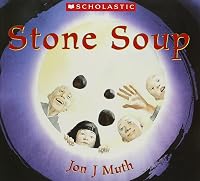
Stone Soup
by Jon J. Muth (Adapter & Illustrator)
On This Page
Description
Three wise monks trick a poor, frightened community into finding happiness by teaching them the magic of generosity.Tags
Recommendations










Member Reviews
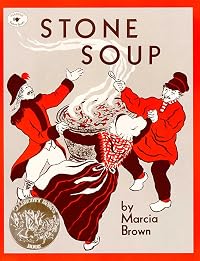
The classic European folktale - best known by its French variant, as seen in Marcia Brown's Stone Soup - is transplanted to China in this lovely picture-book from Jon J. Muth, whose popular Zen Shorts (and sequels) also explore Zen Buddhist beliefs. Following the wandering of three monks - Hok, Lok and Siew - who question what happiness is as they walk, the story sees a hostile village transformed, as the wise Siew sets out to teach its residents how to make stone soup...
I'm not always thrilled with titles that seek to transplant the stories of one culture into another - as if all cultures were interchangeable, and context were meaningless - but sometimes, when it is done with respect, and I feel that there is some reason for it (some show more reason that doesn't involve discomfort at the idea of a story coming from a specific culture, or the mistaken belief that multiculturalism requires stories to be racially "remade"), I am very pleased indeed. This is one of those cases, and I thought Muth's narrative, and his gorgeous watercolor illustrations, worked flawlessly together, producing a picture-book experience that was simply delightful!
I really appreciated the author/artist's afterword, in which he talked about the Chinese tradition involving these three wandering monks, who often bestow wealth and prosperity, and teach wisdom - it's easy to see how Muth might have thought of them, when reading the original! - and I loved the artwork, which had that luminous quality I have come to associate with Muth's paintings. The scene in which all the villagers are peering into the pot was particularly charming! All in all, this Stone Soup is one I would recommend to those readers who enjoy transplanted folktales (or even those who, like me, are normally leery of them), and to fans of the artist. show less
I'm not always thrilled with titles that seek to transplant the stories of one culture into another - as if all cultures were interchangeable, and context were meaningless - but sometimes, when it is done with respect, and I feel that there is some reason for it (some show more reason that doesn't involve discomfort at the idea of a story coming from a specific culture, or the mistaken belief that multiculturalism requires stories to be racially "remade"), I am very pleased indeed. This is one of those cases, and I thought Muth's narrative, and his gorgeous watercolor illustrations, worked flawlessly together, producing a picture-book experience that was simply delightful!
I really appreciated the author/artist's afterword, in which he talked about the Chinese tradition involving these three wandering monks, who often bestow wealth and prosperity, and teach wisdom - it's easy to see how Muth might have thought of them, when reading the original! - and I loved the artwork, which had that luminous quality I have come to associate with Muth's paintings. The scene in which all the villagers are peering into the pot was particularly charming! All in all, this Stone Soup is one I would recommend to those readers who enjoy transplanted folktales (or even those who, like me, are normally leery of them), and to fans of the artist. show less
I cried as I was reading this book. The story sums up what it means to find true love and beauty through a time of brokenness. In the beginning, Jon Muth, the author introduces the pure value of three Chinese buddhist monks by having one ask, “What makes one happy,” which Siew, one of the monks, responds by saying, “Let’s find out.” This could be used to explain foreshadowing to children. The next page uses brilliant watercolor paint work to support the stated history of a village that struggled to survive through famine, floods, and war. The art work evidently supports the storyline again when it captures the attitudes of the villagers. For instance, the seamstress has her nose held up high and the seemingly obese carpenter show more is pushing back a closet full of food, which I assume is all for himself. After having felt the eeriness and constraint of the village, the monks agree that “these people do not know happiness” and decide to “show them how to make stone soup,” which I predict will effectively incite children’s curiosities as it had for me. I also liked how the first villager to approach the busy monks is a little girl because it reminds me, and probably people of older generations, of the purity and innocence of childhood. Also, the colors used in the illustrations are all neutral until this little girl approaches the monks wearing a bright yellow tunic.
As the monks and the little girl cook, the monks encourage more and more villagers to contribute to the stone soup, and I especially love how the author states that “Something magical began to happen among the villagers. As each person opened their heart to give, the next person gave even more. And as this happened, the soup grew richer and smelled more delicious.” I could go on and on about this sentence alone. This sentence holds so much meaning, more than I can comprehend. Firstly, the structure of the sentences and word choice is perfect. Each sentence/word contains so much meaning that just comes together beautifully as a whole. Secondly, these three sentences demonstrate how happiness can be achieved by seeing the light in others and letting yourself be influenced by other broken people despite all their flaws. The following pages of the feast and the following entertainment appropriately capture the Chinese culture, what happiness may have looked like for them, and what happiness may look like to all the cultures apparent in the reader’s mind. The book also states that the villagers “unlocked their doors and took the monks into their homes,” which I think represents the villagers’ acts of unlearning what they’ve learned, which is to be untrusting and suspicious towards strangers, and even their neighbors.
After the villagers soften their walls that once divided them from one another, they gather around to say a warm goodbye to their heroes (which makes me reconsider my personal definition of a hero). After the monks first thank the villagers for their generosity, the villagers demonstrate what they have learned when they reply by saying, “Thank you. With the gifts you have given, we will always have plenty. You have shown us that sharing makes us all richer.” This is the best book ever! I love Jon J Muth for writing a story of achieving true and rooted merriment. Of course the story is not completely realistic, but it’s realistic enough to inspire change. show less
As the monks and the little girl cook, the monks encourage more and more villagers to contribute to the stone soup, and I especially love how the author states that “Something magical began to happen among the villagers. As each person opened their heart to give, the next person gave even more. And as this happened, the soup grew richer and smelled more delicious.” I could go on and on about this sentence alone. This sentence holds so much meaning, more than I can comprehend. Firstly, the structure of the sentences and word choice is perfect. Each sentence/word contains so much meaning that just comes together beautifully as a whole. Secondly, these three sentences demonstrate how happiness can be achieved by seeing the light in others and letting yourself be influenced by other broken people despite all their flaws. The following pages of the feast and the following entertainment appropriately capture the Chinese culture, what happiness may have looked like for them, and what happiness may look like to all the cultures apparent in the reader’s mind. The book also states that the villagers “unlocked their doors and took the monks into their homes,” which I think represents the villagers’ acts of unlearning what they’ve learned, which is to be untrusting and suspicious towards strangers, and even their neighbors.
After the villagers soften their walls that once divided them from one another, they gather around to say a warm goodbye to their heroes (which makes me reconsider my personal definition of a hero). After the monks first thank the villagers for their generosity, the villagers demonstrate what they have learned when they reply by saying, “Thank you. With the gifts you have given, we will always have plenty. You have shown us that sharing makes us all richer.” This is the best book ever! I love Jon J Muth for writing a story of achieving true and rooted merriment. Of course the story is not completely realistic, but it’s realistic enough to inspire change. show less
By far my favorite version of this timeless tale. We especially loved the water color, the Buddhist spin, and how the author/illustrator? taught us at the end how to study the illustrations in this and consequently any book for deeper meaning by introducing a few common symbols utilized for this piece. We went back and "read" the pictures again afterward. Morgan was delighted to learn that he had already noticed several details that I hadn't (he always does--that eye for visual detail); he learned for the first time that things he sees are not noticed by everyone, and that the illustrator does certain things to communicate ideas. The whole experience of reading this book together, even after we've both read or heard the general story show more countless times, was immeasurably valuable. show less
Retelling: This story has been told many times in different settings though-out the world. Different communities have their own versions of it. In this version, a town is wary of strangers due to past hardships. When a group of monks arrive, they begin assembling a fire for a pot of stone soup. Their activity attracts attention from the townspeople who come out to make a contribution to the soup pot. In the end, they feast together, building a sense of community and reviving an old tradition.
Thoughts and Feelings: This story reminded me of one of Martin Luther King Jr.'s speeches about service. "You don't need a college degree," he said, "to serve....You don't have to know the second theory of thermodynamics in physics to serve. All you show more need is a heart filled with grace, a soul generated by love, and you can be that servant." The character who began contributing to the pot of soup was a little girl who knew that her mother had a bigger pot. Young people aren't just learning so that they can serve some day. Everyone, no matter how young or old, has something valuable to give. show less
Thoughts and Feelings: This story reminded me of one of Martin Luther King Jr.'s speeches about service. "You don't need a college degree," he said, "to serve....You don't have to know the second theory of thermodynamics in physics to serve. All you show more need is a heart filled with grace, a soul generated by love, and you can be that servant." The character who began contributing to the pot of soup was a little girl who knew that her mother had a bigger pot. Young people aren't just learning so that they can serve some day. Everyone, no matter how young or old, has something valuable to give. show less
You can tell this author was really excited about retelling this story. Reading the author's note showed how much thought he put into every aspect of this book. The names of the monks, the color that the little girl who first approaches them wears, even secret Chinese symbols spelled out in the soup ingredients. Muth admits that the story is traced farthest back in european history but that many different cultures have adopted the sweet tale to fit their needs. I really enjoyed his water color style. The landscape imagery is so soft and loose while the portraits of characters are very detailed. The transition between the two styles was a little jolting from page to page but it is a nice way of bringing asian artwork into the story while show more giving it a modern twist. When I was originally searching for this book I was looking for the Marcia Brown version but I am glad I found this one. It centers on the moral of the story -- sharing is caring -- rather than the creators of the stone soup being tricksters. show less
Richer than some versions, in that there is the theme of neighborly happiness made explicit, as well as the simple theme of pooling resources. There's also an author's note that teaches about some traditions of China, from which I learned what's the significance of the the three stacked stones often seen in garden decor. And, of course, Muth's paintings are appealing. Not my favorite Muth, but def. worth seeking out.
"Stone Soup" is a traditional tale with many different versions. Author John J. Muth chose China for the setting in this rendition. Muth’s soft, pastel artwork contributes to the serene mood of the three monks, our main characters. As the three descend upon a village, they notice what all the villagers lack. Using wit, they pull out neighbors one by one until, “something magical began to happen among the villagers.” This tale offers lessons in kindness, happiness, and community.
Members
- Recently Added By
Lists

Best Friendship Stories
205 works; 16 members
Author Information

Jon J. Muth is a children's author and illustrator. His books have received numerous awards and critical acclaim. Stone Soup, a familiar tale set in China won a National Parenting Book Award. Books he has illustrated include Come On, Rain!, which won the Gold Medal from the Society of Illustrators in 1999, Gershon's Monster, and No Dogs Allowed. show more Zen Shorts is a New York Times Bestseller, a Quill Award nominee, and was awarded the 2006 Caldecott Honor. Zen Ghosts was published in September 2010 by Scholastic Press. His title, Hi, Koo!, is a New York Times Bestseller for 2014 and was published by Scholastic Press, as well. (Bowker Author Biography) show less
Awards and Honors
Common Knowledge
- People/Characters
- Hok; Lok; Siew; little girl; Seamstress; Farmer (show all 7); Tea Merchant
- Important places
- China
- First words
- Three monks, Hok, Lok and Siew, traveled along a mountain road.
- Quotations
- "What makes one happy, Siew?" asked Hok, the youngest monk.
Old Siew, who was the wisest, said, "Let's find out." - Last words
- (Click to show. Warning: May contain spoilers.)"And to think," said the monks, "to be happy is as simple as making stone soup."
Classifications
Statistics
- Members
- 2,828
- Popularity
- 6,435
- Reviews
- 103
- Rating
- (4.14)
- Languages
- Chinese, English, French, Spanish
- Media
- Paper, Audiobook, Ebook
- ISBNs
- 23
- UPCs
- 1
- ASINs
- 4