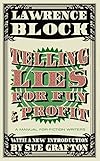
Telling Lies for Fun and Profit
by Lawrence Block
On This Page
Description
Characters refusing to talk? Plot plodding along? Where do good ideas come from anyway? In this wonderfully practical volume, two-time Edgar Award-winning novelist Lawrence Block takes an inside look at writing as a craft and as a career. From studying the market, to mastering self-discipline and "creative procrastination," through coping with rejections, Telling Lies for Fun & Profit is an invaluable sourcebook of information. It is a must read for anyone serious about writing or show more understanding how the process works. show lessTags
Recommendations




Member Reviews
This is a really great collection of articles Block wrote over the years about writing that he strung together in book format. Block is down to earth and funny; his articles easy to read. The article format makes it easy to read in little bits here and there and the book is divided into thematic sections. His advice isn't necessarily going to be groundbreaking if you've read other writing books - I find many authors have similar techniques and practices, but how they present them can sometimes click better than others. Block's humor does a lot to make this book fun to read. It also made me want to read his fiction - he's quite the prolific author, having written under several pennames. I picked up a book form one of his series and I show more look forward to finding out if I enjoy his fiction as much as his advice.
I'd definitely recommend this and it inspired me to get back on track with my own writing. show less
I'd definitely recommend this and it inspired me to get back on track with my own writing. show less
The articles that compose this writing guide are all, happily, nicely written – but there's not much new here, I'm afraid, and not much applicable to my particular situation … Larry Block – as he tells the story a couple of times in this collection of essays – has basically always written. Motivation can be an issue for him, as it is for all writers, but for the most part the driving force that made him apply butt to chair and fingers to keyboard has been that he enjoys eating, and what puts food on his table is the money he makes by writing.
One article which raised my eyebrows a bit was one in which Block talks about how easy it is to excuse oneself from actually applying one's butt to one's chair and writing: "well, writers show more are actually working 24/7, every bit of sensory input has the possibility of adding to a scene sometime, there's editing needed, and research, and a good writer reads a great deal" – etc. What it comes down to, for Block, is that yes, he does agree with all of that – it's true, after all, even if it is easy to use the list as excuses – but what he feels is the real work is actually pushing the current project forward by so many pages. He doesn't set times, he says, but instead sets a daily goal that takes as long as it takes. His goal is, apparently, five pages a day, and this generally takes about three hours, and then he can feel free to, as he says, go enjoy the day.
Three hours?
No wonder so many people want to be writers when they grow up.
What he doesn't seem to be mentioning here is that it's probably taken him years to reach a level of discipline where he can, as mentioned, apply butt to chair and get to work rather than frittering away time and needing to achieve the correct mindset and such. Also, to where he can achieve five pages in three hours with some reliability; that's not always a given. In my experience sometimes twenty pages will come in that space of time; other times, one, and I count myself lucky.
The reasoning he gives for the five page/three hour goal is sound, but the reason my eyebrows went up was that it sounded so very much like something that could be misconstrued. Hhe may not at the time of the writing of this book have been making millions, but he'd established himself and was making a modest living. And the little nugget he neglects here is that the less time you spend writing, the less you will write – and the less you write, the less money you can make through your writing.
I said before that a lot of this misses the mark for me. That's because I do not now write and never have written short stories. It's not how my mind works. Maybe it should be; I know in past decades it was almost unthinkable to try to make it with a novel right out of the gate. You were supposed to write short stories and submit them and get them rejected and send them out again over and over till someone took them. I almost wish I could do that. A beaten path is always easier to follow. This is the way Jo March did it; this is the way E. Byrd Starr did it. This is the way Lawrence Block did it. Me? Not so much. Short stories are very simply not in my repertoire. (I don't know if a novel is, either, but that's what's in the works. Sort of.)
Due to the nature of the book – a collection of articles from whatever magazine this was – there is a great deal of repetition. Sometimes two essays in a row say essentially the same thing. Block says in the introduction that he decided to arrange the book in a sort of chronological-by-process way, and did very little editing to the essays beyond changing "essay" to "chapter" and such … As a writer, I'm sure this was a tremendous idea. As a reader, it wasn't. Rather than a book to read straight through, it became a reference book, something to dip into here and there. show less
One article which raised my eyebrows a bit was one in which Block talks about how easy it is to excuse oneself from actually applying one's butt to one's chair and writing: "well, writers show more are actually working 24/7, every bit of sensory input has the possibility of adding to a scene sometime, there's editing needed, and research, and a good writer reads a great deal" – etc. What it comes down to, for Block, is that yes, he does agree with all of that – it's true, after all, even if it is easy to use the list as excuses – but what he feels is the real work is actually pushing the current project forward by so many pages. He doesn't set times, he says, but instead sets a daily goal that takes as long as it takes. His goal is, apparently, five pages a day, and this generally takes about three hours, and then he can feel free to, as he says, go enjoy the day.
Three hours?
No wonder so many people want to be writers when they grow up.
What he doesn't seem to be mentioning here is that it's probably taken him years to reach a level of discipline where he can, as mentioned, apply butt to chair and get to work rather than frittering away time and needing to achieve the correct mindset and such. Also, to where he can achieve five pages in three hours with some reliability; that's not always a given. In my experience sometimes twenty pages will come in that space of time; other times, one, and I count myself lucky.
The reasoning he gives for the five page/three hour goal is sound, but the reason my eyebrows went up was that it sounded so very much like something that could be misconstrued. Hhe may not at the time of the writing of this book have been making millions, but he'd established himself and was making a modest living. And the little nugget he neglects here is that the less time you spend writing, the less you will write – and the less you write, the less money you can make through your writing.
I said before that a lot of this misses the mark for me. That's because I do not now write and never have written short stories. It's not how my mind works. Maybe it should be; I know in past decades it was almost unthinkable to try to make it with a novel right out of the gate. You were supposed to write short stories and submit them and get them rejected and send them out again over and over till someone took them. I almost wish I could do that. A beaten path is always easier to follow. This is the way Jo March did it; this is the way E. Byrd Starr did it. This is the way Lawrence Block did it. Me? Not so much. Short stories are very simply not in my repertoire. (I don't know if a novel is, either, but that's what's in the works. Sort of.)
Due to the nature of the book – a collection of articles from whatever magazine this was – there is a great deal of repetition. Sometimes two essays in a row say essentially the same thing. Block says in the introduction that he decided to arrange the book in a sort of chronological-by-process way, and did very little editing to the essays beyond changing "essay" to "chapter" and such … As a writer, I'm sure this was a tremendous idea. As a reader, it wasn't. Rather than a book to read straight through, it became a reference book, something to dip into here and there. show less
An editor once told me that if you're going to take advice on writing, take it either from name-bestselling writers or gatekeepers such as acquiring editors or agents--not necessarily anyone who writes for Writer's Digest or has taught a writing class. Well, Lawrence Block is at least a published writer--and an Edgar-award winning one at that. But unlike Stephen King and Elizabeth George, both authors of books on the craft of writing, he's not an author I've personally enjoyed. Moreover, this isn't an integrated book on writing--it's a collection of articles he wrote for Writer's Digest, so as a LibraryThing reviewer pointed out, a lot of this is repetitive--and rarely offers anything I haven't read before. So, in looking over my show more writing books and comparing them to those by Stephen King, Elizabeth George, Renni Browne, Noah Lukeman, Orson Scott Card, Nancy Kress you'll have to pry out of my cold, dead hands? This doesn't make the cut for the precious space on my shelves. show less
A little old-fashioned humor never hurt anyone... and the tips and advice given by Lawrence Block in this writing classic far outweigh the groans that will be coaxed forth at his puns and gags. Some of them are enjoyable, actually. And he does a great job of using his own experience, giving examples, comparing for illustration, and showing why some things work and others don't. Highly recommended for those writing fiction.
A little old-fashioned humor never hurt anyone... and the tips and advice given by Lawrence Block in this writing classic far outweigh the groans that will be coaxed forth at his puns and gags. Some of them are enjoyable, actually. And he does a great job of using his own experience, giving examples, comparing for illustration, and showing why some things work and others don't. Highly recommended for those writing fiction.
A little outdated for today's writers who use laptops, computers, smart phones, etc. but some useful and interesting writing info from a prolific writer.
Writing advice based on his old Writer's Digest columns. Possibly you've seen it before, but he says it well.
Members
- Recently Added By
Author Information

492+ Works 38,070 Members
Lawrence Block is the author of the popular series' featuring Bernie Rhodenbarr, Matthew Scudder, and Chip Harrison. Over 2 million copies of Lawrence Block's books are in print. He has published articles and short fiction in American Heritage, Redbook, Playboy, GQ, and The New York Times, and has published several collections of short fiction in show more book form, most recently Collected Mystery Stories. Block is a Grand Master of Mystery Writers of America. He has won the Edgar and Shamus awards four times, the Japanese Maltese Falcon award twice, as well as the Nero Wolfe award. In France, he was proclaimed a Grand Maitre du Roman Noir and has been awarded the Societe 813 trophy twice. Block was presented with the key to the city of Muncie, Indiana, and is a past president of the Private Eye Writers of America and the Mystery Writers of America. (Bowker Author Biography) Lawrence Block is the author of the popular series featuring Bernie Rhodenbarr, Matthew Scudder, and Chip Harrison. Over 2 million copies of Lawrence Block's books are in print. Lawrence Block has won the Edgar Award three times, the Shamus Award four times, the Maltese Falcon Award twice, and was named Grandmaster by the Mystery Writers of America. (Publisher Provided) show less
Some Editions
Common Knowledge
- Canonical title
- Telling Lies for Fun and Profit
- Original publication date
- 1981
- Dedication
- For HAL DRESNER
Colleague, Companion,
and Corsican Brother
Classifications
Statistics
- Members
- 487
- Popularity
- 61,802
- Reviews
- 9
- Rating
- (4.19)
- Languages
- English
- Media
- Paper, Audiobook, Ebook
- ISBNs
- 11
- ASINs
- 7