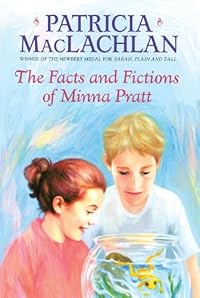
The Facts and Fictions of Minna Pratt
by Patricia MacLachlan
On This Page
Description
An eleven-year-old cellist learns about life from her eccentric family, her first boyfriend, and Mozart.Tags
Recommendations











Member Reviews
Two stars I guess. This book was--jarring to read as an adult, especially since five seconds before, I'd finished reading "Taking Care of Terrific" by Lois Lowry. It's another "rich girl wants an adventure" story, only this time, the girl wants to do well at a semi-professional youth orchestra competition and find her vibrato. Her younger brother sings instead of speaks as a conscious decision, and the book is careful to point out when he does speak. I finished the book early this morning and can't remember the dad at all. Rather than the wacky, inept housekeeper in "Terrific," here we have the -mom- who's eccentric. She only cooks the kids oatmeal, and not very well. She's a self-centered dreamer, but this is excused as, "She's a show more professional writer." I was not at all a fan of hers. All I could think was, "I've seen kids temporarily put into foster care for this exact thing." Child services got called because the parents needed to take a class on children's nutrition and make grocery choices that weren't oatmeal. Once they did, they got their kids back. So, seeing something similar (unintentional triple alliteration, woo!) in a fiction book portrayed as humorous was annoying at best.
Much of the book is taken up by Minna's experiences and goals as a cellist, which I appreciated. She gets a crush on newcomer Lucas, whose life is wildly different than hers. He's a complete character foil for Minna. No siblings, but several beloved frogs...that he has somehow successfully hidden from his parents because ~they don't ever go into his room~. They're excessively formal in speech and manner to themselves and others, and I wondered if they realized it wasn't the late 1800s anymore. Twig, the housekeeper, is quite lively next to them, and more like a cheerful parent. Lucas' mother goes into his room on a flimsy pretext. She sees the frogs thriving in their aquariums, and runs downstairs screaming about aliens. Absurd! It was not funny, cute, or in any way believable. Lucas regularly carries frogs in his pockets and somehow they don't die. Somehow they're all fine when he releases them into a nearby pond.
It was at this point I started skimming. Cliches and some low-level hijinks fill the rest of the book. The final paragraph, and especially the final line of the book, have always stuck with me. In fact, I used them to find the book as an adult. I still think they're great. But now, I believe they belong in a better book.. show less
Much of the book is taken up by Minna's experiences and goals as a cellist, which I appreciated. She gets a crush on newcomer Lucas, whose life is wildly different than hers. He's a complete character foil for Minna. No siblings, but several beloved frogs...that he has somehow successfully hidden from his parents because ~they don't ever go into his room~. They're excessively formal in speech and manner to themselves and others, and I wondered if they realized it wasn't the late 1800s anymore. Twig, the housekeeper, is quite lively next to them, and more like a cheerful parent. Lucas' mother goes into his room on a flimsy pretext. She sees the frogs thriving in their aquariums, and runs downstairs screaming about aliens. Absurd! It was not funny, cute, or in any way believable. Lucas regularly carries frogs in his pockets and somehow they don't die. Somehow they're all fine when he releases them into a nearby pond.
It was at this point I started skimming. Cliches and some low-level hijinks fill the rest of the book. The final paragraph, and especially the final line of the book, have always stuck with me. In fact, I used them to find the book as an adult. I still think they're great. But now, I believe they belong in a better book.. show less
I picked it up from the children's section at the Williamsburg Library Book Sale on Sunday, thinking that it would be a Christmas present for a friend, but I fell in love with it and don't want to give it up. (Sorry, Rach! You'll get something else wonderful!) Minna's family is really strange: her mother's a writer and never asks her normal questions like "How was your day?" Instead, she gets questions like "What is the quality of beauty?" She longs for a normal family, maybe one like Lucas's, the cute new viola player at the conservatory with a gorgeous vibratto (and no, that's not a euphamism). The usual sequence of growing up and coming to terms with life events happen, but it's the language and wordplay that makes this such a show more wonderful and lyrical book:
Minna looks out the bus window and thinks about her life. Her one life. She likes artichokes and blue fingernail polish and Mozart played too fast. She loves baseball, and the month of March because no one else much likes March, and every shade of brown she has ever seen. But this is only one life. Someday, she knows, she will have another life. A different one. A better one. McGrew knows this too. McGrew is ten years old. He knows nearly everything. He knows, for instance, that his older sister, Minna Pratt, age eleven, is sitting patiently next to her cello waiting to be a woman.
This was the passage that convinced me to take the book home, and it was well worth it. show less
Minna looks out the bus window and thinks about her life. Her one life. She likes artichokes and blue fingernail polish and Mozart played too fast. She loves baseball, and the month of March because no one else much likes March, and every shade of brown she has ever seen. But this is only one life. Someday, she knows, she will have another life. A different one. A better one. McGrew knows this too. McGrew is ten years old. He knows nearly everything. He knows, for instance, that his older sister, Minna Pratt, age eleven, is sitting patiently next to her cello waiting to be a woman.
This was the passage that convinced me to take the book home, and it was well worth it. show less
With my recent reading of MacLachlan's Waiting for the Magic, this author is fast becoming one of my favorites. I found this older book of hers, and devoured it in one evening. The city setting and tone reminded me of some of Madeleine L'Engle's books and of Anastasia Krupnik, by Lois Lowry. Minna, an accomplished cellist at 11, lives with her brother and rather eccentric parents. Her mother, a writer, tacks strange (to Minna) phrases above her typewriter. The hardest one for Minna to understand is: "Fact and Fiction are different truths." How can fiction be truth? thinks the literal-minded girl. Then she meets Lucas, a new member of her music group, who plays the viola, and has very orderly, calm parents. Over the course of several show more months, Minna learns facts and fictions about herself and her family. The novel is at times, drily humorous, warm, and thoughtful, my favorite type of writing. Minna has a good, strong relationship with her one year younger brother, McGrew (what an unusal name!), who puts everything to song, driving his teachers crazy, but delighting friends and family. This makes me think about the habits of some kids at school, and how they may be annoying in a school environment, but appreciated at home. I love all the other characters, too: Minna's music instructor, Porch, who loves Mozart; Willie, the street player who always returns Minna's donations; her psychologist father, who is gentle; her mother, so focused on her writing; Lucas' housekeeper, Twig (what a great name!), a crazy driver and briliant cook who keeps Lucas' secret (frogs in his bedroom); Emily Parmalee, the catcher on McGrew's baseball team. Here are some of my favorite quotes:
FACT AND FICTION ARE DIFFERENT TRUTHS
"Think about the music, not just the notes." Porch to students, p. 83; also THINK ABOUT THE STORY, NOT JUST THE WORDS
"Outside it was overcast, with a light that softened them all." p.107 - "softened" is a perfect description
"Dog falls into her lap in a heap of love." p. 108
The ending is perfect! show less
FACT AND FICTION ARE DIFFERENT TRUTHS
"Think about the music, not just the notes." Porch to students, p. 83; also THINK ABOUT THE STORY, NOT JUST THE WORDS
"Outside it was overcast, with a light that softened them all." p.107 - "softened" is a perfect description
"Dog falls into her lap in a heap of love." p. 108
The ending is perfect! show less
Minna wishes for many things. She wishes she understood the quote taped above her mother's typewriter: Fact and fiction are different truths. She wishes her mother would stop writing long enough to really listen to her. She wishes her house were peaceful and orderly like her friend Lucas's. Most of all, she wishes she could find a vibrato on her cello and play Mozart the way he deserves to be played.
Minna soon discovers that some things can't be found - they just have to happen. And as she waits for her vibrato to happen, Minna begins to understand some facts and fictions about herself.
Minna soon discovers that some things can't be found - they just have to happen. And as she waits for her vibrato to happen, Minna begins to understand some facts and fictions about herself.
Delightful! Shows kids longing for a different family (didn't we all?) and learning the strengths of the family they have. Great characters, sweet people. Lovely book!
I snagged this MacLachlan book from a BookCrossing bookshelf at my local coffee house, looking forward to an easy read between my more "grown-up" novels. In my opinion, The Facts and Fictions of Minna Pratt is an unusual book. For young readers unfamiliar with music, understanding and enjoying the short novel may be difficult. Even with 7 years as a musician under my belt, I felt a bit intimidated by the book. With numerous references to famous composers and an extensive musical vocabulary, the charming characters may not make up for the interest-specific plot and writing style. What's more, I often felt unnerved while reading, but am not sure if this is because of Minna's own disconnected personality, or MacLachlan's writing style. show more
Would I suggest this book to a young musician? Definintely. To my little brother or sister? Probably not. show less
Would I suggest this book to a young musician? Definintely. To my little brother or sister? Probably not. show less
Unliike all other books I read by Patricia MacLachlan, this one fell flat, to be point of boredom. Minna Pratt is a young girl who excels at play the Chello. She is very good act this skill, even though she rarely practices. Her new friend, McGraw flippantly plays and, like her rarely practices.
Mina watches as others excel at their skills, and McGraw is among them.
When Minna attend dinner at McGraw's house, she listens carefully to the crisp English spoken at the table. And the items presented are also very different then those at her table at home. She longs to have parents like McGraw's.
Throughout the book, I sense that Minna is more interested in McGraw then McGraw is in her.
There really isn't much more to write about. There is no show more drama, only children who are wanting to excel at their musical development.
I'm sad that this is unlike all other books, yet one book that does nit compare to the others is not bad odds. show less
Mina watches as others excel at their skills, and McGraw is among them.
When Minna attend dinner at McGraw's house, she listens carefully to the crisp English spoken at the table. And the items presented are also very different then those at her table at home. She longs to have parents like McGraw's.
Throughout the book, I sense that Minna is more interested in McGraw then McGraw is in her.
There really isn't much more to write about. There is no show more drama, only children who are wanting to excel at their musical development.
I'm sad that this is unlike all other books, yet one book that does nit compare to the others is not bad odds. show less
Members
- Recently Added By
Lists

Honey For a Child's Heart
1,152 works; 25 members

Books Featured in "Paperback Crush"
228 works; 7 members
Author Information

92+ Works 40,388 Members
Patricia MacLachlan was born in Cheyenne, Wyoming on March 3, 1938. She received a B.A. from the University of Connecticut in 1962 and taught English at a junior high school until 1979. She began writing picture books and novels at the age of thirty-five. Her works include The Facts and Fictions of Minna Pratt, Skylark, Caleb's Story, show more Grandfather's Dance, Three Names, All the Places to Love, Before You Came, Cat Talk, and Snowflakes Fall. She won the Golden Kite Award for Arthur, for the Very First Time and the 1986 Newbery Medal for Sarah, Plain and Tall. (Bowker Author Biography) show less
Awards and Honors
Awards
Work Relationships
Common Knowledge
- Canonical title
- The Facts and Fictions of Minna Pratt
- People/Characters
- Minna Pratt | Melinda Pratt; McGrew; Emily Parmalee; Lucas Ellerby; Porch; Willie | William Gray (show all 7); Twig
- Epigraph
- We all know that art is not truth, Art is a lie that makes us realize the truth.
---Pablo Picasso - Dedication
- Once I told a class of Natalie Babbitt's that she had inspired and encouraged me as a writer,
as a friend. "Why then," said Natalie crisply
(joking, of course) "haven't you ever dedicated a book
to me?" Well... (show all) this is it, with deep affection.
To Nat from Pat - First words
- Melinda Pratt rides city bus number twelve to her cello lesson, wearing her mother's jean jacket and only one sock.
- Last words
- (Click to show. Warning: May contain spoilers.)"Congratulations," says Lucas.
Classifications
- Genres
- Kids, Fiction and Literature, Children's Books
- DDC/MDS
- 813.54 — Literature & rhetoric American literature in English American fiction in English 1900-1999 1945-1999
- LCC
- PZ7 .M2225 .F — Language and Literature Fiction and juvenile belles lettres Fiction and juvenile belles lettres Juvenile belles lettres
- BISAC
Statistics
- Members
- 621
- Popularity
- 46,808
- Reviews
- 14
- Rating
- (3.82)
- Languages
- 5 — Dutch, English, French, German, Italian
- Media
- Paper, Audiobook, Ebook
- ISBNs
- 21
- ASINs
- 3