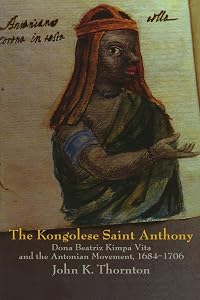
The Kongolese Saint Anthony: Dona Beatriz Kimpa Vita and the Antonian Movement, 1684-1706
by John Thornton
On This Page
Description
This book tells the story of the Christian religious movement led by Dona Beatriz Kimpa Vita in the Kingdom of Kongo from 1704 until her death, by burning at the stake, in 1706. Beatriz, a young woman, claimed to be possessed by St Anthony, argued that Jesus was a Kongolese, and criticized Italian Capuchin missionaries in her country for not supporting black saints. The movement was largely a peace movement, with a following among the common people, attempting to stop the devastating cycle show more of civil wars between contenders for the Kongolese throne. Thornton supplies background information on the Kingdom, the development of Catholicism in Kongo since 1491, the nature and role of local warfare in the Atlantic slave trade, and contemporary everyday life, as well as sketching the lives of some local personalities. show lessTags
Recommendations

































Member Reviews
The subject matter is fascinating, but the execution is lacking. The Kongolese Saint Anthony relates the story of an intriguing, but little known, incident in Kongolese history: the heretical Catholic movement founded by Dona Beatriz Kimpa Vita, a young Kongolese noblewoman who is sort of an African Joan of Arc. She claimed to be possessed by Saint Anthony of Padua and led an uprising against both the secular rulers of Kongo—unpopular because of their constant warmongering—and its religious hierarchy—mostly white Capuchins from Italy. Despite widespread support, Kimpa Vita was captured by orthodox forces and burnt at the stake at the age of 22.
However, though the topic itself was intriguing, Thornton's stylistic and organisational show more decisions made this a book that I struggled to finish, though it's only about 200 pages long. He disdains oral and anthropological evidence in favour of working from written commentary from European sources. It's a thoroughly Eurocentric approach, compounded by the fact that when those sources "quote" a Kongolese speaker, Thornton changes those indirect speech remarks to direct quotations, often with remarks on tone such as "he said sarcastically." It makes for a dramatic narrative, but it's jarring, makes pretty much everything Thornton writes suspect, and requires us to view everything through a European lense. Interesting introduction to what is a new topic to me, but very flawed. show less
However, though the topic itself was intriguing, Thornton's stylistic and organisational show more decisions made this a book that I struggled to finish, though it's only about 200 pages long. He disdains oral and anthropological evidence in favour of working from written commentary from European sources. It's a thoroughly Eurocentric approach, compounded by the fact that when those sources "quote" a Kongolese speaker, Thornton changes those indirect speech remarks to direct quotations, often with remarks on tone such as "he said sarcastically." It makes for a dramatic narrative, but it's jarring, makes pretty much everything Thornton writes suspect, and requires us to view everything through a European lense. Interesting introduction to what is a new topic to me, but very flawed. show less
Ratings
Members
- Recently Added By
Lists

r/AskHistorians' Recommended Books
1,068 works; 19 members
Author Information
2+ Works 447 Members
Common Knowledge
- People/Characters
- Anthony of Padua
Classifications
- Genres
- Nonfiction, History, Religion & Spirituality, General Nonfiction, Biography & Memoir, Politics and Government
- DDC/MDS
- 967.51 — History & geography History of Africa Central Africa: Congo, Angola, Chad Democratic Republic of the Congo (Congo-Kinshasa); Rwanda & Burundi Democratic Republic of the Congo (Congo-Kinshasa -- former Zaire)
- LCC
- DT654.2 .V58 .T48 — History of Europe, Asia, Africa and Oceania Africa History of Africa West Africa. West Coast Zaire. Congo (Democratic Republic). Belgian Congo History
- BISAC
Statistics
- Members
- 90
- Popularity
- 357,536
- Reviews
- 1
- Rating
- (3.33)
- Languages
- English
- Media
- Paper, Ebook
- ISBNs
- 5