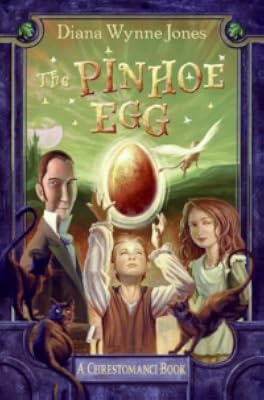
The Pinhoe Egg
by Diana Wynne Jones
The Chronicles of Chrestomanci: Publication (10), The Chronicles of Chrestomanci: Chronological (10)
On This Page
Description
Two powerful young enchanters, Cat, the future Chrestomanci, and Marianne, who is being trained to be Gammer of the Pinhoes, work together as friends to try to end an illegal witches' war and, in the process, right some old wrongs.Tags
Recommendations




Member Reviews
This book is an absolute delight; it takes place in the same universe where Christopher lives with his family, which is a nice change of pace, and we get to see them from the point of view of the people who live near him in the village. It’s really fun to see how chaotic his family life is–it fits his lifestyle perfectly–and how wild is children are. I enjoyed getting to see a closer in-depth look at that.
One of the best things is seeing how Christopher isn’t all-powerful and all-knowing; I love that his son needs to rescue him from a tight spot and that it’s the children who really start figuring things out and fixing things throughout most of the story. I wish there were more books in this series; I wish this could be show more continued, because I love the budding friendship between Cat and Marianne and would so much enjoy seeing it develop in future books. Marianne is such a treasure of a main character–a girl who is kept down by her family because they don’t realize (or don’t want to realize) just how powerful and special she is.
As always, I’m astounded at how the story beautifully comes together in the end. I’ve learned to trust Jones’s stories by now, but I’m always amazed at how all different sorts of random hints get dropped along the story and it turns out that these side-conversations were all super important to the story as a whole. It’s beautifully done in this story, and I loved seeing all the threads tied off at the end of it. I can’t recommend this story enough for fantasy lovers, it’s just SO GOOD and Jones’s books are absolute treasures.
Also posted on Purple People Readers. show less
One of the best things is seeing how Christopher isn’t all-powerful and all-knowing; I love that his son needs to rescue him from a tight spot and that it’s the children who really start figuring things out and fixing things throughout most of the story. I wish there were more books in this series; I wish this could be show more continued, because I love the budding friendship between Cat and Marianne and would so much enjoy seeing it develop in future books. Marianne is such a treasure of a main character–a girl who is kept down by her family because they don’t realize (or don’t want to realize) just how powerful and special she is.
As always, I’m astounded at how the story beautifully comes together in the end. I’ve learned to trust Jones’s stories by now, but I’m always amazed at how all different sorts of random hints get dropped along the story and it turns out that these side-conversations were all super important to the story as a whole. It’s beautifully done in this story, and I loved seeing all the threads tied off at the end of it. I can’t recommend this story enough for fantasy lovers, it’s just SO GOOD and Jones’s books are absolute treasures.
Also posted on Purple People Readers. show less
Saddened by the passing of Diana Wynne Jones, I thought it appropriate to commemorate her by dipping into her vast bibliography of books. She can be a charming writer, with interesting characters, gentle humor, pointed social commentary, and creative plotting and world-building. An unplanned stop at an unfamiliar library turned up [b:The Pinhoe Egg|34281|The Pinhoe Egg (Chrestomanci, #6)|Diana Wynne Jones|http://photo.goodreads.com/books/1168548306s/34281.jpg|1103585], described as "Book 6 in the Chrestomanci Chronicles." As I had read two or three of the Crestomanci books in the past, I thought I could get by in the world--in my experience, her books are more like loosely related stories in the same world with some of the same show more characters, and not an epic novel in installments like Harry Potter. It turned out to be a bit of a wander through the woods but had some nice stops along the way.
Super-fast non-spoiler summary: teenage girl, Marianne, with a large, intrusive and witchy extended family. Although she is supposed to be heir to the family position of power, she has little say in what she does, and is delegated to deal with a failing grandma. Meanwhile, teenage boy enchanter, Cat, discovers his own growing powers as he meets a horse. On their explorations he encounters the complicated witchy dynamics of the surrounding town.
The good stuff: DWJ has an interesting world idea, the concept of multiple variations of a basic format (ex. World A having 1-9 similar realities). Love the idea, although she doesn't play with it at all here. There is a lot of magic thrown about, and I enjoy her applications of magic in creatures and activity, and the fact that there are limitations to it and it can't solve everything. I thought Marianne and Cat were characterized well--when she takes the time, DWJ's characters shine. Touches of humor were sprinkled throughout, from a contrary magical cat (aren't they all?) to Crestomanci's variety of dressing gowns, to magical shenanigans. The little girl in me squealed at the appearance of the griffin; I would have been right there with Cat, taking an egg home to hatch. Griffins and the magical creatures made the story worthwhile.
Unfortunately, "Pinhoe" could have used more development. It generally suffers from an assumption that the reader is familiar with the world. The Crestomanci world is never really very well explained in any book but the first, and even then the level of explanation is questionable. While a telephone makes a singular appearance, people are forever being sent on errands to deliver messages, and a crucial plot point involves mistakenly knocking on one person's window in an attempt to reach the brother's. As cars also exist, it seems to be about an early 1900s sort of time/tech level, but it bugs my Virgo soul that no one calls each other if the tech is available.
Unfortunately, uneven pacing almost hamstrung it from the start, where the first seventy-five pages deal with moving Grandma ("Gammer") out of her giant house and into the hands of someone who can care for her. Now, as an adult, I can appreciate the drawn-out problem of dealing with an aging but incompetent relative, but as this is a young adult book, it would likely be a section that lacked relevance to younger people and contained too much detail. Had I been a teenager and in Marianne's place, I would have wandered away from the adults tout de suite and found my own thing to do, but instead there is far too much story focus on "Uncle Edgar did this," and "Aunt Dinah did that" that detracts from Marianne's story and own conflict development.
There were also rather disturbing actions by the adults, who not only behaved in typically ignorant adult ways (ruining holidays, ignoring talented children, discounting their ideas, etc), but flagrantly homicidal oneslike deliberate leg-breaking, imprisonment and attempting to unleash smallpox on a rival family . Including those crimes into the repertoire of childish pranks was an odd decision on the author's part that seemed to either inflate the seriousness of their earlier crimes, or minimize the seriousness of ones the teens didn't know about. It takes the story to a rather disturbing level that doesn't fit well into the whimsy of the rest of the book.
Heavy-handed application of A Message at the end hurt an otherwise nicely dovetailed wrap-up.
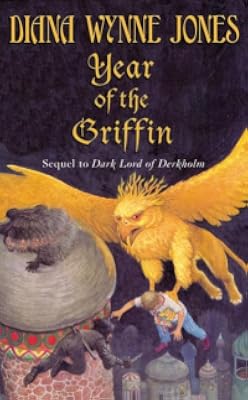
Like Neil Gaiman, I do love me some DWJ, but this isn't one of the books I'd recommend. Try [b:The Dark Lord of Derkholm|47587|The Dark Lord of Derkholm (Derkholm, #1)|Diana Wynne Jones|http://photo.goodreads.com/books/1170347861s/47587.jpg|869986] for a better story, even stronger characterization and even moregriffins. or [b:The Year of the Griffin|47573|The Year of the Griffin (Derkholm, #2)|Diana Wynne Jones|http://photo.goodreads.com/books/1170347858s/47573.jpg|1121912] for a lovely little "magical college" storyline that's told with humor, wild creativity and left me wishing DWJ could write at least six more.
Three stars for beginning, three for the ending, four for a fun, fast-paced middle, leading me to three and a half stars. show less
Super-fast non-spoiler summary: teenage girl, Marianne, with a large, intrusive and witchy extended family. Although she is supposed to be heir to the family position of power, she has little say in what she does, and is delegated to deal with a failing grandma. Meanwhile, teenage boy enchanter, Cat, discovers his own growing powers as he meets a horse. On their explorations he encounters the complicated witchy dynamics of the surrounding town.
The good stuff: DWJ has an interesting world idea, the concept of multiple variations of a basic format (ex. World A having 1-9 similar realities). Love the idea, although she doesn't play with it at all here. There is a lot of magic thrown about, and I enjoy her applications of magic in creatures and activity, and the fact that there are limitations to it and it can't solve everything. I thought Marianne and Cat were characterized well--when she takes the time, DWJ's characters shine. Touches of humor were sprinkled throughout, from a contrary magical cat (aren't they all?) to Crestomanci's variety of dressing gowns, to magical shenanigans. The little girl in me squealed at
Unfortunately, "Pinhoe" could have used more development. It generally suffers from an assumption that the reader is familiar with the world. The Crestomanci world is never really very well explained in any book but the first, and even then the level of explanation is questionable. While a telephone makes a singular appearance, people are forever being sent on errands to deliver messages, and a crucial plot point involves mistakenly knocking on one person's window in an attempt to reach the brother's. As cars also exist, it seems to be about an early 1900s sort of time/tech level, but it bugs my Virgo soul that no one calls each other if the tech is available.
Unfortunately, uneven pacing almost hamstrung it from the start, where the first seventy-five pages deal with moving Grandma ("Gammer") out of her giant house and into the hands of someone who can care for her. Now, as an adult, I can appreciate the drawn-out problem of dealing with an aging but incompetent relative, but as this is a young adult book, it would likely be a section that lacked relevance to younger people and contained too much detail. Had I been a teenager and in Marianne's place, I would have wandered away from the adults tout de suite and found my own thing to do, but instead there is far too much story focus on "Uncle Edgar did this," and "Aunt Dinah did that" that detracts from Marianne's story and own conflict development.
There were also rather disturbing actions by the adults, who not only behaved in typically ignorant adult ways (ruining holidays, ignoring talented children, discounting their ideas, etc), but flagrantly homicidal ones
Heavy-handed application of A Message at the end hurt an otherwise nicely dovetailed wrap-up.
Like Neil Gaiman, I do love me some DWJ, but this isn't one of the books I'd recommend. Try [b:The Dark Lord of Derkholm|47587|The Dark Lord of Derkholm (Derkholm, #1)|Diana Wynne Jones|http://photo.goodreads.com/books/1170347861s/47587.jpg|869986] for a better story, even stronger characterization and even more
Three stars for beginning, three for the ending, four for a fun, fast-paced middle, leading me to three and a half stars. show less
Almost a sequel to "Charmed Life". In parts quite funny, and in parts really dark. Horribly muddled at the end. The girl who is one of the primary characters simply can't get any of the adults to listen to her. Cat has grown up, and realized that when there is trouble, consulting Chrestomanci is the right thing to do. But he is swayed by others who haven't worked that out yet.
The last of the Chrestomanci books written by Diana Wynne Jones, The Pinhoe Egg was also the longest and, arguably, the most complicated in terms of plot. Unlike some of the novels preceding it Chrestomanci doesn’t just have a walk-on part at the end but takes on the most integrated role in proceedings since Charmed Life, the very first Chrestomanci story of all. The story actually centres on young Eric ‘Cat’ Chant, who lives at Chrestomanci Castle near Helm St Mary, and his contemporary Marianne Pinhoe, who lives about ten miles away in Ulverscote. Marianne’s grandmother appears to lose her mind in a blast of magic — did I mention this is a fantasy? — and poor Marianne’s long-anticipated summer holidays start to disappear show more over the horizon as her extended family gets drawn into a feud with a neighbouring village. Not only this but her family also fear the attention of Chrestomanci, the ‘Big Man’ at the Castle, whose job is to monitor any misuse of magic. And it turns out a whole lot of misuse of magic is going on.
As well as the last of the Chrestomanci books this was the first of the series where I felt you could draw a detailed map of the localities and how they related to each other; which, in fact, is just what I did. This gave the characters a landscape in which to work and interact, and helped to make the story more grounded, as it were, than some of the others in the series. This was, for me, also one of the richest and most satisfactory of the stories, as well as one of the longest, and helped to further enrich the sequence as a whole. True, some readers have been overwhelmed by what seems a cast of thousands — at a conservative estimate six ‘family’ members at the Castle , their staff of over two dozen, at least forty named villagers (a thousand appear in the final battle) and a handful of assorted non-humans. But rather than being a turn-off surely such complexity, requiring close attention to and engagement with the text, is something to celebrate rather than criticise? There is certainly no let-up in the expected drive of her story-telling.
The joint fulcrums on which the story turns are personified in both Marianne and Cat, the latter a nine-lifed enchanter who is likely to become the next Chrestomanci. The general assumption that children should be seen and not heard is not one that Diana Wynne Jones subscribed to, and so both youngsters have to struggle against not being believed by adults by becoming more brave and assertive. Being gifted magically they recognise each other’s innate abilities, and by working in tandem have the opportunity to avert the dangerous situation that all and sundry find themselves in. Things are particularly hard because there seem to be outside forces operating that prevent the truth from being investigated, let alone revealed. Is that truth being hidden by 'dwimmery', a state brought about by an Old English word implying an illusion brought about by sleight or magic?
The Pinhoe Egg is a novel that reveals more the more you enquire. The author explains in a note that she could only get started on the book by imaginatively exploring the countryside around Chrestomanci Castle and the villagers who lived there. Many of the names of villages and families are genuine, and Jones clearly delved around in her memories and her extensive learning to retrieve them. The Pinhoes for example live in a village called Ulverscote. There is in fact a real village called Pinhoe on the outskirts of Exeter, where a great battle was fought by Danish Vikings and King Ethelred’s army in the 11th century; the settlement, in hilly country, has a name probably derived from Celtic pen and Old English hoe, meaning ‘top of the hill’. As it happens, the village inhabited by Jones’ Pinhoes is called Ulverscote, close by Ulverscote Wood and situated on an eminence. The ‘cote’ element could denote ‘cottage’ or Welsh coed (‘wood’), while the first element seems to imply a personal name like Ulf, an old Scandinavian name meaning ‘Wolf’. Is it beyond the bounds of reason to suggest that ‘Ulverscote’ was concocted partly from a memory of the real Wolvercote, on the outskirts of Oxford? After all, Jones went to Oxford University, where she attended lectures by Tolkien, and the man himself was buried in Wolvercote cemetery. Yes, Wolvercote was before the 12th century originally the cottage of a certain Woolgar, not Ulf, but I am also mindful that in Charmed Life Cat’s home town is noted as … Wolvercote. In a lively and creative mind like Diana’s all these associations could easily have been tangled together, partly consciously, partly subconsciously; as a reader it is not necessary to know that these associations are possible but it certainly adds to one’s appreciation if historic events, etymologies and personal experiences are woven together in an artful and satisfying way.
With exactly 400 pages in the paperback edition it’s neither possible nor desirable to give a detailed plot description, so instead I’ll draw attention to a few other aspects that struck me in this reread. Fot example, Jones slyly alludes to the fairytale trope of seven sons, but despite Marianne’s father being one of these boys she herself is no seventh son of a seventh son; instead, she is the only girl amongst thirteen cousins — a fact which helps cement her unique magical status. Another theme that Jones harps on about is bigotry. Though there is a church and a Reverend Pinhoe in evidence, we are never anywhere told the precise religion of this fantasy world; however that doesn’t stop the rival Farleigh family, equally witches and magic-users, from inveighing against “ungodly abominations”, an all too familiar rant in our own world. There’s a confusing backstory of an orthodox religion but this seems to predate ‘the Romans'; whether these are ‘our’ Romans or a closet reference to Roman Catholics is unclear, and may be the sort of typical obfuscation that Jones tends to throw into her novels from time to time.
The final aspect I want to explore is the place The Pinhoe Egg has in the series’ chronology. Luckily Jones gives us some clues. It’s been almost a year since the moment in Charmed Life when Cat accepted he was a nine-lifed enchanter. So we have a fairly tight timeline between the 1977 title and this last in the series published nearly three decades later, all linked by the character of Cat (and Chrestomanci, of course). Since I’ve reviewed all these at some time or another I won’t give full details, but the sequence is Charmed Life (when we first meet Cat) followed by the short story ‘The Sage of Theare’ (where Cat puts in a brief appearance). The young Italian Tonino (who appears in The Magicians of Caprona) meets up with Cat in another short story ‘Stealer of Souls’, and both feature again in ‘Caroline Oneir’s Hundredth Dream’. This last short story ends with the Chrestomanci ‘family’ on holiday in the South of France, from which they return in time for the start of The Pinhoe Egg. As always, most of these tales can be read as standalones, but those readers wanting continuity in their series reading could do worse than read the stories in this order.
You will by now be wondering what the egg of the title is. This appears as a result of “a promise I made to my sister” (Ursula, perhaps) “that I would write more about such things”. What this spotted mauve egg contains is a surprise I leave to the reader to discover for themselves, but it is a creature that traditionally guards gold. And while I feel the egg itself is a bit of a McGuffin I suppose the story itself, in a way, is the gold.
https://calmgrove.wordpress.com/2015/03/21/egg/ show less
As well as the last of the Chrestomanci books this was the first of the series where I felt you could draw a detailed map of the localities and how they related to each other; which, in fact, is just what I did. This gave the characters a landscape in which to work and interact, and helped to make the story more grounded, as it were, than some of the others in the series. This was, for me, also one of the richest and most satisfactory of the stories, as well as one of the longest, and helped to further enrich the sequence as a whole. True, some readers have been overwhelmed by what seems a cast of thousands — at a conservative estimate six ‘family’ members at the Castle , their staff of over two dozen, at least forty named villagers (a thousand appear in the final battle) and a handful of assorted non-humans. But rather than being a turn-off surely such complexity, requiring close attention to and engagement with the text, is something to celebrate rather than criticise? There is certainly no let-up in the expected drive of her story-telling.
The joint fulcrums on which the story turns are personified in both Marianne and Cat, the latter a nine-lifed enchanter who is likely to become the next Chrestomanci. The general assumption that children should be seen and not heard is not one that Diana Wynne Jones subscribed to, and so both youngsters have to struggle against not being believed by adults by becoming more brave and assertive. Being gifted magically they recognise each other’s innate abilities, and by working in tandem have the opportunity to avert the dangerous situation that all and sundry find themselves in. Things are particularly hard because there seem to be outside forces operating that prevent the truth from being investigated, let alone revealed. Is that truth being hidden by 'dwimmery', a state brought about by an Old English word implying an illusion brought about by sleight or magic?
The Pinhoe Egg is a novel that reveals more the more you enquire. The author explains in a note that she could only get started on the book by imaginatively exploring the countryside around Chrestomanci Castle and the villagers who lived there. Many of the names of villages and families are genuine, and Jones clearly delved around in her memories and her extensive learning to retrieve them. The Pinhoes for example live in a village called Ulverscote. There is in fact a real village called Pinhoe on the outskirts of Exeter, where a great battle was fought by Danish Vikings and King Ethelred’s army in the 11th century; the settlement, in hilly country, has a name probably derived from Celtic pen and Old English hoe, meaning ‘top of the hill’. As it happens, the village inhabited by Jones’ Pinhoes is called Ulverscote, close by Ulverscote Wood and situated on an eminence. The ‘cote’ element could denote ‘cottage’ or Welsh coed (‘wood’), while the first element seems to imply a personal name like Ulf, an old Scandinavian name meaning ‘Wolf’. Is it beyond the bounds of reason to suggest that ‘Ulverscote’ was concocted partly from a memory of the real Wolvercote, on the outskirts of Oxford? After all, Jones went to Oxford University, where she attended lectures by Tolkien, and the man himself was buried in Wolvercote cemetery. Yes, Wolvercote was before the 12th century originally the cottage of a certain Woolgar, not Ulf, but I am also mindful that in Charmed Life Cat’s home town is noted as … Wolvercote. In a lively and creative mind like Diana’s all these associations could easily have been tangled together, partly consciously, partly subconsciously; as a reader it is not necessary to know that these associations are possible but it certainly adds to one’s appreciation if historic events, etymologies and personal experiences are woven together in an artful and satisfying way.
With exactly 400 pages in the paperback edition it’s neither possible nor desirable to give a detailed plot description, so instead I’ll draw attention to a few other aspects that struck me in this reread. Fot example, Jones slyly alludes to the fairytale trope of seven sons, but despite Marianne’s father being one of these boys she herself is no seventh son of a seventh son; instead, she is the only girl amongst thirteen cousins — a fact which helps cement her unique magical status. Another theme that Jones harps on about is bigotry. Though there is a church and a Reverend Pinhoe in evidence, we are never anywhere told the precise religion of this fantasy world; however that doesn’t stop the rival Farleigh family, equally witches and magic-users, from inveighing against “ungodly abominations”, an all too familiar rant in our own world. There’s a confusing backstory of an orthodox religion but this seems to predate ‘the Romans'; whether these are ‘our’ Romans or a closet reference to Roman Catholics is unclear, and may be the sort of typical obfuscation that Jones tends to throw into her novels from time to time.
The final aspect I want to explore is the place The Pinhoe Egg has in the series’ chronology. Luckily Jones gives us some clues. It’s been almost a year since the moment in Charmed Life when Cat accepted he was a nine-lifed enchanter. So we have a fairly tight timeline between the 1977 title and this last in the series published nearly three decades later, all linked by the character of Cat (and Chrestomanci, of course). Since I’ve reviewed all these at some time or another I won’t give full details, but the sequence is Charmed Life (when we first meet Cat) followed by the short story ‘The Sage of Theare’ (where Cat puts in a brief appearance). The young Italian Tonino (who appears in The Magicians of Caprona) meets up with Cat in another short story ‘Stealer of Souls’, and both feature again in ‘Caroline Oneir’s Hundredth Dream’. This last short story ends with the Chrestomanci ‘family’ on holiday in the South of France, from which they return in time for the start of The Pinhoe Egg. As always, most of these tales can be read as standalones, but those readers wanting continuity in their series reading could do worse than read the stories in this order.
You will by now be wondering what the egg of the title is. This appears as a result of “a promise I made to my sister” (Ursula, perhaps) “that I would write more about such things”. What this spotted mauve egg contains is a surprise I leave to the reader to discover for themselves, but it is a creature that traditionally guards gold. And while I feel the egg itself is a bit of a McGuffin I suppose the story itself, in a way, is the gold.
https://calmgrove.wordpress.com/2015/03/21/egg/ show less
A sequel to Charmed Life, with a focus on Cat, the Chrestomanci-in-training. Like The Magicians of Caprona, a major element is a war between families, but this one is much more interesting than the ersatz Romeo and Juliet Magicians. One reason is that the background is much more complicated, and only revealed only in a long denouement, so the mystery of exactly what is going is left up in the air much longer. Another helpful factor is that unlike Magicians all this takes place in Chrestomanci's backyard, so to speak, so there's a nice intermingling of characters from Charmed Life with the new protagonists. The only quibble I have is that the introduction of the key characters Joe and Marianne is so cursory that it's unclear if they're show more adults, older teens, or what.
Recommended. show less
Recommended. show less
My favorite of the Chrestomanci books, which is saying something! (Now that I've read them all, I'd like to go back to most of them a second time.) The Pinhoe Egg sticks together well and features a compelling girl main character alongside the magically-talented boy lead so common in Jones's novels. The mundane, domestic interactions and the magical world furl together beautifully here. A real pleasure.
The Pinhoe Egg is magnificent. Marianne is a great character, and the other Pinhoes are firmly established too - simplistic but not cardboard. I like Cat best - his was the first Chrestomanci story I read - so this illumination of his life is great. Not sidelight, it's a continuation of his story, since we haven't seen him as an adult or Chrestomanci yet. Joe and Roger together are nicely mad; Janet and Julia are left out of things a bit but when they do show up they're well-drawn. The way all the various storylines intertwine - Grammer's 'illness', the empty forest, Joe at the castle and Marianne in the village, the Pinhoe house, the egg, all the rest of it - is great. They seem quite individual to start with, then start getting mixed, show more then they turn out all to be facets or reflections of one problem. Though I have to say Chrestomanci's summing up, though no doubt accurate, comes way out of left field. I wish we'd seen some of the research that produced those answers. show less
Members
- Recently Added By
Lists

NPRs your favorites: 100 Best Ever Teen Novels
237 works; 49 members

Favourite books by Diana Wynne Jones
35 works; 3 members

4th Grade Books
312 works; 5 members

Books Read in 2008
336 works; 8 members

Main Character is aged 10-19
363 works; 6 members
Author Information

112+ Works 80,689 Members
Diana Wynne Jones was born in London on August 16, 1934. In 1953, she began school at St. Anne's College Oxford and attended lectures by J. R. R. Tolkien and C. S. Lewis. After graduation, she created plays for children that were performed at the London Arts Theatre. Her first book was published in 1973. She wrote over 40 books during her lifetime show more including Dark Lord of Derkholm, Earwig and the Witch, and the Chrestomanci series. She won numerous awards including the Guardian Award for Children's Books in 1977 for Charmed Life, the Boston Globe-Horn Book Award in 1984 for Archer's Goon, the Mythopeic Award in 1999, the Karl Edward Wagner Award in 1999, and the Life Achievement Award from the World Fantasy Organization in 2007. Her book Howl's Moving Castle was adapted into an animated film by director Hayao Miyazaki, and the film was nominated for an Academy Award for Best Animated Feature. She died from lung cancer on March 26, 2011 at the age of 76. (Bowker Author Biography) show less
Some Editions
Awards and Honors
Series


Work Relationships
Common Knowledge
- Canonical title
- The Pinhoe Egg
- Original publication date
- 2006
- People/Characters
- Chrestomanci; Millie Chant; Eric Chant (Cat Chant); Janet Chant; Roger Chant; Julia Chant (show all 19); Jason Yeldham; Irene Yeldham; Marianne Pinhoe; Joe Pinhoe; Gammer Edith Pinhoe; Gaffer Elijah Pinhoe; Joss Callow; Gaffer Jed Farleigh; Gammer Norah Farleigh; Syracuse (horse); Molly (unicorn); Klartch (griffin); Nutcase (cat)
- Important places
- Ulverscote; Chrestomanci Castle
- Dedication
- To Greer Gilman
- First words
- At the beginning of the summer holidays, while Chrestomanci and his family were still in the south of France, Marianne Pinhoe and her brother Joe walked reluctantly up the steep main street of Ulverscote.
- Last words
- (Click to show. Warning: May contain spoilers.)And sometimes, sometimes, when Cat rode out on Syracuse into the more distant woods, they would see a tall old man striding along in the distance with his hand on the back of a glimmering white unicorn.
- Blurbers
- Gaiman, Neil
- Original language
- English
Classifications
- Genres
- Fiction and Literature, Kids, Fantasy, Tween
- DDC/MDS
- 823.914 — Literature & rhetoric English & Old English literatures English fiction 1900- 1901-1999 1945-1999
- LCC
- PZ7 .J684 .P — Language and Literature Fiction and juvenile belles lettres Fiction and juvenile belles lettres Juvenile belles lettres
- BISAC
Statistics
- Members
- 1,593
- Popularity
- 14,354
- Reviews
- 42
- Rating
- (3.97)
- Languages
- English, Finnish, Japanese
- Media
- Paper, Audiobook, Ebook
- ISBNs
- 28
- ASINs
- 10