
On This Page
Description
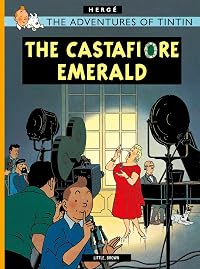
The classic graphic novel. When Tintin and Captain Haddock happen across a community of gypsies they invite them home . . . just as Bianca Castafiore, the famous opera singer, decides to visit Tintin. It's chaos at Marlinspike Hall, and then a precious emerald goes missing!Tags
Recommendations


















Member Reviews
My review, published in Tintin Books
My review:
This is it: Tintin's least formulaic adventure, and Herge's greatest stylistic experiment. That's not to say it's necessarily the best in the series, but "The Castafiore Emerald" completes a five-album cycle in which Herge perfected his craft. (Explorers on the Moon gave him his greatest artistic challenge; The Calculus Affair was the height of his skills as an artist; The Red Sea Sharks was a perfect story; and he capped all this off with the emotional study that is Tintin in Tibet)
The story is well-known by now: tiring, like Captain Haddock, of adventures, Herge decided to test his own skill by doing a story in which "nothing much happens". In this adventure, Bianca Castafiore is one of show more many unwanted visitors at Marlinspike, throwing Haddock's blissful life into disarray. Herge continually teases with the idea of an adventure - there are Roma people living on the land with suspicious motives; there are shady men pursuing Castafiore; the diva herself is in fear that her emeralds will be stolen, and the actions of her entourage indicate something malevolent. Instead, all but one of these proves to be a red herring. And even then, the one that does come true doesn't happen until three-quarters through the narrative!
The artist has great fun drawing a light farce, as most of this album is. Some pages are entirely filled with people talking in a room. He beautifully plays with depth and the art of the comedy of manners, and very much enjoys the slow burn of Haddock's halcyon days becoming but a distant memory. Some of the best moments include the gorgeous artwork of the gypsies by a late-night fire, Snowy's amusing asides to the reader ("I can't stand animals who talk!", that delightfully underplayed cover, and Calculus' invention (preceding the real world unveiling) of colour television. This sequence is clearly a labour of love for the artist, who spends many frames playing around with the tuning of Calculus' invention (while our characters sit, increasingly impatiently, often with their backs to us), and subsequently a frame of his own artwork into the fuzzy static of an old television set.
By its very nature, of course, nothing happens, and all rumblings of discontent reveal themselves to be either red herrings, or at the least unexpected trivialities. Certainly, for this reason, I can't imagine this work will be made into one of Spielberg's films any time soon! But that is, of course, its aim - and Herge succeeds in capturing our attention even without the aid of pirates, rockets, abominable snowmen or any of the other diversions which he had recently employed.
Of course, there is still plenty going on here to justify the album's existence. The plight of the Roma is deftly handled, with Haddock quicker these days to learn from his prejudices. Herge cleverly explores the prejudice on both sides of the issue - with characters on both 'our' side and that of the Roma who are bigoted, and those who aren't. Beyond this, the general sense of foreboding in the air makes the album's location come alive: Marlinspike genuinely feels well-populated, and it's truly a joy to see Tintin, Calculus, Haddock et al in their home environment.
And La Castafiore, a vibrant character in all her appearances, is put to great use here too. She may be the least dimensional person in the album (everyone begins life as a caricature in Herge's work, but despite the title, Castafiore doesn't really get to break her bonds until she joins everyone else in doing so in Tintin and the Picaros), but the diva is a force to be reckoned with, and never fails to steal the show.
In fact, when all is said and done I can't think of much to complain about. (Note the sly reference in the very first frame, which will ultimately explain the mystery.) As with "Tintin in Tibet", I'm certainly glad it was a one-time experiment: these albums must by design be langorously paced, and as such offer a little less on future readings. But this is an achievement which should be more appreciated amongst Tintin fans. show less
My review:
This is it: Tintin's least formulaic adventure, and Herge's greatest stylistic experiment. That's not to say it's necessarily the best in the series, but "The Castafiore Emerald" completes a five-album cycle in which Herge perfected his craft. (Explorers on the Moon gave him his greatest artistic challenge; The Calculus Affair was the height of his skills as an artist; The Red Sea Sharks was a perfect story; and he capped all this off with the emotional study that is Tintin in Tibet)
The story is well-known by now: tiring, like Captain Haddock, of adventures, Herge decided to test his own skill by doing a story in which "nothing much happens". In this adventure, Bianca Castafiore is one of show more many unwanted visitors at Marlinspike, throwing Haddock's blissful life into disarray. Herge continually teases with the idea of an adventure - there are Roma people living on the land with suspicious motives; there are shady men pursuing Castafiore; the diva herself is in fear that her emeralds will be stolen, and the actions of her entourage indicate something malevolent. Instead, all but one of these proves to be a red herring. And even then, the one that does come true doesn't happen until three-quarters through the narrative!
The artist has great fun drawing a light farce, as most of this album is. Some pages are entirely filled with people talking in a room. He beautifully plays with depth and the art of the comedy of manners, and very much enjoys the slow burn of Haddock's halcyon days becoming but a distant memory. Some of the best moments include the gorgeous artwork of the gypsies by a late-night fire, Snowy's amusing asides to the reader ("I can't stand animals who talk!", that delightfully underplayed cover, and Calculus' invention (preceding the real world unveiling) of colour television. This sequence is clearly a labour of love for the artist, who spends many frames playing around with the tuning of Calculus' invention (while our characters sit, increasingly impatiently, often with their backs to us), and subsequently a frame of his own artwork into the fuzzy static of an old television set.
By its very nature, of course, nothing happens, and all rumblings of discontent reveal themselves to be either red herrings, or at the least unexpected trivialities. Certainly, for this reason, I can't imagine this work will be made into one of Spielberg's films any time soon! But that is, of course, its aim - and Herge succeeds in capturing our attention even without the aid of pirates, rockets, abominable snowmen or any of the other diversions which he had recently employed.
Of course, there is still plenty going on here to justify the album's existence. The plight of the Roma is deftly handled, with Haddock quicker these days to learn from his prejudices. Herge cleverly explores the prejudice on both sides of the issue - with characters on both 'our' side and that of the Roma who are bigoted, and those who aren't. Beyond this, the general sense of foreboding in the air makes the album's location come alive: Marlinspike genuinely feels well-populated, and it's truly a joy to see Tintin, Calculus, Haddock et al in their home environment.
And La Castafiore, a vibrant character in all her appearances, is put to great use here too. She may be the least dimensional person in the album (everyone begins life as a caricature in Herge's work, but despite the title, Castafiore doesn't really get to break her bonds until she joins everyone else in doing so in Tintin and the Picaros), but the diva is a force to be reckoned with, and never fails to steal the show.
In fact, when all is said and done I can't think of much to complain about. (Note the sly reference in the very first frame, which will ultimately explain the mystery.) As with "Tintin in Tibet", I'm certainly glad it was a one-time experiment: these albums must by design be langorously paced, and as such offer a little less on future readings. But this is an achievement which should be more appreciated amongst Tintin fans. show less
Late in the Tintin series, Hergé seems to have run out of story ideas, including more and more filler material to compensate for the increasingly paltry plots. The story in The Red Sea Sharks was recycled. The story in Tintin in Tibet was flimsy. The plot in The Castafiore Emerald is nonexistent, resulting in a book that is full of nothing but slapstick gags and red herrings. The lack of any real story is compounded by the fact that the focal character of the book is my least favorite supporting character in the series: the obnoxiously self-absorbed Bianca Castafiore. Although the series did recover somewhat in the final two books of the series, each of them including something akin to an actual plot, this book is the nadir of show more storytelling in the series, and as a result is among the weakest of the Adventures of Tintin.
This weakness is the result, in large part, of the fact that there is essentially no "adventure" in The Castafiore Emerald. The activity in the story is almost exclusively confined to the grounds of Marlinspike Hall, making this one of the few Tintin books in which all of the action is confined to a single country, or in this case, a single country estate. While having a story set exclusively in a setting like Marlinspike Hall is not necessarily bad, after adventures in which the characters journeyed to exotic places, tangled with spies, and even flew to the moon, a manor mystery is something of a disappointment. Not only that while the story seems to be something of a heist mystery, with Castafiore bringing her precious jewels with her for an unexpected visit with Tintin and the Captain, lead after lead turns into a dead end, until the entire "plot" evaporates into nothingness.
The book does open up somewhat promisingly, as Tintin and Captain Haddock come across a gypsy caravan while out on a walk. Upon learning that the only place the local police would let the Romany set up their camp was a dump, Haddock is incensed and insists that they move to a meadow on his property at Marlinspike. Given the widespread prejudice against the Romany that continues to this day, having his central character take such a strong position in support of extending basic human decency towards them is a fairly powerful statement for Hergé to make. This statement is made all the stronger when, despite the dire warnings issued by the police and even Nestor concerning the trouble that having the Romany as guests is sure to bring, they end up causing no trouble at all. The one redeeming aspect of this book is the very sympathetic treatment given to this persecuted minority.
Unfortunately, that is more or less the sum total of the good parts of the book. The rest consists of tired slapstick gags, mistaken identity, and misdirection. The book sets up the running gag of a broken step on Marlinspike's main staircase, which Calculus, Nestor, and eventually Captain Haddock all fall prey to while Mr. Bolt the repairman avoids coming to fix the problem. This results in Captain Haddock being laid up and unable to avoid the Milanese Nightingale's visit, or her attentions when she does arrive. And of course when Captain Haddock is trying to call Mr. Bolt, the book revives the long-running gag involving misdialing the number for Mr. Cutts the butcher. The primary occurrence of the book is the unexpected and uninvited visit to Marlinspike by Bianca Castafiore and her small entourage of Irma, her maid, and Igor Wagner, her accompanist. In the swirl of self-absorbed activity surrounding Ms. Castafiore (including the delivery of a gift of a parrot for Captain Haddock and one of her own albums for Tintin), we learn that she has brought her jewels and is somewhat paranoid about them being stolen. And this paranoia drives the rest of the book as nosy reporters, employees going about their business, and coincidental events take on unwarranted importance.
One of the central problems of the book is that it features Bianca Castafiore as a primary character. In previous books the opera singer would appear for a page or two of humor as she mangled Captain Haddock's name, sang The Jewel Song from Faust and generally behaved like a self-absorbed diva. And in small doses her self-centered obnoxiousness is annoying but kind of funny. But Bianca quickly becomes tiresome, and in an entire book devoted to her, she becomes insufferable. In terms of character, Bianca Castafiore is sort of like a nightmare version of Professor Calculus. While Calculus is oblivious to those around him, this is because he is virtually deaf, but even when he misunderstands what is said to him, he is well-meaning and kind in his responses (with the one exception being when he displays a monumental temper in Destination Moon). He is helpful and puts his intellect to great use building magnificent inventions that he intends to be used to benefit all people. One the other hand, Bianca Castafiore is oblivious to those around her because she is a selfish and simply doesn't care about them except to the extent that they serve as an audience to shower adulation upon her. Her one talent - singing opera - is one that Hergé thought useless, and she apparently has a repertoire of exactly one song. In short, where Calculus is an unassuming asset to society, Castafiore is a vain and useless bauble.
Centered as it is on Bianca Castafiore, the book isn't helped by the appearance of the equally annoying Jolyon Wagg who does his usual pushy salesman routine and tries to get Bianca to buy insurance for her jewels. As usual, Haddock seems to completely lack the ability to tell annoying guests that he'd rather they not stay, a situation exacerbated by his being wheelchair bound as a result of a foot injury caused by stumbling on the broken step in Marlinspike Hall. As a result, we are treated to a series of fairly excruciating scenes in which Haddock is forced to endure the company of Castafiore and Wagg without the ability to make himself scarce. The book winds its way through a series of red herrings, driven by Bianca Castafiore's combination of vanity and paranoia; she announces that she does not want publicity, but then clarifies that she doesn't want publicity from particular news outlets, it becoming clear quite quickly that she craves publicity from other newspapers and even arranges a television interview. She even revels in a false story that she and Captain Haddock will be getting married, a development that once again clumsily attempts to provide humor at Haddock's expense. Against a backdrop of a media circus surrounding Bianca's visit to Marlinspike, Tintin's lack of attention to doing anything related to his purported job as a journalist is particularly noticeable. People come and go from the estate, each being suspected of being after the prize emerald in Bianca Castafiore's jewel collection, or later, being suspected of stealing the item.
The true failure of the books is that all this activity simply goes nowhere. In the end, Tintin solves the "mystery" as a result of sudden inspiration that strike him while listening to Bianca sing The Jewel Song from Faust, a development that comes out of left field. None of the strange happenings around the estate amount to anything of substance, none of the clues are actually clues, and none of the suspects are actually up to anything particularly nefarious. The book is, in total, a collection of red herrings that add up to nothing more than a giant red herring. In all the previous books, even ones like Tintin in America which had thin stories, there was at least a story. In The Castafiore Emerald, it seems that Hergé simply ran out of ideas for a story and resorted to rehashed gags, coincidences, and misdirection in the place of any semblance of a plot. With no plot and featuring the most annoying recurring character in the Tintin cast, this is simply the weakest book of the series.
This book has also been posted to my blog Dreaming About Other Worlds. show less
This weakness is the result, in large part, of the fact that there is essentially no "adventure" in The Castafiore Emerald. The activity in the story is almost exclusively confined to the grounds of Marlinspike Hall, making this one of the few Tintin books in which all of the action is confined to a single country, or in this case, a single country estate. While having a story set exclusively in a setting like Marlinspike Hall is not necessarily bad, after adventures in which the characters journeyed to exotic places, tangled with spies, and even flew to the moon, a manor mystery is something of a disappointment. Not only that while the story seems to be something of a heist mystery, with Castafiore bringing her precious jewels with her for an unexpected visit with Tintin and the Captain, lead after lead turns into a dead end, until the entire "plot" evaporates into nothingness.
The book does open up somewhat promisingly, as Tintin and Captain Haddock come across a gypsy caravan while out on a walk. Upon learning that the only place the local police would let the Romany set up their camp was a dump, Haddock is incensed and insists that they move to a meadow on his property at Marlinspike. Given the widespread prejudice against the Romany that continues to this day, having his central character take such a strong position in support of extending basic human decency towards them is a fairly powerful statement for Hergé to make. This statement is made all the stronger when, despite the dire warnings issued by the police and even Nestor concerning the trouble that having the Romany as guests is sure to bring, they end up causing no trouble at all. The one redeeming aspect of this book is the very sympathetic treatment given to this persecuted minority.
Unfortunately, that is more or less the sum total of the good parts of the book. The rest consists of tired slapstick gags, mistaken identity, and misdirection. The book sets up the running gag of a broken step on Marlinspike's main staircase, which Calculus, Nestor, and eventually Captain Haddock all fall prey to while Mr. Bolt the repairman avoids coming to fix the problem. This results in Captain Haddock being laid up and unable to avoid the Milanese Nightingale's visit, or her attentions when she does arrive. And of course when Captain Haddock is trying to call Mr. Bolt, the book revives the long-running gag involving misdialing the number for Mr. Cutts the butcher. The primary occurrence of the book is the unexpected and uninvited visit to Marlinspike by Bianca Castafiore and her small entourage of Irma, her maid, and Igor Wagner, her accompanist. In the swirl of self-absorbed activity surrounding Ms. Castafiore (including the delivery of a gift of a parrot for Captain Haddock and one of her own albums for Tintin), we learn that she has brought her jewels and is somewhat paranoid about them being stolen. And this paranoia drives the rest of the book as nosy reporters, employees going about their business, and coincidental events take on unwarranted importance.
One of the central problems of the book is that it features Bianca Castafiore as a primary character. In previous books the opera singer would appear for a page or two of humor as she mangled Captain Haddock's name, sang The Jewel Song from Faust and generally behaved like a self-absorbed diva. And in small doses her self-centered obnoxiousness is annoying but kind of funny. But Bianca quickly becomes tiresome, and in an entire book devoted to her, she becomes insufferable. In terms of character, Bianca Castafiore is sort of like a nightmare version of Professor Calculus. While Calculus is oblivious to those around him, this is because he is virtually deaf, but even when he misunderstands what is said to him, he is well-meaning and kind in his responses (with the one exception being when he displays a monumental temper in Destination Moon). He is helpful and puts his intellect to great use building magnificent inventions that he intends to be used to benefit all people. One the other hand, Bianca Castafiore is oblivious to those around her because she is a selfish and simply doesn't care about them except to the extent that they serve as an audience to shower adulation upon her. Her one talent - singing opera - is one that Hergé thought useless, and she apparently has a repertoire of exactly one song. In short, where Calculus is an unassuming asset to society, Castafiore is a vain and useless bauble.
Centered as it is on Bianca Castafiore, the book isn't helped by the appearance of the equally annoying Jolyon Wagg who does his usual pushy salesman routine and tries to get Bianca to buy insurance for her jewels. As usual, Haddock seems to completely lack the ability to tell annoying guests that he'd rather they not stay, a situation exacerbated by his being wheelchair bound as a result of a foot injury caused by stumbling on the broken step in Marlinspike Hall. As a result, we are treated to a series of fairly excruciating scenes in which Haddock is forced to endure the company of Castafiore and Wagg without the ability to make himself scarce. The book winds its way through a series of red herrings, driven by Bianca Castafiore's combination of vanity and paranoia; she announces that she does not want publicity, but then clarifies that she doesn't want publicity from particular news outlets, it becoming clear quite quickly that she craves publicity from other newspapers and even arranges a television interview. She even revels in a false story that she and Captain Haddock will be getting married, a development that once again clumsily attempts to provide humor at Haddock's expense. Against a backdrop of a media circus surrounding Bianca's visit to Marlinspike, Tintin's lack of attention to doing anything related to his purported job as a journalist is particularly noticeable. People come and go from the estate, each being suspected of being after the prize emerald in Bianca Castafiore's jewel collection, or later, being suspected of stealing the item.
The true failure of the books is that all this activity simply goes nowhere. In the end, Tintin solves the "mystery" as a result of sudden inspiration that strike him while listening to Bianca sing The Jewel Song from Faust, a development that comes out of left field. None of the strange happenings around the estate amount to anything of substance, none of the clues are actually clues, and none of the suspects are actually up to anything particularly nefarious. The book is, in total, a collection of red herrings that add up to nothing more than a giant red herring. In all the previous books, even ones like Tintin in America which had thin stories, there was at least a story. In The Castafiore Emerald, it seems that Hergé simply ran out of ideas for a story and resorted to rehashed gags, coincidences, and misdirection in the place of any semblance of a plot. With no plot and featuring the most annoying recurring character in the Tintin cast, this is simply the weakest book of the series.
This book has also been posted to my blog Dreaming About Other Worlds. show less
One of Hergé's better attempts at humour, even if still largely slapstick. A worthy, if necessarily superficial, swipe at racial/cultural stereotyping and prejudice. Digs also at the tabloid media and paparazzi. This one has a lot going on for a children's book, but the moralising is lightly done and this is still very much a funny, adventuresome comedy-of-errors.
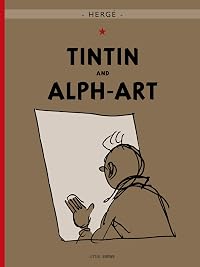
This is a unique comic in all of Herge's repertoir in that it is probably the most absurd of his stories. Granted, Tintin and Alpha-Art (which is unfinished and I am unlikely to purchase it on those grounds) appears to move into a more post-modern setting (it is suggested that Alpha-Art was an adventure into the world of art, but Herge died before its completion) but in this story, basically nothing happens. In fact, the entire story seems to be one great red-herring.
The entire story is set in Marlinspike, and Captain Haddock is simply having a really bad day (or at least a month). It seems as if it is a comedy of errors for the poor captain. First he learns that Bianca Castafiore, the famous opera singer, is coming to stay so he wants show more to get out but he slips on the broken stairs and busts his pelvis and ends up being confined to a wheelchair. He gets his nose stung and his finger bitten, and near the end he has become a patchwork of bandages.
Throw in the red-herrings, as well as the running jokes (such as Cutts the Butcher and Joylon Wagg) and we have a very interesting story, which doesn't seem to really go anywhere. This is not necessarily a bad thing though, since it succeeded in Waiting for Godot and also in Seinfeld. Then there are the jokes running through the story, such as the broken step. Pretty much everybody in the story, with the exception of Bianca Castafiore, slips and falls on the step at one time or another. Herge does it brilliantly, and it is very clear that he had truly developed his style by this point. There is also the parrot that keeps on screaming 'Hello! I can hear you!' which we soon discover is how Bianca Castafiore answers the phone.
There is a little case of the missing emerald, and it is unexpected (too an extent, though there is a hint dropped in the first frame) where it turns up. However, it disappears nearer to the end, namely because through the story we hear Bianca Castafiore continually jumping at ghosts believing that her emerald has been stolen. We are also led to believe that it is likely that either the Gypsies or the Pianist Wagner, are the culprits, but it turns out that they are not (I am not going to reveal the culprit though, since it is a surprise).
Herge does not pull back on commentary here either, and in this particular story it involves the gypsies. It appears that Herge is very supportive and sympathetic towards them, which shows in the character of Haddock and Tintin. I have never had any interaction with the Romani until 2011 when I travelled to Europe, and you pretty quickly work out who they are. It is also very tempting to take a prejudice view of them, particularly with the multiple warnings you receive about them on the web and in other travel literature. While I am tempted to say that they brought it on themselves, I believe that there is a lot of prejudice in Europe towards these people. I know Romanians that wail in anger over suggestions that they are connected with the Romani. However, I believe it is very brave and noble of Herge to stand up for these people.
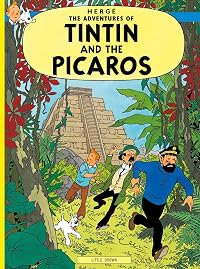
It seems that by this time Herge was winding down the Tintin comics, as he only produced another two and a half comics after this one. Earlier it appeared that he would produce at least one to two a year, but has now dropped down to about two a decade. Maybe Herge was simply getting tired of the endless adventures of Tintin and wanted to pull the plug. However, it appears he continued to experiment, and in doing so, explored new areas. In all seriousness, nothing that I have seen coming out of the US comic book scene even compares to the ingeniousness of Herge, and in a way, I do not feel that even Asterix comes anywhere near to Herge's brilliance. show less
The entire story is set in Marlinspike, and Captain Haddock is simply having a really bad day (or at least a month). It seems as if it is a comedy of errors for the poor captain. First he learns that Bianca Castafiore, the famous opera singer, is coming to stay so he wants show more to get out but he slips on the broken stairs and busts his pelvis and ends up being confined to a wheelchair. He gets his nose stung and his finger bitten, and near the end he has become a patchwork of bandages.
Throw in the red-herrings, as well as the running jokes (such as Cutts the Butcher and Joylon Wagg) and we have a very interesting story, which doesn't seem to really go anywhere. This is not necessarily a bad thing though, since it succeeded in Waiting for Godot and also in Seinfeld. Then there are the jokes running through the story, such as the broken step. Pretty much everybody in the story, with the exception of Bianca Castafiore, slips and falls on the step at one time or another. Herge does it brilliantly, and it is very clear that he had truly developed his style by this point. There is also the parrot that keeps on screaming 'Hello! I can hear you!' which we soon discover is how Bianca Castafiore answers the phone.
There is a little case of the missing emerald, and it is unexpected (too an extent, though there is a hint dropped in the first frame) where it turns up. However, it disappears nearer to the end, namely because through the story we hear Bianca Castafiore continually jumping at ghosts believing that her emerald has been stolen. We are also led to believe that it is likely that either the Gypsies or the Pianist Wagner, are the culprits, but it turns out that they are not (I am not going to reveal the culprit though, since it is a surprise).
Herge does not pull back on commentary here either, and in this particular story it involves the gypsies. It appears that Herge is very supportive and sympathetic towards them, which shows in the character of Haddock and Tintin. I have never had any interaction with the Romani until 2011 when I travelled to Europe, and you pretty quickly work out who they are. It is also very tempting to take a prejudice view of them, particularly with the multiple warnings you receive about them on the web and in other travel literature. While I am tempted to say that they brought it on themselves, I believe that there is a lot of prejudice in Europe towards these people. I know Romanians that wail in anger over suggestions that they are connected with the Romani. However, I believe it is very brave and noble of Herge to stand up for these people.
It seems that by this time Herge was winding down the Tintin comics, as he only produced another two and a half comics after this one. Earlier it appeared that he would produce at least one to two a year, but has now dropped down to about two a decade. Maybe Herge was simply getting tired of the endless adventures of Tintin and wanted to pull the plug. However, it appears he continued to experiment, and in doing so, explored new areas. In all seriousness, nothing that I have seen coming out of the US comic book scene even compares to the ingeniousness of Herge, and in a way, I do not feel that even Asterix comes anywhere near to Herge's brilliance. show less
The ebook edition that I read online was taken from a somewhat less than perfect print copy so that the artwork in it was much grainier than that in the other 2 issues of Tintin I have read. However, I found this entry in the series hilarious, not only the Captain with his temper and his magnificent way with cussing but also the detectives Thompson & Thomson (from "The Crab with the Golden Claw") with their malapropisms and woeful inability to actually detect anything, Bianca Castafiore who also has a tendency to malapropisms with regard to people's names and Professor Calculus who never properly hears what people say to him. I also liked the bit of social commentary regarding the Romany.
Mmmph. Another "let's annoy Captain Haddock" story. A few amusing bits, but mostly I was about as annoyed as the captain. Castafiore, Professor Calculus, and the builder are all being amazingly self-centered - if Calculus lived in my house, I'd insist he wear hearing aids! The bird things are mildly amusing. Thompson and Thomson are their usual idiotic selves - except this time, they managed to actually hurt people. We don't see it - the gypsies are off-stage by that point - but they're held and questioned for quite some time. I hope T&T had to pay them an indemnity. Not a favorite, though Tintin himself is pretty good - including distinguishing various red herrings that are held up temptingly in front of the reader's face from the show more actual cause(s) of events. show less
The ebook edition that I read online was taken from a somewhat less than perfect print copy so that the artwork in it was much grainier than that in the other 2 issues of Tintin I have read. However, I found this entry in the series hilarious, not only the Captain with his temper and his magnificent way with cussing but also the detectives Thompson & Thomson (from "The Crab with the Golden Claw") with their malapropisms and woeful inability to actually detect anything, Bianca Castafiore who also has a tendency to malapropisms with regard to people's names and Professor Calculus who never properly hears what people say to him. I also liked the bit of social commentary regarding the Romany.
Members
- Recently Added By
Lists

Evan's Reading List 2021
16 works; 1 member

The Guardian's 1000 Novels Everyone Must Read
1,005 works; 550 members

Books Read in 2013
1,630 works; 51 members

Books Read in 2014
2,343 works; 89 members
Author Information

'Hergé' was born Georges Remi on 22 May, 1907 in Etterbeek, a suburb of Brussels, in Belgium. After leaving school, he worked for the daily newspaper, Le XXe Siècle (The 20th Century). He was responsibe the for the section of the newspaper designed for children. Tintin, the main character in his works, was introduced on January 10, 1929 in a show more story entitled 'Tintin in the Land of the Soviets.' Each story ran as a comic strip in the newspaper and then was published as a book. Some of these books were adapted for the small screen including The Crab With The Golden Claws, Star of Mystery, Red Rakham's Treasure, Black Island, Objective Moon and The Calculus Affair. French TV produced longer versions of twenty of the books in 1992, which have been broadcast in over fifty countries. On 3 March, 1983, he died in Brussels. At the time of his death, he was working on Tintin and the Alpha-Art, which was published in an unfinished form. (Bowker Author Biography) show less
Awards and Honors
Series

Work Relationships
Is contained in
Common Knowledge
- Canonical title
- The Castafiore Emerald
- Original title
- Les Bijoux de la Castafiore
- Alternate titles*
- Tintin : Les bijoux de la Castafiore
- Original publication date
- 1963; 1961-07-04 - 1962-09-04 [1961, 1962] (serial) (serial)
- People/Characters
- Tintin
- Important places*
- Moulinsart, Belgique; Château de Moulinsart, Belgique
- Dedication*
- A ma mamet Ventureto que m'a trempa, tout bèu just nascu,dins lou bouioun de Prouvènço. A ma maire e moun paire qu'an tout fa pèr jamai me n'en seca.
- First words*
- Ah! le printemps!
Ah ! Lou printèms !.. Lou galant mes de mai !.. La naturo ... dins touto la frescour de soun nouvelun !.. - Last words*
- (Click to show. Warning: May contain spoilers.)C'est fini, mille sabords!
- Original language
- French
*Some information comes from Common Knowledge in other languages. Click "Edit" for more information.
Classifications
- Genre
- Graphic Novels & Comics
- DDC/MDS
- 741.5 — Arts & recreation Drawing & decorative arts Drawing Comic books, graphic novels, fotonovelas, cartoons, caricatures, comic strips
- LCC
- PN6790 .B43 .R38513 — Language and Literature Literature (General) Literature (General) Collections of general literature Comic books, strips, etc.
- BISAC
Statistics
- Members
- 2,058
- Popularity
- 10,077
- Reviews
- 17
- Rating
- (3.96)
- Languages
- 27 — Afrikaans, Arabic, Aragonese Spanish, Bengali, Catalan, Chinese, Czech, Danish, Dutch, English, Finnish, French, German, Irish, Hindi, Italian, Japanese, Korean, Norwegian (Bokmål), Norwegian, Polish, Portuguese, Serbian, Spanish, Swedish, Turkish, Walloon
- Media
- Paper, Ebook
- ISBNs
- 95
- ASINs
- 16