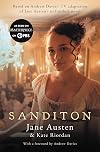
Sanditon [unfinished]
by Jane Austen
On This Page
Description
An English coastal town is the setting for this unfinished novel, the inspiration for the ITV series, by the author of Pride and Prejudice. Believed to be influenced by a town visited by Jane Austen herself, Sanditon is the story of Mr. Parker, an ambitious man intent on building a seaside resort town that will attract fashionable society; of Charlotte Heywood, a beautiful young woman who finds herself invited to Sanditon through an accident of fate; Mr. Parker's extended family, including show more the handsome Sidney Parker and his three comical siblings; and the wealthy Lady Denham, who aims to marry off her impoverished nephew to an heiress from the West Indies. The final unfinished novel by Austen, Sanditon has inspired numerous adaptations and continuations, including the recent television series by prize-winning screenwriter Andrew Davies. Literature. Fiction. Romance. show lessTags
Recommendations













Member Reviews
As thanks for nursing his sprained ankle after a carriage topple, Mr. Tom Parker and his wife invite young country girl Charlotte Heywood to summer with them in Sanditon, a developing beach town that the Parkers are invested in (in more ways than one). Charlotte meets the rest of the Parker family - Tom's handsome brother Sidney and their hilariously hypochondriac sisters and brother - as well as the rich widowed financier of Sanditon, Lady Denholm, and the various relatives trying to get their hands on her fortune.
I read this along with watching the current PBS adaptation, because I was interested to compare the two and see how much of the show was directly from the original text and how much was new. This fragment has almost no plot - show more it's mostly just Charlotte hearing about people and then meeting them. But boy is it riotously funny! Charlotte is, to this point, fairly passive and mostly just observes the world around her. In true Austen heroine fashion she lets the buffoons around her speak for themselves. There are several scenes I would have loved to see in the tv show, such as one where hypochondriac Arthur Parker tells Charlotte that if he drinks any green tea his whole right side gets paralyzed for hours, and Charlotte tells him he should go see a doctor who specializes in right sides and green tea consumption. But I'll have to be content to merely read them here again.
It was an enjoyable read, though the very unedited nature of the draft took some getting used to - there are randomly capitalized words, abbreviations, and misspellings galore. My mind is still reeling to think of the many possible ways Austen could have taken this story. show less
I read this along with watching the current PBS adaptation, because I was interested to compare the two and see how much of the show was directly from the original text and how much was new. This fragment has almost no plot - show more it's mostly just Charlotte hearing about people and then meeting them. But boy is it riotously funny! Charlotte is, to this point, fairly passive and mostly just observes the world around her. In true Austen heroine fashion she lets the buffoons around her speak for themselves. There are several scenes I would have loved to see in the tv show, such as one where hypochondriac Arthur Parker tells Charlotte that if he drinks any green tea his whole right side gets paralyzed for hours, and Charlotte tells him he should go see a doctor who specializes in right sides and green tea consumption. But I'll have to be content to merely read them here again.
It was an enjoyable read, though the very unedited nature of the draft took some getting used to - there are randomly capitalized words, abbreviations, and misspellings galore. My mind is still reeling to think of the many possible ways Austen could have taken this story. show less
I'm very surprised by how much I loved this. I'd been avoiding it for ages, since it's unfinished, and I thought I'd be disappointed. Not a bit—sure, I'd rather there was more, but it would have been like not eating the free appetizer from Le Bernardin because you prefer an entire meal ... I'd been silly.
I try to explain to friends who say "Jane Austen? I'm not into those romance novels" that Austen is really a hilarious obvious of character, tucked into a romance format, but now I'm just going to hand them Sanditon, where there's no romance at all, but so much delicious prose commentary. She has everyone nailed, and the point-of-view is early-Victorian-bitchy, and it's wonderful. Take this about two fashionable young maidens, the show more Miss Beauforts:
They were very accomplished and very ignorant, their time being divided between such pursuits as might attract admiration, and those labours and expedients of dexterous ingenuity by which they could dress in a style much beyond what they ought to have afforded.
I'm sure I bumped into them yesterday.
It seems churlish to deduct a point because she died, so it's too short and lacks resolution, so I won't. This is top-notch writing at its finest.
(Note: 5 stars = amazing, wonderful, 4 = very good book, 3 = decent read, 2 = disappointing, 1 = awful, just awful. I'm fairly good at picking for myself so end up with a lot of 4s). I feel a lot of readers automatically render any book they enjoy 5, but I grade on a curve! show less
I try to explain to friends who say "Jane Austen? I'm not into those romance novels" that Austen is really a hilarious obvious of character, tucked into a romance format, but now I'm just going to hand them Sanditon, where there's no romance at all, but so much delicious prose commentary. She has everyone nailed, and the point-of-view is early-Victorian-bitchy, and it's wonderful. Take this about two fashionable young maidens, the show more Miss Beauforts:
They were very accomplished and very ignorant, their time being divided between such pursuits as might attract admiration, and those labours and expedients of dexterous ingenuity by which they could dress in a style much beyond what they ought to have afforded.
I'm sure I bumped into them yesterday.
It seems churlish to deduct a point because she died, so it's too short and lacks resolution, so I won't. This is top-notch writing at its finest.
(Note: 5 stars = amazing, wonderful, 4 = very good book, 3 = decent read, 2 = disappointing, 1 = awful, just awful. I'm fairly good at picking for myself so end up with a lot of 4s). I feel a lot of readers automatically render any book they enjoy 5, but I grade on a curve! show less
Jane Austen started this novel during her final illness. She had only written eleven chapters and part of a twelfth when she died. Although she had already made some revisions to the manuscript, she likely would have made more edits and revisions had she lived to complete the novel. It reads like a draft and doesn't have the polish of her completed works.
A coach accident brings the Parkers of Sanditon into the Heywood home. In gratitude for the family's assistance, Mr. Parker invites Charlotte, one of the Heywood daughters, to return to Sanditon with them. The coach journey provides plenty of time for Mr. Parker to familiarize Charlotte with his siblings; his most distinguished neighbor, Lady Denham; and their joint project to develop show more Sanditon into a seaside resort town. Austen didn't tell readers much about Charlotte in the chapters she completed other than what can be inferred from her opinions of the people she meets. Lady Denham is surrounded by poor relatives eager to secure a legacy in her will. Three of Mr. Parker's four siblings are hypochondriacs who talk incessantly about their infirmities. It seems ironic that Austen's final work centered so much on illness and medical treatments. Would a healthy Austen have written about this topic in this way? Did Austen receive a lot of unsolicited advice as her illness progressed, and was this her way of expressing her irritation? show less
A coach accident brings the Parkers of Sanditon into the Heywood home. In gratitude for the family's assistance, Mr. Parker invites Charlotte, one of the Heywood daughters, to return to Sanditon with them. The coach journey provides plenty of time for Mr. Parker to familiarize Charlotte with his siblings; his most distinguished neighbor, Lady Denham; and their joint project to develop show more Sanditon into a seaside resort town. Austen didn't tell readers much about Charlotte in the chapters she completed other than what can be inferred from her opinions of the people she meets. Lady Denham is surrounded by poor relatives eager to secure a legacy in her will. Three of Mr. Parker's four siblings are hypochondriacs who talk incessantly about their infirmities. It seems ironic that Austen's final work centered so much on illness and medical treatments. Would a healthy Austen have written about this topic in this way? Did Austen receive a lot of unsolicited advice as her illness progressed, and was this her way of expressing her irritation? show less
This review pertains to the Hesperus edition of the original and never completed story "Sanditon" by Jane Austen. For a Jane Austen fan, reading this work is bittersweet. While it is one final taste of her ingenious use of satire, it very much leaves the reader wishing for the rest of the novel and, indeed, imagining what other works she would have written had she been given more time.
The story begins with a carriage accident and an ensuing conversation of a delightfully ridiculous nature between the injured Mr. Parker and the unwitting Mr. Heywood, who lives nearby and kindly offers his assistance. This is when you realize why the novel was titled thus, for Mr. Parker is expounding on the virtues of a town by the name of Sanditon, show more which is a relatively young seaside resort.
Charlotte, one of Mr. Heywood's daughters, becomes a focal point of the story when, after Mr. Parker has convalesced at their home for some time, she accompanies Mr. and Mrs. Parker to Sanditon.
Twelve chapters were completed by Austen and, of course, with so many directions for the story to take, you can see why a completion of the tale has been attempted by more than one author. I was left wanting more, but I did enjoy what had already been written. show less
The story begins with a carriage accident and an ensuing conversation of a delightfully ridiculous nature between the injured Mr. Parker and the unwitting Mr. Heywood, who lives nearby and kindly offers his assistance. This is when you realize why the novel was titled thus, for Mr. Parker is expounding on the virtues of a town by the name of Sanditon, show more which is a relatively young seaside resort.
Charlotte, one of Mr. Heywood's daughters, becomes a focal point of the story when, after Mr. Parker has convalesced at their home for some time, she accompanies Mr. and Mrs. Parker to Sanditon.
Twelve chapters were completed by Austen and, of course, with so many directions for the story to take, you can see why a completion of the tale has been attempted by more than one author. I was left wanting more, but I did enjoy what had already been written. show less
 This review was written for LibraryThing Early Reviewers.
Note: I read an unfinished edition of Sanditon.
Overall, quite an enjoyable experience, but I was distressed by the brevity of the work. While some might find it fun to imagine where Jane would have gone with this one had she been able to finish it, I think letting it stand on its own is a wise idea.
It may be true, as stated in the foreword, that the author was poking fun at what she inaccurately perceived to be her own hypochondria when she wrote about some of the Parker family. While I was quite amused at the antics of the three character who possessed 'nervous sensibilities,' I also found those parts of the novel to be very bittersweet. Miss Austen was fatally ill while she was writing this and didn't realize it.
I dove right into show more Jane Austen's biography by Claire Tomalin as soon as I finished Sanditon, so it genuinely piqued my interest in her life. In general, I would recommend this book mainly to lovers of Austen. It won't satisfy the casual reader much. show less
Overall, quite an enjoyable experience, but I was distressed by the brevity of the work. While some might find it fun to imagine where Jane would have gone with this one had she been able to finish it, I think letting it stand on its own is a wise idea.
It may be true, as stated in the foreword, that the author was poking fun at what she inaccurately perceived to be her own hypochondria when she wrote about some of the Parker family. While I was quite amused at the antics of the three character who possessed 'nervous sensibilities,' I also found those parts of the novel to be very bittersweet. Miss Austen was fatally ill while she was writing this and didn't realize it.
I dove right into show more Jane Austen's biography by Claire Tomalin as soon as I finished Sanditon, so it genuinely piqued my interest in her life. In general, I would recommend this book mainly to lovers of Austen. It won't satisfy the casual reader much. show less
This review was written for LibraryThing Early Reviewers.I loved the uncompleted fragment by Jane Austen of Sandition we have, and can only mourn that her death meant it's forever incomplete. It had such possibilities! I really liked our heroine Charlotte Heywood, with her obvious intelligence, lack of pretension and good sense. In the eleven chapters of 26,000 or so words we have left to us, Lady Denham and the three Parker hypochondriac siblings strike me as brilliant comic creations. Then there's Sir Edward Denham, who models himself after rakes like Richardson's Lovelace and schemes to seduce, and if not abduct, Clara, his rival for Lady Denham's inheritance. Then there's Miss Lambe, "a young West Indian of large fortune," who is "about seventeen, half mulatto, and chilly and tender." show more What an interesting character to find in an Austen novel! I certainly will be trying at least one of the completions by other hands, although I expect I'll sadly be disappointed. In terms of what's on the page I'd rate this five stars to be honest. It gets only three because I can't imagine anyone but us hardcore Austen fanatics or scholars wanting to read an incomplete novel.
Edit: For what it's worth, I loved the 1975 completion by "Another Lady." No, I'm not saying she's Austen's equal. But she tacked on her story seamlessly from where Austen ended, developed the characters very nicely, seemed to get the period details right, and I ended reading the story with a smile. show less
Edit: For what it's worth, I loved the 1975 completion by "Another Lady." No, I'm not saying she's Austen's equal. But she tacked on her story seamlessly from where Austen ended, developed the characters very nicely, seemed to get the period details right, and I ended reading the story with a smile. show less
Although I’ve read all of Jane Austen’s novels twice, and some of them three times, I’d never heard of Sanditon so when a copy was on offer through the Library Thing Reviewer Program, I was a bit sceptical about it but thought I may as well apply.
I had forgotten all about it when the book finally arrived. It’s only 82 pages long because it’s an incomplete work. Austen was ill when she began writing it, and died before its completion. There is apparently another version of this book which ‘Another Lady’ has completed, but this edition is just the twelve chapters that Austen was able to finish, and a fifteen page introduction by a Professor A.C.Grayling.
Even though it’s been a while since I last read one of Austen’s show more novels – and I’m certainly not a scholar of her work, I think her style is unmistakeable, most notably for the subtlety of her humour. While her social observations are witty they are never caustic, and there is affection and tolerance for the foibles and follies she portrays.
Sanditon, however, seems a bit waspish. In describing Mrs Parker, ‘the properest wife in the world’ Austen goes on to say that she was ‘not of a capacity to supply the cooler reflection which her own husband sometimes needed, and so entirely waiting to be guided on every occasion that whether he was risking his fortune of spraining his ankle, she remained equally useless. (p13).
‘Useless’? That word seems uncharacteristic of Austen. It’s too blunt. I bet if she’d lived long enough to revise her work she would have chosen something less direct.
Then there’s Lady Denham. She was ‘born to wealth but not to education’ (p17). Again this seems not quite right. Apart from lacking that characteristic subtlety, it doesn’t make sense: how can anyone be ‘born to’ education? What’s more, this comment goes nowhere. There’s no witty example of this lack of education, but rather a rather cynical explanation of the lady’s acquisition of additional wealth and a title through her marriages.
There are other examples, but I think I’ve made my point. It’s not just that the story isn’t finished, it’s also that the revisions and rewritings weren’t done. And they needed to be.
I don’t want to criticise Jane Austen, and I’m not saying the book shouldn’t have been published, but I think it’s being marketed to satisfy Austenmania. In my opinion Sanditon may be of interest to scholars, but it will disappoint Austen’s fans looking for more of what they love. My advice would be to re-read the finished novels instead.
Author: Jane Austen
Title: Sanditon
Publisher: Hesperus 2009
ISBN: 9781843911845
Source: Library Thing Early Reviewer’s Program
Cross-posted at http://anzlitlovers.wordpress.com/2010/01/24/sanditon-by-jane-austen/ show less
I had forgotten all about it when the book finally arrived. It’s only 82 pages long because it’s an incomplete work. Austen was ill when she began writing it, and died before its completion. There is apparently another version of this book which ‘Another Lady’ has completed, but this edition is just the twelve chapters that Austen was able to finish, and a fifteen page introduction by a Professor A.C.Grayling.
Even though it’s been a while since I last read one of Austen’s show more novels – and I’m certainly not a scholar of her work, I think her style is unmistakeable, most notably for the subtlety of her humour. While her social observations are witty they are never caustic, and there is affection and tolerance for the foibles and follies she portrays.
Sanditon, however, seems a bit waspish. In describing Mrs Parker, ‘the properest wife in the world’ Austen goes on to say that she was ‘not of a capacity to supply the cooler reflection which her own husband sometimes needed, and so entirely waiting to be guided on every occasion that whether he was risking his fortune of spraining his ankle, she remained equally useless. (p13).
‘Useless’? That word seems uncharacteristic of Austen. It’s too blunt. I bet if she’d lived long enough to revise her work she would have chosen something less direct.
Then there’s Lady Denham. She was ‘born to wealth but not to education’ (p17). Again this seems not quite right. Apart from lacking that characteristic subtlety, it doesn’t make sense: how can anyone be ‘born to’ education? What’s more, this comment goes nowhere. There’s no witty example of this lack of education, but rather a rather cynical explanation of the lady’s acquisition of additional wealth and a title through her marriages.
There are other examples, but I think I’ve made my point. It’s not just that the story isn’t finished, it’s also that the revisions and rewritings weren’t done. And they needed to be.
I don’t want to criticise Jane Austen, and I’m not saying the book shouldn’t have been published, but I think it’s being marketed to satisfy Austenmania. In my opinion Sanditon may be of interest to scholars, but it will disappoint Austen’s fans looking for more of what they love. My advice would be to re-read the finished novels instead.
Author: Jane Austen
Title: Sanditon
Publisher: Hesperus 2009
ISBN: 9781843911845
Source: Library Thing Early Reviewer’s Program
Cross-posted at http://anzlitlovers.wordpress.com/2010/01/24/sanditon-by-jane-austen/ show less
This review was written for LibraryThing Early Reviewers.Members
- Recently Added By
Lists

Read the book and saw the movie
1,170 works; 195 members

"I'd Group-Read That"
20 works; 6 members

Female Author
1,234 works; 67 members

Top Five Books of 2020
982 works; 350 members

Books Featured in Jane Austen's Bookshelf
37 works; 7 members

Books referenced in the Astral Library
60 works; 1 member
Talk Discussions
Past Discussions
Reading of Sanditon at JAHM on 17 March 2017 in I Love Jane Austen (March 2017)
Author Information

713+ Works 317,669 Members
Jane Austen's life is striking for the contrast between the great works she wrote in secret and the outward appearance of being quite dull and ordinary. Austen was born in the small English town of Steventon in Hampshire, and educated at home by her clergyman father. She was deeply devoted to her family. For a short time, the Austens lived in the show more resort city of Bath, but when her father died, they returned to Steventon, where Austen lived until her death at the age of 41. Austen was drawn to literature early, she began writing novels that satirized both the writers and the manners of the 1790's. Her sharp sense of humor and keen eye for the ridiculous in human behavior gave her works lasting appeal. She is at her best in such books as Pride and Prejudice (1813), Mansfield Park (1814), and Emma (1816), in which she examines and often ridicules the behavior of small groups of middle-class characters. Austen relies heavily on conversations among her characters to reveal their personalities, and at times her novels read almost like plays. Several of them have, in fact, been made into films. She is considered to be one of the most beloved British authors. (Bowker Author Biography) show less
Series
Belongs to Publisher Series
Work Relationships
Is contained in
Emma / Mansfield Park / Northanger Abbey / Persuasion / Pride and Prejudice / Sense and Sensibility / Shorter Works by Jane Austen (indirect)
Has the adaptation
Common Knowledge
- Canonical title
- Sanditon [unfinished]
- Original publication date
- 1925
- People/Characters
- Charlotte Heywood; Mr. Heywood; Tom Parker; Mary Parker; Mrs. Heywood; Lady Denham (show all 50); Sir Harry Denham; Sir Edward Denham; Esther Denham; Clara Brereton; Mary Parker jr.; Mrs. Hillier; Mr. Hillier; Mr. Stringer; Andrew; Sidney Parker; William Heeley; Susan Parker; Diana Parker; Arthur Parker; Mrs. Sheldon; Mrs. Whitby; Mrs. Mathews; Miss E. Mathews; Miss H. Mathews; Dr. Brown; Mrs. Brown; Richard Pratt; Lieutenant Smith; Captain Little; Jane Fisher; Miss Fisher; Miss Scroggs; Mr. Hanking; Mr. Beard; Mr. Gray; Mrs. Davis; Miss Merryweather; Mr. Morgan; Mr. Woodcock; Sam; Mrs. Griffiths; Miss Capper; Mr. Darling; Mrs. Darling; Fanny Noyce; Miss Lambe; Mrs. Dupuis; Miss Beaufort; Letitia Beaufort
- Important places
- Sanditon, England, UK; Willingden, England, UK
- Disambiguation notice
- This is the Unfinished work by Jane Austen. If your copy of Sanditon has been completed, please separate it and combine it with the correct work.
Classifications
Statistics
- Members
- 262
- Popularity
- 123,628
- Reviews
- 24
- Rating
- (3.37)
- Languages
- English, German, Italian, Portuguese
- Media
- Paper, Audiobook, Ebook
- ISBNs
- 10
- ASINs
- 19