On This Page
Description
Story based on adventurous themes; supposedly for children.Tags
Recommendations










Member Reviews
Hurray for Haddock!!
The Captain finally makes his drunken appearance in a liver-bursting whirlwind of whisky-quaffing, profanity, loutishness, maudlin self-pity and violent assault! The perfect foil for Tintin's often beige-bland earnestness.
While certainly played for laughs, Captain Haddock's alcoholism is also clearly shown as being a bad thing - he frequently endangers Tintin's life and several times almost scuppers the investigation - and so we can take a moral lesson from that.
Other reviewers have said what happens, so I won't bother. Suffice to say it's really rather good. To be precise, very good.
The Captain finally makes his drunken appearance in a liver-bursting whirlwind of whisky-quaffing, profanity, loutishness, maudlin self-pity and violent assault! The perfect foil for Tintin's often beige-bland earnestness.
While certainly played for laughs, Captain Haddock's alcoholism is also clearly shown as being a bad thing - he frequently endangers Tintin's life and several times almost scuppers the investigation - and so we can take a moral lesson from that.
Other reviewers have said what happens, so I won't bother. Suffice to say it's really rather good. To be precise, very good.
The Crab with the Golden Claws is the first Tintin book that Hergé wrote while Belgium was occupied. Although he had begun writing The Land of Black Gold just before Belgium was invaded and occupied, he shelved that book for the duration of the war and tried to write less "controversial" books. What is noticeable about this and the subsequent five books written during Belgium's occupation is the lack of political themes criticizing the Axis powers, whether the explicit criticism of Japan found in The Blue Lotus, or the implicit criticism of the Third Reich found in King Ottokar's Sceptre. It seems as though Hergé deliberately turned away from making any political statement during the occupation years, and instead tried to focus on show more more fantastical stories. This book is also noteworthy as the first in the series in which Captain Haddock makes his appearance, introducing the character who will become almost as iconic a member of the Tintin books as Tintin himself.
The story starts with a somewhat unusual twist for a Tintin story: rather than stumbling into a mystery and having the villains wildly overreact and try to kill him, Tintin is talking with Thompson and Thomson concerning their most recent investigation into a ring of counterfeiters when he spots a small collection of items in their office that reminds him of a can Snowy had found in the trash earlier that day. It turns out that the object came from a drowned body, and the scrap of paper torn from the can has very faint writing on it. We see a brief scene in which an Asian man inquires after Tintin, and then Tintin figures out that the scrap of paper says "Karaboudjan", the Asian man is abducted when he tries to call on Tintin, and the adventure is underway. And all of these clues are strung together without a single threat to Tintin's life or an attempt by gangsters to warn him off.
This doesn't mean that Tintin is left alone, but at least in this story the gangsters wait until he has at least some information and is actively poking their nose into their business before they try to drop a huge crate of canned sardines on his head. Apparently gangsters can sense the inherent incompetence of the Thompson and Thomson, because when they join Tintin to search the Karaboudjan, the villains leave them alone but whack our hero on the head and tie him up in the ship's hold. This development results in Tintin making two discoveries - the first of which is important to the plot of the book, the second of which is important to the future of the series. First, Tintin discovers that the cans of crab don't hold crab at all, but rather are filled with opium (which Tintin recognizes on sight). Second, while making his escape from the Karaboudjan, Tintin comes across Captain Haddock, at this point a pathetically drunk ship captain kept a virtual prisoner by his evil first mate Allan. But even at this point, with Haddock so looped on whiskey that he stutters when he talks, his fundamental goodness comes through when he learns that his ship is being used to smuggle opium and the smugglers have kidnapped Tintin. He immediately jumps in to offer his inebriated assistance to Tintin, helping him make his escape in a ship's boat.
Once the pair have escaped the Karaboudjan, Haddock quickly establishes what will become a regular pattern for the series: although sobered up, he comes across a bottle of alcohol and even though he knows he should stay sober he decides to have "just one". Before he knows it, Haddock has polished off the whole bottle and then does something destructively stupid that creates a plot complication that Tintin must overcome. Through the series, Haddock is mostly helpful, and it seems like Hergé does understand something about alcoholism, given Haddock's inability to control himself when presented with liquor. However, Haddock's alcoholism is played for laughs - because as has been established in previous books with Snowy, in Hergé's world, getting uncontrollably drunk is funny. And in this book, it is often destructively dangerous.
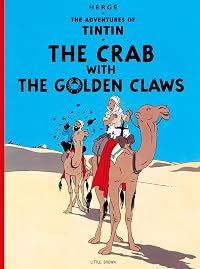
After some improbable escapades involving an airplane (and I will note that it seems absurdly easy to get hold of an armed civilian airplane in Hergé's fictional reality), Tintin, Snowy, and Haddock wind up on their own in the North African desert with no water and no supplies. (I'll note that the crashed airplane they leave behind should have had a fair amount of water in its radiator, and also that the captured pilots seem to have acquired Tintin's amazing resistance to fire). After some comedy involving mirages, Snowy's love of bones and Haddock's love of spirits, the three are rescued by a Foreign Legion detachment, and soon set out for the coast after hearing that the Karaboudjan had sunk with all hands. This sequence provides the cover for the book, and also provides more alcohol-related humor as Haddock's supply of liquor is shot up throwing him into a frenzy.
Eventually they arrive in the port city of Bagghar, and the coincidences fly thick and fast leading to a resolution of the mystery. Tintin runs across Thompson and Thomson, who have been assigned to track down opium smugglers. They all run across the Karaboudjan, which has been disguised, and Allan, who has not. Eventually their investigations lead them to Omar Ben Salaad, a prominent citizen of Bagghar who they suspect is the ringleader of the opium smugglers. Haddock is kidnapped, and Tintin manages to rescue him, whereupon Haddock clumsily messed everything up, both of them get inebriated, and they still manage to solve the mystery and capture the villains. Although the plot wraps up in a moderately contrived manner, the artwork in the book displays the steady improvement that has been characteristic of the series, with the regular panels regularly punctuated by beautifully rendered full page artwork. In addition, the series continues the tradition of Tintin not actually doing any reporting, despite his job title of "journalist". Despite breaking up yet another international opium smuggling ring, Tintin doesn't appear to file any story, or actually do anything related to his job. I suppose, given that this is the third smuggling ring Tintin has foiled, that perhaps he considers this to be a not particularly newsworthy event.
A decent chunk of this book was used to make part of the plot of the Steven Spielberg movie The Adventures of Tintin, lifting the portions in which Tintin is abducted onto the Karaboudjan, meeting Captain Haddock, and the subsequent adventure leading to the North African desert. Some elements were altered - in the movie the Karaboudjan is not smuggling opium, and Omar Ben Salaad is no longer an opium smuggler but rather a minor potentate who is tangled into the story via a model ship. In a small Easter egg for fans of the books, in the movie, the courtyard of Salaad's palace has a prominently placed fountain with a golden crab decoration. In addition, Haddock's character is slightly changed, making him a little bit less destructively dangerous when drunk and more comically dangerous.
Overall, this book represents both a substantial step forward for the Tintin series, and a sad stagnation. The introduction of Captain Haddock as a foil for Tintin represents an important turning point in the series. No longer does Tintin have to bounce his ideas off of Snowy. No longer do Thompson and Thomson have to fill both the role of Tintin's investigatory collaborators and comic relief. From this point forward, Haddock will become as integral part of the Tintin stories as Tintin and Snowy. On the other hand, the "Tintin foils a smuggling ring" has, by this point, been done to death. For fairly obvious reasons, the political bent that the stories had been taking is conspicuously absent from this volume, with the one exception of the appearance of a bit of appeasement thrown to the Axis powers in the form of the mysterious Asian man who turns out to be a Japanese detective hot on the trail of the opium smugglers - marking a turnaround from the positioning of the Japanese as the ringleaders of the drug trade in The Blue Lotus. Despite the "been there, done that" nature of the story, the introduction of Captain Haddock into the series makes this book a memorable one, and makes it worth reading.
This review has also been posted to my blog Dreaming About Other Worlds. show less
The story starts with a somewhat unusual twist for a Tintin story: rather than stumbling into a mystery and having the villains wildly overreact and try to kill him, Tintin is talking with Thompson and Thomson concerning their most recent investigation into a ring of counterfeiters when he spots a small collection of items in their office that reminds him of a can Snowy had found in the trash earlier that day. It turns out that the object came from a drowned body, and the scrap of paper torn from the can has very faint writing on it. We see a brief scene in which an Asian man inquires after Tintin, and then Tintin figures out that the scrap of paper says "Karaboudjan", the Asian man is abducted when he tries to call on Tintin, and the adventure is underway. And all of these clues are strung together without a single threat to Tintin's life or an attempt by gangsters to warn him off.
This doesn't mean that Tintin is left alone, but at least in this story the gangsters wait until he has at least some information and is actively poking their nose into their business before they try to drop a huge crate of canned sardines on his head. Apparently gangsters can sense the inherent incompetence of the Thompson and Thomson, because when they join Tintin to search the Karaboudjan, the villains leave them alone but whack our hero on the head and tie him up in the ship's hold. This development results in Tintin making two discoveries - the first of which is important to the plot of the book, the second of which is important to the future of the series. First, Tintin discovers that the cans of crab don't hold crab at all, but rather are filled with opium (which Tintin recognizes on sight). Second, while making his escape from the Karaboudjan, Tintin comes across Captain Haddock, at this point a pathetically drunk ship captain kept a virtual prisoner by his evil first mate Allan. But even at this point, with Haddock so looped on whiskey that he stutters when he talks, his fundamental goodness comes through when he learns that his ship is being used to smuggle opium and the smugglers have kidnapped Tintin. He immediately jumps in to offer his inebriated assistance to Tintin, helping him make his escape in a ship's boat.
Once the pair have escaped the Karaboudjan, Haddock quickly establishes what will become a regular pattern for the series: although sobered up, he comes across a bottle of alcohol and even though he knows he should stay sober he decides to have "just one". Before he knows it, Haddock has polished off the whole bottle and then does something destructively stupid that creates a plot complication that Tintin must overcome. Through the series, Haddock is mostly helpful, and it seems like Hergé does understand something about alcoholism, given Haddock's inability to control himself when presented with liquor. However, Haddock's alcoholism is played for laughs - because as has been established in previous books with Snowy, in Hergé's world, getting uncontrollably drunk is funny. And in this book, it is often destructively dangerous.
After some improbable escapades involving an airplane (and I will note that it seems absurdly easy to get hold of an armed civilian airplane in Hergé's fictional reality), Tintin, Snowy, and Haddock wind up on their own in the North African desert with no water and no supplies. (I'll note that the crashed airplane they leave behind should have had a fair amount of water in its radiator, and also that the captured pilots seem to have acquired Tintin's amazing resistance to fire). After some comedy involving mirages, Snowy's love of bones and Haddock's love of spirits, the three are rescued by a Foreign Legion detachment, and soon set out for the coast after hearing that the Karaboudjan had sunk with all hands. This sequence provides the cover for the book, and also provides more alcohol-related humor as Haddock's supply of liquor is shot up throwing him into a frenzy.
Eventually they arrive in the port city of Bagghar, and the coincidences fly thick and fast leading to a resolution of the mystery. Tintin runs across Thompson and Thomson, who have been assigned to track down opium smugglers. They all run across the Karaboudjan, which has been disguised, and Allan, who has not. Eventually their investigations lead them to Omar Ben Salaad, a prominent citizen of Bagghar who they suspect is the ringleader of the opium smugglers. Haddock is kidnapped, and Tintin manages to rescue him, whereupon Haddock clumsily messed everything up, both of them get inebriated, and they still manage to solve the mystery and capture the villains. Although the plot wraps up in a moderately contrived manner, the artwork in the book displays the steady improvement that has been characteristic of the series, with the regular panels regularly punctuated by beautifully rendered full page artwork. In addition, the series continues the tradition of Tintin not actually doing any reporting, despite his job title of "journalist". Despite breaking up yet another international opium smuggling ring, Tintin doesn't appear to file any story, or actually do anything related to his job. I suppose, given that this is the third smuggling ring Tintin has foiled, that perhaps he considers this to be a not particularly newsworthy event.
A decent chunk of this book was used to make part of the plot of the Steven Spielberg movie The Adventures of Tintin, lifting the portions in which Tintin is abducted onto the Karaboudjan, meeting Captain Haddock, and the subsequent adventure leading to the North African desert. Some elements were altered - in the movie the Karaboudjan is not smuggling opium, and Omar Ben Salaad is no longer an opium smuggler but rather a minor potentate who is tangled into the story via a model ship. In a small Easter egg for fans of the books, in the movie, the courtyard of Salaad's palace has a prominently placed fountain with a golden crab decoration. In addition, Haddock's character is slightly changed, making him a little bit less destructively dangerous when drunk and more comically dangerous.
Overall, this book represents both a substantial step forward for the Tintin series, and a sad stagnation. The introduction of Captain Haddock as a foil for Tintin represents an important turning point in the series. No longer does Tintin have to bounce his ideas off of Snowy. No longer do Thompson and Thomson have to fill both the role of Tintin's investigatory collaborators and comic relief. From this point forward, Haddock will become as integral part of the Tintin stories as Tintin and Snowy. On the other hand, the "Tintin foils a smuggling ring" has, by this point, been done to death. For fairly obvious reasons, the political bent that the stories had been taking is conspicuously absent from this volume, with the one exception of the appearance of a bit of appeasement thrown to the Axis powers in the form of the mysterious Asian man who turns out to be a Japanese detective hot on the trail of the opium smugglers - marking a turnaround from the positioning of the Japanese as the ringleaders of the drug trade in The Blue Lotus. Despite the "been there, done that" nature of the story, the introduction of Captain Haddock into the series makes this book a memorable one, and makes it worth reading.
This review has also been posted to my blog Dreaming About Other Worlds. show less
My review, as posted in Tintin Books
Unfortunately, due to the circumstances of Nazi-occupied Belgium, constraints forced "The Crab with the Golden Claws" to fall back a bit, after the heights reached by King Ottokar’s Sceptre. (As someone who stayed in Belgium after the start of World War II (at the call of the Belgian King Leopold's call for people to return), Herge was setting himself up for controversy. He never sympathised with Nazis, but "Le Soir" itself was staffed by collaborators and it would be a black mark. His friend and editor Raymond De Becker resigned under Nazi oppression. But in the short term, "Le Soir" was a boon for Tintin as it heightened Herge's readership considerably.)
There is a lot to appreciate: Herge's show more artistry was continually improving, particularly so now that he was aware of the colour endgame that would result from each adventure. Particularly notable are the full-page drawings added to the final version.
Of course, one of the story's biggest contributions to the series was the introduction of Captain Haddock, an expletive-spewing but loveable alcoholic who would become Tintin's closest human friend. The Captain was a hit with both readers and the author himself, and would remain a presence until the series' end some forty years later. Captain Haddock has perhaps the best introduction of any character throughout the series. He is a weak, broken alcoholic who initially distrusts Tintin, going so far as to assault him in mid-flight! His gradual growth toward beloved character is noteworthy and clever. (Even now, upon re-reading, it's jarring to think that this drunk man in the ship's hold will become our second hero!)
While the depiction of the Sahara, Morocco and the ocean is beautiful and vivid, the Arab cultures are less well-defined than those of Syldavia. And it must be said that things take a while to get going. The opening pages are enjoyable to read, but give no sign of the overarching plot that never really materialises.
Herge has certainly come a long way from the days of "chase-capture-escape-chase" that prevailed in Tintin in America, and this is evident in his characters, and in the appearance of a driving plot. But at heart, there are really several set-pieces here. It's not bad, but Herge was stuck writing something less political than he was used to, and sadly it forced his writing style back a stage or two. Not a mis-step, but certainly a pause in proceedings. show less
Unfortunately, due to the circumstances of Nazi-occupied Belgium, constraints forced "The Crab with the Golden Claws" to fall back a bit, after the heights reached by King Ottokar’s Sceptre. (As someone who stayed in Belgium after the start of World War II (at the call of the Belgian King Leopold's call for people to return), Herge was setting himself up for controversy. He never sympathised with Nazis, but "Le Soir" itself was staffed by collaborators and it would be a black mark. His friend and editor Raymond De Becker resigned under Nazi oppression. But in the short term, "Le Soir" was a boon for Tintin as it heightened Herge's readership considerably.)
There is a lot to appreciate: Herge's show more artistry was continually improving, particularly so now that he was aware of the colour endgame that would result from each adventure. Particularly notable are the full-page drawings added to the final version.
Of course, one of the story's biggest contributions to the series was the introduction of Captain Haddock, an expletive-spewing but loveable alcoholic who would become Tintin's closest human friend. The Captain was a hit with both readers and the author himself, and would remain a presence until the series' end some forty years later. Captain Haddock has perhaps the best introduction of any character throughout the series. He is a weak, broken alcoholic who initially distrusts Tintin, going so far as to assault him in mid-flight! His gradual growth toward beloved character is noteworthy and clever. (Even now, upon re-reading, it's jarring to think that this drunk man in the ship's hold will become our second hero!)
While the depiction of the Sahara, Morocco and the ocean is beautiful and vivid, the Arab cultures are less well-defined than those of Syldavia. And it must be said that things take a while to get going. The opening pages are enjoyable to read, but give no sign of the overarching plot that never really materialises.
Herge has certainly come a long way from the days of "chase-capture-escape-chase" that prevailed in Tintin in America, and this is evident in his characters, and in the appearance of a driving plot. But at heart, there are really several set-pieces here. It's not bad, but Herge was stuck writing something less political than he was used to, and sadly it forced his writing style back a stage or two. Not a mis-step, but certainly a pause in proceedings. show less
Dupont and Dupond are on the trail of counterfeit 20-franc pieces, and their investigation has turned up a clue leading to the cargo ship Karaboudjan, which Tintin just saw in port. He and Milou sneak on board and discover that the ship is full of opium. Then of course the crew running the cargo ring discover the intrepid boy journalist. How will he get out of this one?
I am reading the Tintins totally out of order. This one is the first to feature Captain Haddock, which is why I borrowed it. And it was delightful. The story moves along really quickly, and it features boats AND airplanes, two of my favourite things. I would certainly recommend this one if you were looking to try a Tintin story.
I am reading the Tintins totally out of order. This one is the first to feature Captain Haddock, which is why I borrowed it. And it was delightful. The story moves along really quickly, and it features boats AND airplanes, two of my favourite things. I would certainly recommend this one if you were looking to try a Tintin story.
This was my first excursion into the world of Tintin and Snowy but it won't be my last! Hergé's artwork was excellent and the colors vivid; the Open Library's digital edition was essentially created by combining digital photographs of the 1974 Little, Brown edition (translated by Leslie Lonsdale-Cooper and Michael Turner). The story was the perfect blend of adventure and humor for both children and adults.
http://nwhyte.livejournal.com/1841877.html#cutid2
The Crab With The Golden Claws is a farily straightforward tale of Tintin, not especially helped by the detectives Thomson and Thompson, investigating a mysterious death which turns to be linked to drug smuggling from Morocco. While the effects of the smuggled opium are not really described - it is assumed that the reader's parents will explain why it is a Bad Thing - there is much material about the effects of alcohol, incarnated in the new character of Captain Haddock. There's also an possibly sinister Asian character who turns out to be a Japanese detective and therefore a good guy. The moral, if there is one, is that things are not always as they seem, and depths are usually show more hidden.
Its contributions to the recent film include the story of how Tintin and Captain Haddock actually meet, and the sea voyage and landing for an exciting time in a Moroccan port. I noted several changes from these elements as they were adapted for the screen. First off, Haddock's destructive alcoholism, which teeters on the edge of being really not funny in the film, has actually been toned down from the book where he repeatedly and deliberately endangers himself and others for the sake of his addiction. I think the film makers moved this in the right direction, though not necessarily far enough. Once we reach Morocco, Omar Ben Salaad has been transformed from scheming Arab merchant and drug smuggler to genial local potentate with a taste for model ships and opera singers, who then gets his palace and town smashed up by Tintin and his enemies; and finally - think I caught this right - the seaplane which attacks Tintin, Haddock and Snowy is mysteriously said to have Portuguese markings in the film rather than Moroccan as in the book (which would make more sense). While the upgrading of Ben Salaad's character to victim rather than villain is probably an improvement, he still has an offensively silly name. show less
The Crab With The Golden Claws is a farily straightforward tale of Tintin, not especially helped by the detectives Thomson and Thompson, investigating a mysterious death which turns to be linked to drug smuggling from Morocco. While the effects of the smuggled opium are not really described - it is assumed that the reader's parents will explain why it is a Bad Thing - there is much material about the effects of alcohol, incarnated in the new character of Captain Haddock. There's also an possibly sinister Asian character who turns out to be a Japanese detective and therefore a good guy. The moral, if there is one, is that things are not always as they seem, and depths are usually show more hidden.
Its contributions to the recent film include the story of how Tintin and Captain Haddock actually meet, and the sea voyage and landing for an exciting time in a Moroccan port. I noted several changes from these elements as they were adapted for the screen. First off, Haddock's destructive alcoholism, which teeters on the edge of being really not funny in the film, has actually been toned down from the book where he repeatedly and deliberately endangers himself and others for the sake of his addiction. I think the film makers moved this in the right direction, though not necessarily far enough. Once we reach Morocco, Omar Ben Salaad has been transformed from scheming Arab merchant and drug smuggler to genial local potentate with a taste for model ships and opera singers, who then gets his palace and town smashed up by Tintin and his enemies; and finally - think I caught this right - the seaplane which attacks Tintin, Haddock and Snowy is mysteriously said to have Portuguese markings in the film rather than Moroccan as in the book (which would make more sense). While the upgrading of Ben Salaad's character to victim rather than villain is probably an improvement, he still has an offensively silly name. show less
This was my first excursion into the world of Tintin and Snowy but it won't be my last! Hergé's artwork was excellent and the colors vivid; the Open Library's digital edition was essentially created by combining digital photographs of the 1974 Little, Brown edition (translated by Leslie Lonsdale-Cooper and Michael Turner). The story was the perfect blend of adventure and humor for both children and adults.
Members
- Recently Added By
Lists

Evan's Reading List 2021
16 works; 1 member

A Child's Book Tour of North Africa ::: Algeria, Morocco, Sahara
27 works; 3 members

The Guardian's 1000 Novels Everyone Must Read
1,005 works; 552 members
Author Information

'Hergé' was born Georges Remi on 22 May, 1907 in Etterbeek, a suburb of Brussels, in Belgium. After leaving school, he worked for the daily newspaper, Le XXe Siècle (The 20th Century). He was responsibe the for the section of the newspaper designed for children. Tintin, the main character in his works, was introduced on January 10, 1929 in a show more story entitled 'Tintin in the Land of the Soviets.' Each story ran as a comic strip in the newspaper and then was published as a book. Some of these books were adapted for the small screen including The Crab With The Golden Claws, Star of Mystery, Red Rakham's Treasure, Black Island, Objective Moon and The Calculus Affair. French TV produced longer versions of twenty of the books in 1992, which have been broadcast in over fifty countries. On 3 March, 1983, he died in Brussels. At the time of his death, he was working on Tintin and the Alpha-Art, which was published in an unfinished form. (Bowker Author Biography) show less
Some Editions
Awards and Honors
Series

Work Relationships
Is contained in
Is a retelling of
Has the adaptation
Is expanded in
Common Knowledge
- Canonical title
- The Crab with the Golden Claws
- Original title
- Le Crabe aux pinces d'or; Le crabe aux pinces d'or - édition spéciale 80 ans
- Alternate titles*
- Tintin : Le crabe aux pinces d'or
- Original publication date
- 1941
- People/Characters
- Tintin; Snowy; Captain Haddock; Captain Allan Thompson; Thomson and Thompson; Mister Mate (show all 12); Pedro; Mr. Allan; Ahmed; Mohammed Ben Ali; Omar Ben Salaad; Bunji Kuraki
- Important places
- Sahara; Morocco; Bagghar
- Related movies
- The Adventures of Tintin (2011 | IMDb)
- First words*
- Vesas, uschia vai cun quels che sfuignan adina en ils ruments!
- Last words*
- (Click to show. Warning: May contain spoilers.)... el ha tschifftà mal cun baiver in magiel aua...
- Original language
- French
- Disambiguation notice
- This is the 1943 redrawn and colourised version of "The Crab with the Golden Claws" (Le Crabe aux pinces d'or). Please, DO NOT COMBINE it with the 1941 original black and white version.
*Some information comes from Common Knowledge in other languages. Click "Edit" for more information.
Classifications
- Genre
- Graphic Novels & Comics
- DDC/MDS
- 741.59493 — Arts & recreation Drawing & decorative arts Drawing Comic books, graphic novels, fotonovelas, cartoons, caricatures, comic strips History, geographic treatment, biography European Other European Belgium & Luxembourg
- LCC
- PN6790 .B43 — Language and Literature Literature (General) Literature (General) Collections of general literature Comic books, strips, etc.
- BISAC
Statistics
- Members
- 2,233
- Popularity
- 9,085
- Reviews
- 21
- Rating
- (3.91)
- Languages
- 38 — Afrikaans, Arabic, Basque, Bengali, Catalan, Chinese, Czech, Danish, Dutch, English, Esperanto, Estonian, Finnish, French, Frisian, German, Scottish Gaelic, Irish, Greek, Hindi, Hungarian, Italian, Korean, Norwegian (Bokmål), Norwegian, Farsi/Persian, Polish, Portuguese, Raeto-Romance, Romanian, Serbian, Scots, Croatian, Slovak, Spanish, Swedish, Turkish, Welsh
- Media
- Paper, Ebook
- ISBNs
- 111
- ASINs
- 18