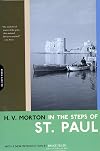
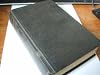
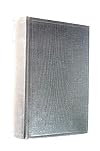
In the Steps of St. Paul
by H. V. Morton, Henry Vollam Morton (Author)
On This Page
Description
In the Steps of St. Paul dazzlingly retraces the apostle's famed journey of faith through Israel, Greece, and Italy, using the Bible itself as a guide. With an ear for good stories and an eye alert to detail, Morton creates a compulsively readable narrative that will satisfy the most curious traveler as well as the most informed and passionate reader of the Bible.Tags
Recommendations























Member Reviews
Amongst all the misery caused by Covid, not being able to travel seems a comparatively trivial hardship, but we Australians are great travellers, and I've got very itchy feet. Reading travel books seems like pouring salt on the wound, but In the Steps of St Paul is painless. Published not far off a century ago in October 1936, it's about a lost world anyway. The contemporary Middle East bears no resemblance to the places HVM visited, and travel there is fraught with complexities. One can't read HVM's introduction without a wry smile...
Though I've been a member of the H.V.Morton Society for years, have read several of his travel books and collected many more, I've never read a biography of HVM so I don't know if he was religious or not. But as it says at Who is H V Morton? he had a lifelong passion for archaeology and ancient history, and it was the brilliance of his eye witness account for the Daily Express of the opening of the tomb of Tutankhamun in 1923 which made his name as a journalist. It makes sense that retracing the journeys of St Paul would have made a fascinating quest, especially at a time when so many ancient sites of Christian religious significance were unknown to most people. And though some of what he writes would now offend modern sensibilities, I can understand his scathing contempt about the destruction of ancient monuments and artefacts because of religious intolerance. I imagine he would have been livid to witness the looting of Baghdad museum during the 2003 American invasion of Iraq too.
In the course of four journeys, HVM visited Palestine (then under British administration, which — being an imperialist — HVM thinks is a good thing), Syria, Turkey, Macedonia, Greece, the islands of Cyprus, Malta, Rhodes and the City of Rome. It all takes place before the age of mass tourism, and he travels by boat, train, hired car, a sand-cart and on foot. His eye for detail is prodigious, and his pen-portraits of the people he meets make them unforgettable. The photo at left is of Father John, who presides over what remains of the Church of St Paul at Caesarea, described as a squalid collection of houses and a mass of ruined walls where little was left of the thriving Roman city but fallen stones and the neglected remains of a Roman theatre. As HVM explores the area with his hospitable guides, a horseman topped a rise of ground...
It turns out that it's Father John, who had seen a hare in the corn and hoped to catch it to serve to the Bishop of Caesarea who was coming to stay with him, despite the fact that there is no congregation at Caesarea because there were no Christians. Father John holds Sunday Service entirely alone. The reader can sense HVM's pity and dismay when he writes that it was the most pathetically poor little church he'd ever seen, and it was also the only Greek church he'd ever seen without an ikonostasis. And when he sees Father John's distress about the desecration of the holy vault below the church — said to be the prison of St Paul — he subsequently intervenes. He writes to the Palestine Government requesting that a competent antiquary be sent to inspect the building and is pleased to report that pending the purchase of the vault by the Greek Orthodox Church, steps have been taken to prevent it being used as a stable for donkeys and mules by the farmers who had bought it!
The book is full of fascinating snippets like this.
To read the rest of my review please visit https://anzlitlovers.com/2020/12/31/in-the-steps-of-st-paul-by-h-v-morton/ show less
The modern traveller who takes the Acts of the Apostles as his guide-book, as I have done, journeys into a part of the world which once enjoyed the unity of the Roman Empire and is now divided among manyshow more
nations. Where he is held up at national frontiers, to pass onward under a different flag and among men who speak under a different tongue, St Paul moved forward over a Roman road, speaking Greek all the time.
It follows, therefore, that travel was easier for St. Paul than for those who follow him, for the great commercial highways along which he moved, and the famous ports from whose harbours he sailed, are no longer the main highways of the world. What was to St. Paul a progress along the best-known roads of the Roman Empire, becomes, to the modern traveller, a series of explorations from the beaten track. The harbour of Antioch is desolate, and Ephesus is a nesting-place for the stork.
Though I've been a member of the H.V.Morton Society for years, have read several of his travel books and collected many more, I've never read a biography of HVM so I don't know if he was religious or not. But as it says at Who is H V Morton? he had a lifelong passion for archaeology and ancient history, and it was the brilliance of his eye witness account for the Daily Express of the opening of the tomb of Tutankhamun in 1923 which made his name as a journalist. It makes sense that retracing the journeys of St Paul would have made a fascinating quest, especially at a time when so many ancient sites of Christian religious significance were unknown to most people. And though some of what he writes would now offend modern sensibilities, I can understand his scathing contempt about the destruction of ancient monuments and artefacts because of religious intolerance. I imagine he would have been livid to witness the looting of Baghdad museum during the 2003 American invasion of Iraq too.
In the course of four journeys, HVM visited Palestine (then under British administration, which — being an imperialist — HVM thinks is a good thing), Syria, Turkey, Macedonia, Greece, the islands of Cyprus, Malta, Rhodes and the City of Rome. It all takes place before the age of mass tourism, and he travels by boat, train, hired car, a sand-cart and on foot. His eye for detail is prodigious, and his pen-portraits of the people he meets make them unforgettable. The photo at left is of Father John, who presides over what remains of the Church of St Paul at Caesarea, described as a squalid collection of houses and a mass of ruined walls where little was left of the thriving Roman city but fallen stones and the neglected remains of a Roman theatre. As HVM explores the area with his hospitable guides, a horseman topped a rise of ground...
He sat in an Arab saddle and his bridle was a single strand of rope. He wore a pair of striped trousers which had once, in some inconceivable past, belonged to a morning coat. His grey shirt was open at the neck and his feet in Arab slippers were thrust into bucket stirrups. He carried a shot-gun slung across his back. But the most remarkable thing about him was his face, which was as dark as an Arab's. It was a lean, brown face, with the straight nose seen in classical sculpture. His beard grew away from the lips and stood out crisply. His hair was looped up at the back in a gigantic knot that would, if unbound, have fallen below his waist. This impressive person came riding towards us, an odd mixture of brigand and saint. (p. 358)
It turns out that it's Father John, who had seen a hare in the corn and hoped to catch it to serve to the Bishop of Caesarea who was coming to stay with him, despite the fact that there is no congregation at Caesarea because there were no Christians. Father John holds Sunday Service entirely alone. The reader can sense HVM's pity and dismay when he writes that it was the most pathetically poor little church he'd ever seen, and it was also the only Greek church he'd ever seen without an ikonostasis. And when he sees Father John's distress about the desecration of the holy vault below the church — said to be the prison of St Paul — he subsequently intervenes. He writes to the Palestine Government requesting that a competent antiquary be sent to inspect the building and is pleased to report that pending the purchase of the vault by the Greek Orthodox Church, steps have been taken to prevent it being used as a stable for donkeys and mules by the farmers who had bought it!
The book is full of fascinating snippets like this.
To read the rest of my review please visit https://anzlitlovers.com/2020/12/31/in-the-steps-of-st-paul-by-h-v-morton/ show less
Beautiful old photographs of places Paul went, together with lots of backgound information.
travel guide w. Paul
Ratings
Members
- Recently Added By
Author Information

52+ Works 4,091 Members
H. V. Morton began writing as an undergraduate in England. By the time he was 19, he became assistant editor of the Birmingham Gazette and Express. Later he joined the staff of the Daily Mail in London. Returning home from the British army after World War I, he realized how little he actually knew his country. His explorations led him to write a show more travel series later published by Dodd. He has been called "perhaps the greatest living authority on the material being of the British Isles---that is to say, on their landscape, buildings, monuments, customs and history." As a devout churchman, he has also written several books on biblical personages and places. He was an experienced and worldly traveler who had a "unique talent for capturing the essence of lives long past." (Bowker Author Biography) show less
Common Knowledge
- Canonical title
- In the Steps of St. Paul
- Original publication date
- 1936
- First words
- I went on deck before sunrise.
Classifications
- Genres
- Nonfiction, Travel, Religion & Spirituality, Biography & Memoir, General Nonfiction
- DDC/MDS
- 915.6 — History & geography Geography & travel Geography of and travel in Asia Middle East
- LCC
- DS49 .M65 — History of Europe, Asia, Africa and Oceania Asia History of Asia Middle East. Southwestern Asia. Ancient Orient.
- BISAC
Statistics
- Members
- 362
- Popularity
- 86,752
- Reviews
- 3
- Rating
- (3.67)
- Languages
- English, Swedish
- Media
- Paper, Ebook
- ISBNs
- 6
- ASINs
- 23