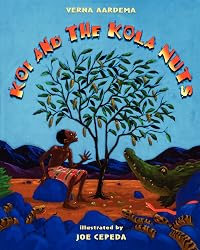
Koi and the Kola Nuts: A Tale from Liberia
by Verna Aardema
On This Page
Description
An African folktale in which the son of the chief must make his way in the world with only a sackful of kola nuts and the help of some creatures that he has treated with kindness.Tags
Recommendations






Member Reviews
When Koi loses out on his share of his father's inheritance, he sets out into the world with only a bag of kola nuts to his name. His generosity towards a snake, some ants, and a crocodile during the course of his journey is rewarded when he comes to the village of Chief Fulikolli, and needs help completing the three tasks required to win his daughter's hand in marriage.
The tale of the hunter/wanderer who spares/helps three animals, and is in turn assisted in three "impossible" tasks is a widespread one, with many variants worldwide. This charming Liberian version of the story includes the almost ubiquitous sub-plot of the ants who sort out a field of grain, and emphasizes the rewards for generosity. Originally published as part of show more Aardema's 1960 collection, Tales from the Story Hat, Koi and the Kola Nuts presents an engaging story. With Joe Cepeda's bright illustrations - an excellent accompaniment to the tale - this book is sure to please enthusiasts young and old. show less
The tale of the hunter/wanderer who spares/helps three animals, and is in turn assisted in three "impossible" tasks is a widespread one, with many variants worldwide. This charming Liberian version of the story includes the almost ubiquitous sub-plot of the ants who sort out a field of grain, and emphasizes the rewards for generosity. Originally published as part of show more Aardema's 1960 collection, Tales from the Story Hat, Koi and the Kola Nuts presents an engaging story. With Joe Cepeda's bright illustrations - an excellent accompaniment to the tale - this book is sure to please enthusiasts young and old. show less
A Liberian tale that teaches the importance of doing good for others. Interesting and colorful illustrations enhance this story about a boy who learns firsthand what is truly worthy of reward and how sharing what you have can be much better than keeping it all to yourself. For 1st - 4th graders.
As the reader I really felt for the young Koi as he learned that he was only receiving the kola tree from his father's fortune. However, when he decides to take a journey and travel the area, you get a sense of hope for him. Before he leaves, he collects the kola nuts from the tree. Along his journey, the nuts help him to help others. In return, those who he helped return the favors when they’re most needed. Because of Koi’s good deeds, he was rewarded profusely. This concept is wonderful for children to pick up on. What I liked most about the story was that Koi helped others simply from the goodness of heart-not from greed. This is something we all should try to do!
I find it very interesting that the idea of three events/things/tasks comes up so repeatedly in folk tales, even across cultural boundaries, such as in this book, as well as Fiona's Luck. I'm very hesitant to share stories that are so patriarchal with students, but many folktales are very patriarchal, and still have a value in the classroom. This book had beautiful paints, which I loved as well.
Traditional literature, folk tale from Liberia.
Koi is the youngest son of the village Chief, but when the chief dies, he gets only a Kola tree instead of animals and ivory like his brothers. He decides to take the nuts from the tree and travel to change his luck. Along the way, he gives away his Kola nuts to help other creatures. No surprise to find that those acts of kindness will help his situation later on.
In Aardema's signature style, this tale includes the sound effects and tight structure and pattern of African tales. The illustrations are double page spreads in thick dark colors - sometimes the black text is hard to read easily. Overall, a fine story with a good "pay it forward" lesson.
Koi is the youngest son of the village Chief, but when the chief dies, he gets only a Kola tree instead of animals and ivory like his brothers. He decides to take the nuts from the tree and travel to change his luck. Along the way, he gives away his Kola nuts to help other creatures. No surprise to find that those acts of kindness will help his situation later on.
In Aardema's signature style, this tale includes the sound effects and tight structure and pattern of African tales. The illustrations are double page spreads in thick dark colors - sometimes the black text is hard to read easily. Overall, a fine story with a good "pay it forward" lesson.
Age: Intermediate
Genre: Folklore
Media: oil paint
Review/Critique: The youngest son of a chief in Africa inherits a kola nut tree from his father. He takes a bunch of the nuts and goes on a journey. He helps a snake, ants, and an alligator by giving them kola nuts. Later, he is trying to win the hand of a chief's daughter and all the animals help him with the challenges because he helped them. This is an African folklore, set in Liberia. I am not personally familiar with it, but it would be something told in villages throughout generations, until written down for the first time in 1960. There are also very clear lessons in the story such as humility, caring for animals, sharing, and hard work. The main character, Koi, is an obvious hero show more in the story. show less
Genre: Folklore
Media: oil paint
Review/Critique: The youngest son of a chief in Africa inherits a kola nut tree from his father. He takes a bunch of the nuts and goes on a journey. He helps a snake, ants, and an alligator by giving them kola nuts. Later, he is trying to win the hand of a chief's daughter and all the animals help him with the challenges because he helped them. This is an African folklore, set in Liberia. I am not personally familiar with it, but it would be something told in villages throughout generations, until written down for the first time in 1960. There are also very clear lessons in the story such as humility, caring for animals, sharing, and hard work. The main character, Koi, is an obvious hero show more in the story. show less
This Liberian folktale follow Koi, the youngest son of a chief who dies. Koi misses out on the division of his father's treasures, but decides to make due with what he has: the Kola nuts from his tree. His travels lead his to those in need, which he takes time to help. These same characters come back to help him when he needs it. The moral of the story is "do good and good will come back to you."
Members
- Recently Added By
Lists

A Child's Book Tour of West Africa ::: Côte d'Ivoire, Mali, Ghana, Nigeria
59 works; 5 members

One Picture Book Per Country
206 works; 1 member

The Story of the World: History for the Classical Child: Activity Book Two
415 works; 2 members
Author Information

36+ Works 14,465 Members
Verna Aardema was born on June 6, 1911 in New Era Michigan. She received her B.A. degree from Michigan State College of Agriculture and Applied Sciences in 1934. She was a grade school teacher from 1934 to 1973 and staff correspondent for the Muskegon Chronicle from 1951 to 1972. Aardema started writing children's stories in the 1950's, and in show more 1960 she published her first books, Tales from the Story Hat and The Sky God Stories. She specializes in the modernization and adaptation of traditional African folktales. In the 1970s, Aardema joined illustrators Leo and Diane Dillon and produced three picture books. Why Mosquitoes Buzz in People's Ears received the Caldecott Medal in 1976 and the Brooklyn Art Books for Children Award in 1977. Who's in Rabbit's House? was the 1977 School Library Journal Best Book of the Year and a Lewis Carroll Shelf Award winner in 1978. Aardema received the Children's Reading Round Table Award in 1981, and several of her books have been selected as Notable Books by the American Library Association. Oh Kojo! How Could You! won the 1984 Parents' Choice Award for Literature. Verna Aardema died in 2000. show less
All Editions
Awards and Honors
Awards
Common Knowledge
- Canonical title
- Koi and the Kola Nuts: A Tale from Liberia
- Important places*
- Liberia
*Some information comes from Common Knowledge in other languages. Click "Edit" for more information.
Classifications
Statistics
- Members
- 106
- Popularity
- 305,896
- Reviews
- 7
- Rating
- (3.50)
- Languages
- English
- Media
- Paper
- ISBNs
- 5