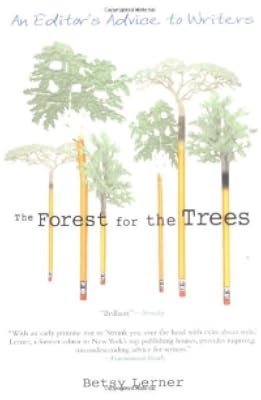
The Forest for the Trees: An Editor's Advice to Writers
by Betsy Lerner
On This Page
Description
"The Forest for the Trees should become a permanent part of any writer's or editor's personal library." -The Seattle Times Quickly established as an essential and enduring companion for aspiring writers when it was first published, Betsy Lerner's sharp, funny, and insightful guide has been meticulously updated and revised to address the dramatic changes that have reshaped the publishing industry in the decade since. From blank page to first glowing (or gutting) review, Betsy Lerner is a show more knowing and sympathetic coach who helps writers discover how they can be more productive in the creative process and how they can better their odds of not only getting published, but getting published well. This is an essential trove of advice for writers and an indispensable user's manual to both the inner life of the writer and the increasingly anxious place where art and commerce meet: the boardrooms and cubicles of the publishing house. show lessTags
Recommendations

Member Reviews
This is another of those accumulated wisdom books - which is not a bad thing. It is split into sections that cover various writer personality types and issues relating to how publishing really works. That's the intention, but I think you could probably dispense with the chapter titles for the most part and consider this book to be one rambling conversation between yourself and Betsy Lerner, sat in Covent garden perhaps, on a long sunny afternoon. I don't mean that as a criticism; I think it works very well and puts the reader at ease.
This is a well written book, which provides interesting insights into the dynamics of relationships between authors, editors, agents, publishers, publicists, and the public at large - including other show more authors. There are many references to anecdotes and quotes from authors both famous and unknown. These are backed up by an impressive bibiography which it seems that the author has actually read.
What kept me reading was the refreshingly honest and open advice that Betsy Lerner offers. She deals with some quite intense issues, such as author's relationships with their parents - including outright hatred - and the correlation of alcoholism to arty types such as the novelist. The honesty and personality of the author - the voice of this book - make it a refreshing and interesting read which I would recommend to anyone who is seriously considering seeking publication for their own novel. show less
This is a well written book, which provides interesting insights into the dynamics of relationships between authors, editors, agents, publishers, publicists, and the public at large - including other show more authors. There are many references to anecdotes and quotes from authors both famous and unknown. These are backed up by an impressive bibiography which it seems that the author has actually read.
What kept me reading was the refreshingly honest and open advice that Betsy Lerner offers. She deals with some quite intense issues, such as author's relationships with their parents - including outright hatred - and the correlation of alcoholism to arty types such as the novelist. The honesty and personality of the author - the voice of this book - make it a refreshing and interesting read which I would recommend to anyone who is seriously considering seeking publication for their own novel. show less
Why don't we wander in the complex interlacing worlds of writing and reading? This book is about writing, written by an agent who was once an editor and also a writer of poetry.
The book is divided in two sections, one about writers, and one about the publishing process. Her insight on writers is humorous and incisive. She is a writer herself, so she has that inside perspective, yet she has worked with so many other writers as an editor and an agent that she can also step outside and show what the world sees. The six chapters detail different types of writers, from the self destructive addict to the neurotic megalomaniac. Her point was that all writers tend to share some of these traits, to greater or lesser extent. And, in truth, I show more found many truths that applied to my own writing life, even though I am a far cry from a professional, nor have I devoted my faith and love to writing to the same extent as others, even Lerner herself. The second portion was also fascinating, as she details the many trials and tribulations that face a book after being accepted but before the physical copies hit a bookstore shelf. To be honest, the thought of all a writer and her work has to face before the book is an accomplished fact is daunting, but if I ever even reach that stage I'd be grateful. I enjoyed this read, and I think it helped spur me in my own writing ambitions. Highly recommended for all readers and writers out there. show less
The book is divided in two sections, one about writers, and one about the publishing process. Her insight on writers is humorous and incisive. She is a writer herself, so she has that inside perspective, yet she has worked with so many other writers as an editor and an agent that she can also step outside and show what the world sees. The six chapters detail different types of writers, from the self destructive addict to the neurotic megalomaniac. Her point was that all writers tend to share some of these traits, to greater or lesser extent. And, in truth, I show more found many truths that applied to my own writing life, even though I am a far cry from a professional, nor have I devoted my faith and love to writing to the same extent as others, even Lerner herself. The second portion was also fascinating, as she details the many trials and tribulations that face a book after being accepted but before the physical copies hit a bookstore shelf. To be honest, the thought of all a writer and her work has to face before the book is an accomplished fact is daunting, but if I ever even reach that stage I'd be grateful. I enjoyed this read, and I think it helped spur me in my own writing ambitions. Highly recommended for all readers and writers out there. show less
This is an enjoyable, engrossing and unfailingly interesting book. The author is an experienced editor who is distilling her years of working with writers into a book about the editing and publishing process. Early chapters are about different types of writers she has encountered and how they get (or don't get) their writing done. Later ones are about different facets of the publishing process, leading inexorably towards the moment when the accepted, edited, jacketed, marketed, sold and distributed book sees the light of day. Her writing is economical and marked with deep insight into and respect for the creative process, and the mysterious synergy that is successful editing. At the same time she isn't mealy-mouthed; you are left in no show more doubt that some agents, editors and writers are creeps of the first order. Her literary preferences and judgements are clearly expressed and occasionally trenchant.
From her account of the publishing process, I get this sense of potential books swimming upstream like salmon to spawn, of which many get eaten, or just end up dead in the water. Yet amid the Darwinian carnage authors do get discovered and books do get published, because enough agents, editors, publishers and sales staff continue to care about writing. show less
From her account of the publishing process, I get this sense of potential books swimming upstream like salmon to spawn, of which many get eaten, or just end up dead in the water. Yet amid the Darwinian carnage authors do get discovered and books do get published, because enough agents, editors, publishers and sales staff continue to care about writing. show less
This book surprised me on many levels. I bought it and expected a dry yet useful commentary on the publishing industry and what writers must do to survive. Instead, I discovered something that was highly readable--as smooth as fiction--and comparable to someone taking a writer by the hand to offer them advice. The Forest for the Trees is a gentle book. Lerner's approach is that she understands writers, with all their angst, writer's block, and depression, and that it takes more than talent to succeed in the business. She's blunt in her assessment of the rapid changes in the industry and that publishers never know what will be a hit or not. It's nice to see the viewpoint of someone with experience as an editor and an agent; the show more information is familiar from other writing and author blogs and books, but the angle is different and appreciated.
It's a useful read, but I admit it didn't resonate with me as much as Bird by Bird by Anne Lamott. Still, it's a solid read and a recommended book for any writer who is just starting out or has become disillusioned along the way. show less
It's a useful read, but I admit it didn't resonate with me as much as Bird by Bird by Anne Lamott. Still, it's a solid read and a recommended book for any writer who is just starting out or has become disillusioned along the way. show less
I loved this book. It's not a craft book, and I think that's what I like about it. It felt like listening to the stories of a wiser, more experienced writing buddy. Lerner has a way of writing that is casual and sympathetic but realistic. The only thing I found that I didn't like about it was the section on publication. I'm definitely not there, so I sort of skimmed it. But the anecdotes she tells about the experiences of famous writers are just so fascinating that I would stop and read those. Nevertheless, I highly recommend this book overall.
I picked up Betsy Lerner's The Forest for the Trees: An Editor's Advice for Writers expecting a practical handbook on editing. Instead, Lerner's book is comprised of a series of anecdotes about writers, about their myriad of troubling and irresponsible ways. I wasn't particularly disappointed--Lerner's writing is stylistically quite strong, perhaps thanks to her past life as a poet, not to mention incredibly juicy. Lerner exposes the ugliness of the literary world, as she experienced it in both Columbia's MFA program and her experiences as a writer. I found myself dog-earing many pages, not because I found them particularly instructive, but because I recognized in them something of my own experiences in MFA-land. For example:
When I wasshow more
getting my MFA, it became eminently clear to me that being in the program meant being indoctrinated with very specific ideas about taste. The people who were highly praised and encouraged were those who worked in a particular vein, whose voices most closely approximated those of the writers who were held up as masters. One woman working on a novel based on her own experiences as an undercover cop was told by a professor that solely because of the subject matter he could not possibly read or respond to her book. There was absolutely no room in the program for any kind of genre writing and absolutely no humor. I'll never forget the humiliation I felt when I thought I had finally made a breakthrough in my own writing by allowing my sense of humor into my work. A professor whom I worshiped sniffed a few of those new poems before he cocked his eyebrow and sad, "Well if you want to be the poetic equivalent of Fran Lebowitz that's fine, but I can't possibly help you."This kind of apt description of genre ghettoization hit extremely close to home for me, though of course not all professors or peers were quite so brashly unsupportive of exploring genre work in my program (and, I'm sure, those who were would feel they were doing so for good reason). But, though I enjoyed these stories and little, jarringly honest, reflections on the literary life, I did feel a bit like the presentation of Lerner's book was deceptive. The cover looks like a standard non-fiction handbook; the first section of the book is called "writing" but instead describes in it various personality archetypes/stereotypes of working writers. By the second section, purportedly on the editing and publishing process, the generalities about writers and literary folktales wear a bit thin on the reader. Lerner glosses over practical advice (she mentions, briefly, that one shouldn't submit writing on colored paper) in favor of whining about the dangers that electronic journal and agent submissions pose to the literary world. But its the readers who would pick up a book such as this one, I can imagine--the writers without MFA programs to expose them to not only the personalities she describes but also the real conventions of the field--who would most strongly benefit from both her anecdotes and more concrete, useful advice. It's not that I necessarily disliked the existing content of the The Forest for the Trees (though I certainly disagree with her stance on online journals), but I felt that it could have been better framed in another--perhaps any other--way. show less
Really enjoyed this book. Lerner offers a warts-and-all perspective on writing and publishing from the perspective of someone who's sat on all sides (poet, agent, editor) of that particular table and who understands the insecurities and needs of all the participants. Excellently-written, and full of funny, heartbreaking, wonderful anecdotes about writers and editors - some famous and some not so much - to illustrate her points. Worth having on your shelf and going back to now and then.
Members
- Recently Added By
Author Information

4 Works 1,737 Members
Betsy Lerner is the author of The Forest for the Trees: An Editor's Advice to Writers and Food and Loathing: A Lament.
Common Knowledge
- Original publication date
- 2000
- Epigraph
- I really think that the great difficulty in bringing "The Valley of Decision" into final shape is the old one of not being able to see the forest for the trees. There are such a great number of trees. We must somehow bring th... (show all)e underlying scheme or pattern of the book into emphasis, so that the reader will be able to see the forest in spite of the many trees.
--Maxwell Perkins, in a letter to Marcia Davenport (A. Scott Berg, in his biography Max Perkins: Editor of Genius recounts that Davenport had turned in a completely disjointed manuscript of nearly 800,000 words, which she revised over a five-month period, according to the editor's extensive notes. The book went on to sell 600,000 copies.) - Dedication
- "For My Authors"
- First words
- "I never dreamed of becoming an editor."
- Last words
- (Click to show. Warning: May contain spoilers.)'"With a book,' she explained, 'you're never lonesome.'"
Classifications
Statistics
- Members
- 1,088
- Popularity
- 23,614
- Reviews
- 27
- Rating
- (3.85)
- Languages
- English
- Media
- Paper, Ebook
- ISBNs
- 7
- ASINs
- 5