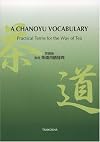
A CHANOYU VOCABULARY: Practical Terms for the Way of Tea
by Genshitsu Sen
On This Page
Tags
Member Reviews
The following comments were made by Lauren Deutsch on the Yahoo! group wakeiseijaku. This is a stand-in review until I've had a chance to prepare my own.
'Urasenke’s Tankosha has published A Chanoyu Vocabulary: Practical Terms for the Way of Tea, a very handy and interesting addition to any tea person’s (and dogu collector’s) reference library. Price is about $20.
'It comprises 1642 terms ‘selected out of the approximately 3000 included in the Jitsuyo Chadoyogo Jiten (Tankosha, 1993). From “aburashishaku” to”zungiri”, the selection includes historical references, proper names and other nouns, verbs, adverbs, adjectives for those idiosyncratic elements that comprise the practice of tea that, for a nonJapanese language show more speaker, can be a significant source of frustration. The book includes lots of line drawings of items, kanji and historical references. The appendix includes lineage of the three Sen families, outline of major chanoyu historical events and Japanese / Chinese and Korean historical periods. In addition, units of linear measure, Roji composition, Tea room exterior and interior parts, tatami and sunken hearth arrangements, types and parts of dogu, and ash arrangements.
'As one who has learned the old school — direct oral transmission from a teacher — who cannot read kanji and whose oral and aural Nihongo capacities are limited to an approximation after 22 years getting in the Way, it’s quite a wake up call to be able to actually see words transliteration. Almost a new experience of information.
'It’s a great complement to Sadler’s Chanoyu and to Tanko’s English for Use in the Way of Tea, the latter designed for native speakers of Japanese who are sent out to the Diaspora to spread the word and the way.' show less
'Urasenke’s Tankosha has published A Chanoyu Vocabulary: Practical Terms for the Way of Tea, a very handy and interesting addition to any tea person’s (and dogu collector’s) reference library. Price is about $20.
'It comprises 1642 terms ‘selected out of the approximately 3000 included in the Jitsuyo Chadoyogo Jiten (Tankosha, 1993). From “aburashishaku” to”zungiri”, the selection includes historical references, proper names and other nouns, verbs, adverbs, adjectives for those idiosyncratic elements that comprise the practice of tea that, for a nonJapanese language show more speaker, can be a significant source of frustration. The book includes lots of line drawings of items, kanji and historical references. The appendix includes lineage of the three Sen families, outline of major chanoyu historical events and Japanese / Chinese and Korean historical periods. In addition, units of linear measure, Roji composition, Tea room exterior and interior parts, tatami and sunken hearth arrangements, types and parts of dogu, and ash arrangements.
'As one who has learned the old school — direct oral transmission from a teacher — who cannot read kanji and whose oral and aural Nihongo capacities are limited to an approximation after 22 years getting in the Way, it’s quite a wake up call to be able to actually see words transliteration. Almost a new experience of information.
'It’s a great complement to Sadler’s Chanoyu and to Tanko’s English for Use in the Way of Tea, the latter designed for native speakers of Japanese who are sent out to the Diaspora to spread the word and the way.' show less
Ratings
Members
- Recently Added By
Author Information
2 Works 27 Members
Classifications
- Genres
- Nonfiction, Sociology, General Nonfiction, Food & Cooking
- DDC/MDS
- 394.1 — Society, government, & culture Customs, etiquette & folklore General customs Eating, drinking, using drugs
- LCC
- GT2910 .J5813 — Geography, Anthropology and Recreation Manners and customs (General) Manners and customs (General) Customs relative to private life
Statistics
- Members
- 19
- Popularity
- 1,328,985
- Reviews
- 1
- Rating
- (5.00)
- Languages
- English, Japanese
- Media
- Paper
- ISBNs
- 1