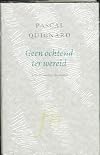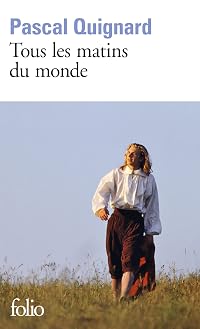
All the World's Mornings
by Pascal Quignard
On This Page
Description
Kunsten kontra berømmelse og meningen med livet er det underliggende tema i historien om en musiker og hans elev, begge virtuoser på viola da gamba, i Frankrig på Ludvig XIV's tid.Tags
Recommendations









Member Reviews
The writing is very lush, very sensuous, and with an erotic charge to it. I love reading such beautiful narratives about music, creativity, passion. Quignard is a fine writer. The ending though, is such a tired trope -- the spurned woman who wastes away from a broken heart, her purity gone. It's an older book, so to be forgiven. It was going somewhere so beautiful and rich, and just really hobbled itself.
This restrained and delicately ironic novella, set in the countryside around Paris in the second half of the 17th century and dealing with the relationship between two musicians of different generations, became an unlikely popular hit thanks to the very successful film by Alain Corneau, which was made in parallel with the writing of the book.
M. de Sainte-Colombe has an almost legendary standing among his contemporaries as a composer, performer and technical innovator on the viola da gamba, but he lives in rustic isolation with his two daughters on the banks of the Bièvre and refuses to travel the few miles to Versailles to show off his skill, even at the direct command of the King. His ascetic tendency is partly religious (he's show more associated with the Jansenist Port-Royal movement) but he's also clearly been plunged into a depression by the untimely death of his wife.
Against all his instincts, he accepts the young Marin Marais as his pupil. Marais is the son of a cobbler and has been thrown out of the royal choir-school when his voice broke: it's his evident grief at being cut off from music and probably forced to follow his father's trade that moves Sainte-Colombe to accept him. By the logic of such stories, we would expect him to become a grateful pupil, marry one of the daughters, and inherit his master's secrets, but that would be too neat for Quignard's way of seeing things. The relationship that develops between Marais and the Sainte-Colombe family involves a curious mixture of low comedy and bleak tragedy - baroque, yes, but baroque in an oddly low-key way.
The descriptions in the book are every bit as striking as the visuals of the film, and also draw on the art of the period. The still-life paintings of Lubin Baugin play an important role, and there's a lot of discussion of the way ideas cross over between the different arts: Sainte-Colombe even instructs Marais to listen carefully to the rhythms of Baugin's brush when he's painting and use them as a model for his bowing. Interesting: putting music into literature is always tricky, and writers have to resort to all kinds of tricks to make it work, but until now I've never come across someone who does it principally by using visual images as Quignard is doing here.
Another interesting and very pleasant little diversion, but I suspect that Quignard can do rather better than this: ultimately it seems a rather slight piece of work, and you wonder a bit whether the book or the film was the main goal here. show less
M. de Sainte-Colombe has an almost legendary standing among his contemporaries as a composer, performer and technical innovator on the viola da gamba, but he lives in rustic isolation with his two daughters on the banks of the Bièvre and refuses to travel the few miles to Versailles to show off his skill, even at the direct command of the King. His ascetic tendency is partly religious (he's show more associated with the Jansenist Port-Royal movement) but he's also clearly been plunged into a depression by the untimely death of his wife.
Against all his instincts, he accepts the young Marin Marais as his pupil. Marais is the son of a cobbler and has been thrown out of the royal choir-school when his voice broke: it's his evident grief at being cut off from music and probably forced to follow his father's trade that moves Sainte-Colombe to accept him. By the logic of such stories, we would expect him to become a grateful pupil, marry one of the daughters, and inherit his master's secrets, but that would be too neat for Quignard's way of seeing things. The relationship that develops between Marais and the Sainte-Colombe family involves a curious mixture of low comedy and bleak tragedy - baroque, yes, but baroque in an oddly low-key way.
The descriptions in the book are every bit as striking as the visuals of the film, and also draw on the art of the period. The still-life paintings of Lubin Baugin play an important role, and there's a lot of discussion of the way ideas cross over between the different arts: Sainte-Colombe even instructs Marais to listen carefully to the rhythms of Baugin's brush when he's painting and use them as a model for his bowing. Interesting: putting music into literature is always tricky, and writers have to resort to all kinds of tricks to make it work, but until now I've never come across someone who does it principally by using visual images as Quignard is doing here.
Another interesting and very pleasant little diversion, but I suspect that Quignard can do rather better than this: ultimately it seems a rather slight piece of work, and you wonder a bit whether the book or the film was the main goal here. show less
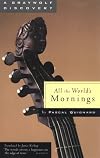
I had stumbled across a reference to Le Voix Humaine in a not very good work of fiction and decided to seek out the music. Then picked up All the World's Mornings in a random 'friends of the library' sale because of the head of the viol on the cover. Funny how serendipity works, no? This is the story of Saint Colombe, his daughters, their lover Marin Marais and their music. This is an enjoyable work for lovers of music as well as lovers of love and heartbreak.
Introduced me to Quignard!
Hmm... I'm a little scared to read this because the movie was oh-so-bad. From Margriet Tindemans.
"Todas las mañanas del mundo son caminos sin retorno". Novelita curta baseada na vida de personaxes reais, músicos, pero que quere falarnos de moito máis que de música. As relacións entre os vivos e os mortos, entre o mundo interior e o exterior. Música e silencio.
May 26, 2024Galician
Melomanie in woorden. De verfilming van deze novelle leerde me de viola da gamba, Marin Marais en Sainte Colombe kennen. Het boek is op zijn minst even geslaagd. Blij dit gelezen te hebben. Deed me qua stijl bij momenten denken aan Michon.
1
Members
- Recently Added By
Lists

Recommend the 20 best books you've read in the last five years
2,168 works; 609 members

Best of French Literature
138 works; 27 members

Books I've Read More Than Once
602 works; 49 members

Novels featuring siblings
133 works; 8 members

music to my eyes
86 works; 12 members

Books You Read During High School (For School)
301 works; 52 members

All Things France
100 works; 8 members

Books Read in 2016
4,666 works; 199 members
Books About the Arts that Aren't Art Books
21 works; 4 members

Books Read in 2019
4,052 works; 108 members

Les 50 meilleurs livres de langue française de 1900 à aujourd’hui
69 works; 2 members
Author Information

Some Editions
Awards and Honors
Awards
Series
Belongs to Publisher Series
Franse Bibliotheek (Modern)
A tot vent (789)
Gallimard, Folio (2533)
Work Relationships
Has the adaptation
Common Knowledge
- Canonical title
- All the World's Mornings
- Original title
- Tous les matins du monde
- Original publication date
- 1991
- People/Characters
- Marin Marais; Saint Colombe
- Important places
- France
- Related movies
- Tous les matins du monde (1991 | IMDb)
- Original language*
- Français
*Some information comes from Common Knowledge in other languages. Click "Edit" for more information.
Classifications
- Genres
- Fiction and Literature, General Fiction, Historical Fiction
- DDC/MDS
- 843.914 — Literature & rhetoric French Literature French fiction 1900- 20th Century 1945-1999
- LCC
- PQ2677 .U486 .T68 — Language and Literature French, Italian, Spanish and Portuguese literatures French literature Modern literature 1961-2000
- BISAC
Statistics
- Members
- 384
- Popularity
- 81,927
- Reviews
- 15
- Rating
- (3.50)
- Languages
- 16 — Afrikaans, Catalan, Danish, Dutch, English, Finnish, French, German, Greek, Icelandic, Italian, Lithuanian, Portuguese, Spanish, Swedish, Turkish
- Media
- Paper, Audiobook, Ebook
- ISBNs
- 34
- ASINs
- 4