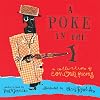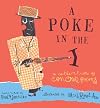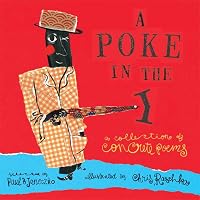
A Poke in the I: A Collection of Concrete Poems
by Paul B. Janeczko
On This Page
Description
Thirty poems which have their text arranged to startle the reader.Tags
Recommendations

Member Reviews
Summary
Oh man oh man. A Poke in the I, in addition to being full of amazing pun based titles, is full of concrete poems. Concrete poetry is poetry “in which the typographical arrangement of words is as important in conveying the intended effect as the conventional elements of the poem, such as meaning of words, rhythm, rhyme and so on.” In other words, the words make up the poem in size, shape, and arrangement as much as their content. The best example would be “Tennis, anyone?” which is split down across two pages (so the reader has to turn their head back and forth like a tennis match, savvy?)
Personal Opine
I dislike poems. I love puns. To find a book of poetry that flies in the face of traditional style for the sake of fun show more and visual flaire is just…just awesome. I cannot recommend a book of poetry more (and I probably wouldn’t). This book is amazing.
Classroom Extension Ideas
1. Talk to the kids about their favorite of the poems (and why).
2. Have the kids work to make their own concrete poems. It. Would. Be. Amazing. show less
Oh man oh man. A Poke in the I, in addition to being full of amazing pun based titles, is full of concrete poems. Concrete poetry is poetry “in which the typographical arrangement of words is as important in conveying the intended effect as the conventional elements of the poem, such as meaning of words, rhythm, rhyme and so on.” In other words, the words make up the poem in size, shape, and arrangement as much as their content. The best example would be “Tennis, anyone?” which is split down across two pages (so the reader has to turn their head back and forth like a tennis match, savvy?)
Personal Opine
I dislike poems. I love puns. To find a book of poetry that flies in the face of traditional style for the sake of fun show more and visual flaire is just…just awesome. I cannot recommend a book of poetry more (and I probably wouldn’t). This book is amazing.
Classroom Extension Ideas
1. Talk to the kids about their favorite of the poems (and why).
2. Have the kids work to make their own concrete poems. It. Would. Be. Amazing. show less
"A Poke in the I", collected by Paul Janeczko, is a book of concrete poems. Concrete poems are visual, the words taking a particular shape to convey meaning. The poems in this book are engaging, visually exciting, and funny. The shapes the poems take coupled with the additional artwork keep the reader interested in what is on the page. The poems range from one or two words to rather lengthy paragraphs, so there is good variety. This would be a great book to use in class as an introduction to this type of poetry or even just for a fun break. I appreciate this book of poems because it shows a kid who may be turned off to poetry that poems can be silly, visual, exciting, and more. The media used for this book is a mix of watercolor, ink, show more and collage/torn paper. show less
At the beginning, I had mixed feelings about the book; it was hard to follow at times and process all the different poems that the editor selected. However, at the end, I started to enjoy this book for various reasons. This book had an interesting approach to poetry and its presentation of the book was nontraditional. I liked the book because of the illustrations, point of view, and language. The illustrations reflected that of the title of each poem. For example, in Popsicle, the poem was put together in the shape of a Popsicle. The visual effects of the illustrations/presentation brought out a real sense of the words into a pictorial meaning for the audience. The pages were colorful and somewhat abstract, so that readers can interpret show more it for themselves. I thought the point of view of these selections were particularly interesting; it came from a variety of speakers. Some came from children, two lovers, or even animals. This allows readers to step into another angle and look at life a little differently than they are accustomed to. Lastly, the language and choice of words were carefully chosen. Many of the words were play on words, meaning they had various meaning associated with it. For example, in Balloon, it said, “As big as ball as round as sun… I tug and pull you when you run and when wind blows I say politely hold me tightly”. The rhythm and rhymes paint a picture to describe balloons without actually saying the word balloon. Each poem had their own big ideas and I like these particular selections because their themes flow and connect from one poem to another. One big idea that stuck out to me was in the poem called A Weak Poem. In this poem, the poem’s illustration was growing weaker (drooping down the page) because the narrator ate too much junk food late at night; this teaches a lesson about health. I would recommend teachers to use this as well in their future classrooms as a great book to show their students different ways to write and present a poem. show less
This is a collection of 30 concrete poems. Concrete poems are described by the editor of the book as being playful with unique positioning of letters and words creating a unique format. The poems are written by a variety of authors and each one is illustrated with simple drawings, paintings, and/or collages. The poems themselves illustrate the message of the poem depending on how it is written. For example, the poem, "Easy Diver," is written in a way that the text looks like an arrow pointing downwards. I especially liked the "Tennis Anyone?" poem that spans two pages and makes you bounce back and forth between the pages to read the poem, just like watching a tennis match. This is a fun and creative book that makes us realize how show more creative and non-threatening poetry can be. I would definitely recommend this book, especially for a poetry unit. Children could have fun creating their own concrete poems based on what this book shows us. I never enjoyed poetry as a child because it seemed to have so many rules and parameters, but this book opened up my eyes to a new look on poetry. show less
I liked that the poems are also visual poems. The words are not in a straight line they are formatted very differently and all over the page at times. It is very visually interesting as the artwork includes many pops of colors. The poem does not follow one structure, nor does it talk about one thing. Each page is something different.
I think that this is an excellent book! I love how the poems in the book truly portray and even resemble the central message. The central message of this book is that concrete poems are eye-catching and come in different shapes and sizes. The author and illustrator portray this central message simply by combining text and illustrations to make poems come alive on the page. For example, the text in the poem written about a lightbulb is written in the shape of a lightbulb.I think that gives readers a deeper understanding of the poem because they can visualize what the poem is actually about through the text. Also, I like how the illlustrations tie into the poems. For example, on the lightbulb poem there is an illustration of a boy show more thinking. I think that by including an illustration of a boy thinking and shaping the text in the poem to that of a lightbulb, the reader's mind can truly grasp what the poem is about, or at least visualize it. I also like how the type and size of the font throughout the text changes. By having the text be different size and type font, the author keeps the reader interested and creates a book that has variety, spunk, and creativity. show less
A Poke in the I is a collection of "concrete" poems, which are arranged in clever, often playful, ways on the page. Oftentimes the shape of the poem is more evocative than the word or words in the poem. Some poems are silly, some are sweet, some are beautiful, but they are all complemented wonderfully by Chris Raschka's artwork.
This book is appropriate for people of all ages. Across the thirty poems, some are fun to read aloud for small children, some have subjects that will be understood more completely by adults, and the pictures will delight across the board. A good book, especially, to illustrate that poetry can be widely variable and can actually be fun. I would use this book to introduce poetry at a young age, before children show more have had a chance to form misconceptions about it. show less
This book is appropriate for people of all ages. Across the thirty poems, some are fun to read aloud for small children, some have subjects that will be understood more completely by adults, and the pictures will delight across the board. A good book, especially, to illustrate that poetry can be widely variable and can actually be fun. I would use this book to introduce poetry at a young age, before children show more have had a chance to form misconceptions about it. show less
Members
- Recently Added By
Lists

Youth: Poetry
124 works; 1 member

Sonlight Books
1,487 works; 25 members
Author Information

55+ Works 5,881 Members
Paul Bryan Janeczko was born in Passaic, New Jersey on July 27, 1945. He received a bachelor's degree in English from St. Francis College in 1967 and a master's degree in English from John Carroll University in 1970. While teaching public high school, he created his own poetry anthology to use in his classes. He retired from teaching in 1990 after show more 22 years. He became a poet and anthologist best known for his poetry anthologies for children. From the 1980s through the early 2000s, he was the compiler for several anthologies including Pocket Poems: Selected for a Journey, I Feel a Little Jumpy Around You: A Book of Her Poems and His Poems Collected in Pairs, and A Kick in the Head: An Everyday Guide to Poetic Forms. He wrote several poetry collections including The Crystal Image, Requiem, Worlds Afire, and The Proper Way to Meet a Hedgehog and Other How-to Poems. His novel, Bridges to Cross, was published 1986. He died on February 19, 2019 at the age of 73. (Bowker Author Biography) show less
All Editions
Awards and Honors
Awards
Distinctions
Classifications
- Genres
- Poetry, Children's Books, Fiction and Literature
- DDC/MDS
- 811.008 — Literature & rhetoric American literature in English American poetry Specific kinds of poetry {only by more than one author} Modified standard subdivisions Collections of literary texts
- LCC
- PS593 .C63 .C66 — Language and Literature American literature American literature Collections of American literature Poetry By form
- BISAC
Statistics
- Members
- 736
- Popularity
- 38,337
- Reviews
- 61
- Rating
- (4.09)
- Languages
- English
- Media
- Paper
- ISBNs
- 8
- UPCs
- 1