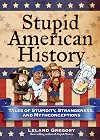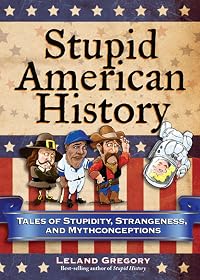
Stupid American History: Tales of Stupidity, Strangeness, and Mythconceptions
by Leland Gregory
On This Page
Description
America is the home of the brave and, apparently, the stupid and gullible. Satirist Leland Gregory teaches us a lesson in historical hilarity with Stupid American History. From Columbus to George W. Bush (that's a lot of material, people), Leland leads us through American history's mythconceptions, exposing idiocy and inanity along the time line. He reeducates by informing us about myths. For example, Samuel Prescott actually was the guy to alert us that the British were coming and not that show more Paul Revere dude. Move over Colbert and Stewart; satire has finally found its rightful place in American history. Excerpt from the book: "John Tyler was on his knees playing marbles when he was informed that Benjamin Harrison had died and he was now president of the United States. At that time marbles was a very popular game for both children and grown-ups." For reasons still unknown, Texas congressman Thomas Lindsay Blanton, a Presbyterian Sunday school teacher and prohibitionist, inserted dirty words into the Congressional Record in 1921. His colleagues overwhelmingly censured him on October 24, 1921, by a vote of 293-0.". show lessTags
Recommendations











Member Recommendations

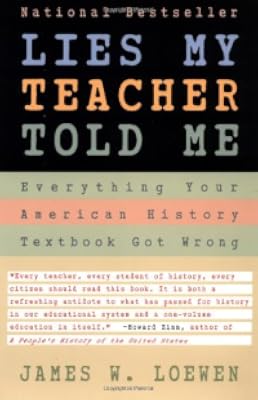
Lies My Teacher Told Me: Everything Your American History Textbook Got Wrong {original edition} by James W. Loewen
bragan If you're interested in a more serious and deep discussion/debunking of the myths of American history, this one's worth checking out.
40
Member Reviews
If you like your history with a bit a humor, then this book will fit your fancy. Don’t expect to learn a lot of details from it, and I would suggest further research for any tidbits you are really interested in, but it was interesting and entertaining. It’s a quick read, so you won’t have to invest a lot of time to get a varied slice of a lot of history.
Very stupid: Leland Gregory's Stupid American History is billed as "informing us about myths", "lead[ing] us through American history's mythconceptions, exposing idiocy and inanity". It does nothing of the sort; the main idiocy and inanity the book exposes is its own.
A more-or-less random collection of largely uninteresting scraps of information, Gregory's book was not at all what I was expecting. Based on the book's publicity (and probably helped along by some wishful thinking of my own), I anticipated a more lighthearted approach to the same sort of myths and distortions discussed in James Loewen's fascinating (but sober) Lies My Teacher Told Me.
Instead, I "learned" that the Pilgrims were Marxian Communists (page 48), that show more "revisionists" are people who "rewrite history to make it politically correct" (page 147), and that the first line of the Constitution doesn't make sense (page 2): Gregory apparently believes that "more perfect" really means "better than perfect", as opposed to the "closer to perfect" meaning that seems obvious to me. Nothing in the book is referenced or sourced in any way (in some cases probably for good reason).
Even the entries that appear to be factually correct are often puzzlingly insignificant. Why should anyone care that Rachel Jackson was the only First Lady who smoked a pipe (page 2), or that George H. W. Bush was the only President with four names (page 16)? In at least one case, Gregory ignored what I consider the most interesting facet of the factoid: when he mentions Victor Berger's 1911 introduction of a Constitutional amendment to abolish the Senate (page 232), he fails to note that Berger was one of only two Socialists to be elected to Congress (so far).
The book as a whole has no discernible organization. Unfortunately, some entries refer to earlier ones, which could inconvenience those who would prefer to flip to random pages instead of reading straight through. Like most books that overview American history, there is disproportionate focus on the Revolution, the "founding fathers", and the Civil War.
The two stars I give Stupid American History may be generous. I found some of Gregory' factoids amusing. Others were new to me, but given the material mentioned above, I can't trust the information or feel as though I learned anything. Be sure to read a few pages before buying this, to make sure it's what you expect, and what you want. show less
A more-or-less random collection of largely uninteresting scraps of information, Gregory's book was not at all what I was expecting. Based on the book's publicity (and probably helped along by some wishful thinking of my own), I anticipated a more lighthearted approach to the same sort of myths and distortions discussed in James Loewen's fascinating (but sober) Lies My Teacher Told Me.
Instead, I "learned" that the Pilgrims were Marxian Communists (page 48), that show more "revisionists" are people who "rewrite history to make it politically correct" (page 147), and that the first line of the Constitution doesn't make sense (page 2): Gregory apparently believes that "more perfect" really means "better than perfect", as opposed to the "closer to perfect" meaning that seems obvious to me. Nothing in the book is referenced or sourced in any way (in some cases probably for good reason).
Even the entries that appear to be factually correct are often puzzlingly insignificant. Why should anyone care that Rachel Jackson was the only First Lady who smoked a pipe (page 2), or that George H. W. Bush was the only President with four names (page 16)? In at least one case, Gregory ignored what I consider the most interesting facet of the factoid: when he mentions Victor Berger's 1911 introduction of a Constitutional amendment to abolish the Senate (page 232), he fails to note that Berger was one of only two Socialists to be elected to Congress (so far).
The book as a whole has no discernible organization. Unfortunately, some entries refer to earlier ones, which could inconvenience those who would prefer to flip to random pages instead of reading straight through. Like most books that overview American history, there is disproportionate focus on the Revolution, the "founding fathers", and the Civil War.
The two stars I give Stupid American History may be generous. I found some of Gregory' factoids amusing. Others were new to me, but given the material mentioned above, I can't trust the information or feel as though I learned anything. Be sure to read a few pages before buying this, to make sure it's what you expect, and what you want. show less
 This review was written for LibraryThing Early Reviewers.
"Move over Colbert and Stewart" – are they serious!?
(Full disclosure: I received a free copy of this book for review through Library Thing's Early Reviewer program.)
I requested a copy of STUPID AMERICAN HISTORY through Library Thing's Early Reviewer program. Based on the book's description, I was hoping that it might be a hybrid of James Loewen's classic, LIES MY TEACHER TOLD ME, and The Daily Show's satirical American history "textbook," AMERICA: THE BOOK. Unfortunately, STUPID AMERICAN HISTORY lacks both the wisdom (not to mention, attention to detail and sources) of LIES MY TEACHER TOLD ME and the snarky humor of AMERICA: THE BOOK.
STUPID AMERICAN HISTORY is really more a collection of anecdotes and (unreferenced) factoids than a show more comprehensive book. As such, it lends itself better to bathroom reading as opposed to a thorough, cover-to-cover reading. It might make for a cute gift or stocking stuffer – the pages are made to resemble faux parchment paper, and there's lots of ornamentation around the text – but it's not really suitable for a history buff. Each "mythconception," for example, is presented on a single page – and most don't even take up the whole page!
STUPID AMERICAN HISTORY reminds me of those little paperback books of "odd facts" I used to enjoy…in junior high school. Which is fine, if that's what you're after. But if you're looking for a debunking or reimagining of American history, check out James Loewen's LIES MY TEACHER TOLD ME – or any of his books, for that matter.
http://www.easyvegan.info/2009/04/03/stupid-american-history-by-leland-gregory/ show less
(Full disclosure: I received a free copy of this book for review through Library Thing's Early Reviewer program.)
I requested a copy of STUPID AMERICAN HISTORY through Library Thing's Early Reviewer program. Based on the book's description, I was hoping that it might be a hybrid of James Loewen's classic, LIES MY TEACHER TOLD ME, and The Daily Show's satirical American history "textbook," AMERICA: THE BOOK. Unfortunately, STUPID AMERICAN HISTORY lacks both the wisdom (not to mention, attention to detail and sources) of LIES MY TEACHER TOLD ME and the snarky humor of AMERICA: THE BOOK.
STUPID AMERICAN HISTORY is really more a collection of anecdotes and (unreferenced) factoids than a show more comprehensive book. As such, it lends itself better to bathroom reading as opposed to a thorough, cover-to-cover reading. It might make for a cute gift or stocking stuffer – the pages are made to resemble faux parchment paper, and there's lots of ornamentation around the text – but it's not really suitable for a history buff. Each "mythconception," for example, is presented on a single page – and most don't even take up the whole page!
STUPID AMERICAN HISTORY reminds me of those little paperback books of "odd facts" I used to enjoy…in junior high school. Which is fine, if that's what you're after. But if you're looking for a debunking or reimagining of American history, check out James Loewen's LIES MY TEACHER TOLD ME – or any of his books, for that matter.
http://www.easyvegan.info/2009/04/03/stupid-american-history-by-leland-gregory/ show less
This review was written for LibraryThing Early Reviewers.Did you know that the first Bible printed in America was in Algonquin? The New Testament in 1661 and the full text in 1663.
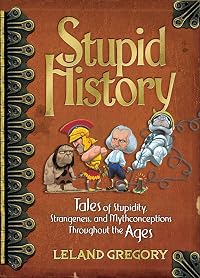
Stupid American History: Tales of Stupidity, Strangeness, and Mythconceptions has many interesting facts like this. It is a quick and enjoyable read. There are many surprises and outright contradictions of commonly held beliefs. I probably knew 10 of the things he mentions, so I learned a lot.
Mr. Gregory spends a lot of time debunking myths of the Revolutionary War, our Founding Fathers and the Civil War. There are random mentions of WWI and WWII, Henry Hudson, even Columbus. He delves into the law occasionally and there are quite a few anecdotes about Presidents. Mrs. O'Leary's cow, the OK Corral, the Titanic, and show more Playboy Magazine all have a page.
It’s a fun romp. There's no order, so on one page you'll read about how French Huguenot Apollos Rivoire changed is name to Paul Rivoire then Paul Revere, which is what he named the son we know so well; and across from that a page about how Prohibition didn't outlaw drinking, just the manufacture, sale, and transport of alcohol. Homemade wine and fruit ciders were perfectly legal.
Each tale has its own page regardless of length. Some have other single sentence quotes on them, others have cartoon figures. The cartoon figures are a bit irritating, but all in all this is a book well worth reading. show less
Stupid American History: Tales of Stupidity, Strangeness, and Mythconceptions has many interesting facts like this. It is a quick and enjoyable read. There are many surprises and outright contradictions of commonly held beliefs. I probably knew 10 of the things he mentions, so I learned a lot.
Mr. Gregory spends a lot of time debunking myths of the Revolutionary War, our Founding Fathers and the Civil War. There are random mentions of WWI and WWII, Henry Hudson, even Columbus. He delves into the law occasionally and there are quite a few anecdotes about Presidents. Mrs. O'Leary's cow, the OK Corral, the Titanic, and show more Playboy Magazine all have a page.
It’s a fun romp. There's no order, so on one page you'll read about how French Huguenot Apollos Rivoire changed is name to Paul Rivoire then Paul Revere, which is what he named the son we know so well; and across from that a page about how Prohibition didn't outlaw drinking, just the manufacture, sale, and transport of alcohol. Homemade wine and fruit ciders were perfectly legal.
Each tale has its own page regardless of length. Some have other single sentence quotes on them, others have cartoon figures. The cartoon figures are a bit irritating, but all in all this is a book well worth reading. show less
This review was written for LibraryThing Early Reviewers.There's nothing inherently wrong with this collection of brief anecdotes from American history--except that the same basic idea for a book has been executed better by other people. What you get for your money is 250 or so anecdotes, each told in a short paragraph or so, and surrounded by lots of blank space and the occasional cartoon figure. Some of the anecdotes are familiar stuff that turns up routinely in history books: the origins of the words "gerrymander" and "bunkum," the specifics of the Volstead act (which banned the manufacture and sale of booze, not its consumption), and the coincidental deaths (on July 4, 1826) of friends turned enemies turned friends John Adams and Thomas Jefferson. Others are mere trivia: Martin Van Buren show more was the only president who grew up speaking a language other than English (he spoke Dutch), George Washington was probably impotent, and Tennessee Williams choked to death on the lid from a bottle of eye drops.
At best, the entries are true stories well and briefly told: Henry Ford scarred by an exploding teapot as a child, the 19C Cardiff, New York farmer who ginned up a phony "petrified giant" and charged credulous visitors to see it, the fact that the winter at Valley Forge was unusually warm. At worst, they're thin, undocumented, and stripped of context. The piece on the sinking of the Lusitania, though factually accurate, manages to completely avoid the central issue of when (and how) submarines could attack unarmed vessels.
If you're looking for great short-form writing about American history, try Paul Boller's "Anecdotes" series, If you just want a few minutes of diversion in the bathroom or carpool line . . . this will do nicely. show less
At best, the entries are true stories well and briefly told: Henry Ford scarred by an exploding teapot as a child, the 19C Cardiff, New York farmer who ginned up a phony "petrified giant" and charged credulous visitors to see it, the fact that the winter at Valley Forge was unusually warm. At worst, they're thin, undocumented, and stripped of context. The piece on the sinking of the Lusitania, though factually accurate, manages to completely avoid the central issue of when (and how) submarines could attack unarmed vessels.
If you're looking for great short-form writing about American history, try Paul Boller's "Anecdotes" series, If you just want a few minutes of diversion in the bathroom or carpool line . . . this will do nicely. show less
This review was written for LibraryThing Early Reviewers.Stupid American History by Leland Gregory the continuation of Gregory’s Stupid History is a delightful read. Beginning with comments on the erroneous language in the Preamble to the US constitution (the impossibility of using the comparative degree with the adjective perfect) Gregory takes the reader in torturous snippets through a long history of misconceptions.
As a longtime teacher of both language and history I am appalled at my lack of knowledge and my perpetuation of misinformation. I can visualize a use for this book in the classroom, both as entertainment (let me tell you the real story) and as debunking bias or erroneous scholarship.
The one failing for me is that some of these renderings I simple did not what to know. For show more example: Hill’s picture of the Driving of the Golden Spike representing the completion the First Transcontinental Railroad in embedded in my mind. Gregory says it ain’t so. I am happy with most of my knowledge of history and have a need not to know. show less
As a longtime teacher of both language and history I am appalled at my lack of knowledge and my perpetuation of misinformation. I can visualize a use for this book in the classroom, both as entertainment (let me tell you the real story) and as debunking bias or erroneous scholarship.
The one failing for me is that some of these renderings I simple did not what to know. For show more example: Hill’s picture of the Driving of the Golden Spike representing the completion the First Transcontinental Railroad in embedded in my mind. Gregory says it ain’t so. I am happy with most of my knowledge of history and have a need not to know. show less
This review was written for LibraryThing Early Reviewers.I'll give it 1/2 star for entertainment value. It's a perfect bathroom or read it while you're waiting someplace book. I would not call it history by any means, and I'm sorry to see Amazon classifying it as history...there's not one tiddle or jot of citation, verification, not even a sentence of author bio to lend any credibility to this person's authority to 'debunk' history. Yes, it's fun, but Reader's Digest can be fun too! I certainly wouldn't tout this book as anything but a compilation of unverified factoids (I can get the same info on Wikipedia and at least they're trying to get build in credibility). There are others, Ken Davis, Bill Bryson who write humorously of historical facts, but who give us some back up to believe in. show more This one should be on the shelves with Erma Bombeck.
If this is how we think we can instill a love of history in our students, we're in more trouble than I thought we were. The trivia tag is the most appropriate. show less
If this is how we think we can instill a love of history in our students, we're in more trouble than I thought we were. The trivia tag is the most appropriate. show less
This review was written for LibraryThing Early Reviewers.Members
- Recently Added By
Lists

Non-fiction that you shouldn't waste your time on
45 works; 15 members
Author Information

35 Works 2,235 Members
Common Knowledge
- Canonical title
- Stupid American History: Tales of Stupidity, Strangeness, and Mythconceptions
- Original publication date
- 2009-03
- First words
- History books have idolized our founding fathers to such a degree that a lot of people believe they were perfect.
- Last words
- (Click to show. Warning: May contain spoilers.)Civil War Union general Lew Wallace [1827-1905] gained his greatest fame not from activities on the battlefield but as the author of the novel Ben Hur: A Tale of the Christ.
Classifications
Statistics
- Members
- 386
- Popularity
- 81,379
- Reviews
- 36
- Rating
- (2.97)
- Languages
- English
- Media
- Paper, Ebook
- ISBNs
- 3
- UPCs
- 1
- ASINs
- 5