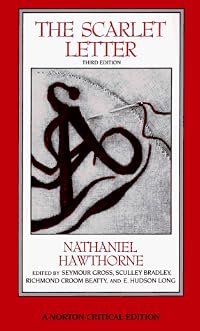
The Scarlet Letter [Norton Critical Edition]
by Nathaniel Hawthorne
On This Page
Description
In a time when adultery is punishable by death, Hester Prynne becomes involved in a risky and scandalous affair with her town's handsome minister and bears his illegitimate child. For this grievous offense, she is condemned to wear a scarlet letter "A" on her breast and endure the mockery of her community forever. Explores the timeless conflict between private truth and public appearance and the choice between sin and salvation.Tags
Recommendations











Member Reviews
Maybe you know the story, even if you’ve never read the novel. Hester Prynne, a woman of seventeenth-century Boston, must be punished for having borne a child out of wedlock. In this most Puritan community, she’s lucky to escape with her life; instead, she spends several months in prison, after which she must forever wear a scarlet letter "A," announcing that she’s an adulteress.
The simplest of premises, you’d think, yet there’s nothing simple about this quintessential American moral tale, written in 1850. Hawthorne, descended from a judge at the Salem witch trials, an ancestry that shamed him and influenced his work and life, cuts surgically into the withered, envious soul of Puritanism and holds the stinking mess up to the show more light.
It’s not just that the reader is meant to understand and sympathize with Hester, who’s actually a bit of a stubborn drip, at times. It’s that Hawthorne wants you to see the society that condemns her, a group of caviling hypocrites who may or may not lust for her but certainly do for the wealth and power they possess. Nobody escapes, Hawthorne says; there’s evil in all of us, and desires aplenty.
H.L. Mencken, writing more than a half-century after Hawthorne, quipped that Puritanism was “the haunting fear that someone, somewhere may be happy.” The Scarlet Letter bears witness, as even children’s play involves games of persecuting Quakers or attending church. Some leading elders assume that Hester’s daughter, Pearl, unable to answer a single question from the catechism at age three, may therefore be Satan’s handmaid. She is ungovernable, it’s true, and has a mean streak that pains her long-suffering mother. But she’s also a happy child, and nobody knows what to make of this.
Crucial too is how Hester wears her "A," skillfully embroidered, perhaps pushing the bounds of everyday Puritan taste (though not of formal wear, curiously enough, especially among the rich and powerful). Consequently, the adulteress hides nothing, though she largely keeps to herself, because her every public appearance challenges her judges as to their righteousness and pretended sobriety of custom.
But, in Hawthorne’s world, sin must be spoken of, or else it eats away at everyone. The Scarlet Letter pays heed to the spiritual and emotional as though they were the same. To feel whole, the sinner must confess, so as to breathe freely; conversely, so as not to overstep the bounds of humility, the hearer must listen and withhold judgment. Desires are human, not particular to individuals. To Hawthorne’s seventeenth-century Boston, this idea was revolutionary — and in some ways, it still is, not in what American society says, but what it does.
Hawthorne’s style can take getting used to, even for readers accustomed to nineteenth-century literature. Not only does he tell, tell, tell, explaining damn near everything, he imbues the smallest moments with hard-working metaphorical swoop.
That style deserves consideration in its context, however. Hawthorne was countering the point of view that all wisdom and truth comes from God; he argues that humans can find truth anywhere if they look hard enough, particularly within themselves. The Scarlet Letter, published nine years before The Origin of Species, feels like kin to Darwin, though it has nothing to do with biology: both works deal with the power of observation and its overriding importance. Hawthorne wants you to see his abstractions, as though the spiritual world inhabits the physical. Often, he succeeds.
Strange, but I had avoided reading The Scarlet Letter, and I’m not the type to shun the classics. As a high school sophomore, I transferred out of an English class, no mean trick, led by a teacher with whom I knew I’d quarrel, and who’d just begun discussing this novel. The teacher whose class I transferred into turned out to be a mentor, so I got the better deal--and swapped Hawthorne for Dostoyevsky, Huxley, Orwell, and Zamiatin besides. But I still didn’t let Hawthorne off the hook—there’s a Puritan in me too—and more than fifty years passed before I found out what Hester’s story has to offer.
Don’t make the mistake I made. At least take a look at The Scarlet Letter. show less
The simplest of premises, you’d think, yet there’s nothing simple about this quintessential American moral tale, written in 1850. Hawthorne, descended from a judge at the Salem witch trials, an ancestry that shamed him and influenced his work and life, cuts surgically into the withered, envious soul of Puritanism and holds the stinking mess up to the show more light.
It’s not just that the reader is meant to understand and sympathize with Hester, who’s actually a bit of a stubborn drip, at times. It’s that Hawthorne wants you to see the society that condemns her, a group of caviling hypocrites who may or may not lust for her but certainly do for the wealth and power they possess. Nobody escapes, Hawthorne says; there’s evil in all of us, and desires aplenty.
H.L. Mencken, writing more than a half-century after Hawthorne, quipped that Puritanism was “the haunting fear that someone, somewhere may be happy.” The Scarlet Letter bears witness, as even children’s play involves games of persecuting Quakers or attending church. Some leading elders assume that Hester’s daughter, Pearl, unable to answer a single question from the catechism at age three, may therefore be Satan’s handmaid. She is ungovernable, it’s true, and has a mean streak that pains her long-suffering mother. But she’s also a happy child, and nobody knows what to make of this.
Crucial too is how Hester wears her "A," skillfully embroidered, perhaps pushing the bounds of everyday Puritan taste (though not of formal wear, curiously enough, especially among the rich and powerful). Consequently, the adulteress hides nothing, though she largely keeps to herself, because her every public appearance challenges her judges as to their righteousness and pretended sobriety of custom.
But, in Hawthorne’s world, sin must be spoken of, or else it eats away at everyone. The Scarlet Letter pays heed to the spiritual and emotional as though they were the same. To feel whole, the sinner must confess, so as to breathe freely; conversely, so as not to overstep the bounds of humility, the hearer must listen and withhold judgment. Desires are human, not particular to individuals. To Hawthorne’s seventeenth-century Boston, this idea was revolutionary — and in some ways, it still is, not in what American society says, but what it does.
Hawthorne’s style can take getting used to, even for readers accustomed to nineteenth-century literature. Not only does he tell, tell, tell, explaining damn near everything, he imbues the smallest moments with hard-working metaphorical swoop.
That style deserves consideration in its context, however. Hawthorne was countering the point of view that all wisdom and truth comes from God; he argues that humans can find truth anywhere if they look hard enough, particularly within themselves. The Scarlet Letter, published nine years before The Origin of Species, feels like kin to Darwin, though it has nothing to do with biology: both works deal with the power of observation and its overriding importance. Hawthorne wants you to see his abstractions, as though the spiritual world inhabits the physical. Often, he succeeds.
Strange, but I had avoided reading The Scarlet Letter, and I’m not the type to shun the classics. As a high school sophomore, I transferred out of an English class, no mean trick, led by a teacher with whom I knew I’d quarrel, and who’d just begun discussing this novel. The teacher whose class I transferred into turned out to be a mentor, so I got the better deal--and swapped Hawthorne for Dostoyevsky, Huxley, Orwell, and Zamiatin besides. But I still didn’t let Hawthorne off the hook—there’s a Puritan in me too—and more than fifty years passed before I found out what Hester’s story has to offer.
Don’t make the mistake I made. At least take a look at The Scarlet Letter. show less
The Scarlet Letter does what many great books do: transport the reader to the time and place of its setting. From the opening paragraph, where Hawthorne describes the crowd waiting outside the prison door for Hester Prynne's appearance, I felt I was in that crowd of Puritans looking on at the weather-beaten jail with its beetle-browed and gloomy frontage. For sure, Hawthorne's prose moves slowly, and its older English usage takes a little time to register. Still, modern readers must try to meet Hawthorne halfway, not only with his prose but with the emotions and actions of the Puritan colonists. This book still has plenty to say, though one needs to understand it in the context of the fears, the religious feelings, and the determination show more to succeed of the community that is proud of its foothold on the new continent. show less
The Scarlet letter would appear on most peoples top ten American literary novels, published in 1850 just a year ahead of Moby Dick it would probably lay claim to being the first great American novel and their is no denying its power and potency, especially as it's subject matter is the early Puritan colony of Boston in the 1640's, which goes to the very the heart of American history making it an essential read for anyone interested in the life and times of those early settlers.
The Scarlet letter does what many great books do and that is transport the reader in to the time and place of its setting. From the opening paragraph where Hawthorne describes the crowd waiting outside the prison door for the appearance of Hester Prynne I felt I show more was I was in that crowd of Puritans looking on at the weather beaten jail with its beetle browed and gloomy frontage. For sure Hawthorne's prose moves slowly, and its older English usage takes a little time to register, but modern readers must make the effort to meet Hawthorne halfway, not only with his prose but with the emotions and actions of the Puritan colonists. This is a book that still has plenty to say, but needs to be understood in the context of the fears, the religious feeling and the determination to succeed of the community that is proud of its foothold in the new continent.
It is a story of sins and sinners: Hester has been found guilty of adultery and in accordance with the law at the time must go to the market place and make a public confession, however when she appears on the scaffold with her three month old daughter she refuses to name the father. She is made to wear the letter A on her outer garment for the rest of her life and is cold shouldered by the community following her confession. The initial mystery is of course the identity of the father but this soon becomes apparent, however with the appearance of her elderly misshapen husband bent on revenge it has all the hallmarks of a tragedy. The beauty of this book is that it allows the reader to interpret the story in a variety of readings, for some it is a romantic love story, for others it is a tragedy and for many it is a cautionary tale of sin and its consequences. It is of course all of these things and Hawthorne's prose adds to the mystery, important details are not made entirely clear: for example how does the letter A appear on Arthur Dimmesdale's breast, why does Hester turn the A on her outer garment into a work of art and what does the A actually stand for. It is left to the reader to come to his own conclusions. The book moves inexorably to its climax and the reader is carried along with the magnificent prose right to the bitter end.
Most of the incidental characters were thoroughly researched by Hawthorne and appear as themselves. It is only the four principle characters: Hester, Dimmesdale, Chillingworth and Pearl that were invented by the author and this parachuting of the four into the Puritan colony gives this novel such an authentic feel. This fact I learnt from the section of the Norton Critical edition that contains essays on background and sources. There are further sections on Early reviews, critical, essays on both The Custom House and the Scarlet Letter as well as a bibliography and a chronology. The critical essays are so extensive that they take up nearly two thirds of this publication. It would take a fairly dedicated scholar to read them all and so I skimmed some of them, however I found them all very readable and because the book lends itself to various interpretations many of them contained much of interest.
I am glad I read the Scarlet Letter, but may well have not got to it, if it wasn't for my bookclub which selected it for the next meeting. For anybody thinking of reading it I would encourage you to do so, but don't be put off with "The Custom House" which serves as Hawthorne's introduction to his novel. This can be skipped and picked up later if you choose to do so. Once again I found the Norton Critical Edition enhanced my reading, so much so in fact that I was tempted to read the novel again right away, but I will save that delight for another time. A Five star read of course. show less
The Scarlet letter does what many great books do and that is transport the reader in to the time and place of its setting. From the opening paragraph where Hawthorne describes the crowd waiting outside the prison door for the appearance of Hester Prynne I felt I show more was I was in that crowd of Puritans looking on at the weather beaten jail with its beetle browed and gloomy frontage. For sure Hawthorne's prose moves slowly, and its older English usage takes a little time to register, but modern readers must make the effort to meet Hawthorne halfway, not only with his prose but with the emotions and actions of the Puritan colonists. This is a book that still has plenty to say, but needs to be understood in the context of the fears, the religious feeling and the determination to succeed of the community that is proud of its foothold in the new continent.
It is a story of sins and sinners: Hester has been found guilty of adultery and in accordance with the law at the time must go to the market place and make a public confession, however when she appears on the scaffold with her three month old daughter she refuses to name the father. She is made to wear the letter A on her outer garment for the rest of her life and is cold shouldered by the community following her confession. The initial mystery is of course the identity of the father but this soon becomes apparent, however with the appearance of her elderly misshapen husband bent on revenge it has all the hallmarks of a tragedy. The beauty of this book is that it allows the reader to interpret the story in a variety of readings, for some it is a romantic love story, for others it is a tragedy and for many it is a cautionary tale of sin and its consequences. It is of course all of these things and Hawthorne's prose adds to the mystery, important details are not made entirely clear: for example how does the letter A appear on Arthur Dimmesdale's breast, why does Hester turn the A on her outer garment into a work of art and what does the A actually stand for. It is left to the reader to come to his own conclusions. The book moves inexorably to its climax and the reader is carried along with the magnificent prose right to the bitter end.
Most of the incidental characters were thoroughly researched by Hawthorne and appear as themselves. It is only the four principle characters: Hester, Dimmesdale, Chillingworth and Pearl that were invented by the author and this parachuting of the four into the Puritan colony gives this novel such an authentic feel. This fact I learnt from the section of the Norton Critical edition that contains essays on background and sources. There are further sections on Early reviews, critical, essays on both The Custom House and the Scarlet Letter as well as a bibliography and a chronology. The critical essays are so extensive that they take up nearly two thirds of this publication. It would take a fairly dedicated scholar to read them all and so I skimmed some of them, however I found them all very readable and because the book lends itself to various interpretations many of them contained much of interest.
I am glad I read the Scarlet Letter, but may well have not got to it, if it wasn't for my bookclub which selected it for the next meeting. For anybody thinking of reading it I would encourage you to do so, but don't be put off with "The Custom House" which serves as Hawthorne's introduction to his novel. This can be skipped and picked up later if you choose to do so. Once again I found the Norton Critical Edition enhanced my reading, so much so in fact that I was tempted to read the novel again right away, but I will save that delight for another time. A Five star read of course. show less
this classic screamed a message regarding hypocrisy, but i found it somewhat difficult to follow. i cared about the main characters and was pleased that the lives of the 2 females turned out well. i also liked that hester prynne took control of her life, but i was not very interested in the lengthy discussion of spirits. hawthorne had a point, but i am not interested in his other works. this is not the edition i read. Also included in it is endicott and the red cross, the very short story that hawthrone wrote earlier and then developed in to the scarlett letter.
I read this as a "buddy read" with a friend and I am so glad I did. There are many classics that are hard for me to read, but this was not one of them.
Members
- Recently Added By
Lists

19th Century
190 works; 16 members

American Lit for Eng 11 Research Project
368 works; 6 members
Author Information

890+ Works 78,872 Members
Nathaniel Hawthorne was born on July 4, 1804 in Salem, Massachusetts. When he was four years old, his father died. Years later, with financial help from his maternal relatives who recognized his literary talent, Hawthorne was able to enroll in Bowdoin College. Among his classmates were the important literary and political figures Horatio Bridge, show more Henry Wadsworth Longfellow, and Franklin Pierce. These friends supplied Hawthorne with employment during the early years after graduation while Hawthorne was still establishing himself as a legitimate author. Hawthorne's first novel, Fanshawe, which he self-published in 1828, wasn't quite the success that he had hoped it would be. Not willing to give up, he began writing stories for Twice-Told Tales. These stories established Hawthorne as a leading writer. In 1842, Hawthorne moved to Concord, Massachusetts, where he wrote a number of tales, including "Rappaccini's Daughter" and "Young Goodman Brown," that were later published as Mosses from an Old Manse. The overall theme of Hawthorne's novels was a deep concern with ethical problems of sin, punishment, and atonement. No one novel demonstrated that more vividly than The Scarlet Letter. This tale about the adulterous Puritan Hester Prynne is regarded as Hawthorne's best work and is a classic of American literature. Other famous novels written by Hawthorne include The House of Seven Gables and The Blithedale Romance. In 1852, Hawthorne wrote a campaign biography of his college friend Franklin Pierce. After Pierce was elected as President of the United States, he rewarded Hawthorne with the Consulship at Liverpool, England. Hawthorne died in his sleep on May 19, 1864, while on a trip with Franklin Pierce. (Bowker Author Biography) show less
Series
Belongs to Publisher Series
Work Relationships
Contains
The Custom House (indirect)
Common Knowledge
- Canonical title
- The Scarlet Letter [Norton Critical Edition]
- Original publication date
- 1850
- People/Characters
- Hester Prynne; Arthur Dimmesdale; Roger Chillingworth; Pearl Prynne; Governor Bellingham
- Original language
- English
- Disambiguation notice
- Do Not Combine: This is a "Norton Critical Edition", it is a unique work with significant added material, including essays and background materials. Do not combine with other editions of the work. Please maintain the p... (show all)hrase "Norton Critical Edition" in the Canonical Title and Publisher Series fields.
Classifications
Statistics
- Members
- 1,097
- Popularity
- 23,209
- Reviews
- 5
- Rating
- (3.74)
- Languages
- English, Norwegian (Bokmål)
- Media
- Paper
- ISBNs
- 4
- ASINs
- 5