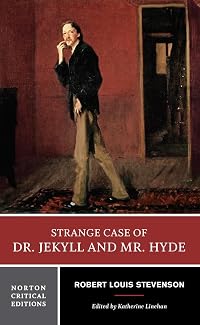
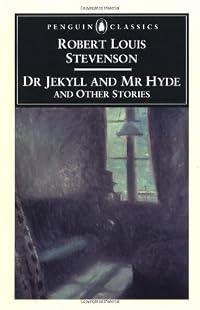
Dr. Jekyll and Mr. Hyde [Norton Critical Edition]
by Robert Louis Stevenson
On This Page
Description
Presents the annotated text of Robert Louis Stevenson's novel about a kind and well-respected doctor who is transformed into a murderous madman by taking a secret drug of his own creation, and includes essays on the story's backgrounds and contexts, a look at performance adaptations, and a selection of critical commentary.Tags
Recommendations





Member Reviews
Strange though it reads, Stevenson's title does not start with "The" though many later printings added it. It was first released as a "shilling novel", i.e. a cheap paperback, and certainly not novel length. It was almost immediately very popular, but because of the format it took a bit before critics took notice.
The structure of the story may frustrate modern readers who know the basic story from multiple movie and TV versions. The first half or more is set up like a mystery. Who is Mr. Hyde? What hold does he have over Dr. Jekyll. Why does the good doctor provide him housing ? Why has the doctor changed his will to leave everything to him? Why is everyone who meets Mr. Hyde immediately filled with disgust? And eventually, why did Mr. show more Hyde fly into a rage over some minor interaction and beat a man to death? Why does Dr. Jekyll then hide himself away? Why does his old friend Mr. Lanyon want nothing more to do with him? Since we know what is going on, it's easy to have a "get on with it" reaction to this lengthy section of the story.
After all this mystery has been set up, and events come to a climax, two documents are then presented to end the story, one from Mr. Lanyon who learned the truth, and then final story of how it all began from Dr. Jekyll.
The Norton Critical edition includes footnotes, a thematically related earlier story, Markheim, various reviews of the time, some essays by noted modern critics like Nabokov, and a discussion of how the story has been repurposed in plays and multiple movies, noting how the first major stage version added several elements used so often that it's surprising they are not in the original story.There are no women -- no fiance or bride for Dr. Jekyll, nor prostitutes for Mr. Hyde. Dr. Jekyll is not an innocent. He in fact always had his secret indiscretions. Mr. Hyde allowed him to indulge at a distance, in an important sense. He is rarely horrified by what Mr. Hyde does.
As a classic, and a short one at that, how could this not be recommended? show less
The structure of the story may frustrate modern readers who know the basic story from multiple movie and TV versions. The first half or more is set up like a mystery. Who is Mr. Hyde? What hold does he have over Dr. Jekyll. Why does the good doctor provide him housing ? Why has the doctor changed his will to leave everything to him? Why is everyone who meets Mr. Hyde immediately filled with disgust? And eventually, why did Mr. show more Hyde fly into a rage over some minor interaction and beat a man to death? Why does Dr. Jekyll then hide himself away? Why does his old friend Mr. Lanyon want nothing more to do with him? Since we know what is going on, it's easy to have a "get on with it" reaction to this lengthy section of the story.
After all this mystery has been set up, and events come to a climax, two documents are then presented to end the story, one from Mr. Lanyon who learned the truth, and then final story of how it all began from Dr. Jekyll.
The Norton Critical edition includes footnotes, a thematically related earlier story, Markheim, various reviews of the time, some essays by noted modern critics like Nabokov, and a discussion of how the story has been repurposed in plays and multiple movies, noting how the first major stage version added several elements used so often that it's surprising they are not in the original story.
As a classic, and a short one at that, how could this not be recommended? show less
Just read this for maybe the 8th time, this time with my Victorian Lit class. For such a short novel (a novella, really), it presents an incredibly comprehensive image of some of the central anxieties of Victorian culture.
It's not much like the various films made from it in violence--there are only two murders in the book vs. some of the veritable blood baths that occur in the films. But the insight into internal conflicts and struggles, especially considering the Victorian concerns with belief, keeping up middle-class appearances, and science/religion controversy, is eye-opening.
One thing to keep in mind as you read is that the conflict is not between Jekyll-the-good and Hyde-the-evil, but between Hyde-the-all-evil and show more Jekyll-the-good-and-evil. Also, be aware of the subtext of whether one is one's brother's keeper. show less
It's not much like the various films made from it in violence--there are only two murders in the book vs. some of the veritable blood baths that occur in the films. But the insight into internal conflicts and struggles, especially considering the Victorian concerns with belief, keeping up middle-class appearances, and science/religion controversy, is eye-opening.
One thing to keep in mind as you read is that the conflict is not between Jekyll-the-good and Hyde-the-evil, but between Hyde-the-all-evil and show more Jekyll-the-good-and-evil. Also, be aware of the subtext of whether one is one's brother's keeper. show less
Delicious fiction; has much of the feel of a Conan-Doyle Sherlock Holmes story, with an added undercurrent of supernatural fright. Questions of human nature are put very directly, but without any attempt to provide direct or simple answers that disrespect the reader's intelligence. The characters--Utterson, Jeckyll, Hyde, Lanyon--are all quite memorably sketched.
It has been noted as "one of the best guidebooks of the Victorian times because of its piercing description of the fundamental dichotomy of the 19th century outward respectability and inward lust" as it had a tendency for social hypocrisy. Victorian yes, but most people I know lead some kind of double life, some worse than others - the theme is a timeless observation of social morality.
See also the open source annotated version: http://en.wikisource.org/wiki/The_Annotated_Strange_Case_Of_Dr_Jekyll_And_Mr_Hyd...
See also the open source annotated version: http://en.wikisource.org/wiki/The_Annotated_Strange_Case_Of_Dr_Jekyll_And_Mr_Hyd...
Finally read story have heard of for years. No real surprises,
Ratings
Members
- Recently Added By
Lists

Epistolary Books
105 works; 25 members

Books Set in London
49 works; 2 members
Author Information

2,783+ Works 138,974 Members
Novelist, poet, and essayist Robert Louis Stevenson was born in Edinburgh, Scotland. A sickly child, Stevenson was an invalid for part of his childhood and remained in ill health throughout his life. He began studying engineering at Edinburgh University but soon switched to law. His true inclination, however, was for writing. For several years show more after completing his studies, Stevenson traveled on the Continent, gathering ideas for his writing. His Inland Voyage (1878) and Travels with a Donkey (1878) describe some of his experiences there. A variety of essays and short stories followed, most of which were published in magazines. It was with the publication of Treasure Island in 1883, however, that Stevenson achieved wide recognition and fame. This was followed by his most successful adventure story, Kidnapped, which appeared in 1886. With stories such as Treasure Island and Kidnapped, Stevenson revived Daniel Defoe's novel of romantic adventure, adding to it psychological analysis. While these stories and others, such as David Balfour and The Master of Ballantrae (1889), are stories of adventure, they are at the same time fine studies of character. The Master of Ballantrae, in particular, is a study of evil character, and this study is taken even further in The Strange Case of Dr. Jekyll and Mr. Hyde (1886). In 1887 Stevenson and his wife, Fanny, went to the United States, first to the health spas of Saranac Lake, New York, and then on to the West Coast. From there they set out for the South Seas in 1889. Except for one trip to Sidney, Australia, Stevenson spent the remainder of his life on the island of Samoa with his devoted wife and stepson. While there he wrote The Wrecker (1892), Island Nights Entertainments (1893), and Catriona (1893), a sequel to Kidnapped. He also worked on St. Ives and The Weir of Hermiston, which many consider to be his masterpiece. He died suddenly of apoplexy, leaving both of these works unfinished. Both were published posthumously; St. Ives was completed by Sir Arthur Quiller-Couch, and The Weir of Hermiston was published unfinished. Stevenson was buried on Samoa, an island he had come to love very much. Although Stevenson's novels are perhaps more accomplished, his short stories are also vivid and memorable. All show his power of invention, his command of the macabre and the eerie, and the psychological depth of his characterization. (Bowker Author Biography) show less
Series
Belongs to Publisher Series
Work Relationships
Common Knowledge
- Canonical title
- Dr. Jekyll and Mr. Hyde [Norton Critical Edition]
- Original publication date
- 1886
- Disambiguation notice
- Do Not Combine: This is a "Norton Critical Edition", it is a unique work with significant added material, including essays and background materials. Do not combine with other editions of the work. Please maintain the p... (show all)hrase "Norton Critical Edition" in the Canonical Title and Publisher Series fields.
Classifications
Statistics
- Members
- 531
- Popularity
- 55,848
- Reviews
- 5
- Rating
- (3.84)
- Languages
- English, Spanish
- Media
- Paper, Ebook
- ISBNs
- 3
- ASINs
- 1