
On This Page
Description
A clue hidden in a toy ship leads Tintin on a dangerous treasure hunt.Tags
Recommendations







Member Reviews
My review, as published in Tintin Books:
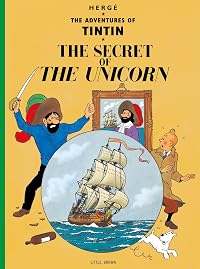
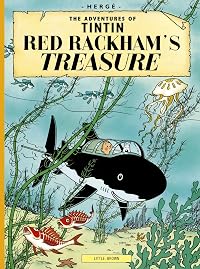
There's no denying the feat that was "The Secret of the Unicorn" and "Red Rackham's Treasure". Gone is the padding of The Crab with the Golden Claws, and there are no wasted characters or moments, which follows logically on from the well-characterised The Shooting Star. The album opens with two mysteries - that of the model ship, and the Thom(p)sons' investigation into a spate of wallet thefts - and weaves them together in a tale which involves historical fiction, kidnap, and an adventure that intimately involves both Tintin and Captain Haddock.
Certainly the most captivating sequence is Haddock's retelling of his ancestor's tale: a pirate story which is vividly retold for us by Herge, who never show more lags even in the frames which feature Haddock retelling the story to an amazed Tintin. And it's great stuff - fast-paced, fantastical yet never implausible - but it's equalled by the rest of the tale. The mystery involving Tintin's model ship is truly intriguing, and full of characters who may or may not be involved in the plot. And the finale, as we race toward revelation amidst the kidnapping of Tintin and the introduction of Marlinspike Hall, is constantly engaging.
Hergé considered this his greatest success to date when the 1942 serial was published in colour in 1943. Indeed, Tintin's 11th adventure would loom large in the memories of fans as a truly timeless tale. (Also, it's worth pointing out that this s the first Tintin album where the contemporary scenes at least take place entirely in Belgium).
On its own, "The Secret of the Unicorn" merits five stars. Within the context of Herge's albums - where we know he has the insight to incorporate political satire into his fiction - it probably gets pushed down to four-and-a-half. Either way, this is definitely a peak that Herge had not yet reached, and it seems to have heralded a new era in his storytelling. show less
There's no denying the feat that was "The Secret of the Unicorn" and "Red Rackham's Treasure". Gone is the padding of The Crab with the Golden Claws, and there are no wasted characters or moments, which follows logically on from the well-characterised The Shooting Star. The album opens with two mysteries - that of the model ship, and the Thom(p)sons' investigation into a spate of wallet thefts - and weaves them together in a tale which involves historical fiction, kidnap, and an adventure that intimately involves both Tintin and Captain Haddock.
Certainly the most captivating sequence is Haddock's retelling of his ancestor's tale: a pirate story which is vividly retold for us by Herge, who never show more lags even in the frames which feature Haddock retelling the story to an amazed Tintin. And it's great stuff - fast-paced, fantastical yet never implausible - but it's equalled by the rest of the tale. The mystery involving Tintin's model ship is truly intriguing, and full of characters who may or may not be involved in the plot. And the finale, as we race toward revelation amidst the kidnapping of Tintin and the introduction of Marlinspike Hall, is constantly engaging.
Hergé considered this his greatest success to date when the 1942 serial was published in colour in 1943. Indeed, Tintin's 11th adventure would loom large in the memories of fans as a truly timeless tale. (Also, it's worth pointing out that this s the first Tintin album where the contemporary scenes at least take place entirely in Belgium).
On its own, "The Secret of the Unicorn" merits five stars. Within the context of Herge's albums - where we know he has the insight to incorporate political satire into his fiction - it probably gets pushed down to four-and-a-half. Either way, this is definitely a peak that Herge had not yet reached, and it seems to have heralded a new era in his storytelling. show less
The story in The Secret of the Unicorn and its sequel Red Rackham's Treasure is source from which Spielberg drew the bulk of the material for his movie The Adventures of Tintin, which was a good decision because this is probably the most loved of all the Tintin books (although I am partial to the two part series Destination Moon and Explorers on the Moon). In The Secret of the Unicorn the roster of characters for the Tintin series finally takes full shape. The first of three two-part stories, and one of the best story lines of the entire book series, this volume begins the process of fully fleshing out Captain Haddock's character into the sharp edged, often inebriated, somewhat out-of-place patrician that fans of the series have come to show more know. This is also the story line that introduces the last regular characters on the series: the eccentric (and almost completely deaf) but brilliant Professor Calculus and the indefatigable butler Nestor. With the cast of characters complete, the story weaves together what has now become the standard Tintin versus gangsters story with some family history for Captain Haddock and a mystery pointing towards buried treasure.
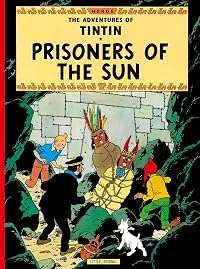
The World War II era posed a problem for Hergé. Prior to the conflict in which his native Belgium was invaded and occupied, the Tintin series had begun to incorporate overtly political commentary in its stories, in some cases quite critical of the Axis powers. But with Belgium occupied and Hergé's publisher enduring government oversight, this was no longer possible, and the Tintin stories backed away from this political bent. In the first two books written during the occupation, Hergé moved back to his standard gangster driven plot (in The Crab with the Golden Claws) and experimented with outlandish science fiction (in The Shooting Star), neither of which produced particularly memorable stories. It wasn't until The Secret of the Unicorn that Hergé hit upon the formula that would work: pulp-style adventures in exotic but non-politically charged locales. The result was this story of pirates and lost treasure, and the following two book story involving Inca mummies and hidden temples found in The Seven Crystal Balls and Prisoners of the Sun.
The book starts with some comic relief as Tintin runs across Thompson and Thomson while the detectives are in the middle of an investigation into a rash of pick pocketings in the local open air market. But before too long the real story rears its head when Tintin comes across a model ship that he purchases as a gift for Captain Haddock. The model ship draws a lot of interest as two other interested buyers immediately offer to buy the ship from Tintin, offering substantially more than he paid for it. Even after being refused, the ship collector Sakharine pursues Tintin to his apartment to renew his offer. In the Spielberg movie, Sakharine is developed into a sinister figure, but in the books, he is more or less just a minor speed bump in the story that vanishes in fairly short order. As with most Tintin stories, The Secret of the Unicorn is built on a healthy dose of coincidence, and when Captain Haddock sees the model ship, he immediately identifies it as the ship his ancestor Sir Francis Haddock captained several generations before, identifying it in the background of a portrait of Sir Francis that Captain Haddock just happened to have hanging in his apartment.
The plot thickens as Tintin's apartment is broken into and the model ship is stolen. Then when he goes to mistakenly accuse Sakharine of stealing the ship (discovering in the process that Sakharine owns an identical model ship), his apartment is broken into and ransacked again. (As an aside, Tintin is clearly a bibliophile, as his primary concern over the ransacking of his apartment appears to be the condition of his books). After some slapstick comedy when Thompson and Thomson stop by to investigate the break-ins, Tintin discovers an old scrap of paper behind a cabinet that apparently fell from the now missing model ship. Deducing that it is a clue to a hidden treasure, Tintin rushes back to Captain Haddock's apartment, and coincidence strikes again to drive the plot forward in the form of an old sea chest belonging to Sir Francis that just happened to be in Captain Haddock's possession - including a hat, cutlass, and most importantly, a journal detailing Sir Francis' exploits against the pirate Red Rackham.
It is this section more than any other that had me convinced the first time I read it that the Tintin series was set in the United Kingdom. The key element is that Sir Francis' ship the Unicorn flies the Union Jack, at least in the English language translation. Perhaps in the original French version the Unicorn hoists the Belgian flag, something that seems more likely given that the book was written during the years that Germany occupied Belgium while at war with the U.K. However, I don't know this for sure (not having a copy of the original French translation), and my twelve year-old self certainly didn't know. This coupled with numerous other small cures (such as Thompson and Thomson's references to Scotland Yard) led me to believe that Tintin, Haddock, and their other companions were British. I don't think it materially changes the story for them to be British or Belgian, but somehow it seems more aesthetically pleasing to me mentally for them to be in the U.K.
In any event, it turns out that Sir Francis had a run-in with the pirate Red Rackham which resulted in the sinking of both of their ships, but not before a hard-fought sword fight between the noble Sir Francis and the treacherous Rackham. During this confrontation, Sir Francis learned of the treasure that Rackham had acquired during his exploits, and after blowing up the Unicorn to keep it from falling into the hands of the pirates, created a series of clues to lead his descendants to the trove. In a substantial departure from the books, the movie The Adventures of Tintin changed the source of the treasure from Rackham's piratical endeavors to a secret cargo being carried by Haddock's ship on behalf of the Crown, which makes Haddock something of a traitor insofar as he failed to turn over the location of the treasure to the proper authorities when he returned home. Claiming pirate booty as one's own is one thing, claiming the contents of the cargo you are carrying for your government as your own is quite another. This whole sequence is told mostly via flashbacks as Haddock recounts the events to Tintin in his apartment (and not in a drink induced frenzy at a Foreign Legion outpost like in the movie), filling in Tintin and the reader on the key elements that make the scrap of paper Tintin found in his apartment meaningful.
But Tintin doesn't have the scrap of paper - the B-plot comes crashing into the A-plot as Tintin discovers his wallet has been stolen by a pickpocket. And then when Tintin takes Haddock to see Sakharine (and see if his model of the Unicorn has a scrap of paper hidden in its mast), they discover Sakharine has been attacked and his model stolen. Obviously someone is also after the treasure, and Tintin and Haddock almost get more clues when one of the gentlemen who had vied for ownership of Tintin's now-stolen model Unicorn at the beginning of the book shows up just in time to be downed by a drive-by shooting. When asked who was behind his shooting, he apparently has enough strength to point to some sparrows and say "there", but not enough to leave a less cryptic clue, like a name. Things begin to look up when Tintin's wallet is recovered (and Tintin has to help Thompson and Thomson with some basic detective work), but then take a turn for the worse when Tintin is chloroformed and kidnapped (as an aside, I have to wonder where the crooks in the Tintin universe get their supplies of chloroform - it seems at times that it is so common that they must be able to pick it up at the corner store).
Through his usual methods of investigation by being captured coupled with a villain who spills the beans at the first opportunity, Tintin foils the villains and solves the mystery. Along the way, there is some adventure and the first appearances of Marlinspike Hall and the long-suffering butler Nestor (who is in the employ of the villains at this point). Captain Haddock arrives with Thompson and Thomson just in time to save the day, and everything turns out okay. We also find out the meaning of the cryptic "sparrow" clue bestowed upon Tintin earlier, and it turns out to be a clue that was so cryptic that it really only makes sense if you already knew the answer. In other words, with what he thought was his dying breath, instead of giving a name, the character in question used that effort to hand out a clue that was certain to be incomprehensible to the recipients. It is also during this sequence that Tintin is once again knocked out by a couple blows to the head, and then displays his amazing punching prowess by slugging a pair of much larger men into unconsciousness.
Although this is only the first half of the story, the volume does come to a reasonable stopping point, wrapping up the portion of the story that relates to hunting for the treasure map quite nicely. Oddly, for a story about looking for lost pirate treasure from a ship that sank in the Caribbean, all of the action in the book takes place in Tintin's home country, making this the first book in the series in which Tintin does not cross any international borders. The other odd thing about the story is how quickly the villains go from antique dealers, to thieves, to attempted murderers - in Hergé's world it seems that once you get into smuggling or larceny that you are perfectly willing to scale up to murder without a second's thought. And your clueless butler will be willing to help you. All three of the two-part stories in the Tintin series are excellent, and represent the best of Hergé's work. Loaded with mystery, action, comedy, and fun, The Secret of the Unicorn is no exception, and is the first half of what I consider to be the second best Tintin story ever made.
This review has also been posted to my blog Dreaming About Other Worlds. show less
The World War II era posed a problem for Hergé. Prior to the conflict in which his native Belgium was invaded and occupied, the Tintin series had begun to incorporate overtly political commentary in its stories, in some cases quite critical of the Axis powers. But with Belgium occupied and Hergé's publisher enduring government oversight, this was no longer possible, and the Tintin stories backed away from this political bent. In the first two books written during the occupation, Hergé moved back to his standard gangster driven plot (in The Crab with the Golden Claws) and experimented with outlandish science fiction (in The Shooting Star), neither of which produced particularly memorable stories. It wasn't until The Secret of the Unicorn that Hergé hit upon the formula that would work: pulp-style adventures in exotic but non-politically charged locales. The result was this story of pirates and lost treasure, and the following two book story involving Inca mummies and hidden temples found in The Seven Crystal Balls and Prisoners of the Sun.
The book starts with some comic relief as Tintin runs across Thompson and Thomson while the detectives are in the middle of an investigation into a rash of pick pocketings in the local open air market. But before too long the real story rears its head when Tintin comes across a model ship that he purchases as a gift for Captain Haddock. The model ship draws a lot of interest as two other interested buyers immediately offer to buy the ship from Tintin, offering substantially more than he paid for it. Even after being refused, the ship collector Sakharine pursues Tintin to his apartment to renew his offer. In the Spielberg movie, Sakharine is developed into a sinister figure, but in the books, he is more or less just a minor speed bump in the story that vanishes in fairly short order. As with most Tintin stories, The Secret of the Unicorn is built on a healthy dose of coincidence, and when Captain Haddock sees the model ship, he immediately identifies it as the ship his ancestor Sir Francis Haddock captained several generations before, identifying it in the background of a portrait of Sir Francis that Captain Haddock just happened to have hanging in his apartment.
The plot thickens as Tintin's apartment is broken into and the model ship is stolen. Then when he goes to mistakenly accuse Sakharine of stealing the ship (discovering in the process that Sakharine owns an identical model ship), his apartment is broken into and ransacked again. (As an aside, Tintin is clearly a bibliophile, as his primary concern over the ransacking of his apartment appears to be the condition of his books). After some slapstick comedy when Thompson and Thomson stop by to investigate the break-ins, Tintin discovers an old scrap of paper behind a cabinet that apparently fell from the now missing model ship. Deducing that it is a clue to a hidden treasure, Tintin rushes back to Captain Haddock's apartment, and coincidence strikes again to drive the plot forward in the form of an old sea chest belonging to Sir Francis that just happened to be in Captain Haddock's possession - including a hat, cutlass, and most importantly, a journal detailing Sir Francis' exploits against the pirate Red Rackham.
It is this section more than any other that had me convinced the first time I read it that the Tintin series was set in the United Kingdom. The key element is that Sir Francis' ship the Unicorn flies the Union Jack, at least in the English language translation. Perhaps in the original French version the Unicorn hoists the Belgian flag, something that seems more likely given that the book was written during the years that Germany occupied Belgium while at war with the U.K. However, I don't know this for sure (not having a copy of the original French translation), and my twelve year-old self certainly didn't know. This coupled with numerous other small cures (such as Thompson and Thomson's references to Scotland Yard) led me to believe that Tintin, Haddock, and their other companions were British. I don't think it materially changes the story for them to be British or Belgian, but somehow it seems more aesthetically pleasing to me mentally for them to be in the U.K.
In any event, it turns out that Sir Francis had a run-in with the pirate Red Rackham which resulted in the sinking of both of their ships, but not before a hard-fought sword fight between the noble Sir Francis and the treacherous Rackham. During this confrontation, Sir Francis learned of the treasure that Rackham had acquired during his exploits, and after blowing up the Unicorn to keep it from falling into the hands of the pirates, created a series of clues to lead his descendants to the trove. In a substantial departure from the books, the movie The Adventures of Tintin changed the source of the treasure from Rackham's piratical endeavors to a secret cargo being carried by Haddock's ship on behalf of the Crown, which makes Haddock something of a traitor insofar as he failed to turn over the location of the treasure to the proper authorities when he returned home. Claiming pirate booty as one's own is one thing, claiming the contents of the cargo you are carrying for your government as your own is quite another. This whole sequence is told mostly via flashbacks as Haddock recounts the events to Tintin in his apartment (and not in a drink induced frenzy at a Foreign Legion outpost like in the movie), filling in Tintin and the reader on the key elements that make the scrap of paper Tintin found in his apartment meaningful.
But Tintin doesn't have the scrap of paper - the B-plot comes crashing into the A-plot as Tintin discovers his wallet has been stolen by a pickpocket. And then when Tintin takes Haddock to see Sakharine (and see if his model of the Unicorn has a scrap of paper hidden in its mast), they discover Sakharine has been attacked and his model stolen. Obviously someone is also after the treasure, and Tintin and Haddock almost get more clues when one of the gentlemen who had vied for ownership of Tintin's now-stolen model Unicorn at the beginning of the book shows up just in time to be downed by a drive-by shooting. When asked who was behind his shooting, he apparently has enough strength to point to some sparrows and say "there", but not enough to leave a less cryptic clue, like a name. Things begin to look up when Tintin's wallet is recovered (and Tintin has to help Thompson and Thomson with some basic detective work), but then take a turn for the worse when Tintin is chloroformed and kidnapped (as an aside, I have to wonder where the crooks in the Tintin universe get their supplies of chloroform - it seems at times that it is so common that they must be able to pick it up at the corner store).
Through his usual methods of investigation by being captured coupled with a villain who spills the beans at the first opportunity, Tintin foils the villains and solves the mystery. Along the way, there is some adventure and the first appearances of Marlinspike Hall and the long-suffering butler Nestor (who is in the employ of the villains at this point). Captain Haddock arrives with Thompson and Thomson just in time to save the day, and everything turns out okay. We also find out the meaning of the cryptic "sparrow" clue bestowed upon Tintin earlier, and it turns out to be a clue that was so cryptic that it really only makes sense if you already knew the answer. In other words, with what he thought was his dying breath, instead of giving a name, the character in question used that effort to hand out a clue that was certain to be incomprehensible to the recipients. It is also during this sequence that Tintin is once again knocked out by a couple blows to the head, and then displays his amazing punching prowess by slugging a pair of much larger men into unconsciousness.
Although this is only the first half of the story, the volume does come to a reasonable stopping point, wrapping up the portion of the story that relates to hunting for the treasure map quite nicely. Oddly, for a story about looking for lost pirate treasure from a ship that sank in the Caribbean, all of the action in the book takes place in Tintin's home country, making this the first book in the series in which Tintin does not cross any international borders. The other odd thing about the story is how quickly the villains go from antique dealers, to thieves, to attempted murderers - in Hergé's world it seems that once you get into smuggling or larceny that you are perfectly willing to scale up to murder without a second's thought. And your clueless butler will be willing to help you. All three of the two-part stories in the Tintin series are excellent, and represent the best of Hergé's work. Loaded with mystery, action, comedy, and fun, The Secret of the Unicorn is no exception, and is the first half of what I consider to be the second best Tintin story ever made.
This review has also been posted to my blog Dreaming About Other Worlds. show less
This is hands down my favorite Tintin book, along with its sequel "Red Rackham's Treasure". Brilliantly drawn, fast-paced, with understated humor throughout in typical Herge fashion. Love, love, love this book!
Jolie histoire, j'adore le dessin simple et la palette de couleur, surtout la rougeur sur les joues des personnages. Capitaine Haddock est drôle avec son problème d'alcool. Et les Dupondt. Quels drôles personnages. Tintin est courageux et tellement sage et intelligent, et Milou est trop brave. J'adore.
A favorite read, this one - and lacking a lot of the racist overtones of some of the earlier books.
Herge's obsession with ancestry - some chambermaid conspiracy theorists even speculated he was hidden grandson to King Leopold II, is artistically rendered in "Secret of the Unicorn" and its sequel - "Red Rackham's Treasure". Knowledgeable "Tintinophiles" Daniel Couvreur, Frederick Soumois and Philippe Goddin, give the origins of the creation of this story in the well published "Les vrais secrets de la Licorne" or "The true secrets of the Licorne" from Editions Moulinsart/Casterman. Frederic Soumois in his "Dossier Tintin" distinguishes between the Uchronia of the "Secret of the Unicorn" with his fictional Louis XIV (in the original French version) navigator Francois de Haddoque, and the Utopia of "Red Rackham's Treasure" and show more Calculus/Tournesol's invention.
This was first published in Black & White mini-strips in the stolen "Le Soir" under German occupation in 1943 in Brussels, Belgium. The later color editions do not unfortunately render how suspenseful each of these mini-strips were, as they had to be so that on next day newspaper, readers would want to go back to his favorite hero/Journalist, TINTIN.
Now of Spielberg universal fame, this adventure is also an experiential journey for TINTIN who discovers his hidden ancestry and unites with the unlikely and slightly dysfunctional family that makes the charm of later albums: alcoholic "father" Haddock created in the "Crab with the Golden Claws", hearing impaired Professor Calculus/Tournesol, Snowy/Milou and mirror like detectives Thompson & Thompson Dupont/Dupond. Bianca Castafiore motherly operatic figure is not present in these two albums, the first one ending with a cliffhanger.
Herge is already a master by then and how brilliant is the appearance of Moulinsart castle, through the basement and by breaking a brick wall - what a Freudian metaphor - leading our inquisitive journalist to medieval vaults full of the trappings and furnishings of the nobility.
Perhaps it is this sense of timing which was absent from Spielberg's recreation, all rushed in to make it more accessible to a modern audience though visually pleasing and equally masterful. show less
This was first published in Black & White mini-strips in the stolen "Le Soir" under German occupation in 1943 in Brussels, Belgium. The later color editions do not unfortunately render how suspenseful each of these mini-strips were, as they had to be so that on next day newspaper, readers would want to go back to his favorite hero/Journalist, TINTIN.
Now of Spielberg universal fame, this adventure is also an experiential journey for TINTIN who discovers his hidden ancestry and unites with the unlikely and slightly dysfunctional family that makes the charm of later albums: alcoholic "father" Haddock created in the "Crab with the Golden Claws", hearing impaired Professor Calculus/Tournesol, Snowy/Milou and mirror like detectives Thompson & Thompson Dupont/Dupond. Bianca Castafiore motherly operatic figure is not present in these two albums, the first one ending with a cliffhanger.
Herge is already a master by then and how brilliant is the appearance of Moulinsart castle, through the basement and by breaking a brick wall - what a Freudian metaphor - leading our inquisitive journalist to medieval vaults full of the trappings and furnishings of the nobility.
Perhaps it is this sense of timing which was absent from Spielberg's recreation, all rushed in to make it more accessible to a modern audience though visually pleasing and equally masterful. show less
Ja, Tintin er god, men når Haddock ikke for alvor folder sig ud, så er det hele lidt slattent. Således her.
Members
- Recently Added By
Lists

Evan's Reading List 2021
16 works; 1 member

CCE 1000 Good Books List
1,033 works; 12 members

Best Sea Stories
33 works; 5 members

Hugo Award 2019 Reading List
126 works; 4 members
Author Information

'Hergé' was born Georges Remi on 22 May, 1907 in Etterbeek, a suburb of Brussels, in Belgium. After leaving school, he worked for the daily newspaper, Le XXe Siècle (The 20th Century). He was responsibe the for the section of the newspaper designed for children. Tintin, the main character in his works, was introduced on January 10, 1929 in a show more story entitled 'Tintin in the Land of the Soviets.' Each story ran as a comic strip in the newspaper and then was published as a book. Some of these books were adapted for the small screen including The Crab With The Golden Claws, Star of Mystery, Red Rakham's Treasure, Black Island, Objective Moon and The Calculus Affair. French TV produced longer versions of twenty of the books in 1992, which have been broadcast in over fifty countries. On 3 March, 1983, he died in Brussels. At the time of his death, he was working on Tintin and the Alpha-Art, which was published in an unfinished form. (Bowker Author Biography) show less
Some Editions
Awards and Honors
Notable Lists
Series

Work Relationships
Is contained in
Has the adaptation
Common Knowledge
- Canonical title
- The Secret of the Unicorn
- Original title
- Le Secret de La Licorne
- Alternate titles*
- Tintin : Le secret de la Licorne
- Original publication date
- 1942-1943
- People/Characters
- Tintin; Milou; Capitaine Haddock; Dupont et Dupond; Sir Francis Haddock; The Thompson Twins (show all 16); Ivan Ivanovitch Sakharine; Barnaby; Max Bird; The Bird Brothers; Red Rackham; Diego the Dreadful; Nestor; Brutus the Dog; Pirates; Aristides Silk
- Important places
- Belgium; Marlinspike Hall; 21 Eucalyptus Avenue
- Related movies
- The Adventures of Tintin: The Secret of the Unicorn (2011 | IMDb)
- First words
- Faits divers
- Quotations*
- Trois freres unys. Trois licornes de
conserve voguant au soleil de midi
parleront.
Car c'est de la lumière que
viendra la lumière. Et resplendira
la † de l'Aigle. - Last words
- (Click to show. Warning: May contain spoilers.)Au revoir!
- Original language*
- Français (Belgique) (Belgique)
*Some information comes from Common Knowledge in other languages. Click "Edit" for more information.
Classifications
- Genre
- Graphic Novels & Comics
- DDC/MDS
- 741.59493 — Arts & recreation Drawing & decorative arts Drawing Comic books, graphic novels, fotonovelas, cartoons, caricatures, comic strips History, geographic treatment, biography European Other European Belgium & Luxembourg
- LCC
- PN6790 .B44 .T56713 — Language and Literature Literature (General) Literature (General) Collections of general literature Comic books, strips, etc.
- BISAC
Statistics
- Members
- 2,331
- Popularity
- 8,450
- Reviews
- 25
- Rating
- (4.14)
- Languages
- 31 — Afrikaans, Arabic, Bengali, Catalan, Chinese, French-based Creoles and Pidgins, Czech, Danish, Dutch, English, Finnish, French, German, Greek, Hindi, Italian, Japanese, Korean, Norwegian (Bokmål), Norwegian, Romanian, Russian, Serbian, Scots, Croatian, Slovak, Spanish, Swedish, Turkish, Welsh, Portuguese (Portugal)
- Media
- Paper, Ebook
- ISBNs
- 102
- ASINs
- 14