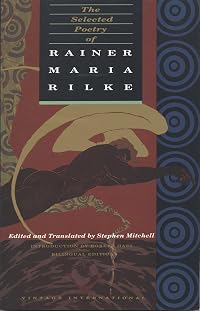
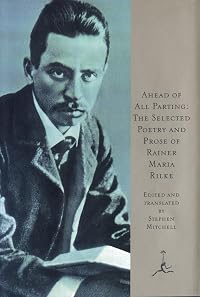
The Selected Poetry of Rainer Maria Rilke
by Rainer Maria Rilke
On This Page
Description
"This miracle of a book, perhaps the most beautiful group of poetic translations this century has ever produced," (Chicago Tribune) should stand as the definitive English language version.Tags
Recommendations









Member Reviews
Left to my own devices to explore these poems, to find pieces of myself and reflections of truth as I know it, to shape that shared privacy Maurice Blanchot speaks of—"the passionately unfurled space of a mutual conflict between speaker and hearer"—I like Rilke very much.
Reading his own thoughts on his poetry, delving into the minutiae of his philosophies, the rigidity of his experiences of the world, his fixations on death, birds, gods, dogs, women, mirrors, fountains, solitude, art, the proper way to love—I find Rilke tiresome indeed.
It will not impress Rilke scholars or practiced readers of poetry, I'm sure, but I'm choosing to engage these poems in their own right with as little attention paid to Rilke's life and beliefs and show more peculiarities of logic as possible. Absent the ability to discuss those things directly with Rilke, I would much rather enter into discussion with his works, where at least my voice finds echo and answer. show less
Reading his own thoughts on his poetry, delving into the minutiae of his philosophies, the rigidity of his experiences of the world, his fixations on death, birds, gods, dogs, women, mirrors, fountains, solitude, art, the proper way to love—I find Rilke tiresome indeed.
It will not impress Rilke scholars or practiced readers of poetry, I'm sure, but I'm choosing to engage these poems in their own right with as little attention paid to Rilke's life and beliefs and show more peculiarities of logic as possible. Absent the ability to discuss those things directly with Rilke, I would much rather enter into discussion with his works, where at least my voice finds echo and answer. show less
I much prefer Rilke's shorter works to his extended poems. The longer ones just seem to give Rilke's pen too much time to dwell and mope and meander. Most of his poetry seems very personal to himself - emotional and about his own psychological state. But all of that emotional slog is tedious and tiresome to the reader - to the me.
"Flamingos," "Archaic Torso," "Orpheus, Euridice, Hermes," "The Swan," "Before Summer Rain," and "Imaginary Career" - are all excellent poems worth reading several times and ferreting out the referents and ideas.
So, when Rilke is on point - his poetry is astounding. When he is laboriously churning out some long-winded rumination - his poetry is approaches drivel.
"Flamingos," "Archaic Torso," "Orpheus, Euridice, Hermes," "The Swan," "Before Summer Rain," and "Imaginary Career" - are all excellent poems worth reading several times and ferreting out the referents and ideas.
So, when Rilke is on point - his poetry is astounding. When he is laboriously churning out some long-winded rumination - his poetry is approaches drivel.
There are not enough stars on LibraryThing for Rilke. I loved this book, which included a little sampler from each of his books, chronologically, except the Duino Elegies, which was here in its entirety. I read the Duino Elegies first and was hooked, but the others are almost as good. The Sonnets to Orpheus especially are great, and some of his stand alone poems. Also because this was roughly chronological, you can see his progression as a poet, and how he developed his ideas, themes, and writing. He's not one of those writers who repeats the same poem throughout his career. Every book here has a different flavor and feel to it, he seemed to be perpetually striving. Stephen Mitchell's translations are very satisfying. I've read a few show more other translations on the web, but none approached the ones in this book. If you read Rilke before in another translation, I urge you to give this one a try. In a bad translation, Rilke can seem overly dramatic, overly romantic, or just plain "icky". But rest assured, he is not.
Here was my original review of Duino Elegies (on 9/16/2008):
I just finished this. It's incredible. I can't believe I hadn't read this before. Poets don't write like this anymore. Who dares to tackle the enormity of these themes, the meaning of life, death, god, love, pain? All conveyed in sometimes concrete sometimes abstract language but always avoiding the easy conclusions. There are so many beautiful passages here where he just tips things slightly so that you see them askew & anew.
Then in elegy 9 he almost sounds like Stevens, talking about thing-ness and language.
Just a little taste, here's the opening of Eighth Elegy:
Here was my original review of Duino Elegies (on 9/16/2008):
I just finished this. It's incredible. I can't believe I hadn't read this before. Poets don't write like this anymore. Who dares to tackle the enormity of these themes, the meaning of life, death, god, love, pain? All conveyed in sometimes concrete sometimes abstract language but always avoiding the easy conclusions. There are so many beautiful passages here where he just tips things slightly so that you see them askew & anew.
Then in elegy 9 he almost sounds like Stevens, talking about thing-ness and language.
Just a little taste, here's the opening of Eighth Elegy:
show less
With all its eyes the natural world looks out
into the Open. Only our eyes are turned
backward, and surround plant, animal, child
like traps, as they emerge into their freedom.
We know what is really out there only from
the animal's gaze; for we take the very young
child and force it around, so that it sees
objects--not the Open, which is so
deep in animals' faces. Free from death,
We, only, can see death; the free animal
has its decline in back of it, forever,
and God in front, and when it moves, it moves
already in eternity, like a fountain.
The influence and popularity of Rilke's poetry in America have never been greater than they are today, more than fifty years after his death. Rilke is unquestionably the most significant and compelling poet of romantic transformation, of spiritual quest, that the twentieth century has known. His poems of ecstatic identification with the world exert a seemingly endless fascination for contemporary readers. In Stephen Mitchell's versions, many readers feel that they have discovered an English rendering that captures the lyric intensity, fluency, and reach of Rilke's poetry more accurately and convincingly than has ever been done before. Mr. Mitchell is impeccable in his adherence to Rilke's text, to his formal music, and to the complexity show more of his thought; at the same time, his work has authority and power as poetry in its own right. Few translators of any poet have arrived at the delicate balance of fidelity and originality that Mr. Mitchell has brought off with seeming effortlessness. The generous and unusual selection that the translator has made from Rilke's large body of work has been praised by scholars for the judicious picture it offers of the breadth and depth of Rilke's greatness. The German text is printed facing the translations, and the poems have been extensively annotated with relevant quotations from Rilke's correspondence and other essential information. Noted poet and critic Robert Hass's searching introduction, "Looking for Rilke," discusses the span of Rilke's career and his importance for the American poetic tradition.
Source: Publisher show less
Source: Publisher show less
I read selections from this book when I was in college and was mesmerized by some of the verses. Having read the whole collection now, some poems speak to me more than others. There is likely a reason that certain poems were assigned and others were not. Still, this is a great collection and a fabulous translation.
Favorite Poems: Autumn Day; Orpheus, Eurydice, Hermes; Requiem for a Friend; The Vast Night; The Second Elegy; The Seventh Elegy
Favorite Poems: Autumn Day; Orpheus, Eurydice, Hermes; Requiem for a Friend; The Vast Night; The Second Elegy; The Seventh Elegy
Extremely uneven poet. His works range from exasperating religious crap to gems like Book of Images, Sonnets to Orpheus and Duino Elegies. At his best he makes his impact by his extraordinary perceptiveness and his knack for creating a mood, most often of the melancholic and sombre kind. His language is unparallelled in its kind; it sort of caresses our minds like gypsy music or something. Hard to translate though, so Rilke should be read in German if possible. When I have read Rilke for a while I usually start having misgivings about the substance of his poems. I think the best ones are the small observations, the images, that really make things stand out from the background and become visible. He has some philosohical aspirations, show more like in Sonnets to Orpheus. As a thinker he is not very convincing though, and even in the philosophical poems it is the small observations that are of any value. I must admit the guy annoys me very much, but at the same time he produces so much of great beauty that I'll always come back to him from time to time. show less
Du im Voraus
Verlone Geliebte, Nimmergekimmene,
Nicht weiss ich, welche Tone dir lieb sind.
Nicht mehr versuch ich, dich, wenn das Kommenende wogt,
Zu erkennen. Alle die grossen
Bilder in mir, im Fernen erfahrene Landschaft,
Stadte und Turme und Brucken und un-
Vermutete Wedung der Wege
Und das Gewaltige jener von Gottern
Einst durchwachsenen Lander:
Steigt zur Bedeutung in mir
Deiner, Entgehende, an.
You who never arrived
In my arms, Beloved, who were lost
From the start,
I don't even know what songs
Would please you. I have given up trying
To recognize you in the surging wave of the next
Moment. All the immense images in me-the far-off, deeply-felt landscape,
Cities, towers, and bridges, and un-
Suspected turns in the path,
And those powerful lands that show more were once
Pulsing with the life of the gods-
All rise within me to mean
You, who forever elude me.
This has been a passage from Rilke's `You who never arrived', one of the many beautiful and profound poems in this extraordinary collection, provided with an equally extraordinary translation by Stephen Mitchell. Rilke is almost universally established as the most important European poet of the 20th century. The poems in this collection will stay in your mind and in your heart long after you finish reading. show less
Verlone Geliebte, Nimmergekimmene,
Nicht weiss ich, welche Tone dir lieb sind.
Nicht mehr versuch ich, dich, wenn das Kommenende wogt,
Zu erkennen. Alle die grossen
Bilder in mir, im Fernen erfahrene Landschaft,
Stadte und Turme und Brucken und un-
Vermutete Wedung der Wege
Und das Gewaltige jener von Gottern
Einst durchwachsenen Lander:
Steigt zur Bedeutung in mir
Deiner, Entgehende, an.
You who never arrived
In my arms, Beloved, who were lost
From the start,
I don't even know what songs
Would please you. I have given up trying
To recognize you in the surging wave of the next
Moment. All the immense images in me-the far-off, deeply-felt landscape,
Cities, towers, and bridges, and un-
Suspected turns in the path,
And those powerful lands that show more were once
Pulsing with the life of the gods-
All rise within me to mean
You, who forever elude me.
This has been a passage from Rilke's `You who never arrived', one of the many beautiful and profound poems in this extraordinary collection, provided with an equally extraordinary translation by Stephen Mitchell. Rilke is almost universally established as the most important European poet of the 20th century. The poems in this collection will stay in your mind and in your heart long after you finish reading. show less
Members
- Recently Added By
Lists

German Literature
518 works; 55 members

Harold Bloom - The Western Canon: D. The Chaotic Age
833 works; 24 members

Mustich's 1000 Books to Read Before You Die: A Life Changing List
1,001 works; 19 members

sotiris' favourites circa january 2023
43 works; 2 members

Favorite Books in Translation
320 works; 133 members

Books That Changed Our Perspective
423 works; 168 members

Emo Books
14 works; 1 member
Author Information

1,114+ Works 31,520 Members
More than any other modern German writer, Rainer Maria Rilke seems to match our romantic idea of what a poet should be, though, as with many writers, separating artistry from affectation is often difficult. Restless, sensitive, reverent, yet egotistical, Rilke often seems to hover in his poems like a sort of ethereal being. He was born in 1875 to show more a wealthy family in Prague. After a few years devoted to the study of art and literature, he spent most of his adult life wandering among the European capitals and devoting himself single-mindedly to poetry. His early poems reflect his interest in the visual and plastic arts, as he tries to lose himself in contemplation of objects such as an antique torso of Apollo.His later books of poetry, such as Duino Elegies (1923) and Sonnets to Orpheus (1923), on the contrary, focus intently on internal realms. The poetry of Rilke is noted, above all, for metaphysical and psychological nuances. (Bowker Author Biography) show less
All Editions
Some Editions
Awards and Honors
Work Relationships
Contains
Common Knowledge
- Canonical title
- The Selected Poetry of Rainer Maria Rilke
- Original publication date
- 1995; 1989 (collection) (collection)
- First words
- I am, O Anxious One.
- Quotations
- If you are the dreamer, I am what you dream. But when you want to wake, I am your wish, and I grow strong with all magnificence and turn myself into a star's vast silence above the strange and distant city, Time.
- Blurbers
- Heller, Erich; Merwin, W.S.; Spender, Stephen; Donoghue, Denis
- Original language
- German
- Disambiguation notice
- Editions edited by Stephen Mitchell (Some German-English, some English only). Do not combine with other selections containing different poems
Classifications
Statistics
- Members
- 2,246
- Popularity
- 8,949
- Reviews
- 12
- Rating
- (4.38)
- Languages
- English, German, Polish
- Media
- Paper, Audiobook, Ebook
- ISBNs
- 6
- ASINs
- 5