On This Page
Description
Tintin, Snowy, and Captain Haddock search in the polar regions for a vast meteorite containing a valuable new metal.Tags
Recommendations











Member Reviews
Tintin's first science fiction adventure is a great one, although Hergé's better with the fiction than with the science! Nonetheless, the story is exciting and atmospheric, particularly the initial "Armageddon" sequence. There's a real feeling of desperation at the impending destruction of civilization. Was this an expression of Hergé's angst at the Nazi occupation of Belgium? However that may be, it's certainly his most effective piece of work in Tintin's adventures to this point.
The story has resonances with H.G. Wells's The Food of the Gods and Jules Verne's Journey to the Center of the Earth and The Mysterious Island: giant growths of vegetation and animals; scientific expeditions in search of strange lands, etc. I don't know show more that Hergé had these books in mind, but I'd be surprised if he wasn't at least aware of the works of Wells and Verne, and the correspondences are there.
Although only introduced in the previous album, The Crab With The Golden Claws, Captain Haddock already seems to be a well-established part of Tintin's world and he adds an extra dimension of unpredictability to the adventures. Hergé relegated Thomson and Thompson's roles to a single-panel cameo, which was a good decision as it gave him the opportunity to get the Captain well bedded-in.
I did feel, however, that Tintin's use of whisky to manipulate the alcoholic Captain was morally suspect, but I guess we're dealing with a story written in simpler times as far as attitudes to substance abuse is concerned. show less
The story has resonances with H.G. Wells's The Food of the Gods and Jules Verne's Journey to the Center of the Earth and The Mysterious Island: giant growths of vegetation and animals; scientific expeditions in search of strange lands, etc. I don't know show more that Hergé had these books in mind, but I'd be surprised if he wasn't at least aware of the works of Wells and Verne, and the correspondences are there.
Although only introduced in the previous album, The Crab With The Golden Claws, Captain Haddock already seems to be a well-established part of Tintin's world and he adds an extra dimension of unpredictability to the adventures. Hergé relegated Thomson and Thompson's roles to a single-panel cameo, which was a good decision as it gave him the opportunity to get the Captain well bedded-in.
I did feel, however, that Tintin's use of whisky to manipulate the alcoholic Captain was morally suspect, but I guess we're dealing with a story written in simpler times as far as attitudes to substance abuse is concerned. show less
My review, as posted in Tintin Books
"The Shooting Star" is a welcome return to form after the entertaining but less innovative "The Crab with the Golden Claws". Herge was still working under Nazi-occupied conditions, which explains why this era of his albums strays from political debates and focuses instead solely on narrative concerns. Still, the battle to recover the meteorite echoes the scientific attitude which prevailed throughout WWII and would culminate in the '50s and '60s with the Space Race.
There's certainly more padding than usual here, as in some albums this adventure would be a six-page subplot! But yet it works: all of the characters, from the crazed Belgians to the Icelandic sailors, are densely characterised. As with the show more previous albums, there is the constant fear of being double-crossed, which is particularly effective here with such a range of characters present.
The scenes at sea, particularly, come alive. This is the second of four consecutive albums which feature large stretches of plot at sea: for whatever reason (the confinement of characters? the literal feel of movement?) Herge must have felt comfortable in this environment, for - as we'd see in his next album, "The Secret of the Unicorn" - he'd create some of his best work here.
And while this isn't a pinnacle of the "Tintin" series, it's four-star entertainment. Captain Haddock is already quite well-defined (although he'll evolve further), and we get the last in a string of mad professors whose descendant will be Cuthbert Calculus. Snowy gets comparatively little to do here (a typical charge laid against Haddock's presence) but it isn't noticeable, because by now we have a wealth of characters and slapstick with a dog now seems only appropriate as occasional tension-relieving humour.
At the end of the race, we get a sprint to the finish: a mysterious island of scientific improbabilities. It's great fun, and shows the wide-reaching canvas that Herge could work with. Perhaps the lack of political implications would suggest this is lighter entertainment than Herge was generally producing, but honestly it's also more sophisticated. show less
"The Shooting Star" is a welcome return to form after the entertaining but less innovative "The Crab with the Golden Claws". Herge was still working under Nazi-occupied conditions, which explains why this era of his albums strays from political debates and focuses instead solely on narrative concerns. Still, the battle to recover the meteorite echoes the scientific attitude which prevailed throughout WWII and would culminate in the '50s and '60s with the Space Race.
There's certainly more padding than usual here, as in some albums this adventure would be a six-page subplot! But yet it works: all of the characters, from the crazed Belgians to the Icelandic sailors, are densely characterised. As with the show more previous albums, there is the constant fear of being double-crossed, which is particularly effective here with such a range of characters present.
The scenes at sea, particularly, come alive. This is the second of four consecutive albums which feature large stretches of plot at sea: for whatever reason (the confinement of characters? the literal feel of movement?) Herge must have felt comfortable in this environment, for - as we'd see in his next album, "The Secret of the Unicorn" - he'd create some of his best work here.
And while this isn't a pinnacle of the "Tintin" series, it's four-star entertainment. Captain Haddock is already quite well-defined (although he'll evolve further), and we get the last in a string of mad professors whose descendant will be Cuthbert Calculus. Snowy gets comparatively little to do here (a typical charge laid against Haddock's presence) but it isn't noticeable, because by now we have a wealth of characters and slapstick with a dog now seems only appropriate as occasional tension-relieving humour.
At the end of the race, we get a sprint to the finish: a mysterious island of scientific improbabilities. It's great fun, and shows the wide-reaching canvas that Herge could work with. Perhaps the lack of political implications would suggest this is lighter entertainment than Herge was generally producing, but honestly it's also more sophisticated. show less
The Shooting Star is the second of the Tintin books written during World War II, and one of the oddest books in the entire series. It is also one of the most disappointing. Although some minor fantastical elements have cropped up in previous books such as Cigars of the Pharaoh, this is the first book in the series that could credibly be classified as science fiction. Despite his apparent attempts to avoid controversy by making his tale as fantastical as possible, some elements of Hergé's book were seen as appeasement of the occupying forces, helping to place a post-War cloud of suspicion over the artist.
The story of The Shooting Star is unusual for the Tintin series in that it is the first in the series that is not primarily focused on show more foiling criminal activity, and is instead focused on a mysterious shooting star that appears in the night sky. It is also the first (and one of the few) stories in the series in which Tintin is not knocked out with a blow to the head, chloroformed into unconsciousness, or shot. (Seriously, one has to wonder how Tintin has any skull bone left after the number of knocks he takes to the noggin, and if women think scars are sexy, then he must be a lady-magnet with all the bullet holes in his body). When the night becomes unseasonably warm, Tintin sneaks into the local observatory and finds out that it is a huge fireball headed in a collision course with the Earth. This sequence gives a little foreshadowing as a spider walks across the lens of the telescope Tintin observes the object with, making it appear that the fireball is bearing a huge spider. Tintin is informed by the director of the observatory that the fireball will strike the Earth and destroy the world, sending Tintin home to wait out the remaining hours. The following sequence also reinforces Tintin's apparent resistance to heat, as he is able to walk about outside when the air temperature is high enough to cause car tires to burst, the tar in street pavement to melt, heat the metal of a window frame so much that burns when touched. Tintin's resistance doesn't appear to be all that exceptional though, as everyone else in the world is apparently only slightly inconvenienced by the presumably oven level temperatures.
In a twist that should surprise no one reading the book, the world does not end, and the flaming threat passes by the Earth without striking it, merely causing an earthquake. Rushing through the aftermath the the observatory, Tintin stumbles in just in time for the director Decimus Phostle to discover, via the use of a spectroscope, a heretofore unknown metal on the passing meteor and name it phostlite. Their elation is short-lived when they learn that the chunk of meteorite that crashed into the Earth (and caused the earthquake) fell into the Arctic Ocean, a fact that causes Phostle to assume that his discovery of phostlite has been swallowed by the sea. Leaving aside the fact that he already has spectroscopic proof of the new metal, it seems odd that it takes Tintin slipping on some bricks that had fallen into the water to figure out that the meteorite fragment might still be sticking up through the water's surface.
Before too long the characters are heading off to find the semi-submerged meteorite and claim the discovery of phostlite for the European Foundation for Scientific Research, racing against a rival commercially funded expedition. And it is at this point in the story that Hergé drew criticism. The expedition Tintin accompanies is organized by and comprised of Europeans, mostly from Axis or Axis-friendly countries, nobly setting out to advance science in the research vessel "Aurora". The rival expedition, organized in pursuit of pure profit and engaged in numerous attempts to sabotage Tintin's compatriots, is based in the Americas (originally the United States), and funded by bankers who, in the original version, had very stereotypical Jewish names. These elements were somewhat toned down in later editions of the book, but enough remains that an astute reader will be able to see what the controversy was about.
With Captain Haddock along to run the ship (and acting as the newly elected president of the Sober Sailor's Society), Tintin, Phostle, and the collection of mostly interchangeable scientists who fill out the expedition's roster head into Arctic waters. After extensive adventures involving overcoming a crazed stowaway, storms, ice, a mysterious fuel shortage in Iceland (a problem solved when Captain Haddock runs across an old friend), and a false distress signal, the Aurora launches its seaplane and Tintin finally parachutes onto the meteorite and plants the E.F.S.R. flag to claim the prize. One thing that seems odd about this race is that it seems to suggest that scientific discoveries are kept from others, and whoever gets to the meteorite first will be able to keep the phostlite for themselves. I suppose in a wartime atmosphere this would be more or less true, but there isn't an indication that there is a war going on in Tintin's fictional reality, making the race for the prize seem more or less pointless.
But it is only when Tintin reaches the meteorite and sets his mind on camping out on it overnight accompanied only by Snowy (to prevent the Americans from claiming it in his absence) that the story gets really weird. First, it seems that Tintin's amazing invulnerability to extreme heat doesn't apply to hot water, as he is scalded when jumping ankle-deep in the water to get his dog. The heat of the water is somewhat odd too, since it is supposed to be heated by the meteorite. But if the water is hot enough to burn Tintin when he steps into it, why is the meteorite itself cool enough to walk around, sit down, and lie down on? Quirky inconsistencies like this seem to me to be an indication that Hergé wasn't yet comfortable writing a story that didn't involve tracking down opium smugglers. While camping on the island, Tintin discovers that the substance it is made of has some truly odd properties - as evidenced by the gigantic mushroom pictured on the cover of the book. Once again, it seems odd that an unknown metal would have the effect of causing plants and insects to grow to enormous size, especially an unknown metal that would have to be on the extreme heavy end of the periodic table (and thus would be highly radioactive and probably deadly to anyone camping on a huge hunk of it). It is this final segment that draws The Shooting Star firmly into the science fiction genre, and almost pulls it all the way into fantasy. It stays just short of fantasy, although it is weird science fiction.
In the end, Tintin scores yet another victory against those who oppose him and once again does no reporting. As a result of Tintin's efforts the E.F.S.R. claims a piece of the mysterious metal, news agencies report their triumph, and it is never mentioned again in any of the Tintin stories. In fact, unlike many other books in the Adventures of Tintin series, no one other than Tintin, Haddock, and Snowy, and no plot elements specific to this book ever crop up again in later installments. This book produced no recurring characters, no recurring villains, no recurring plot devices, and had essentially no lasting impact at all on the series. The only thing that makes this book noteworthy in the series is the introduction of full-blown science fiction elements to the series. The book is even lacking in the full page and half page pieces of artwork that had begun to crop up in the handful of books that immediately preceded it. The Shooting Star is, quite simply, a disappointing book that represents a downturn for the series. That said, it is still Tintin, and still full of humor, intrigue, and adventure, and is, as a result, worth a read.
This review has also been posted to my blog Dreaming About Other Worlds. show less
The story of The Shooting Star is unusual for the Tintin series in that it is the first in the series that is not primarily focused on show more foiling criminal activity, and is instead focused on a mysterious shooting star that appears in the night sky. It is also the first (and one of the few) stories in the series in which Tintin is not knocked out with a blow to the head, chloroformed into unconsciousness, or shot. (Seriously, one has to wonder how Tintin has any skull bone left after the number of knocks he takes to the noggin, and if women think scars are sexy, then he must be a lady-magnet with all the bullet holes in his body). When the night becomes unseasonably warm, Tintin sneaks into the local observatory and finds out that it is a huge fireball headed in a collision course with the Earth. This sequence gives a little foreshadowing as a spider walks across the lens of the telescope Tintin observes the object with, making it appear that the fireball is bearing a huge spider. Tintin is informed by the director of the observatory that the fireball will strike the Earth and destroy the world, sending Tintin home to wait out the remaining hours. The following sequence also reinforces Tintin's apparent resistance to heat, as he is able to walk about outside when the air temperature is high enough to cause car tires to burst, the tar in street pavement to melt, heat the metal of a window frame so much that burns when touched. Tintin's resistance doesn't appear to be all that exceptional though, as everyone else in the world is apparently only slightly inconvenienced by the presumably oven level temperatures.
In a twist that should surprise no one reading the book, the world does not end, and the flaming threat passes by the Earth without striking it, merely causing an earthquake. Rushing through the aftermath the the observatory, Tintin stumbles in just in time for the director Decimus Phostle to discover, via the use of a spectroscope, a heretofore unknown metal on the passing meteor and name it phostlite. Their elation is short-lived when they learn that the chunk of meteorite that crashed into the Earth (and caused the earthquake) fell into the Arctic Ocean, a fact that causes Phostle to assume that his discovery of phostlite has been swallowed by the sea. Leaving aside the fact that he already has spectroscopic proof of the new metal, it seems odd that it takes Tintin slipping on some bricks that had fallen into the water to figure out that the meteorite fragment might still be sticking up through the water's surface.
Before too long the characters are heading off to find the semi-submerged meteorite and claim the discovery of phostlite for the European Foundation for Scientific Research, racing against a rival commercially funded expedition. And it is at this point in the story that Hergé drew criticism. The expedition Tintin accompanies is organized by and comprised of Europeans, mostly from Axis or Axis-friendly countries, nobly setting out to advance science in the research vessel "Aurora". The rival expedition, organized in pursuit of pure profit and engaged in numerous attempts to sabotage Tintin's compatriots, is based in the Americas (originally the United States), and funded by bankers who, in the original version, had very stereotypical Jewish names. These elements were somewhat toned down in later editions of the book, but enough remains that an astute reader will be able to see what the controversy was about.
With Captain Haddock along to run the ship (and acting as the newly elected president of the Sober Sailor's Society), Tintin, Phostle, and the collection of mostly interchangeable scientists who fill out the expedition's roster head into Arctic waters. After extensive adventures involving overcoming a crazed stowaway, storms, ice, a mysterious fuel shortage in Iceland (a problem solved when Captain Haddock runs across an old friend), and a false distress signal, the Aurora launches its seaplane and Tintin finally parachutes onto the meteorite and plants the E.F.S.R. flag to claim the prize. One thing that seems odd about this race is that it seems to suggest that scientific discoveries are kept from others, and whoever gets to the meteorite first will be able to keep the phostlite for themselves. I suppose in a wartime atmosphere this would be more or less true, but there isn't an indication that there is a war going on in Tintin's fictional reality, making the race for the prize seem more or less pointless.
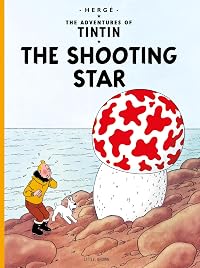
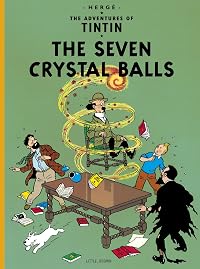
But it is only when Tintin reaches the meteorite and sets his mind on camping out on it overnight accompanied only by Snowy (to prevent the Americans from claiming it in his absence) that the story gets really weird. First, it seems that Tintin's amazing invulnerability to extreme heat doesn't apply to hot water, as he is scalded when jumping ankle-deep in the water to get his dog. The heat of the water is somewhat odd too, since it is supposed to be heated by the meteorite. But if the water is hot enough to burn Tintin when he steps into it, why is the meteorite itself cool enough to walk around, sit down, and lie down on? Quirky inconsistencies like this seem to me to be an indication that Hergé wasn't yet comfortable writing a story that didn't involve tracking down opium smugglers. While camping on the island, Tintin discovers that the substance it is made of has some truly odd properties - as evidenced by the gigantic mushroom pictured on the cover of the book. Once again, it seems odd that an unknown metal would have the effect of causing plants and insects to grow to enormous size, especially an unknown metal that would have to be on the extreme heavy end of the periodic table (and thus would be highly radioactive and probably deadly to anyone camping on a huge hunk of it). It is this final segment that draws The Shooting Star firmly into the science fiction genre, and almost pulls it all the way into fantasy. It stays just short of fantasy, although it is weird science fiction.
In the end, Tintin scores yet another victory against those who oppose him and once again does no reporting. As a result of Tintin's efforts the E.F.S.R. claims a piece of the mysterious metal, news agencies report their triumph, and it is never mentioned again in any of the Tintin stories. In fact, unlike many other books in the Adventures of Tintin series, no one other than Tintin, Haddock, and Snowy, and no plot elements specific to this book ever crop up again in later installments. This book produced no recurring characters, no recurring villains, no recurring plot devices, and had essentially no lasting impact at all on the series. The only thing that makes this book noteworthy in the series is the introduction of full-blown science fiction elements to the series. The book is even lacking in the full page and half page pieces of artwork that had begun to crop up in the handful of books that immediately preceded it. The Shooting Star is, quite simply, a disappointing book that represents a downturn for the series. That said, it is still Tintin, and still full of humor, intrigue, and adventure, and is, as a result, worth a read.
This review has also been posted to my blog Dreaming About Other Worlds. show less
I have a friend who's quite fond of these old Tintin comics, and he's taken to occasionally lending me some if he thinks they'll be of particular interest to me. (Which so far has just meant having something to do with outer space.) This one features a meteorite that hits the Earth and lands in the ocean, provoking a race between two rival expeditions to reach it first and collect a sample of the previously unknown metal it harbors.
The previous Tintin volumes I read featured a trip to the moon, and I was a little surprised by how a lot of the science in it was actually pretty good. This one... not so much. Mostly it's left me wondering how the same author can apparently understand the concept of spectroscopy perfectly well, yet clearly show more have no idea what a meteorite actually is. For that matter, he doesn't even seem to have a good grasp of the fact that the ocean is very deep.
But never mind that, I guess. It's not like this is trying to be hard SF. Really, it's just a silly little adventure story with a bit of humor. And, taken as such, it's mildly amusing, but not particularly memorable. I suspect, not for the first time, that one really has to encounter Tintin at an impressionable age to fully appreciate it, and I've simply missed the window. show less
The previous Tintin volumes I read featured a trip to the moon, and I was a little surprised by how a lot of the science in it was actually pretty good. This one... not so much. Mostly it's left me wondering how the same author can apparently understand the concept of spectroscopy perfectly well, yet clearly show more have no idea what a meteorite actually is. For that matter, he doesn't even seem to have a good grasp of the fact that the ocean is very deep.
But never mind that, I guess. It's not like this is trying to be hard SF. Really, it's just a silly little adventure story with a bit of humor. And, taken as such, it's mildly amusing, but not particularly memorable. I suspect, not for the first time, that one really has to encounter Tintin at an impressionable age to fully appreciate it, and I've simply missed the window. show less
So good for my spanish lessons that I have ordered two more. Knowing the story as well as the pictures means I can read without looking everything up. And as with most Tintin books there is lots and lots of text and only very restrained slang. Bought this one first because I've always loved the astronomy and the exploding mushrooms!
A mysterious meteor has just missed Earth, but a piece falls down into the polar sea. Two expeditions race to find it and the new element it is made of. Tintin, Haddock and some scientists make up one expedition. The second is purely commercial. After some hubbub Tintin gets ashore on an island (the former meteor). The new metal has fun, but unlikely properties, such as accelerating the growth of trees, mushrooms and spiders. Eventually the new island sinks into the sea. Tintin is rescued just in time, returning with a piece of the new metal.
Good clean fun.
Good clean fun.
I had forgotten what an alcoholic the Captain was, but I've turned out ok, so I guess this childhood favorite wasn't too damaging :p
Members
- Recently Added By
Author Information

'Hergé' was born Georges Remi on 22 May, 1907 in Etterbeek, a suburb of Brussels, in Belgium. After leaving school, he worked for the daily newspaper, Le XXe Siècle (The 20th Century). He was responsibe the for the section of the newspaper designed for children. Tintin, the main character in his works, was introduced on January 10, 1929 in a show more story entitled 'Tintin in the Land of the Soviets.' Each story ran as a comic strip in the newspaper and then was published as a book. Some of these books were adapted for the small screen including The Crab With The Golden Claws, Star of Mystery, Red Rakham's Treasure, Black Island, Objective Moon and The Calculus Affair. French TV produced longer versions of twenty of the books in 1992, which have been broadcast in over fifty countries. On 3 March, 1983, he died in Brussels. At the time of his death, he was working on Tintin and the Alpha-Art, which was published in an unfinished form. (Bowker Author Biography) show less
Some Editions
Awards and Honors
Notable Lists
Series

Work Relationships
Is contained in
Has the adaptation
Is expanded in
Common Knowledge
- Canonical title
- The Shooting Star
- Original title
- L'Étoile mystérieuse
- Alternate titles*
- Tintin : L'étoile mystérieuse
- Original publication date
- 1942
- People/Characters
- Tintin; Snowy; Captain Haddock; Philippulus; Professor Decimus Phostle; Eric Bjorgenskjold (show all 15); Senor Porfirio Bodero; Herr Doktor Otto Schulze; Professor Paul Cantonneau; Senhor Pedro Joas; Mr. Bohlwinkel; Johnson; Captain Chester; Smithers; Payne
- Important places
- Akureyri, Iceland; Arctic; Sao Rico
- First words*
- Quelle nuit magnifique!
- Last words*
- (Click to show. Warning: May contain spoilers.)Pis que ça!...Plus de whisky!!!
- Original language
- French
*Some information comes from Common Knowledge in other languages. Click "Edit" for more information.
Classifications
- Genre
- Graphic Novels & Comics
- DDC/MDS
- 741.59493 — Arts & recreation Drawing & decorative arts Drawing Comic books, graphic novels, fotonovelas, cartoons, caricatures, comic strips History, geographic treatment, biography European Other European Belgium & Luxembourg
- LCC
- PN6790 .B44 .T57 — Language and Literature Literature (General) Literature (General) Collections of general literature Comic books, strips, etc.
- BISAC
Statistics
- Members
- 2,041
- Popularity
- 10,233
- Reviews
- 19
- Rating
- (3.85)
- Languages
- 33 — Afrikaans, Basque, Bengali, Catalan, Chinese, Czech, Danish, Dutch, English, Finnish, French, German, Scottish Gaelic, Irish, Galician, Greek, Hebrew, Hindi, Indonesian, Italian, Japanese, Korean, Norwegian (Bokmål), Norwegian, Polish, Portuguese, Russian, Serbian, Croatian, Spanish, Swedish, Turkish, Welsh
- Media
- Paper, Ebook
- ISBNs
- 88
- ASINs
- 17