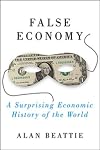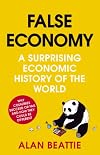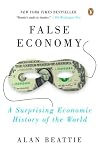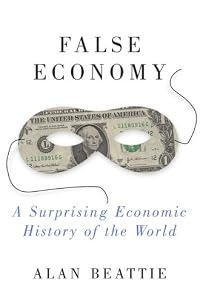
False Economy: A Surprising Economic History of the World
by Alan Beattie
On This Page
Description
'Alan Beattie's forensic analysis shows facts can be a force for change. Give people the facts, and they'll do the right thing' Bono In 2001 Argentina's government bankrupted itself, yet for the past two hundred years it had enjoyed a vista of economic opportunity almost identical to that of the USA. Why did the USA succeed while Argentina stalled? Botswana and Sierra Leone are both blessed with abundant diamonds. Why did Botswana become the world's fastest-growing economy while Sierra Leone show more suffered a decade of brutal civil war? The path to prosperity is rarely obvious and the sources of success are often unexpected. Time and again, world leaders have failed to learn the lessons of economic history, and their mistakes continue to have surprising and catastrophic consequences. In False Economy, Alan Beattie uses extraordinary stories of economic triumph and disaster to explain how some countries went wrong while others went right, and why it's so difficult to change course once you're on the path to ruin. Along the way, you'll discover why Africa doesn't grow cocaine, why our asparagus comes from Peru, why your keyboard spells QWERTY and why giant pandas are living on borrowed time . . . show lessTags
Recommendations










Member Reviews
An interesting and very accessible discussion of why economies all over the world succeed or fail. And according to this author, the answers aren't as clear cut as you might think.
THIS WITTY AND HIGHLY READABLE BOOK BLENDS HISTORY AND ECONOMICS TO EXPLORE WHY SOME COUNTRIES THRIVE WHILE OTHERS FALTER, USING EXAMPLES FROM ARGENTINA TO ZAMBIA
Alan Beattie reviews examples from history of social conditions that contributed to economic success or failure. He has an extensive annotated bibliography for anyone who is interested in verifying the information the author used in the writing of this book. We can hope that our policy makers will inform themselves of this information and make the decisions that will take us to a better world rather into decline.
The subtitle says economic history. Balony. This book is at the level of low grade magazine articles. Every time I try to read it I am stopped by spectacular stupidity.
Ratings
Members
- Recently Added By
Author Information
2 Works 352 Members
Alan Beattie graduated from Balliol College, Oxford, with a degree in history. After taking a master's degree in economics at Cambridge, he worked as an economist at the Bank of England and then joined the Financial Times in 1998. Currently the paper's world trade editor, he writes about economics, globalization, and development.
Awards and Honors
Awards
Common Knowledge
- Original publication date
- 2009
- Epigraph
- Time, that gives and takes our fame and fate
and puts say, Shakespeare's features on a plate
or a Persian poet's name on a Tandoori
can cast aside all we commemorate
and make Lot 86 or Lot 14
even out ... (show all)of Cardinal and Queen
and bring the holy and the high and mighty
to the falling gavel, or the guillotine.
Tony Harrison
The Blasphemers' Banquet - Dedication
- To my parents
- Blurbers
- El-Erian, Mohamed A.; Bono ; Rodrik, Dani
Classifications
Statistics
- Members
- 343
- Popularity
- 91,707
- Reviews
- 4
- Rating
- (3.63)
- Languages
- Chinese, English, Italian, Swedish
- Media
- Paper, Audiobook, Ebook
- ISBNs
- 13
- ASINs
- 6