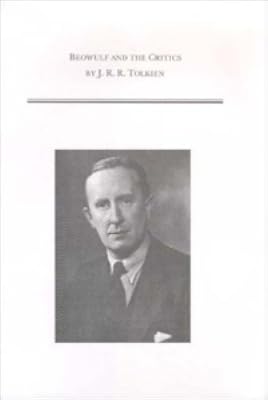
Beowulf and the Critics
by J. R. R. Tolkien
On This Page
Description
The most important essay in the history of Beowulf scholarship, J.R.R. Tolkien's "Beowulf: the monsters and the critics" has been much studied and discussed. But scholars of both Beowulf and Tolkien have to this point been unaware that Tolkien's essay was a redaction of a much longer and more substantial work, Beowulf and the critics, which Tolkien wrote in the 1930s and probably delivered as a series of Oxford lectures. This critical edition of Beowulf and the critics presents both show more unpublished versions of Tolkien's lecture, each substantially different from the other and from the final, published essay. The edition included a description of the manuscript, complete textual and explanatory notes, and a detailed critical introduction that explains the place of Tolkien's Anglo-Saxon scholarship both in the history of Beowulf scholarship and in literary history. show lessTags
Recommendations













Member Reviews
This is an academic text that focuses on Tolkien's lecture about Beowulf. This book along with "Monsters and Critics" is credited with being one of the best and possible the first in describing the way to perform critical analysis on literature. It is a little hard to follow but if you are interested in Beowulf and critical review than this is well worth the time required.
This book analyzes Tolkien's essay "The Monsters and the Critics". It goes into detail about the process he went through to create that essay, providing a fascinating insight into how Tolkien arrived at the ideas and even the wording he used. Somewhat heavy going for the general reader.
Ratings
Members
- Recently Added By
Author Information

610+ Works 519,445 Members
A writer of fantasies, Tolkien, a professor of language and literature at Oxford University, was always intrigued by early English and the imaginative use of language. In his greatest story, the trilogy The Lord of the Rings (1954--56), Tolkien invented a language with vocabulary, grammar, syntax, even poetry of its own. Though readers have show more created various possible allegorical interpretations, Tolkien has said: "It is not about anything but itself. (Certainly it has no allegorical intentions, general, particular or topical, moral, religious or political.)" In The Adventures of Tom Bombadil (1962), Tolkien tells the story of the "master of wood, water, and hill," a jolly teller of tales and singer of songs, one of the multitude of characters in his romance, saga, epic, or fairy tales about his country of the Hobbits. Tolkien was also a formidable medieval scholar, as evidenced by his work, Beowulf: The Monster and the Critics (1936) and his edition of Anciene Wisse: English Text of the Anciene Riwle. Among his works published posthumously, are The Legend of Sigurd and Gudrún and The Fall of Arthur, which was edited by his son, Christopher. In 2013, his title, TheHobbit (Movie Tie-In) made The New York Times Best Seller List. (Bowker Author Biography) show less
Some Editions
Awards and Honors
Awards
Common Knowledge
- Canonical title
- Beowulf and the Critics
- Disambiguation notice
- This is Michael Drout's analysis of Tolkien's essay Beowulf: The Monsters and the Critics and its drafts. The essay itself was published both as a separate book and later in the collection The Monsters and the Critics ... (show all)and other essays. DO NOT COMBINE this work with either the essay itself or with the collection. IT IS NOT THE SAME THING.
Classifications
Statistics
- Members
- 90
- Popularity
- 357,550
- Reviews
- 2
- Rating
- (4.33)
- Languages
- English
- Media
- Paper
- ISBNs
- 3